




 Request Consultation
The use of a surgically implanted electronic device, which protects a sense of sound to a patient with severe-to-profound sensorineural hearing loss, is referred to as a cochlear implant. The global demand has been pushing due to a massive rise in the geriatric population, increasing hearing loss incidence, and ongoing immersive early detection programs, particularly in pediatric, i.e., coupled with the boosting awareness regarding hearing rehabilitation.
Ongoing Initiatives & Future Programmes for Cochlear Implant Surges the Entire Adoption
In 2026, several organizations are emphasizing booming awareness about rehabilitation, specifically for the pediatric population, which is further tied to technological unveiling.
- February 2026,
Many global & domestic players, such as ACI Alliance and CIICA, have addressed the revolutionary impact of cochlear implants on each person with severe-to-profound hearing loss. Another significant step has been taken through online webinars, including the session by the Madras School of Social Work & MERF Institute on CI technology and rehabilitation. A little focus is fostering the rollout of novel technologies, such as the Cochlear Nucleus Nexa System, featuring internal memory for tailored care.
- March 2026
WHO-powered program called From Communities to Classrooms: Hearing Care for All Children has emphasised the integration of hearing care into school & community health programs, aiming for earlier detection & treatment.
2027 is going to be a huge year for awareness, with the latest conferences & online publications on children's rehabilitation & hearing health.
More specifically, the American Cochlear Implant (ACI) Alliance revealed consistency in running awareness and advocacy initiatives, like conferences and online publications, including Listening @ ACI Alliance, which majorly focuses on pediatric rehabilitation and adult hearing health through 2026 & into 2027. 
Whereas, for June 2027, the Cochlear Celebration is scheduled in Denver, Colorado, which acts as a substantial awareness and community-building gathering, combining cochlear implant recipients, their families, & professionals to celebrate hearing health.
What Kinds of Catalysts are Supporting the Broadening of these Awareness Concepts?
Arising Misconceptions & Restricted Usage
Across the globe, particularly older adults are unaware of affordability, quality-of-life improvements by using CIs, and they have misunderstandings regarding these advanced technologies, which fuels the emergence of extensive awareness campaigns.
Lack of Knowledge Among Skilled Personnels
Limited understanding related to the latest, wider candidacy criteria among general practitioners (GPs) & bunch of hearing professionals drives the engaging programs. These programs are assisting by educating them to serve as rigorous advocates, particularly about enhanced candidacy guidelines for adults.
Evolving Digital Advances in Health Information
A vast application and significance of the internet is also acting as a prominent source for medical information, which pushes a transition toward digital campaigns, such as via social media, online news, to get a connection with prospective candidates and their families more efficiently.
Hearing Loss Cases & the Requirement for Rehabilitation Across the Key Countries
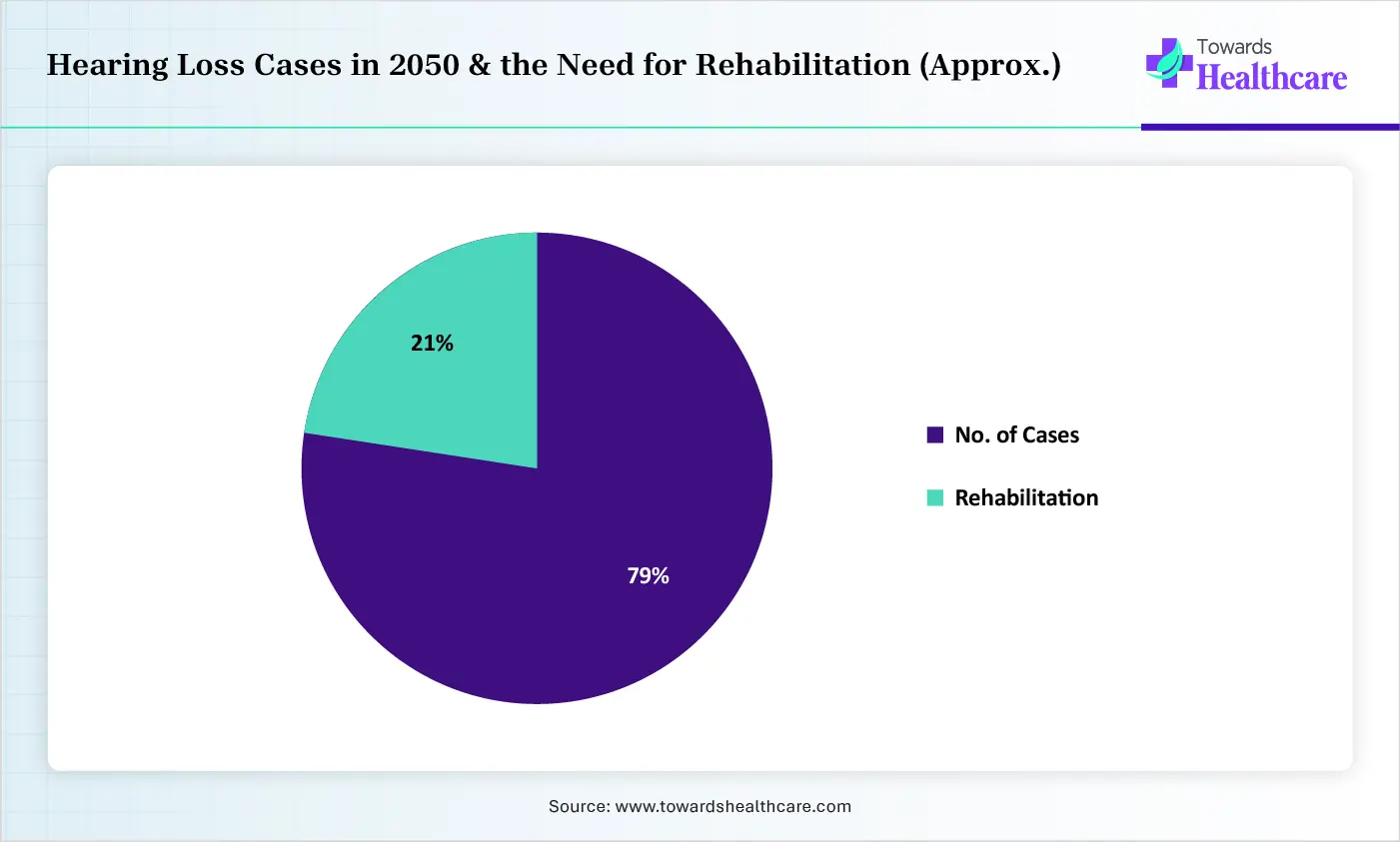
CI has wider importance in these growing cases with strong rehabilitation steps.
A particular rate of CI adoption has been showing its crucial utilization in severe-to-profound hearing loss, single-sided deafness (SSD), and those with critical residual hearing. However, an eventual progression in surgical technologies has also promoted soft-surgical solutions and electrode design, enabling surgeons to protect residual hearing.
Excluding modern technologies, rehabilitation serves as a transformative effort, which encompasses auditory-based therapy with audiologists and speech-language pathologists (SLPs) to train the brain to interpret novel electrical signals as sound. In another mode, certain programs are personalized to classify whether the hearing loss was prelingual or postlingual, with emphasized training on speech perception, communication management, and sound localization, which support more perceptual interventions.
Government Incentives: Specifically in Rapidly Growing Countries for Cochlear Implants
India
India has implemented the ADIP Scheme under the Ministry of Social Justice and Empowerment, which offers free cochlear implants, surgery, & post-operative therapy for children with pre-lingual hearing loss aged 1�5 years or acquired loss (up to 18 years), with a supportive funding of Rs. 6�7 lakh per unit.
Certainly, government hospitals, like GMCH Chandigarh, are now operating sophisticated, simultaneous bilateral cochlear implant surgeries, which have shown a successful procedure on a 1.5-year-old in November 2025.
China
China�s National Tender Projects have invested majorly in CIs, lucratively publishing a project to facilitate 15,000+ cochlear implants for children under age 5.
Also, China showcased a new Volume-Based Procurement (VBP) program as of mid-2025, emphasizing lowering the expenditure of cochlear implants & elevating the adoption rate, with firms such as Advanced Bionics.
Groundbreaking Steps in CI: Exploring Accuracy and Improvements in the Emerging Trends
One of the significant efforts that the industry has fostered is invisible technology, in which all components, such as the microphone and battery, are under the skin. For a specific application, clinical trials for systems, especially the Envoy Medical Acclaim, are progressing, with exceeding availability estimated as these trials conclude.
The era is impelling the utilization of digital solutions, such as OTOPLAN, which leverages 3D modeling to assist surgeons in selecting the adequate electrode for a patient�s unique anatomy, ultimately known for robotic-assisted surgery, like OTOARM, to raise electrode placement precision.
The next generation of digital revolution also comprises AI-driven sound processing, including the Cochlear Nexa, which integrates sophisticated machine learning for automatic adjustment in complex acoustic circumstances.
AI�s Robust Role & Executions: How Far is this Going to Raise the User Experience?
- Some AI algorithms are spotlighting major concerns, which will foster future adaptations and customized measures across the CI.
- A vital algorithm termed deep neural networks, which are employed to refine background noise and focus on speech, highlighting the challenges of conventional signal processing in noisy environments.
- Alongside, AI supports CI devices for automatic adaptation to diverse auditory scenarios and circumstances in real-time, which finally boosts user experience.
- AI-enabled tools, like the Fitting to Outcomes Expert (FOX), are allowing the analysis of patients� data and feedback to customize device settings, with minimal requirement for trial-and-error fitting & optimizing speech perception.
Continuous AI breakthroughs are facilitating descriptions regarding usage, with rigorous assessments.
- AI has explored Cochlear Nucleus 8 Sound Processor, which offers �SmartSound iQ with SCAN 2' technology, to find, evaluate, and automatically adapt to nearby noise environments, with direct streaming via Bluetooth.
- Moreover, the latest Advanced Bionics Naida CI Marvel has used Automatic Sound Scene Manager (AutoSound) technology, which serves similarly to a human brain by assessing the environment 200 times per second to improve sound quality, especially targeting optimized speech understanding.
Recent Unveilings in 2025-2026, with Spotlight on Progressing Activities
| Med-El US (February 2026) | Introduced Remote Care, a telehealth platform for audiologists, and the companion HearCare App for cochlear implant receivers. |
| Nanavati Max Super Speciality Hospital (December 2025) | Launched �Max Suno�, a promising cochlear implant and hearing rehabilitation programme focused on promising early detection, precision surgery & long-term auditory-verbal therapy for children and adults with severe to profound hearing loss.� |
| Cochlear Limited (June 2025) | Commercially launched the new Cochlear Baha 7 Sound Processor and the new non-surgical Baha SoundBand. |
Different activities are under development for CI, which further bolsters the accessibility and technical innovations.
- For sure, an impressive innovation includes India�s indigenous �NEUBIO� device, which shows its full-spectrum-continuous-stimulation (FSCS) coding strategy, & enhances music perception and speech in noise.
- The American Cochlear Implant Alliance (CI2025) in Boston has revealed CI outcomes of, and intervention for, children and adults with cochlear implants who have single-sided deafness or asymmetric hearing loss.
- Warsaw is presenting the 18th International Conference on Cochlear Implants (CI2026) in May 2026, which will show global research on robotic surgery, image-based anatomical modeling, & AI-driven computational solutions to rehabilitation.
Notable Challenges Raised in the Global Cochlear Implant Industry
- A major limitation in the respective area is the expense of devices, surgery, and following rehabilitation, which creates inaccessibility in several, primarily in emerging nations.
- In some cases, CIs often show unsatisfactory performance in real-world scenes with background noise; also, the current electrode technology faces obstacles in facilitating high-fidelity sound, like fine-grained frequency resolution.
- For post-implementation, the rising need for long-term auditory training and therapy is leading to poor availability or difficulties in accessing.
Surging Opportunities Merges Novelty & Success Across Cochlear Implant Area
- One of the robust developments is the use of robotic-assisted tools, such as HEARO and OTOARM, to escalate precision during the delicate insertion of electrodes, which probably minimises the risk of damage to inner ear structures.
- Furthermore, healthcare organizations are encouraging remote fitting and programming apps, particularly Hearcare or AB ListenFit, which allow patients to adjust their devices from home, lowering the need for frequent clinic visits.
- An eventual growth in innovating new electrodes, which comprise slowly releasing steroids or otoprotective drugs to lower inflammation and mitigate scar tissue from forming after surgery.
Conclusion
The overall expansion of the cochlear implant industry is propelled by a rise in the incidence of hearing loss, growth in the ageing population, and immersive technological breakthroughs, such as AI-driven sound processing. To boost the adaptation of CI and its innovative efforts, leading players are promoting awareness and expanded reimbursement policies. Various types of advances, including AI-enabled tools, are pushing remote programming (RP) & virtual follow-ups, enabling patients to receive care from home. Many emerging rehabilitation programs are stepping towards personalized efforts based on age and need to raise auditory training, speech development, & device management.
Expert Insights
According to a recent report on the cochlear implant market, published on Towards Healthcare. The market is experiencing robust growth driven by the rising global prevalence of hearing loss and the increasing geriatric population. Experts emphasize that technological advancements, including AI-enabled sound processing, wireless connectivity, and minimally invasive surgical techniques, are significantly improving patient outcomes and adoption rates. Expanding newborn screening programs and supportive reimbursement policies are further accelerating demand. However, high procedural costs and limited accessibility in low-income regions remain key challenges. Strategic collaborations, continuous innovation, and growing awareness initiatives are expected to sustain long-term market expansion and improve hearing care globally.