




 Request Consultation
At a Glance
Diversity of hematologic malignancies, such as leukemia, lymphoma, and multiple myeloma, is highlighted as the core of one of pharmaceutical development's most competitive and fastest-developing battlefields. Specifically, the global treatment market reached at $72.49 billion in 2025 and is predicted to reach $150.94 billion by 2035 as CAR-T cell therapies, bispecific antibodies, and next-generation targeted inhibitors are advancing for patients with relapsed or refractory disease.
As per Towards Healthcare analysis, in 2019, Bristol Myers Squibb established its modern hematology franchise almost completely through a single $74 billion acquisition of Celgene. Alongside, BeiGene, now BeOne Medicines, developed its position naturally around one drug, i.e. the BTK inhibitor Brukinsa, which led as a billion-dollar-a-quarter product and recorded overall US market leadership within approximately a year. At the same time, four different companies are currently competing head-to-head with approved CAR-T cell therapies for overlapping patient populations. Whereas China and India are establishing indigenous cell therapy manufacturing that could transform global pricing within a few years.
This explanation tracks who is genuinely stepping as a lead in this market in this era, across which specific strategies, and what pushes are most likely to determine whether that leadership accounts through 2027. This is all based on Towards Healthcare's hematologic malignancies market analysis, cross-referenced against company financial disclosures and industry competitive intelligence.
Twenty Players Host a Hematologic Malignancy Market Being Redeveloped Around Cell Therapy & Bispecifics
As the market is expected to reach $78.01 billion in 2026, many firms are involved in this overall expansion, such as:
- Legacy Franchise Leaders: Bristol Myers Squibb (via Celgene acquisitions).
- Single-Class Innovators: BeOne Medicines (BTK inhibitor leadership).
- CAR-T Therapy Makers: Gilead (Kite), J&J/Legend, Novartis, & BMS.
- Bispecific & ADC Developers: Regeneron, Pfizer, Genmab, & ADC Therapeutics.
Inclusion of four truly diverse strategic trajectories, such as acquisition-built scale, organic single-drug leadership, cellular therapy platforms, and antibody engineering. This indicates that there is no single prominent formula in this market, and a firm’s source story impacts less than its current implementation.
Source: Towards Healthcare, “Hematologic Malignancies Treatment Market Expands USD 150.94 Billion in 2035,” July 17, 2026.
By 2035, The Hematologic Malignancy Treatment Market is Expected to Witness Approximately Double Surge
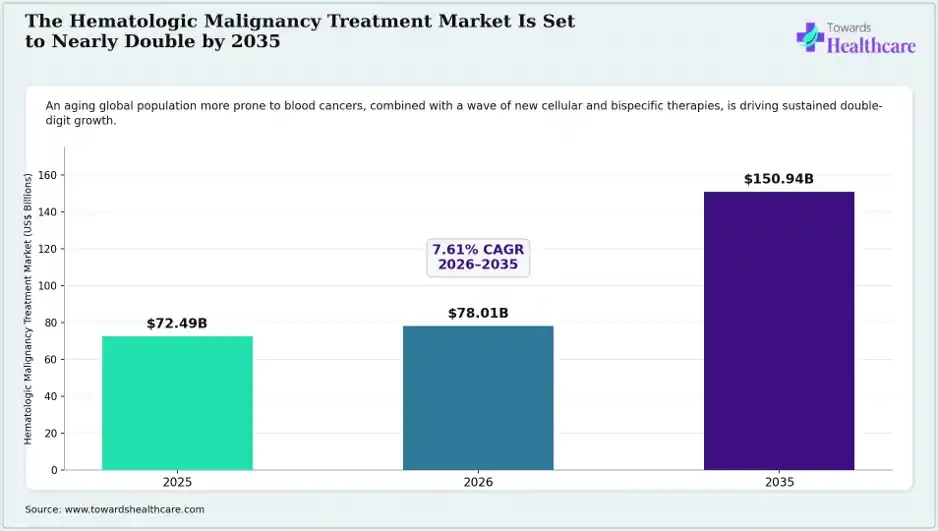
The above graph displays the anticipated growth of the global hematologic malignancy market, spanning 2025 through 2035.
Key Insight: According to Towards Healthcare, in 2025, the global market was valued at $72.49 billion, while it is estimated to reach at nearly $78.01 billion by 2026 and $150.94 billion by 2035. Alongside this, the hematologic malignancy treatment market is predicted to register a 7.61% CAGR during 2026-2035. This expansion is mainly propelled by a rise in the geriatric population that is highly susceptible to blood cancers. This provides a durable demographic tailwind rather than a temporary innovation cycle, while leaders position for 2035 & compete on a systematically growing patient population, not a fad.
Source: Towards Healthcare Database.
Leukemia Holds a Dominant Share of Treatment Spending, Meanwhile Lymphoma Is Projected to Grow Rapidly
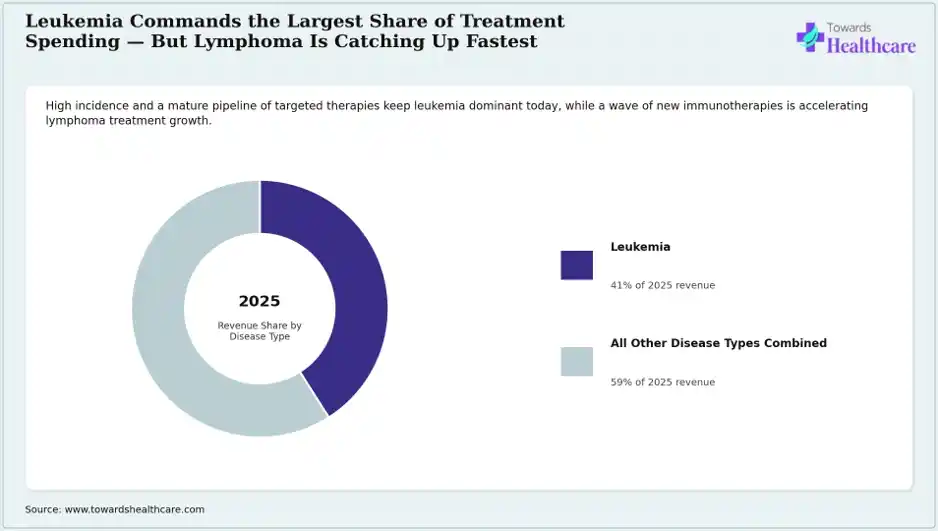
In accordance with Towards Healthcare’s analysis, the chart indicates leukaemia's 41% share of 2025 hematologic malignancy treatment revenue versus all other disease types combined. This shows that leukemia shows the largest share due to increased cases & a strong pipeline of tyrosine inhibitors. Alongside, lymphoma is predicted to register the fastest-growing disease category, which is mainly fueled by increasing non-Hodgkin lymphoma prevalence and the emergence of new CAR-T, bispecific, and antibody-drug conjugate therapies, especially targeting B-cell lymphomas.
Source: Towards Healthcare Database.
One $74 Billion Acquisition Developed the Modern Bristol Myers Squibb Hematology Franchise.
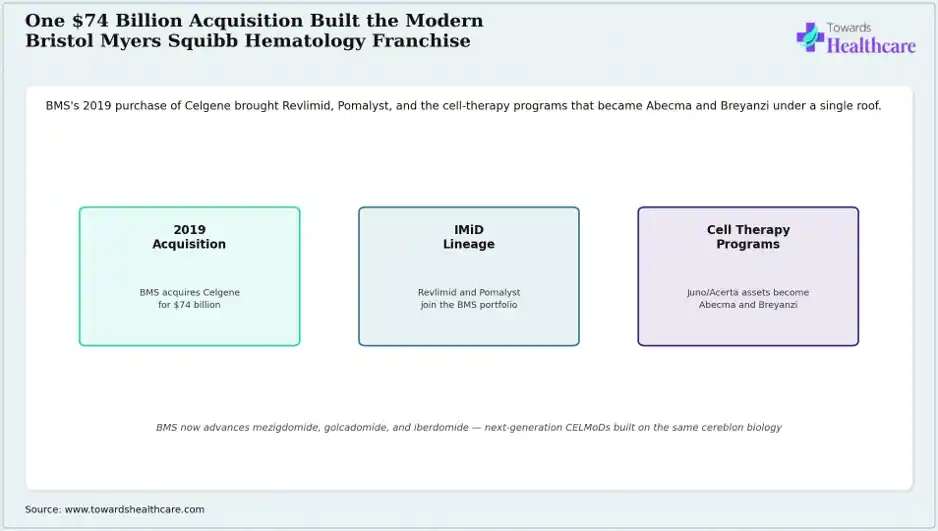
This panel reflects how BMS's 2019 acquisition of Celgene generated the IMiD drug legacy, i.e. Revlimid, Pomalyst, and cell-therapy programs that resulted in Abecma & Breyanzi under one roof.
Key Insight: Across current, approximately each substantial hematology asset BMS explores from its CELMoD pipeline to its CAR-T franchise. This tracks directly back to a single 2019 transaction, showcasing that industrial-scale M&A can establish a competitive position rapidly and more extensively than years of internal R&D.
Source: PatSnap Eureka, “Bristol Myers Squibb Competitive Landscape Analysis,” EHA 2026, June 30, 2026.
First Approved CAR-T Therapy Called Breyanzi Includes Five Different Cancer Kinds
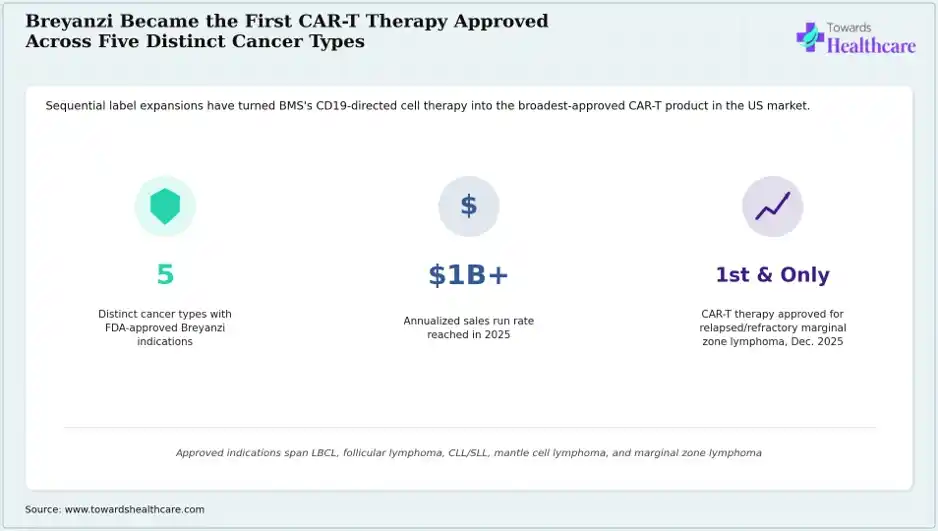
These statistics indicate the scale of Breyanzi's label growth, its 2025 sales surge rate, along with its December 2025 approval as the first CAR-T therapy for marginal zone lymphoma.
Key Insight: Instead of a single booming approval, sequential label expansion has been the key catalyst for Breyanzi, highlighting a $1 billion-plus annualized run rate. This depicts that in a dense CAR-T field, scope of approved indications can be as commercially significant as depth in any single one.
Source: Yahoo Finance, “Will Breyanzi's Strong Uptake Help BMY Offset Generic Competition?,” April 15, 2026; Bristol Myers Squibb, press release, 2025.
Flagship BTK Inhibitor BeOne Medicines Led to a $1 Billion-a-Quarter Drug in a Single Year.
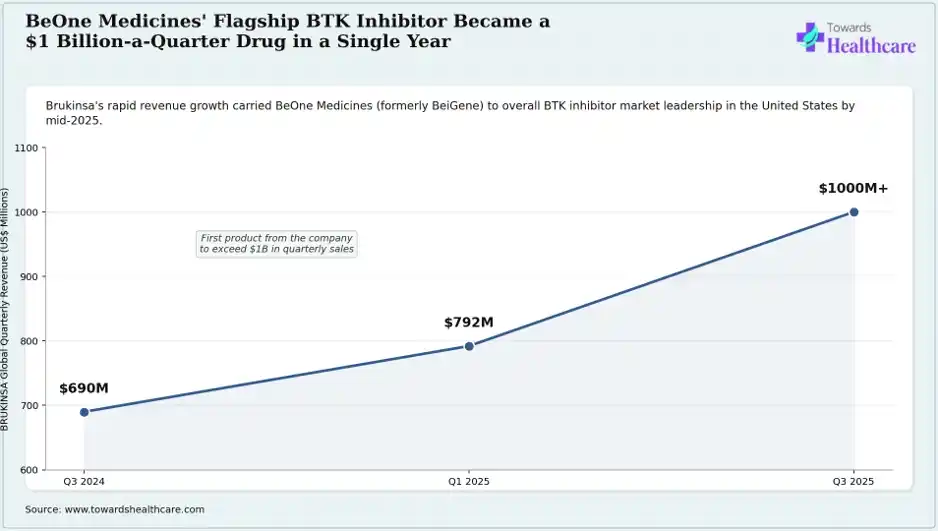
The above graph represents BRUKINSA's global quarterly revenue from Q3 2024 through Q3 2025, the quarter in which the company's first product exceeded $1 billion in quarterly sales.
Key Insight: From the chart, BRUKINSA's surge from $690 million to over $1 billion in quarterly revenue within a year reflects the overall US BTK inhibitor market share player across all lines of CLL therapy. This shows that a single best-in-class drug can still relocate multiple entrenched challengers in a robust therapeutic class.
Source: BeiGene, Ltd., Form 8-K, Q1 2025 earnings release; Medpath, “BeiGene achieved record third-quarter 2025 revenue,” December 5, 2025.
Throughout Therapies, Targeted Therapy Shows Dominance & Immunotherapy is Projected to Expand Fastest
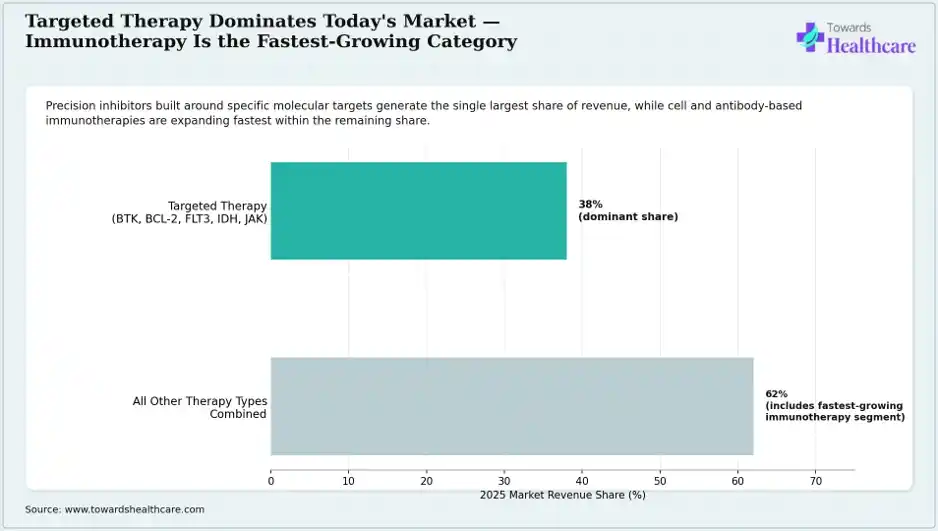
The graph demonstrates a comparison between targeted therapy with a 38 share as the largest share of the market in 2025 and all other therapy types combined with a 62% share, where immunotherapy is anticipated to grow at a rapid rate in the coming era.
Key Insight: This respective distance between targeted therapy & immunotherapy with an immersive growth path shows a definitive shift already underway. Also, in the upcoming few years, the revenue leadership reach itself may change, specifically as CAR-T and bispecific antibody expenses subside through advanced manufacturing capacity.
Source: Towards Healthcare Database.
Specifying Competition Among Four Key CAR-T Products Prominently Across Lymphoma, Leukemia, and Myeloma
| Breyanzi | Bristol Myers Squibb | CD19 | LBCL, FL, CLL/SLL, MZL (5 types) |
| Yescarta | Gilead Sciences/Kite | CD19 | LBCL, follicular lymphoma |
| Kymriah | Novartis | CD19 | ALL, DLBCL |
| Carvykti | Johnson & Johnson/Legend | BCMA | Multiple myeloma |
This comparison indicates their manufacturers, molecular targets, & approved indications. Along with three CD19-directed products betting for overlapping lymphoma and leukemia patients and a fourth targeting BCMA in multiple myeloma, the CAR-T market has stepped firmly from a novel-technology phase into a truly competitive commercial phase where production efficiency, label breadth, and real-world outcomes data currently impact more than being first to market.
Source: Yahoo Finance, “Will Breyanzi's Strong Uptake Help BMY Offset Generic Competition?,” April 15, 2026; Towards Healthcare, July 17, 2026.
In This Era, North America Dominates, While Domestic CAR-T Manufacturing Is Transforming Asia’s Market
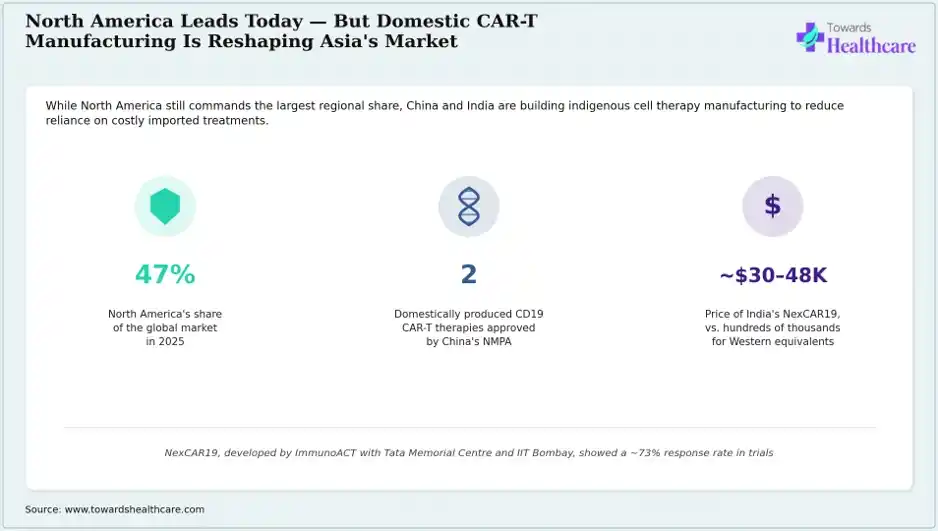
These statistics represent 47% of North America’s market share in 2025, whereas China approved 2 domestically developed CD19 CAR-T therapies by the NMPA and the approximate pricing of India's indigenous CAR-T therapy, NexCAR19, i.e. $30 to 48K. This further declares that the exceptional cost of cell therapy, long considered to be a constant feature of the technology, may actually be a function of where and how it is produced.
Source: Towards Healthcare Database
Through 2025, Regulators Explained a Trajectory of Novel Hematologic Malignancy Therapies
In a single year, i.e. 2025, new drug classes, expanded labels, & innovative combination regimens approached patients, specifically across the US, EU, & UK.
| 2024 | EMA/CHMP broadens Carvykti to use after just one prior therapy. |
| Early 2025 | FDA grants full approval to Calquence for untreated mantle cell lymphoma |
| July 2025 | FDA approves Regeneron’s Lynozyfic, a new BCMA-targeted bispecific for relapsed or refractory multiple myeloma |
| December 2025 | BMS’s Breyanzi becomes first CAR-T approved for marginal zone lymphoma |
The above consolidation of an expanded CAR-T label, i.e. Carvykti, a graduated conditional-to-full approval for Calquence, a brand-new bispecific antibody class known as Lynozyfic, and a first-in-category CAR-T indication, i.e. Breyanzi in MZL, within nearly 18 months reflects regulatory pace expediting across every vital modality at once, not focusing on just one.
Source: Towards Healthcare Database.
Twenty Players Range Across Three Diverse Strategic Positions in Hematologic Malignancy Drug Development
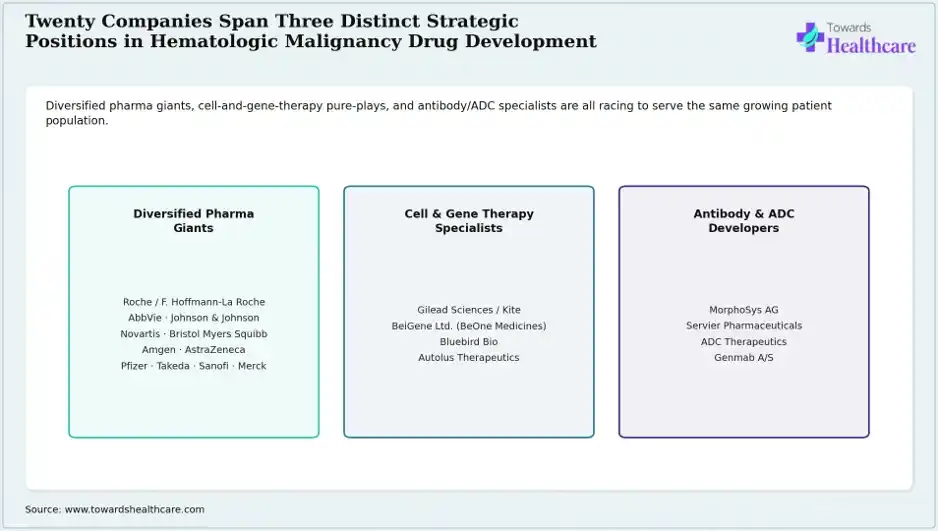
The existence of ten huge, distinguished pharma leaders, coupled with more specialized biotech companies across the market, recognises both approaches simultaneously. Meanwhile, scale and variation facilitate resilience against any single drug's patent cliff & concentrated specialization can develop category-defining products more quickly than a diversified challenger’s internal pipeline.
Source: Towards Healthcare Database.
A Single Licensing Deal Represents What Big Pharma Will Pay for a Mature AML Candidate
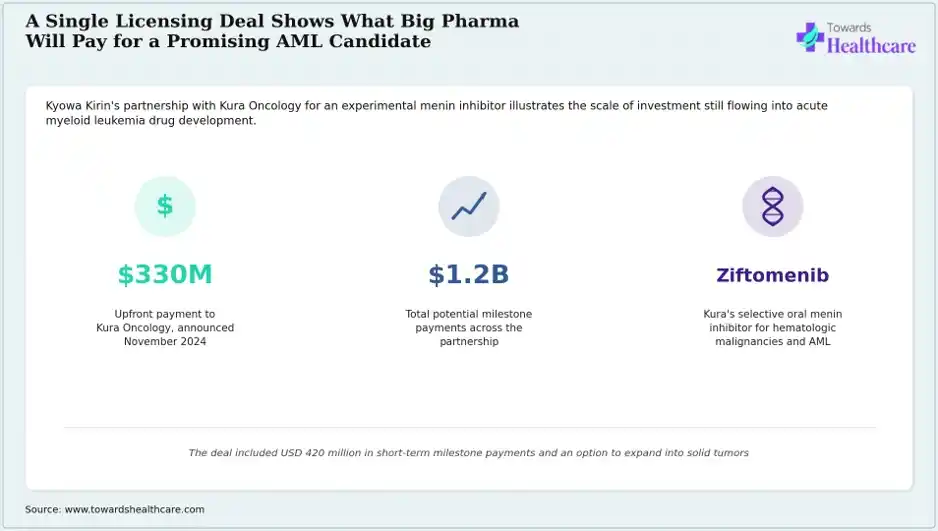
The above panel indicates the financial terms of Kyowa Kirin's November 2024 global strategic alliance with Kura Oncology for ziftomenib, an experimental oral menin inhibitor for acute myeloid leukemia.
Key Insight: The deal structure that unifies a $330 million advance with up to $1.2 billion in milestones, specifically for a drug still in development and not yet approved. This demonstrates that vast pharmaceutical firms consistently observe licensing deals as a rapid, lower-risk path to hematologic malignancy pipeline progression than internal discovery programs.
Source: Towards Healthcare Database.
Execution of Three Forces Will Determine Who Dominates Hematologic Malignancy Drug Development by 2027
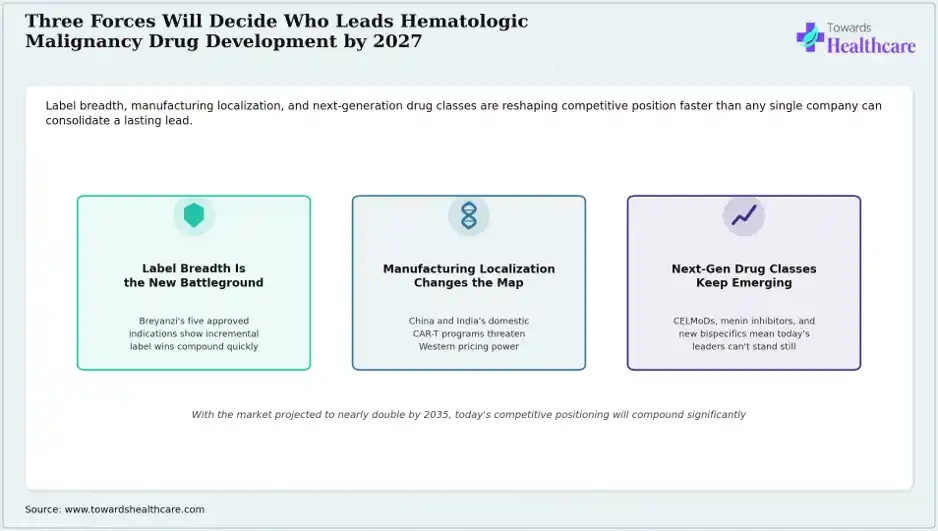
From these three forces, no players can expect their current status to be secure. Furthermore, Breyanzi's label lead can be complemented by a competitor's next approval, while China and India's manufacturing cost advantages could optimize Western pricing power. Meanwhile, new drug classes, such as CELMoDs & menin inhibitors, are actively being licensed and established currently shows the market's competitive rankings by 2027 will similarly look substantially different from today's.
Source: Synthesis of evidence presented in Sections 1-12 of this briefing.
Latest News About Hematologic Malignancy Drug Development in 2026
In August 2026, SillaJen's next-generation oncology pipeline candidate BAL0891 was granted Orphan Drug Designation by the U.S. Food and Drug Administration (FDA) for the treatment of acute myeloid leukemia (AML).
Source- https://finance.biggo.com/news/e19db107-f78d-439b-8313-850c4ad5e2fa
In May 2026, Pfizer and Innovent Biologics signed a global licensing and collaboration agreement valued at up to $10.5 billion to collaboratively establish a portfolio of 12 oncology programs exceeding antibody-drug conjugates (ADCs) and multispecific antibodies.
Source- https://www.biopharminternational.com/view/pfizer-innovent-biologics-forge-10-5-billion-oncology-collaboration-to-advance-next-generation-cancer-therapies
In May 2026, Bristol Myers Squibb (BMS) joined with Hengrui Pharma to co-develop 13 early-stage programs in oncology, hematology, and immunology; & will develop more than $15.2 billion for the Chinese drug developer.
Source- https://www.genengnews.com/topics/drug-discovery/bms-hengrui-pharma-partner-on-13-programs-in-up-to-15-2b-collaboration/
In April 2026, Orca Bio received the U.S. Food and Drug Administration (FDA) grant of Regenerative Medicine Advanced Therapy (RMAT) designation for Orca-Q, the second-generation investigational allogeneic T-cell immunotherapy for the treatment of high-risk hematologic malignancies.
Source- https://www.businesswire.com/news/home/20260428105408/en/Orca-Bio-Announces-U.S.-FDA-Regenerative-Medicine-Advanced-Therapy-RMAT-Designation-Granted-to-Orca-Q-for-the-Treatment-of-High-Risk-Hematologic-Malignancies
In February 2026, Lupin unveiled generic cancer drug Dasatinib Tablets in multiple strengths in the U.S., which is bioequivalent to Bristol-Myers Squibb Company’s Sprycel Tablets & Lupin partnered with Pharmascience Inc.
Source- https://www.thehindu.com/business/lupin-launches-generic-cancer-drug-in-us/article70584135.ece
In January 2026, a research team from the Gates Institute at the University of Colorado Anschutz was awarded $1 million from Blood Cancer United (formerly known as The Leukemia & Lymphoma Society) to bolster a new immunotherapy approach for patients with treatment-resistant acute myeloid leukemia (AML).
Source- https://news.cuanschutz.edu/gates/1-million-grant-from-blood-cancer-united-to-escalate-groundbreaking-car-t-cell-therapy-study
Prospective Pipeline of Hematologic Malignancy Drug Development in 2027
- The U.S. FDA scheduled a Prescription Drug User Fee Act (PDUFA) target date of May 13, 2027, for Bristol Myers Squibb's New Drug Application (NDA) for mezigdomide combined with carfilzomib & dexamethasone in relapsed or refractory multiple myeloma.
- Followed by data readouts and late 2026 NDA submissions, pioneers such as Sumitomo expect potential FDA approvals for menin inhibitors targeting acute myeloid leukemia (AML) in 2027.
- Novartis anticipates pivotal Phase 2 trial developments for pediatric indications of Scemblix (asciminib) transitioning through 2027.
- Takeda is strengthening late-stage program filings through 2027–2029 for elritercept, an activin inhibitor, used to treat anemia linked to hematologic cancers, such as myelodysplastic syndromes (MDS).
Key Companies & Organizations
| Company | Category | Offerings in Hematologic Malignancy Drug Development in 2026 |
| Bristol Myers Squibb | Diversified Pharma | Their pipeline is fostering next-generation cereblon E3 ligase modulators (CELMoDs), cell therapies, & targeted protein degradation platforms. |
| BeiGene Ltd. (BeOne Medicines) | Cell & Gene Therapy Specialist | Recently, they have published 78-month long-term follow-up data at the 2026 American Society of Clinical Oncology (ASCO) meeting, which ensures sustained disease control in chronic lymphocytic leukemia (CLL). |
| Gilead Sciences/Kite Pharma | Cell & Gene Therapy Specialist | As a producer of Yescarta, it is promoting strategic acquisitions, label expansions, and next-generation CAR T-cell pipeline readouts. |
| Johnson & Johnson/Legend Biotech | Diversified Pharma | By collaborating, they have evolved Carvykti and also focused on major manufacturing scale-ups; the allaince achieved its first quarter of company-wide profitability in August 2026. |
| Novartis AG | Diversified Pharma | A manufacturer of Kymriah, this company aims at advanced targeted therapies, next-generation CAR-T cell platforms, and significant late-stage pipeline expansion. |
| AstraZeneca | Diversified Pharma | Along with approval for Calquence (acalabrutinib), the firm is broadening advanced cell therapies and new agents, such as AZD0120 and surovatamig. |
| Regeneron Pharmaceuticals | Antibody Developer | Their 2026 pipeline emphasises robust bispecific and costimulatory antibodies evolved from its proprietary VelociSuite platform. |
| Kura Oncology/Kyowa Kirin | Biotech/Diversified Pharma Partnership | From an alliance, a company designed ziftomenib, an oral menin inhibitor for AML, worth up to $1.53B total and now conducting a pivotal Phase 3 trial assessing frontline ziftomenib in combination with standard 7+3 chemotherapy. |
| ImmunoACT (with Tata Memorial Centre, IIT Bombay) | Regional Cell Therapy Innovator | A leader who evolved NexCAR19, India's first indigenous CAR-T therapy, priced at a fraction of Western equivalents. |
| GSK plc | Diversified Pharma | Their offering includes Blenrep (belantamab mafodotin), an antibody-drug conjugate for multiple myeloma, which became available through the UK's NHS. |
Strategic Business & Research Questions
- Which specific hematologic malignancy subtypes remain underserved by current CAR-T, bispecific, and targeted therapy approvals, reflecting the strongest unmet-need opportunity for new entrants?
- How does Breyanzi's real-world durability of response compare to Yescarta's across overlapping approved indications, based on post-marketing surveillance data?
- What is the realistic probability that BRUKINSA's US BTK inhibitor market leadership position is challenged by a next-generation BTK degrader, like BeiGene's own BGB-16673, within the next three years?
- Which specific companies hold the robust patent positions in menin inhibitor technology beyond Kura Oncology's ziftomenib, and how does that affect competitive dynamics in AML?
- How does the actual manufacturing cost per patient for India's NexCAR19 compare to Western CAR-T products, and what specific process innovations enable that cost differential?
- What proportion of BMS's current hematology revenue still depends on Revlimid and Pomalyst despite ongoing patent expiry, and how quickly is that dependency actually declining?
- Which specific CELMoD compounds (mezigdomide, golcadomide, iberdomide) have the strongest Phase 3 data package, and what is the realistic timeline for regulatory approval?
- How does China's National Medical Products Administration's CAR-T approval timeline compare to the FDA's for domestically developed versus internationally licensed cell therapies?
- What is the realistic addressable market size for bispecific antibodies in multiple myeloma specifically, given the current competitive field of Tecvayli, Elrexfio, and Lynozyfic?
- Which specific companies are best positioned to develop combination regimens pairing CAR-T cell therapy with bispecific antibodies or targeted agents for relapsed/refractory disease?
- How concentrated is hematologic malignancy drug development funding among the top 20 companies identified in this briefing, versus the broader population of smaller biotechs in the space?
- What is the realistic probability that a fifth major CD19 or BCMA-directed CAR-T product reaches approval and captures meaningful market share from the current four incumbents?
- Which specific factors most influence a treating oncologist's choice between Breyanzi, Yescarta, and Kymriah when multiple options are approved for the same indication?
- How does the total cost of care (including CRS/neurotoxicity management) compare across the four major approved CAR-T products in real-world clinical practice?
- What is the realistic timeline for allogeneic (off-the-shelf) CAR-T products to reach approval in hematologic malignancies, and which companies have the most advanced programs?
- Which specific rare hematologic malignancy subtypes, including marginal zone lymphoma, are attracting disproportionate R&D investment relative to their patient population size, and why?
- How does AstraZeneca's oncology division growth rate specifically within hematology compare to its solid tumor franchise, and what does that reveal about capital allocation priorities?
- What is the probability-adjusted risk that continued price competition from domestically manufactured Asian CAR-T products compresses Western pricing power within the next five years?
- Which specific companies have the deepest late-stage pipeline in myelodysplastic syndromes and myeloproliferative neoplasms, the two most underrepresented disease types in current major approvals?
- How does venture capital and licensing deal activity in hematologic malignancy drug development in 2026 compare to 2024 and 2025, and which specific modalities are attracting the most capital?
Data & Intelligence Pointers
- The global hematologic malignancies treatment market reached at $72.49 billion in 2025 and is anticipated to reach $78.01 billion in 2026, surging to $150.94 billion by 2035 at a 7.61% CAGR.
- North America held roughly 47% of the global hematologic malignancies treatment market share in 2025, the largest of any region.
- Leukemia captured 41% of 2025 market revenue, the dominant disease type, while lymphoma is estimated to expand at the fastest rate through the forecast period.
- Targeted therapy (BTK, BCL-2, FLT3, IDH, and JAK inhibitors) accounted for a 38% revenue share in 2025, the largest of any therapy type, while immunotherapy is projected to witness the fastest growth.
- Bristol Myers Squibb built its modern hematology franchise substantially through its 2019 acquisition of Celgene for nearly $74 billion, which unveiled Revlimid, Pomalyst, and the cell-therapy programs that became Abecma and Breyanzi.
- Breyanzi (lisocabtagene maraleucel) exceeded a $1 billion annualized sales run rate in 2025 and became the first and only CAR-T cell therapy approved for relapsed/refractory marginal zone lymphoma in December 2025.
- BeiGene's BRUKINSA (zanubrutinib) became the company's first product to surpass $1 billion in quarterly sales in Q3 2025, with global quarterly revenue rising from $690 million (Q3 2024) to over $1 billion (Q3 2025).
- Four major approved CAR-T cell therapies, i.e. Breyanzi (BMS), Yescarta (Gilead/Kite), Kymriah (Novartis), and Carvykti (J&J/Legend), compete across overlapping lymphoma, leukemia, and multiple myeloma indications.
- India's NexCAR19, the country's first indigenously evolved CAR-T therapy, is priced at roughly $30,000–$48,000, dramatically lower than Western CAR-T equivalents, and represented an approximate 73% response rate in trials.
- China's NMPA has approved two domestically produced CD19-directed CAR-T cell therapies for relapsed/refractory large B-cell lymphoma.
- Kyowa Kirin's November 2024 alliance with Kura Oncology for ziftomenib, an oral menin inhibitor for AML, included $330 million upfront and up to $1.2 billion in additional milestone payments.
- Towards Healthcare tracks 20 top companies in the hematologic malignancies treatment market, including diversified pharma giants, cell and gene therapy specialists, and antibody/ADC developers.
References
- Towards Healthcare. “Hematologic Malignancies Treatment Market Expands USD 150.94 Billion in 2035.” July 17, 2026. Used for: market sizing, CAGR, segmental insights, regional insights, top 20 company list, recent developments. https://www.towardshealthcare.com/insights/hematologic-malignancies-treatment-market-sizing
- PatSnap Eureka. “Bristol Myers Squibb Competitive Landscape Analysis.” EHA 2026. June 30, 2026. Used for: BMS hematology franchise history, Celgene acquisition details, CELMoD pipeline.
- Yahoo Finance. “Will Breyanzi's Strong Uptake Help BMY Offset Generic Competition?” April 15, 2026. Used for: Breyanzi sales run rate, label expansion, CAR-T competitive landscape (Yescarta).
- Bristol Myers Squibb. “Bristol Myers Squibb's Application for Breyanzi Accepted for Priority Review... for Relapsed or Refractory Marginal Zone Lymphoma.” Press release, 2025. Used for: Breyanzi MZL approval details.
- BeiGene, Ltd. Form 8-K, Q1 2025 Earnings Release. SEC filing. Used for: BRUKINSA Q1 2025 revenue and growth figures.
- Medpath. “BeiGene Reports Record $1.4 Billion Quarterly Revenue as BRUKINSA Surpasses $1 Billion Milestone.” December 5, 2025. Used for: Q3 2025 BeiGene/BeOne Medicines financial results.
- BusinessWire. “BeiGene Announces Third Quarter 2024 Financial Results and Corporate Updates.” Used for: Q3 2024 BRUKINSA revenue baseline and CLL market leadership commentary.
- onedayadvisor.com. “Top Cancer Drug Companies (2026 Update): Leaders by Revenue, Pipeline, and Growth.” July 22, 2026. Used for: AstraZeneca oncology revenue figures, BMS hematology portfolio details.