




 Request Consultation
First and foremost, operating room integration encompasses the digital, audio, & visual networking of surgical equipment, imaging systems, and patient data into a single, centralized control hub. Moreover, these breakthroughs are connecting various devices, such as cameras and monitors, to simplify workflows, improve imaging, & allows for real-time information access to enhance surgical precision & effectiveness.
What are the Significant Drivers in the Progression of Operating Room Integration?
- In particular, a large population is demanding diverse yet extensive techniques, with affordability and time-saving features.
- The globally surging demand for minimally invasive procedures (MIS) is fueling the dependency on robotic and laparoscopic surgeries, which need sophisticated high-definition visualization & image-guided systems.
- Furthermore, massive adoption of these integrated solutions is providing optimized workflow, minimal surgical turnover times, and reduced operative spending, which finally enables hospitals to push their resources.
- Across the operating room integration industry, leading firms are increasingly spurring different technological advances, including AI integration for predictive analytics, advanced digital imaging, & high-speed data transmission (Video-over-IP), which ultimately increases precision & real-time decision-making.
- Apart from this, hospitals or other healthcare systems are raising the implementation of operating rooms that unite traditional surgical capabilities with advanced imaging equipment (CT, MRI), mandating combined control systems.
Emerging Certain Limitations in the Operating Room Integration Pause the Adoption
- One of the major challenges, the need for higher capital investment in executing integrated systems, as well as for hardware & software, is creating a key obstacle. For instance, retrofitting older operating theaters with innovative, heavy, or ceiling-mounted equipment often demands substantial, expensive structural alterations.
- Besides this, acquiring devices from various manufacturers to contact efficiently, while blending diverse protocols from different vendors into a perfect system, is also developing another significant technical barrier.
- However, the adoption of novelty needs major modifications in & training for the workflow of surgeons, nurses, and technicians, which notably disturbs well-developed routines.
More Impactful Trends in Operating Room Integration: Elevates Prospective Opportunities
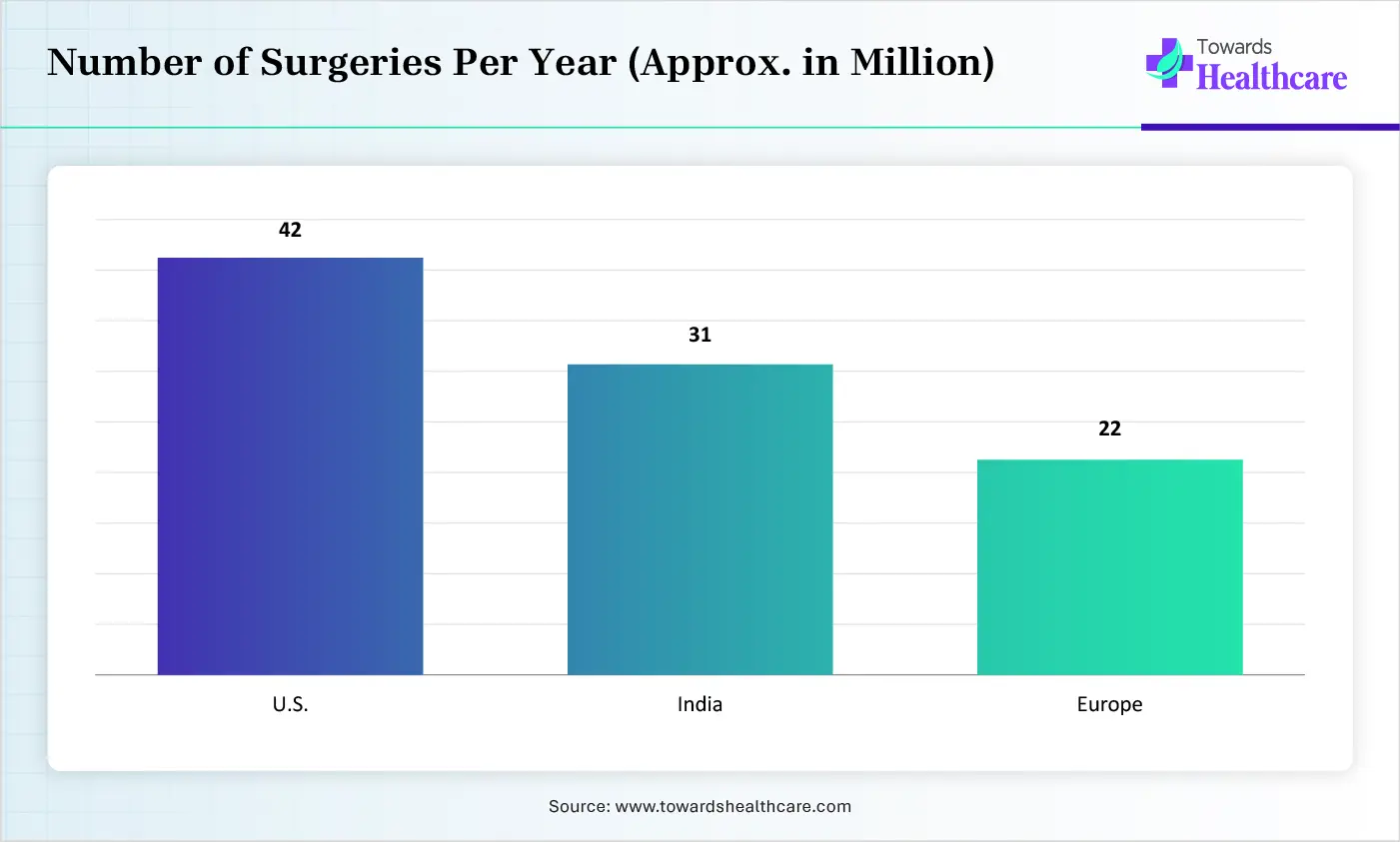
A prominent effort shows robustness in AI, machine learning, and other advanced solutions, specifically in surgeries across different countries, like the U.S., India, and certainly Europe, impelling the comprehensive progression.
- Companies are widely leveraging artificial intelligence in automating documentation, analyzing surgical videos to offer real-time guidance, with the detection of potential complexities, including prolonged surgical times.
- Across the globe, industry has been fostering integrated 4K, 3D, and high-definition imaging systems that assist surgeons in visualising internal anatomy with greater precision, primarily for minimally invasive surgeries.
- Ongoing advances in smart ORs are stepping towards combining numerous robotic devices into a single, cohesive system, which will finally raise precision.
- Systems are promoting hybrid sets, which unite traditional OR capabilities with modern imaging tools, like CT or MRI, enabling complex, image-guided procedures to be operated by multiple specialists.
Major Perspectives in Executing OR Integration Across the Healthcare Systems
For surgical staff, i.e., surgeons & nurses, these advanced OR integrations are rising control over the environment & equipment via a central touchpad, often accommodated within the sterile field, which minimizes the need to leave the field. Inclusion of supporting non-sterile nurses further reports outstanding working conditions and minimal risks, like tripping over cables.
�Whereas, in the settings of hospitals, management & administration, executed OR integration probably lowers turnover time between instances, i.e., boosting operation efficiency. Also, upgraded technologies are streamlining documentation and enabling robust inventory and supply monitoring.
Persistent Pivotal Government Projects Surge Innovations, Executions in the Developing Country
- Primarily, in December 2025, the Tamil Nadu government initiated an integrated government-sector hybrid neurosurgery operating theatre at Kilpauk Medical College Hospital (KMCH) to foster advanced, minimally invasive brain procedures.
- Across India, PM ABHIM (Ayushman Bharat Health Infrastructure Mission) is flowing through 2025�26, which has an outlay of ₹64,180 crore to seal vital gaps, such as setting up emergency operations centres and strengthening critical care hospital blocks with smart technology.
- Alongside, the Himachal Pradesh government is putting efforts into empowering tertiary care centres at IGMC Shimla, AIMSS Chamiana, and Dr. Radhakrishnan Government Medical College, Hamirpur, by implementing integrated critical care monitoring systems, O-arm 3D imaging, & robotic surgery platforms.
Prominent Breaches of Cybersecurity & Their Further Rigorous Measures
Sometimes, significant cybersecurity issues may arise as hurdles in operational procedures, patient safety, or key disruptions in legal systems.
- In certain cases, integration of prior standalone devices into hospital networks develops many new entry points for malware, ransomware, & data theft.
- However, a severe cyberattack can stop surgeries, delay care or lead to malfunction in critical equipment, specifically ventilators.
- Several hospitals are demonstrating numerous OR devices on old-time software, which cannot support modern security protocols, & this makes them easy targets for lateral movement by attackers.
The above concerns can be resolved by unveiling advanced measures, like segmentation, strong presentations, and a few monitoring solutions.
- Over a single flat network, operating systems are fragmented into isolated virtual subnets, which further halts a potential breach in one device from widening to critical surgical equipment.
- A shift towards �zero trust architecture� necessitates consistent validation of all devices & users attempting to access the network, which lowers the reliance on perimeter defenses.�
- Eventually, ORs are broadly adopting specialized IoT/OT security tools for automatic identification of all connected medical devices, inventory their software, & monitor for anomalies in real-time.
Briefing on a Few Recent Rollouts Across the Operating Room Integration Industry
| Medtronic (December 2025) | Received the U.S. FDA clearance for the Hugo robotic-assisted surgery (RAS) system for use in urologic surgical procedures. |
| Meril (September 2025) | Launched the Mizzo Endo 4000, an advanced soft tissue system, which bolsters the position of Surgical Robotics India. |
|
Surgical Safety Technologies (SST)(August 2025)� |
Made the general availability of two innovative mobile applications called the Room State & Explorer to transform interaction among operating room data & surgical video content for surgeons. |
Spotlight on Regional Groundbreakings in OR Integration
North America
The region was dominant in 2025, as it showed several developments. Specifically, in June 2025, Northwestern Medicine Palos Hospitals unveiled a hybrid vascular OR, and Long Island Jewish Medical Center inaugurated a $6.1 million hybrid suite in April 2025.
Alongside, in March 2025, Texas Health Hospital Mansfield broadened its surgical capability with a novel hybrid operating room integrating advanced imaging for both traditional & minimally invasive procedures.
Asia Pacific
APAC is predicted to witness the fastest growth, with their numerous but strong vision in OR integration. Most pivotal efforts have been taken by Japan�s Sapporo Kashiwabakai Hospital, which is establishing Smart-ORs, especially to optimize emergency patient transfer times.
 Additionally, Dr�ger rolled out the Atlan A100 anesthesia workstation in India to bolster workflow integration and patient care in April 2025.
Europe
At the UK�s Royal Orthopaedic Hospital, VitVio (London) successfully piloted an AI platform, which employs cameras and sensors to monitor surgical stages and tools in real-time, in early 2025.
Middle East & Africa (MEA)
e& enterprise and RAIN Technology joined in January 2025 to introduce Orva, the world�s foremost surgical voice assistant, across hospitals in the MEA region to simplify OR workflows.
Latin America
However, KARL STORZ joined with Star M�dica in Mexico in March 2025, & installed advanced OR1 integrated operating rooms & SCENARA software across many locations.
Giant Leaders and Their Notable Offerings
| Stryker Corporation | This mainly facilitates the Connected OR Hub & the 1688 Advanced Imaging Modalities (AIM) 4K Visualization Platform to reinforce imaging and data management.� |
| KARL STORZ GmbH & Co. KG | A firm specializes in OR integration through advanced, software-enabled endoscopes and imaging systems. |
| STERIS plc | They usually offer comprehensive integrated surgical equipment & information management systems for workflow improvements. |
| Olympus Corporation | Its offerings include comprehensive operating room (OR) integration solutions focused on the EASYSUITE video-over-IP platform.  |
| Getinge AB | A company explores diversity from high-level software for video routing & documentation to modular physical infrastructure for the surgical setting. |
| Brainlab AG | This emphasizes specialized digital operating room solutions for image-guided surgery, such as neurosurgery & oncology. |
| Skytron LLC | It has introduced the SkyVision Ascend portfolio, which controls video, audio, and data routing within the surgical suite. |
| Merivaara Corporation | This mainly focuses on the OpenOR management system to raise patient safety, workflow efficiency, and hygiene through vendor-neutral technology.  |
| Barco NV | A player specializes in networked visualization approaches for the digital operating room.� |
| Baxter (formerly Hill-Rom) | This provides a complete ecosystem for operating room (OR) integration, with an emphasis on the Helion Integrated Surgical System. |
Conclusion
Globally growing the need for expanded surgical efficiency, elevated adoption of minimally invasive surgeries, and increasing demand for advanced imaging technology are impacting the overall growth of the operating room integration industry. These novelties are exploring significant benefits across the hospitals, including seamless surgical workflows, boosted efficiency, escalated team communication, minimal error risks, & excellent patient results.
Moreover, the global healthcare systems are facing a need for huge capital investments, complicated interoperability with legacy equipment, and resistance to change from staff. By moving ahead with these concerns, many governments are providing incentives, new projects in OR integration to strengthen their respective healthcare facilities and step with upcoming generations. Although firms are encouraging modern technologies across the industry, including AI & eInfochips to offer real-time feedback & video analytics, as well as Augmented Reality united with robotics to enable real-time navigation of patient anatomy.
Expert Insights
According to a recent report on the operating room integration market, published on Towards Healthcare. The market is rapidly transforming with the increasing adoption of digitally integrated and hybrid operating rooms. Experts highlight that demand is driven by the need for improved surgical precision, real-time data access, and enhanced patient safety. Integration of AI, cloud platforms, and advanced imaging is optimizing workflows and reducing surgical errors. Hospitals are investing in interoperable systems to streamline complex procedures and improve efficiency. However, high implementation costs and skill gaps remain challenges. Overall, innovation in smart, connected surgical environments is expected to significantly enhance clinical outcomes and operational efficiency globally.