


The 2-way Foley catheter market size was estimated at USD 1.94 billion in 2025 and is predicted to increase from USD 2.05 billion in 2026 to approximately USD 3.44 billion by 2035, expanding at a CAGR of 5.9% from 2026 to 2035. The market covers indwelling urinary drainage catheters used for bladder management in hospitals, long-term care, and home settings. Growth is supported by rising urinary disorders, growing surgical volume, an aging population, and increasing demand for safer, more comfortable catheter solutions.
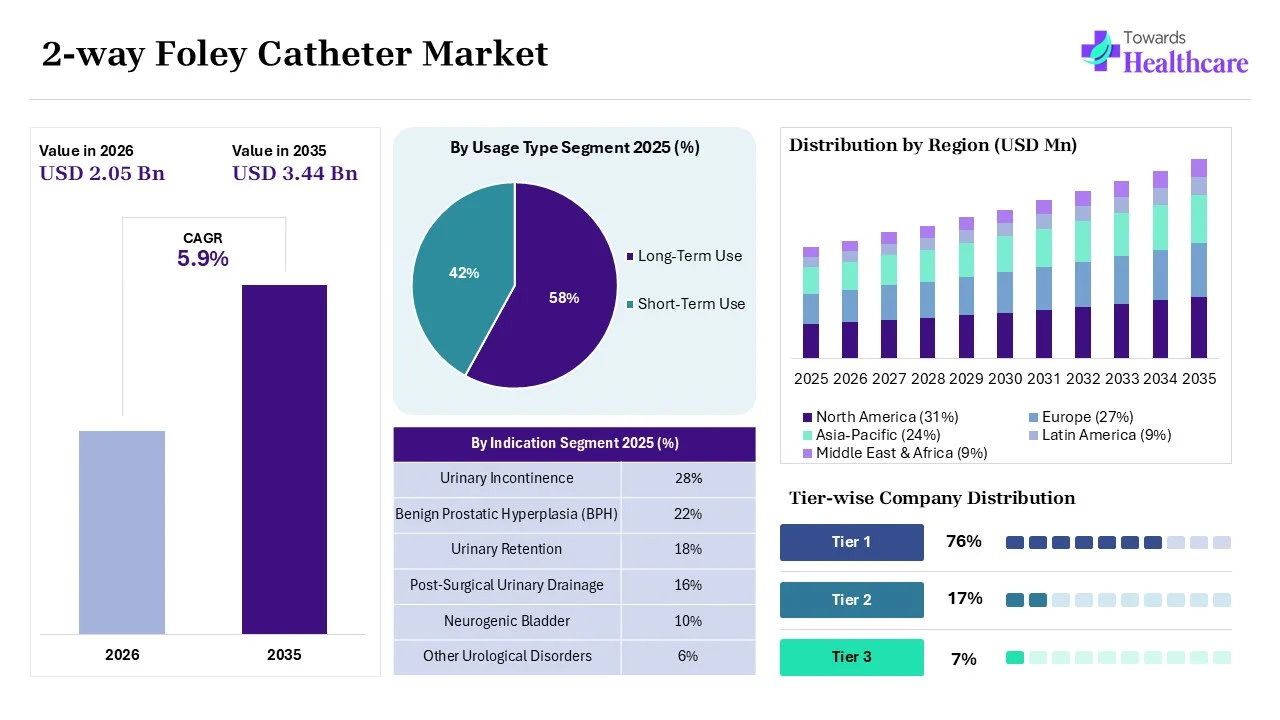
A 2-way Foley is an indwelling urinary catheter with two separate channels, one to drain urine from the bladder and the other to inflate a balloon that holds the catheter in place. The 2-way Foley catheter market is growing due to the increasing prevalence of urinary retention, incontinence, benign prostatic hyperplasia, and postoperative bladder complications that require continuous urinary drainage. Rising surgical volumes, a growing elderly population, and expanding long-term and home healthcare services are further supporting demand. In addition, greater focus on infection prevention, patient comfort, and improved catheter materials is driving wider adoption across healthcare settings.
The 2-way Foley catheter market is expected to grow steadily as healthcare providers increasingly prioritize prevention, patient comfort, and long-term urinary management, long-term care, and home healthcare, along with wider adoption of silicone, latex-free, and coated catheter designs. Growth opportunities are also likely to emerge from outpatient care expansion and improving access to urology products in developing healthcare markets.
| Parameter | Data |
| A hospitalized patient receiving a urinary catheter | 15-25% |
| Hospital-acquired UTIs associated with urinary catheters | 75% |
| Acute-care HAIs represented by UTIs | 30% |
| Long-term care residents using indwelling catheters | 5% |
| Daily bacterial risk with catheterization | 3-10% per day |
| Patient with bacterial infection after 1 month of catheterization | Nearly 100% |
These figures highlight the strong clinical need for 2-way Foley catheters across hospitals and long-term care settings. High catheter utilization among hospitalized patients, the large share of UTIs linked to catheter use, and the rising infection risk with prolonged catheterization all support steady product demand for routine bladder drainage, postoperative care, and chronic urinary management.
The silicon segment held a dominant share of 62% in 2025 due to its strong biocompatibility, lower risk of allergic reactions, and better suitability for long-term catheterization compared to latex alternatives. Silicon catheters also offer smoother insertion, reduced encrustation, and improved patient comfort, making them widely preferred in hospitals and long-term care settings. Growing emphasis on infection prevention and latex-free urinary care solutions further strengthened silicone’s leading market position.
The urinary incontinence segment dominated the 2-way Foley catheter market with a share of 41% in 2025 due to the large number of elderly, neurologically impaired, and mobility-limited patients requiring continuous bladder drainage and urinary management. The condition often demands long-term care facilities and home settings. Rising awareness of continence care, growing aging populations, and an increasing need for convenient urine drainage solutions further supported segment dominance.
The hospitals segment led the 2-way Foley catheter market with a share of 54% in 2025 because hospitals remain the primary settings for catheterization during surgeries, critical care, emergency treatment, and postoperative bladder management. They handle a high volume of patients with urinary retention, incontinence, and acute urological complications that require short-or medium-term drainage. Strong clinical monitoring, routine catheter use, and greater access to trained healthcare professionals further supported the hospital segment dominance.
The adult segment held a dominant share of 89% in 2025 because adults account for the majority of patients with urinary retention, urinary incontinence, benign prostatic hyperplasia, urodynamic bladder, and postoperative bladder drainage needs. This population also undergoes a large number of urological, gynecological, and general surgeries requiring catheterization. Higher hospitalization rates, chronic disease burden, and growing elderly demographics further supported strong demand within the adult patient segment.
The direct tenders segment dominated the 2-way Foley catheter market with a share of 45% in 2025 because hospitals, public health systems, and large care facilities typically purchase 2-way Foley catheters in bulk through centralized contracts. This procurement model ensures consistent supply, standardized product quality, and better pricing from manufacturers. High catheter demand in hospitals and long-term care institutions, along with cost-control measures and long-term supplier agreements, further strengthened the segment’s leading position.
North America dominated the 2-way Foley catheter market with a share of 31% in 2025 due to its high prevalence of urinary incontinence, benign prostatic hyperplasia, neurogenic, and postoperative urinary complications that require catheterization. The region also benefits from advanced hospital infrastructure, high surgical volumes, strong long-term care utilization, and widespread adoption of infection-prevention urinary devices. A growing elderly population and broad access to home healthcare further supported steady demand across the care settings.
Asia Pacific held a 24% share of the 2-way Foley catheter market in 2025 and is expected to grow at the fastest CAGR of 7.1% in the market during the forecast period due to its large patient pool, rapidly aging population, rising prevalence of urinary retention and incontinence, and improving access to hospital and long-term care services. Increasing surgical volumes, expanding healthcare infrastructure, and greater awareness of urinary management are also supporting demand. In addition, stronger availability of affordable catheter products is expected to accelerate adoption across emerging healthcare markets.
Leading companies in the 2-way Foley catheter market include Teleflex Incorporated, B. Braun SE, Becton, Dickinson and Company (BD), Coloplast, Cardinal Health, Bactiguard, Medline Industries, and Well Lead Medical. These companies are supporting market growth through continuous innovation in silicone and latex-free Foley catheters, infection-control coatings, urinary drainage systems, and patient-focused catheter designs. Ongoing investments in product development, manufacturing expansion, and advanced urinary care solutions are further strengthening their position across hospitals, long-term care facilities, and home healthcare settings.
By Material
By Indication
By Usage Type
By End User
By Patient Type
By Distribution Channel
By Region


