


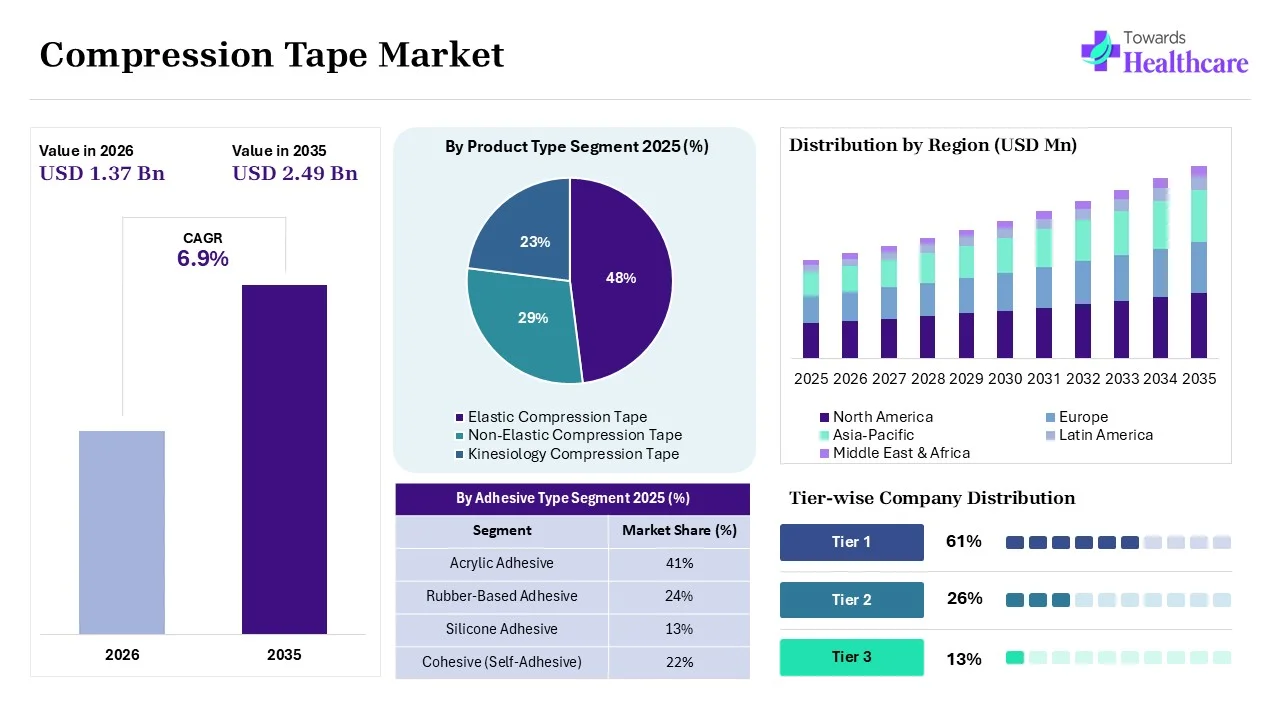
The compression tape market size accounted for USD 1.28 billion in 2025 and is predicted to increase from USD 1.37 billion in 2026 to approximately USD 2.49 billion by 2035, expanding at a CAGR of 6.9% from 2026 to 2035. The increasing cases of sports-related injuries and an aging population requiring advanced orthopaedic care are driving growth in the compression tape market.
Compression tape is a cloth adhesive tape that offers equivalent compression to a traditional adhesive bandage. This tape is coated with latex-free hypoallergenic adhesive. It is particularly intended to be applied in angioplasty, to help muscles and joints, and in post-operative dressing. Healthcare-grade adhesive compression tape designed to offer controlled compression, similar to outdated adhesive tape. It is generally applicable after angioplasty, for post-operative dressings, and to support muscles and joints during recovery. It helps to maintain pressure at the surgical site, support healing, and lower the risk of challenges, as recommended by medical care professionals. It offers support, lessens pain, decreases swelling, and enhances performance.
| Sport Injury | Percentage |
| Males (U.S) | 65% |
| Females' Youth Sports Injuries | 52% |
| Workplace Sports Injuries | 50% |
| Injuries in Runners | 60% |
| Anterior Cruciate Ligament (ACL) | 80% |
Advances in eco-friendly adhesives have enhanced the tape's strength and dependability. They now feature improved elasticity, breathability, and skin-safe adhesives for greater patient comfort. Recent innovations in eco-conscious compression tapes aim to replace petroleum-derived synthetics with biodegradable, plant-based materials and incorporate smart sensors, all while preserving medical-grade elasticity. A biodegradable cotton-based wearable humidity sensor has been created using Fabril-treated cotton fabric coating. Using biodegradable materials offers an environmentally friendly alternative for medical tape manufacturing, enabling natural decomposition over time and minimizing ecological impact. Modern medical tapes also include capabilities to monitor vital signs such as heart rate, respiration, and body temperature, facilitating real-time health tracking and delivering essential data to healthcare professionals.
By product type, the elastic compression tape segment contributed the largest market share of 48% in 2025, as elastic tape strips are applied with restricted compression over a muscle injury. It is easy to use in arthritic knee joints, osteoarthritis soreness, and tendonitis knee pain. Elastic adhesive tapes are called stretch tapes and are made of warp cotton. They are available in both heavyweight and lightweight designs and are commonly available in white or tan colors.
By material, the cotton segment contributed the largest market share of 39%, as cotton tape provides exceptional breathability, enabling air to circulate and moisture to evaporate, which is significant for preserving skin health during physical activities. This charecteristics is specifically important in sports therapy, in which long-term tape application is often required.
By adhesive type, the acrylic adhesive segment held a significant share of 41% in the market. Acrylic adhesive tape offers a stronger, longer-lasting bond, creating it more reliable for applications that required to endure over the years rather than just months. Acrylic adhesive tapes are broadly useful for sealing boxes, cartons, and various packaging materials. Their strong adhesion confirms packages remain securely sealed during transportation and storage.
By application, the sports injury management segment contributed the largest market share of 31%, as compression bandages offer extra support to muscles and joints, supporting to prevent strains and sprains by lowering excessive movement and steadying the body. Compression tape supports in managing swelling and inflammation by encouraging fluid return to the lymphatic system. This is specifically advantageous in preventing and managing injuries.
By end user, the hospitals segment contributed the largest market share of 42%, as taping therapy is efficient in lessening pain in the lower extremities of healthcare nurses. Compression bandaging is a key stone of therapeutic care, providing help, endorsing healing, and managing conditions such as venous insufficiency and lymphedema. It is applied to add compression to a specific region, and the tape promotes fast recovery.
By region, the North America segment contributed the largest market share of 36%, as in this region, Medicaid and commercial insurers govern coverage for compression therapy, and payers generally pay for compression garments. Investment in advanced technology, for instance, in 2026, US medical care providers and facilities invested $17.9 billion in cloud-driven technologies, a figure expected to rise to $29.15 billion. There is a significant acceptance of elastic and kinesiology tapes in American and Canadian sports therapeutics, professional athletics, and general physical therapy, which drives the growth of the compression tape market.
Leading companies in the North American animal health market include 3M Company, Essity AB, Nitto Denko Corporation, and Mueller Sports Medicine. Meanwhile, 3M Company, this provides high-performance foams and stretchable tapes, such as Microfoam and Nexcare generally applied in sports medicine and wound management for compression. Essity AB is a major healthcare producer recognized for its top elastic adhesive bandages (EABs) and compression bandaging technology. Nitto Denko Corporation, a Japanese producer that develops the core material for significant kinesiology tapes and focuses on highly flexible, skin-friendly healthcare adhesives, and Mueller Sports Medicine, providing a wide variety of elastic and rigid compression tapes, as well as cohesive bandages, are majorly used by athletes.
By Product Type
By Material
By Adhesive Type
By Application
By End User
By Distribution Channel
By Region


