


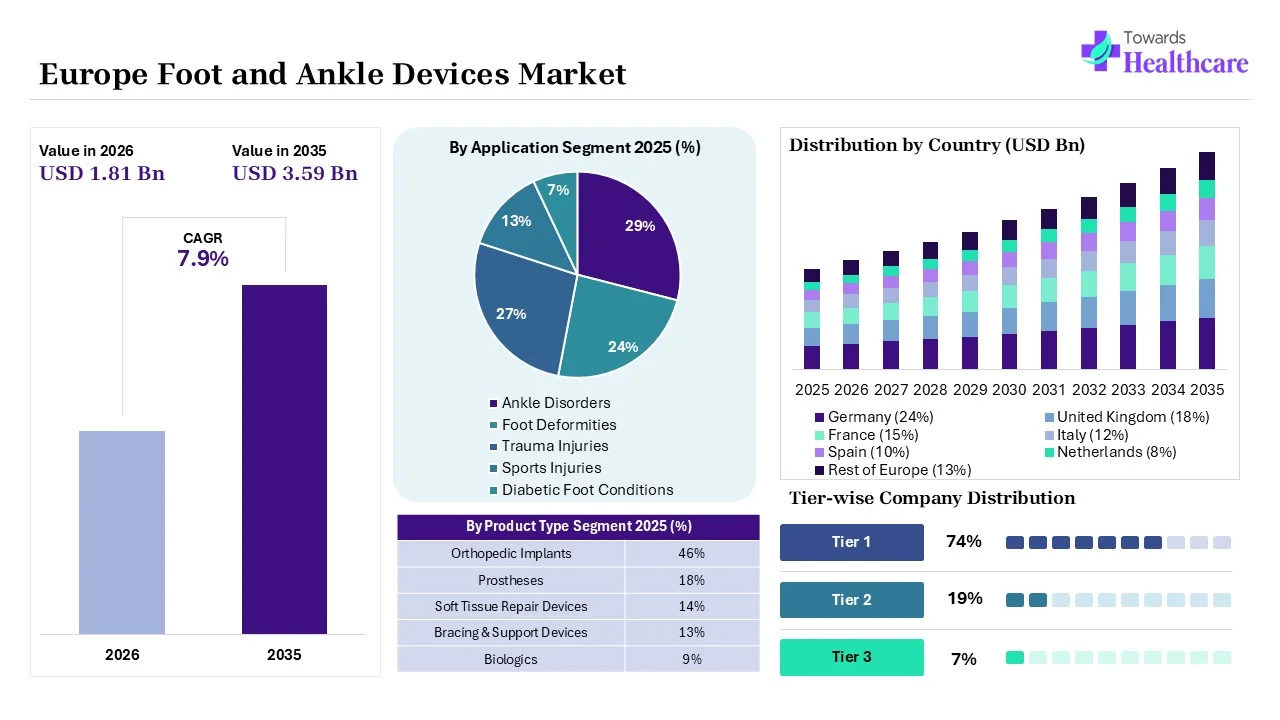
The Europe foot and ankle devices market size reached US$ 1.68 billion in 2025 and is anticipate to increase to US$ 1.81 billion in 2026. By 2035, the market is forecasted to achieve a value of around US$ 3.59 billion, growing at a CAGR of 7.9%. The growing incidence of orthopaedic disorders, increasing cases of arthritis, deformities, and deteriorating bone conditions are leading causes of higher volumes of patients, which drive the growth of the market.
Foot and ankle devices are developed to prevent patients with sensory perception loss from sustaining a fall. These tools are believed to work by lowering the likelihood of a fall by enhancing the balance and gait of the consumers. Foot and ankle professionals recommend orthotics for various foot and ankle conditions such as bunions, corns and calluses, high arch feet, flat feet, foot tendonitis, forefoot pain, hammertoes, Morton’s neuroma, and plantar fasciitis. Orthotics are specially made tools that providers intend to cushion and support feet. Functional orthotics are made of a semi-rigid material such as graphite, carbon fiber, or plastic. They support reducing pain and discomfort by controlling the way the foot moves. This device supports aligning and supporting feet and ankles. They also help prevent and treat foot deformities and other situations involving the feet.
In January 2025, Northlane Capital Partners announced that it had invested in United States Drug Testing Laboratories Inc., a forensic toxicology laboratory testing for alcohol and substance use. NCP capitalised alongside USDTL’s management team and its founders, Veronica and Doug Lewis.
Microprocessor feet are a kind of hydraulic ankle or foot that uses different sensors to continuously monitor the consumer's movement and manage both the angle and stiffness of the hydraulic ankle in real-time. This system provides progressive ankle movement and foot control on rough terrain, inclines, and stairs, which results in reduced socket pressures, lowers the challenges of stumbling, and enhances prosthetic movement. A microprocessor foot has processor chips and sensors that identify how the foot is and what the terrain is like, and make automatic changes. This enhances overall mobility and releases stress and strain when walking. Microchip feet are battery-driven and need charging at night.
By product type, the orthopedic implants segment contributed the largest Europe foot and ankle devices market share of 46% in 2025, as orthopedic implants restore function and mobility to patients with musculoskeletal conditions, enabling them to perform daily activities with lower pain and enhanced independence. Orthopedic instruments are intended to drive precise surgical techniques, confirming accurate placement of implants and ideal arrangement of bones.
By procedure, the trauma & fracture repair segment contributed the largest market share of 38%, as trauma and musculoskeletal care, orthopaedic inserts play a significant role in restoring stability, alignment, and functional help in a broad range of injuries. These services are significant to fracture management and structural rebuilding, allowing controlled fixation while accommodating the biomechanical demands of various bones and joints.
By application, the ankle disorders segment held a significant share of 29 % in the Europe foot and ankle devices market because the human ankle is highly susceptible to severe trauma, sports injuries, and degenerative conditions like osteoarthritis. Furthermore, a surging aging population, rising diabetes-related foot complications, and continuous innovations in advanced, minimally invasive surgical implants drive massive global demand for specialized treatments.
By end user, the hospitals segment contributed the largest market share of 52%, as in-hospital foot and ankle tools lower post-operative pain, have negligible scarring, reduce infection rates, and result in a much faster return to weight-bearing. These tools work by redistributing pressure in patients' feet, lowering stress on difficult areas, and removing pain right at the source.
By material, the titanium alloys segment contributed the largest Europe foot and ankle devices market share of 48%, as compared with other materials. Titanium provides a balanced mixture of safety, strength, and performance. Unlike stainless steel, it is lighter and further resistant to corrosion. Compared to various alloys, it offers better compatibility with bone. Titanium performs well under these situations, supporting the maintenance of implant function for longer.
Leading organizations in the Europe Foot and Ankle Devices Market are DePuy Synthes, Stryker Corporation, Zimmer Biomet, and Smith & Nephew. Meanwhile, DePuy Synthes is a company that helps in lower extremity anatomic plating and joint reconstruction technology in Europe. Stryker Corporation offers advanced joint technology, such as the Infinity total ankle system. Zimmer Biomet significant supplier of orthopaedic devices and an exclusive distributor of foot and ankle orthopaedic solutions. Smith & Nephew offers an inclusive suite of foot and ankle surgical services and extensive European processes.
By Product Type
By Procedures
By Application
By End User
By Material
By Region


