


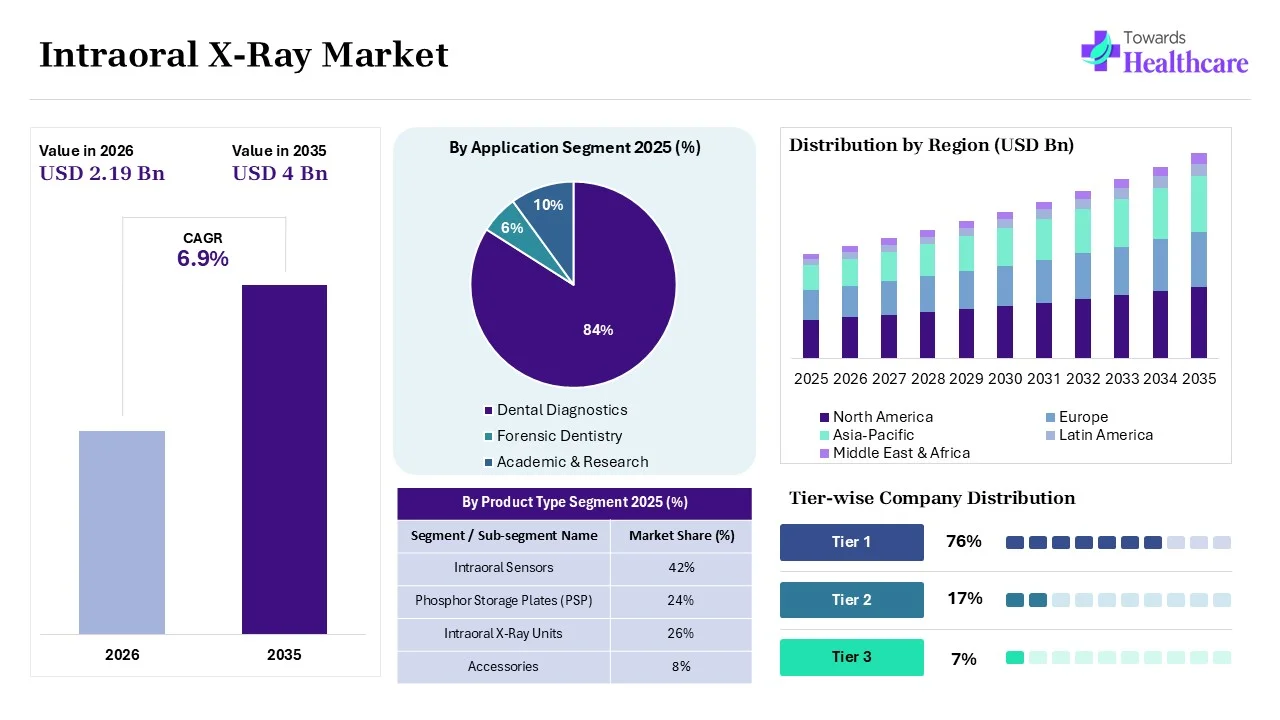
The intraoral X-ray market size accounted for USD 2.05 billion in 2025 and is predicted to increase from USD 2.19 billion in 2026 to approximately USD 6.9 billion by 2035, expanding at a CAGR of 6.9% from 2026 to 2035. Increasing dental disorders, growing preference for digital imaging systems, technological advancements, and rising demand for accurate and early dental diagnostics worldwide are driving the growth of the market.
An intraoral X-ray is a dental imaging technique where a small sensor or film is placed inside the mouth to capture detailed images of teeth and surrounding bone structures. The intraoral X-ray market is growing due to the increasing prevalence of dental caries and gum diseases worldwide. Growing awareness about preventive dental care and early diagnosis is driving demand for accurate imaging solutions. Rapid adoption of digital radiography systems, lower radiation exposure technologies, and expanding dental clinic networks are further supporting market expansion across developed and emerging regions.
Recent advancements in digital sensors eliminate the chemical waste related to traditional X-ray advancements, lowering the ecological footprint of dental services. A dental sensor is a digital imaging tool applied to take X-rays of a patient’s mouth, providing an alternative to outdated film. This sophisticated piece of hardware captures images of a patient’s teeth, gums, and other oral structures. Unlike traditional X-ray film, sensors create digital images instantly, enabling rapid diagnoses and advanced storage abilities. These sensors are linked to computers, allowing high-quality digital imaging of X-rays. Traditional film has been a keystone of dental diagnostics for many decades. They include exposing a piece of photographic film to X-ray radiation, which then requires it to be developed using chemical technologies. They are intended with rounded corners, thinner profiles, and supple materials to reduce patient gag reflexes and uneasiness during placement.
By product, the intraoral sensors segment contributed the largest intraoral X-ray market share of 42% in 2025, as intraoral sensors improve diagnostic accuracy, enhance patient care, and increase practice efficiency. It enables efficient and inclusive scanning, contributing to the development of digital dentistry and improving healthcare workflows.
By technology, the digital intraoral x-ray segment contributed the largest market share of 88% in 2025, as digital X-rays and intraoral cameras enable the early identification of general dental challenges, like cavities, misalignment, and gum disease. Digital X-rays lower radiation exposure by 70% to 90% as compared to traditional X-rays.
By application, the dental diagnostics segment held a major share of 84% in the intraoral X-ray market in 2025. Digital x-ray diagnostics not only enhanced image quality but also potentially lowered patient radiation exposure, improved diagnostic effectiveness, and streamlined dental practice workflows. Increased resolution means advanced diagnostic precision.
By end user, the dental clinics segment contributed the largest market share of 68%, as these clinics offer regular check-ups and cleanings that support preventing oral health challenges such as cavities, gum disease, and bad breath. Dental clinics are operated with qualified and experienced dentists, hygienists, and specialists who offer expert care and advice. These are equipped with advanced technology, like digital X-rays, 3D imaging, and laser treatments, which improve diagnostic precision and treatment results.
By distribution channel, the direct sales segment contributed the largest intraoral X-ray market share of 56%, as direct selling enables salespeople to shape personal collaboration with consumers and generate repeat business, while outdated retail tends to be more impersonal. Direct selling often includes a network of self-governing sales representatives.
By region, the North America segment contributed the largest market share of 37%, as evolving technologies, education, and supremacy were strategically integrated to enhance oral health in North America. Major hospital services are equipped with advanced technologies like cone-beam computed tomography (CBCT) scanners and intraoral cameras, enabling comprehensive care.
Leading companies in the intraoral X-ray market include Dentsply Sirona, DEXIS, Planmeca Oy, and Carestream Dental. Meanwhile, Dentsply Sirona provides an extremely comprehensive, premium suite of digital imaging software and hardware. DEXIS offers advanced intraoral sensors, X-ray generators, and AI-based image improvement software, streamlining the diagnostic workflow. Planmeca Oy, an innovator in dental radiography, this Finnish producer known for tools emphasizing excellent image quality, and Carestream Dental provides a wide range of digital radiography services that accommodate both high-end practices and budget-sensitive hospitals.
By Product Type
By Technology
By Application
By End User
By Distribution Channel
By Region


