


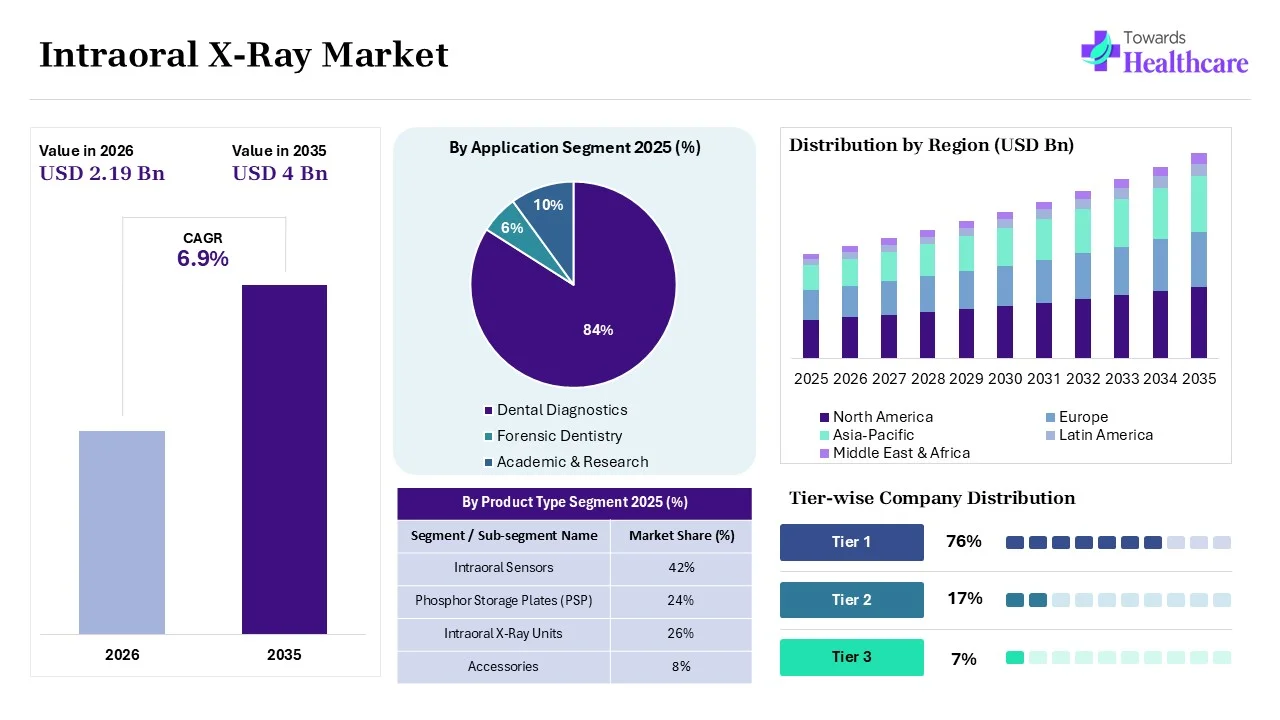
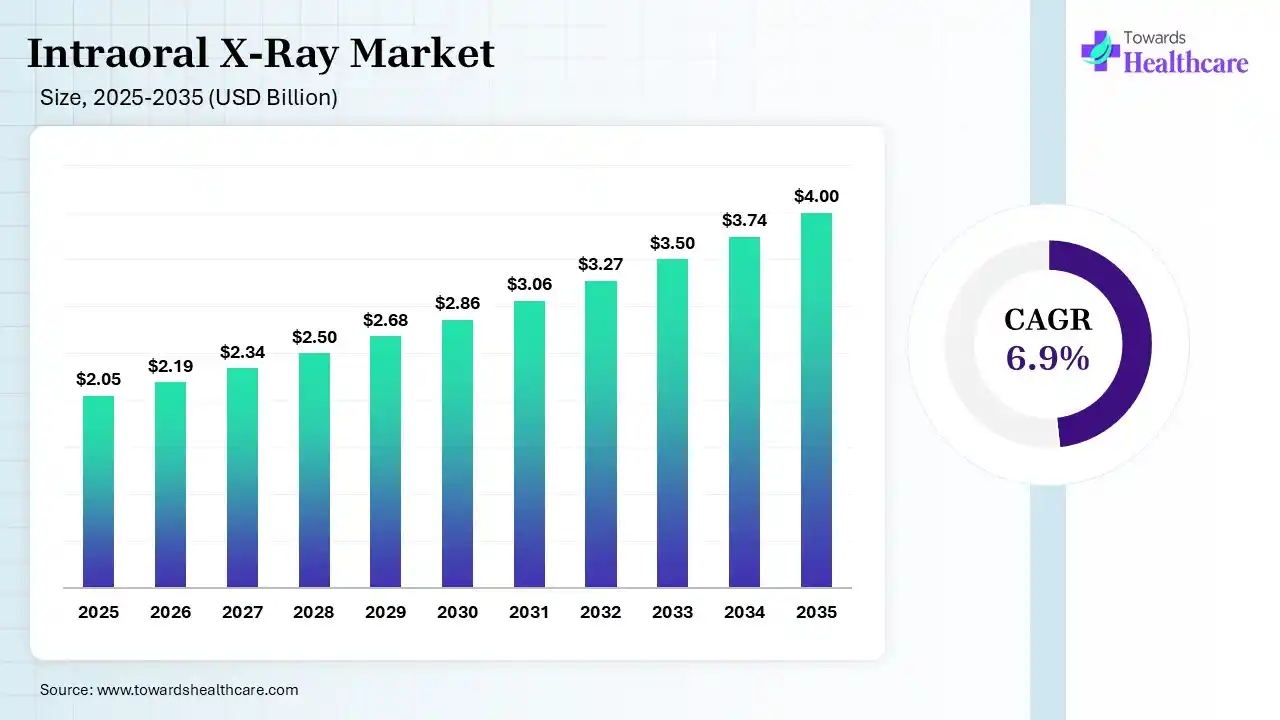
The intraoral x-ray market size is calculated at USD 2.05 billion in 2025 and is expected to reach USD 4 billion by 2035, expanding at a CAGR of 6.9% from 2026 to 2035 as these intraoral x-ray services improve image clarity, contrast, and diagnostic accuracy while enabling seamless integration with clinical management systems. The market is growing in 2026 because, as dental practices increasingly adopt digital workflows, the demand for efficient imaging software that enhances productivity. It is expected to expand through 2035 due to the expansion of private dental chains and increasing focus on comprehensive oral care services, further driving the market growth. North America accounted for 37% of the market in 2025 due to the rising prevalence of dental disorders, widespread insurance coverage, and increased spending on oral healthcare.
Intraoral X-rays are crucial for diagnosing root canals, detecting infections, and guiding precise endodontic treatments. As demand for complex dental procedures rises, more practitioners rely on high-quality imaging to improve treatment outcomes. Increasing patient focus on preserving natural teeth and the adoption of advanced oral care services. Their ease of use, compatibility with existing workflows, and suitability for busy dental practices make them appealing. Expansion in mid-sized clinics and demand for efficient, cost-effective imaging solutions are driving their rapid adoption.
Intraoral X-rays are highly effective for detecting early interproximal caries and monitoring bone levels between teeth. Their frequent use in regular check-ups and strong diagnostic value make this modality increasingly preferred in dentistry during the forecast period. As practices seek efficiency and better patient outcomes, demand for AI-enabled diagnostic software in intraoral imaging is accelerating.
The intraoral x-ray market shifts toward digital radiography, wireless sensors, and AI-driven imaging systems for advanced diagnostic precision. A primary growth factor is the rising global prevalence of dental disorders, alongside expanding geriatric demographics needing complex treatments. Future opportunities exist in integrating cloud-based software, expanding into emerging medical sectors, and standardizing software ecosystems. These portable, lower-radiation devices streamline clinical workflows, helping dentists improve diagnostic speed and enhance patient care.
Artificial intelligence can significantly transform the market by enhancing image accuracy, automating disease detection, and reducing diagnostic time. This technology has the strength to significantly lower radiation doses to patients by automating and streamlining information collection processes. AI-powered software helps dentists identify cavities, bone loss, and infections more precisely, improving treatment planning. It also supports workflow efficiency and minimizes human error. AI-based algorithms analyse thousands of panoramic X-rays, CBCT and intraoral scans, learning to recognise lesions and abnormalities with precision comparable to that of an experienced practitioner. As clinics increasingly adopt smart imaging systems, AI integration is expected to accelerate innovation and drive market growth.
Shift Toward Digital Radiography:
Dental clinics are rapidly replacing conventional film-based systems with digital intraoral X-ray devices. Digital systems offer faster image processing, lower radiation exposure, and improved image clarity, making them a preferred choice in modern dental practices worldwide.
Increasing Demand for Preventive Dentistry:
Increasing awareness about oral health and early diagnosis is boosting the use of intraoral imaging. Routine dental check-ups and preventive treatments are becoming more common, driving consistent demand for reliable and accurate imaging solutions.
Growth in Emerging Economies:
Expanding dental infrastructure, rising disposable income, and improved access to healthcare services in developing countries are creating strong growth opportunities. Government initiatives supporting oral healthcare are further contributing to long-term market expansion.
| Table | Scope |
| Market Size in 2026 | USD 2.19 Billion |
| Projected Market Size in 2035 | USD 4 Billion |
| CAGR (2026 - 2035) | 6.9% |
| Historical Data | 2020 - 2023 |
| Base Year | 2025 |
| Forecast Period | 2026 - 2035 |
| Measurable Values | USD Millions/Units/Volume |
| Market Segmentation | By Product Type, By Technology, By Application, By End User, By Distribution Channel, By Region |
| Top Key Players | Planmeca Oy, Carestream Dental LLC, DÜRR DENTAL India Private Limited, Ritter Concept, Dental Imaging Technologies Corporation, Unicorn Denmart Ltd, REMEDI Inc., Owandy Radiology |
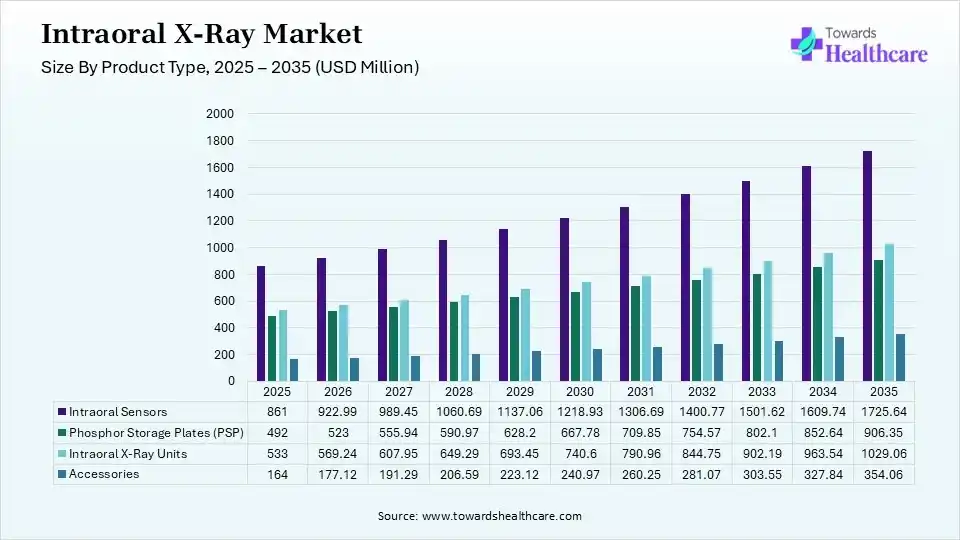
| Segment | Share 2025 (%) |
| Intraoral Sensors | 42% |
| Phosphor Storage Plates (PSP) | 24% |
| Intraoral X-Ray Units | 26% |
| Accessories | 8% |
The Intraoral Sensors Segment Led the Intraoral X-Ray Market in 2025
The intraoral sensors segment contributed the largest market share of 42% in 2025, as intraoral sensors are advanced tools used in dentistry to capture accurate 3D images of the oral cavity, involving the teeth and associated tissues. It revolutionized the way we diagnose and manage oral health challenges, creating a more effective, accurate, and pleasant dental experience.
The intraoral x-ray units segment held a significant share of 26% in 2025, as intraoral cameras enable the early identification of common dental challenges, like cavities, misalignment, and gum disease. Intraoral sensors have transformed dental diagnostics, providing superior imaging quality, rapid results, and improved patient care. They offer a detailed view of the teeth, helping to find cavities, monitor teeth development, and check the health of the bone around the teeth.
The phosphor storage plates (PSP) segment held a significant share of the intraoral X-ray market of 24% in 2025, as this technology uses intraoral plates coated with a crystalline emulsion to make X-rays. Storage phosphor technology is greater than traditional X-rays in different ways, like less radiation, electronic records, fast results, and improved diagnostics.
The accessories segment held a significant share of 8% and is expected to grow at the fastest CAGR of 8% during the forecast period in the market, as intraoral x-ray accessories include sensor holders, positioning arms, alignment rings, and collimators, ensuring appropriate beam alignment, defend sensors, and improve patient comfort. This accessory improves image quality and time management and lowers radiation exposure. Intraoral sensors transformed the dynamics of dentistry.
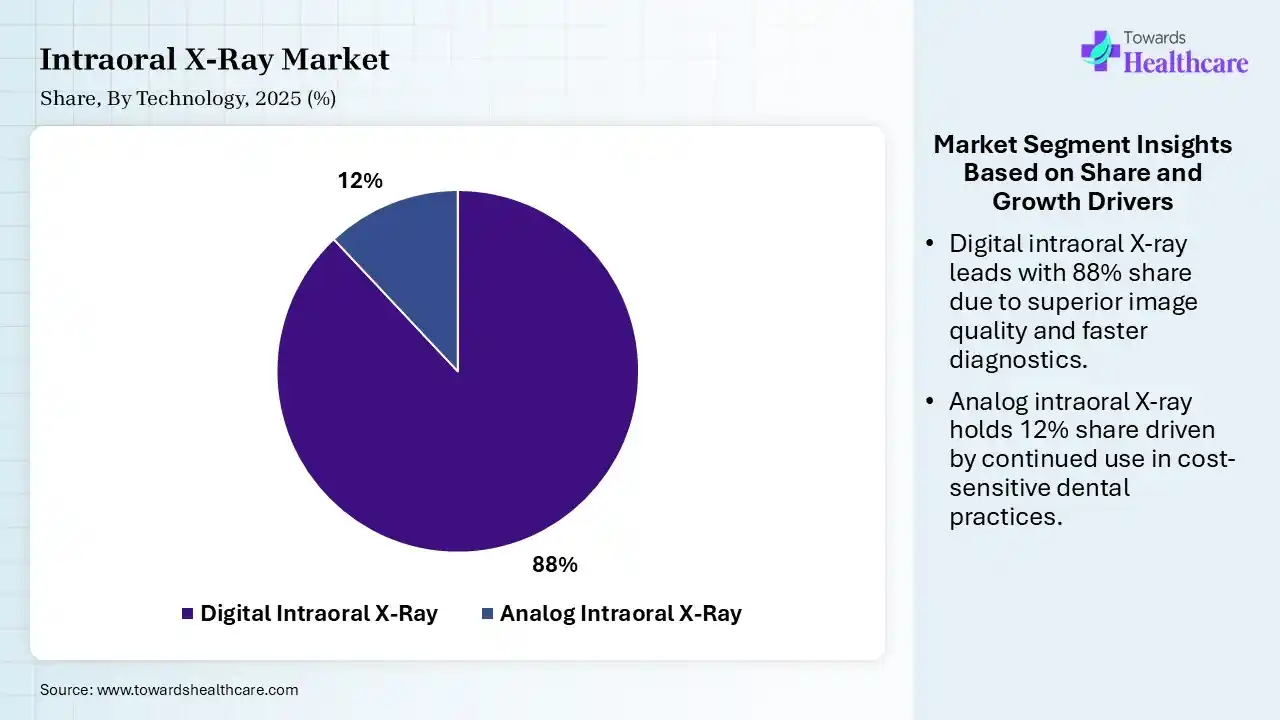
| Segment | Share 2025 (%) |
| Digital Intraoral X-Ray | 88% |
| Analog Intraoral X-Ray | 12% |
The Digital Intraoral X-Ray segment led the Intraoral X-Ray Market in 2025
The digital intraoral x-ray segment contributed the largest market share of 88% in 2025, and is expected to grow at the fastest CAGR of 7.3% during the forecast period in the market, as digital x-rays and intraoral cameras enable the early identification of common dental challenges, such as cavities, misalignment, and gum disease. It necessitates up to 90% less radiation exposure, confirming safety without compromising precision. It lowers patient radiation exposure and removes chemical processing.
The analog intraoral X-ray segment held a significant share of 12% of the market in 2025, as analog X-ray, simply called film X-ray, has been a classic procedure used in radiography. In this technology, X-ray beams pass through the body and imprint an image onto a photographic film. Analog X-ray is a long-established imaging method. It includes passing a controlled amount of X-ray radiation through the body to expose a film, making an image that can be developed and analysed.
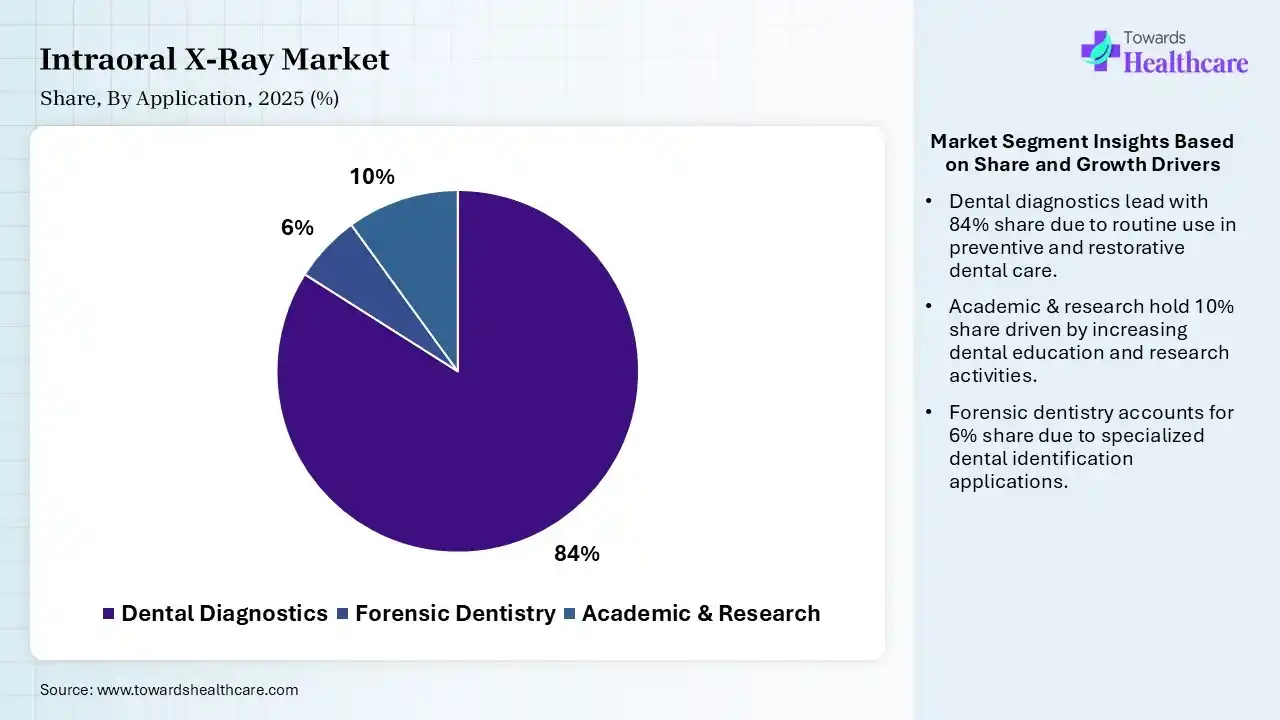
| Segment | Share 2025 (%) |
| Dental Diagnostics | 84% |
| Forensic Dentistry | 6% |
| Academic & Research | 10% |
The Dental Diagnostics Segment led the Intraoral X-Ray Market in 2025
The dental diagnostics segment held a significant share of 84% in the market in 2025. Diagnostic dentistry goal to determine oral health challenges in a patient. A dental diagnosis makes it simple to make an efficient treatment plan. Diagnostics offers objective, reproducible information that assesses functional structural behavior rather than inorganic density alone, enhancing diagnostic confidence in equivocal healthcare scenarios.
The academic & research segment held a significant 10% share of the market, and is expected to grow at the fastest CAGR of 7.5% during the forecast period, as intraoral x-ray technology offers significant diagnostic data related to the teeth, alveolar bone, and periapical. Radiographs help the physicians to evaluate and definitively diagnose major oral diseases and conditions. Intraoral radiography is helpful for the evaluation of dentoalveolar trauma in the academic and research center.
The forensic dentistry segment contributed a market share of 6% in 2025, as forensic dentists supports to detects bite mark injuries, cases of abuse, and the age of both victims and perpetrators. Forensic dentistry is the study of teeth and the mouth as it use to civil and criminal law. Forensic dentist’s assistance investigative agencies by detecting victims and perpetrators of crimes, also victims of disasters. Forensic dentistry plays a significant role in identifying deceased patients when visual or other means of identification are impossible.

| Segment | Share 2025 (%) |
| Dental Clinics | 68% |
| Hospitals | 16% |
| Academic & Research Institutes | 8% |
| Dental Imaging Centers | 8% |
The Dental Clinics Segment led the Intraoral X-Ray Market in 2025
The dental clinics segment contributed the largest market share of 68% in 2025, as these clinics offer routine check-ups and cleanings, which help to avoid oral health challenges like cavities, gum disease, and bad breath. Dental clinics that embrace technology demonstrate expertise and commitment to quality. It offers advanced training, advanced technology, and specific expertise.
The hospitals segment held a significant share of 16% in the market in 2025 as hospitals significantly focus on minimally invasive technologies, sedation options, and rapid healing. The experience is smooth, with negligible discomfort. Hospital dentistry serves as a significant component of the medical care system, offering comprehensive dental care to patients with multifaceted healthcare conditions.
The academic & research institutes segment held a significant share of 8% in the intraoral X-ray market, and is expected to grow at the fastest CAGR of 7.8% during the forecast period, as major dental institutes conduct research to advance dental expertise, develop novel dental technologies, and enhance dental care. Research at the academic centre contributes to the overall development of dental science and oral medical care. Dental science offers students hands-on clinical training to develop practical skills in managing patients in these institutions.
The dental imaging centers segment held a significant share of 8% in the market in 2025, due to the application of advanced tools in dental imaging. It enables manipulation of the image produced, like contrast, density, sharpness, and image orientation, without additional radiation exposure to the patient and the operator.
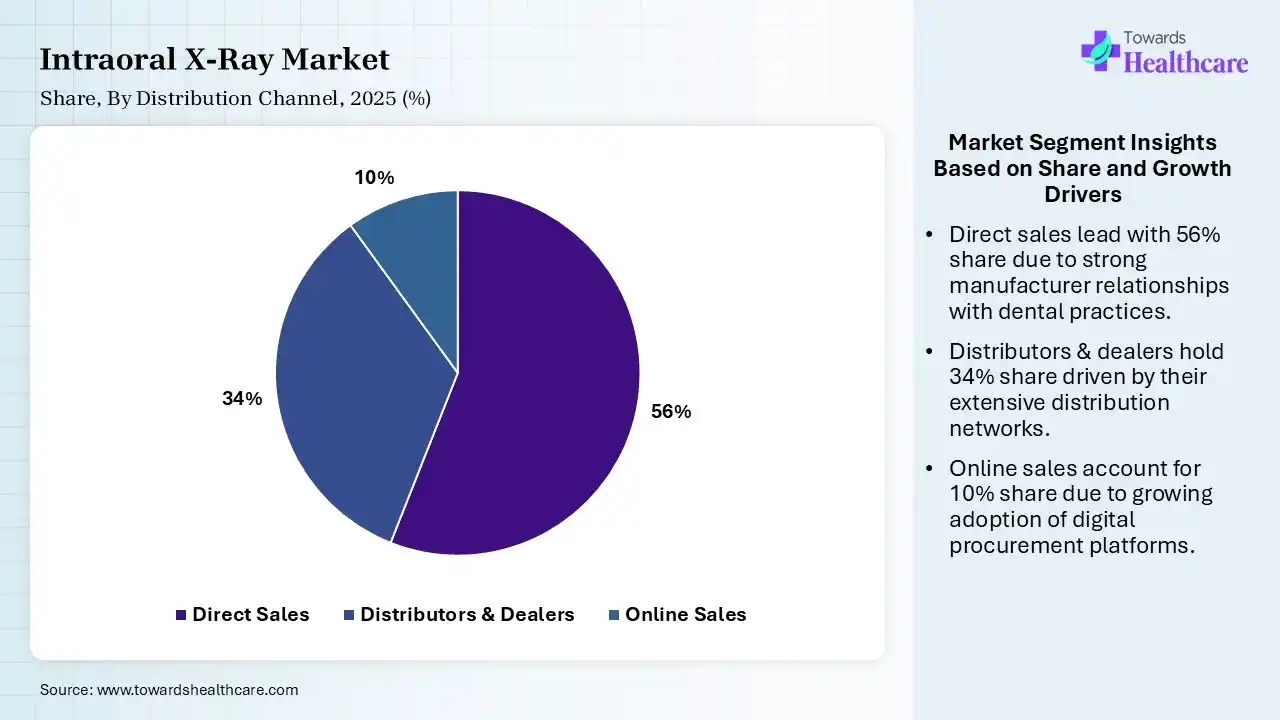
| Segment | Share 2025 (%) |
| Direct Sales | 56% |
| Distributors & Dealers | 34% |
| Online Sales | 10% |
The Direct Sales Segment led the Intraoral X-Ray Market in 2025
The direct sales segment contributed the largest market share of 56% in 2025, as direct sales help streamline supply chains and packaging, lowering waste and environmental impact as compared to outdated distribution models. By selling healthcare services directly, organizations capture advanced margins and reinvest in consumer acquisition strategies and product advancement.
The distributors & dealers segment held a significant share of 34% in the market, as distributors and dealers' expertise supports streamlining the supply chain and confirms medicines reach patients. Working with a healthcare distributor can often be an effective way of saving expenses, as it provides several benefits over working with many vendors.
The online sales segment held a significant share of 10% in the intraoral X-ray market and is expected to grow at the fastest CAGR of 8.4% during the forecast period, as online sales provide competitive pricing because of their reduced overhead expenses. It provides many other advantages, such as discounts, subscription plans, and bulk purchase choices. Rising convenience, enabling patients to get their medications rapidly, saving time and money by lowering the medication price.

North America dominated the intraoral X-ray market share of 37% in 2025 due to its advanced dental infrastructure, high adoption of digital imaging technologies, and strong presence of leading market players. Rising prevalence of dental disorders, widespread insurance coverage, and increased spending on oral healthcare further supported market growth. Continuous technological advancements and early adoption of innovative imaging systems reinforced the region’s leading position.
US Intraoral X-Ray Market Growth
U.S. dominated the North America market in 2025. The U.S. has a well-established dental care infrastructure, high patient awareness, and strong adoption of digital imaging systems. A large number of private dental clinics, favorable reimbursement policies, and continuous investment in advanced diagnostic technologies further supported growth. Additionally, the presence of major industry players and ongoing product innovation reinforced the country’s leading market position.
Mexico Intraoral X-Ray Market Growth
The intraoral X-ray market is expected to grow at the fastest rate in Mexico during the forecast period. In Mexico, digital radiography combines the power of computer technology with electronic sensors and small bursts of radioactivity. Intraoral X-ray systems sensor is placed in the mouth and projects to a computer screen. Mexico’s NOHRS was exclusive in explicitly prioritizing environmental sustainability in its research schema.
The Asia Pacific held a significant share of 24% in the market, and is expected to grow at the fastest CAGR of 8.3% during the forecast period. Due to improving healthcare infrastructure, rising disposable incomes, and increasing awareness of oral health. Expanding dental clinic networks and growing adoption of digital imaging technologies are accelerating market demand. Many countries are implementing seamless integration of equipment with clinical management & 3D treatment planning software.
China Intraoral X-Ray Market Growth
In China, digital dental imaging technology is progressively increasing, supported by AI-driven algorithms, which not only enhance diagnostic precision but also modernize treatment processes, planning, and patient communication. With well-developed diagnostic and analytical functions, dentists gain devices that allow them to work rapidly, more efficiently, and with more clinical confidence.
India Intraoral X-Ray Market Growth
In India increasing awareness of oral health, a large patient population, and the rapid expansion of private dental clinics. Along with this awareness, Indian clinics are moving towards digital solutions and portable devices. Additionally, government initiatives to strengthen healthcare access and increase investment in modern dental technologies are accelerating market growth.
R&D
Clinical Trials
Patient Support and Services
| Companies | Headquarters | Offerings |
| Planmeca Oy | Helsinki, Finland | Develops digital intraoral X-ray units, high-resolution sensors, and integrated imaging software solutions designed for advanced dental diagnostics. |
| Carestream Dental LLC | Georgia, USA | Provides digital intraoral imaging systems, RVG sensors, and cloud-based imaging platforms that support efficient dental workflows |
| DÜRR DENTAL India Private Limited | Gurugram, India | Supplies intraoral X-ray systems, imaging plates, and digital radiography technologies focused on precision and safety. |
| Ritter Concept | Biberach, Germany | Manufactures intraoral X-ray generators and dental operatory equipment integrated with modern imaging solutions. |
| Dental Imaging Technologies Corporation | United States | Offers intraoral imaging devices and digital diagnostic technologies under the Envista portfolio. |
| Unicorn Denmart Ltd | New Delhi, India | Distributes and supports intraoral X-ray systems and digital imaging products across the Indian dental market. |
| REMEDI Inc. | United States | Focuses on compact, handheld intraoral X-ray devices designed for mobility and reduced radiation exposure. |
| Owandy Radiology | Croissy-Beaubourg, France | Produces intraoral sensors, X-ray units, panoramic systems, and dedicated dental imaging software. |
In March 2026, “The CS 1300 reflects our commitment to providing technology that fits naturally into the way dental teams work every day,” Stephane Varlet, director, global business line management, Carestream Dental, said. “By delivering clear, detailed images and seamless integration, we’re helping practices communicate more effectively with patients while maintaining an efficient, connected workflow."
By Product Type
By Technology
By Application
By End User
By Distribution Channel
By Region











Principal Consultant
Shivani Zoting is a dedicated research analyst specializing in the healthcare industry. With a strong academic foundation, a B.Sc. in Biotechnology and an MBA in Pharmabiotechnology, she brings a unique blend of scientific understanding and strategy.
Learn more about Shivani Zoting
Reviewed By
Aditi Shivarkar is a seasoned professional with over 14 years of experience in healthcare market research. As a content reviewer, Aditi ensures the quality and accuracy of all market insights and data presented by the research team.
Learn more about Aditi Shivarkar









