


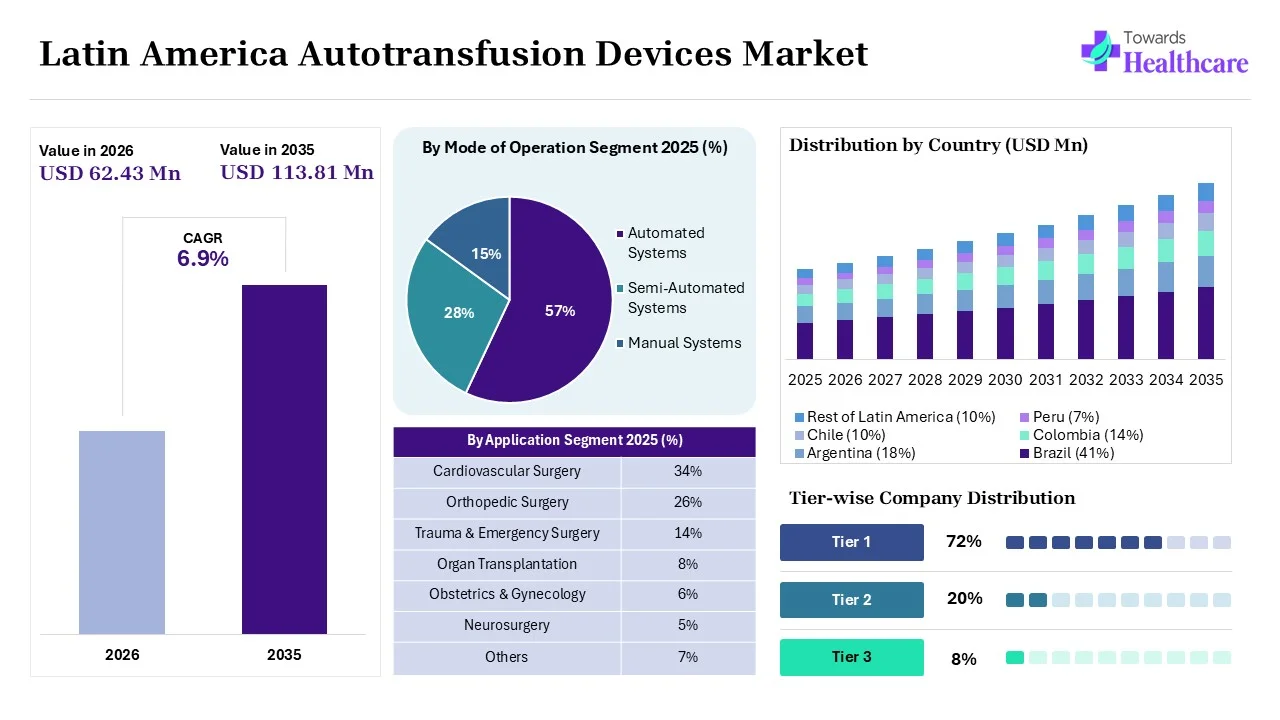
The Latin America autotransfusion devices market size was estimated at USD 58.4 million in 2025 and is predicted to increase from USD 62.43 million in 2026 to approximately USD 113.81 million by 2035, expanding at a CAGR of 6.9% from 2026 to 2035. The market is experiencing steady growth, driven by increasing cardiovascular, orthopedic, trauma, and transplant surgeries, along with rising adoption of patient blood management practices. Growing healthcare investment, expanding hospital infrastructure, and greater awareness of blood conservation strategies are further supporting demand for autotransfusion technologies across the region.
Autotransfusion devices are medical systems that collect, process, and reinfuse a patient’s own blood lost during or after surgery, reducing the ned for donor blood transfusion and associated risks. The Latin America autotransfusion devices market is growing due to the rising number of cardiovascular, orthopedic, trauma, and transplant surgeries that require effective blood management. Increasing awareness of patient blood conservation, concerns over donor blood availability, and efforts to reduce transfusion-related complications are driving adoption. Additionally, improving healthcare infrastructure, expanding access to advanced surgical technologies, and growing investments in specialized care facilities are supporting market expansion.
The Latin America autotransfusion device sector is expected to benefit from the growing adoption of automated blood recovery technologies, increasing surgical volumes, and a stronger focus on patient blood management. Healthcare providers are investing in modern surgical equipment that improves efficiency, reduces dependence on donor blood, and enhances patient safety. Continued improvements in healthcare infrastructure and access to specialized surgical care are expected to support long-term growth.
| Indicator | Data |
| Total blood units collected across Latin America & the Caribbean | 9.21 million units |
| Voluntary blood donation rate | 56.8% of total donations |
| Increase in regional blood collection | 15.5% growth |
| Blood units processed into components | 90% of collected units |
| Brazil performs organ transplants | 31,000 procedures |
| Brazil's first-half organ & tissue transplants | 14,900 procedures |
| Inter-state organ transplants in Brazil | 1,372 procedures |
| Heart Transplants in Brazil | 427 procedures |
The table highlights key healthcare and surgical indicators that influence the adoption of autotransfusion devices across Latin America. High blood collection volumes, increasing transplant procedures, and strong transfusion safety practices demonstrate the growing need for effective blood management solutions. The rising number of complex surgeries, particularly in Brazil, supports the demand for technologies that help address blood concerns, reduce reliance on donor transfusions, and improve surgical outcomes.
The autotransfusion systems segment held a dominant share of 62% in 2025 due to its critical role in collecting, processing, and reinfusing a patient’s own blood during procedures. These systems are widely used in cardiovascular, orthopedic, trauma, and transplant surgeries where significant blood loss is common. Their ability to reduce dependence on donor blood, improve patient safety, and support efficient blood conservation practices has driven strong adoption across hospitals and surgical centers in Latin America.
The cardiovascular surgery segment led the Latin America autotransfusion devices market with a share of 34% in 2025 due to the high risk of blood loss associated with complex cardiac procedures such as bypass surgeries, valve replacements, and aortic repairs. Autotransfusion devices are widely used to collect and reinfuse a patient’s own blood, helping reduce reliance on donor transfusions. The growing prevalence of cardiovascular diseases, increasing surgical volumes, and greater focus on blood conservation contributed to the segment’s to the segment’s leading position.
The hospitals segment held a dominant share of 68% of the Latin America autotransfusion devices market in 2025 due to the large number of complex surgical procedures performed in these settings, including cardiovascular, orthopedic, trauma, and transplant surgeries. Hospitals have advanced operating rooms, skilled healthcare professionals, and access to sophisticated blood management technologies, making them the primary users of autotransfusion systems. Rising patient admissions, increasing surgical volumes, and ongoing investments in healthcare infrastructure further strengthened the segment’s leading position.
The centrifugation-based systems segment held a dominant share of 61% in 2025 due to its superior ability to separate, wash, and concentrate red blood cells for reinfusion. These systems deliver high-quality recovered blood and are widely preferred for cardiovascular, orthopedic, and trauma surgeries involving significant blood loss. Their proven clinical performance, efficiency in removing contaminants, and strong adoption in major hospitals and surgical centers contributed to their leading position across Latin America.
The automated systems segment dominated the Latin America autotransfusion devices market with a share of 57% in 2025 and is expected to grow at the fastest CAGR of 7.2% in the market during the forecast period due to its ability to streamline blood collection, processing, and reinfusion with minimal manual intervention. These systems improve accuracy, reduce the risk of human error, and enhance surgical workflow efficiency. Their widespread adoption in high-volume hospitals and complex surgical procedures, combined with increasing demand for advanced blood management technologies and improved patient safety, supported the segment’s leading position.
The Latin America autotransfusion devices market is advancing steadily due to the growing emphasis on reducing healthcare costs and improving surgical outcomes. Healthcare providers are increasingly adopting blood recovery technologies to enhance resource utilization and support complex procedures. Expansion of specialized surgical services, modernization of operating rooms, and stronger implementation of patient-centered care strategies are further encouraging the use of autotransfusion devices throughout the region.
Leading companies in the Latin America autotransfusion devices sector include Braile Biomédica, Lifemed, Baumer, Scitech Medical, and Labcor. These companies are supporting sector growth through continuous advancements in cardiovascular surgery technologies, perfusion systems, blood management solutions, and critical care equipment. Ongoing investments in product innovation, expansion of manufacturing capabilities, and the development of advanced surgical support technologies are further strengthening their presence across Latin America's healthcare landscape.
By Product Type
By Application
By End User
By Technology
By Mode of Operation
By Region


