


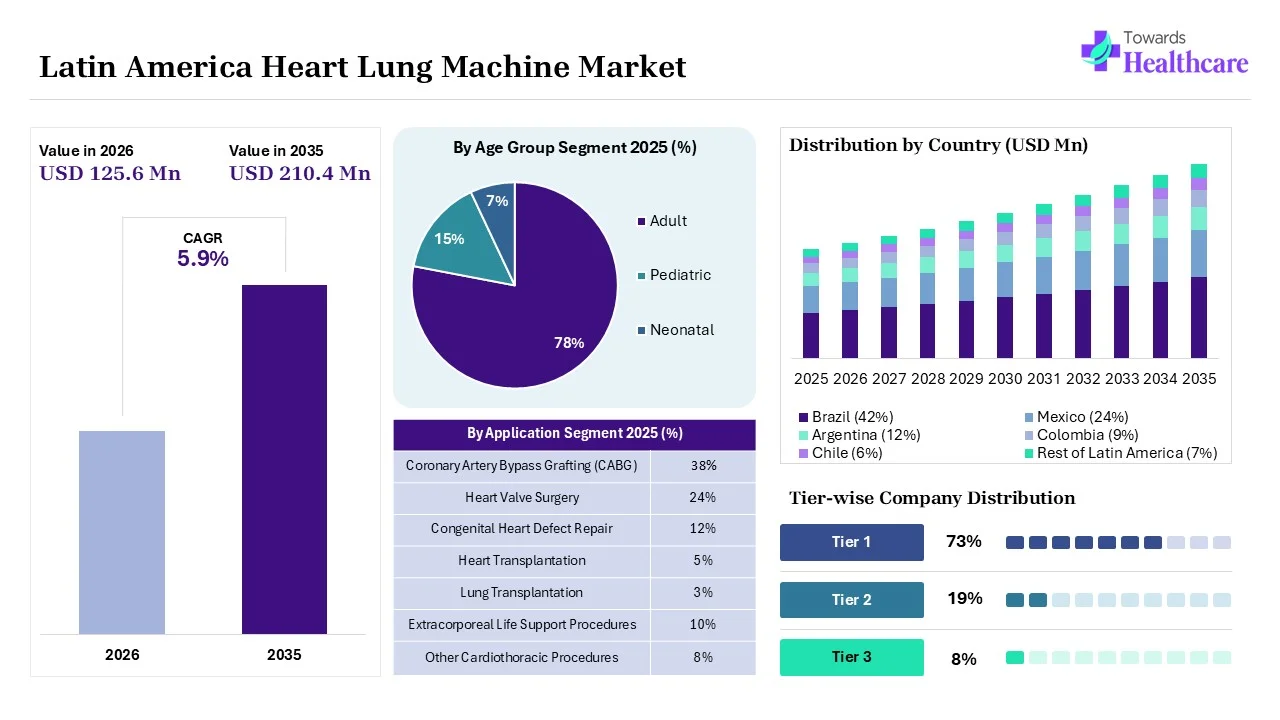
The Latin America heart lung machine market size was estimated at USD 118.6 million in 2025 and is predicted to increase from USD 125.6 billion in 2026 to approximately USD 210.4 million by 2035, expanding at a CAGR of 5.9% from 2026 to 2035. Growing cardiovascular diseases, a rising geriatric population, expanding cardiac centres, increasing healthcare investments, growing training programs, and expanding medical tourism are promoting the market growth.
The Latin America heart lung machine refers to the manufacturing, distribution, and use of medical devices in Latin America utilized in cardiac surgeries. These machines are responsible for temporarily performing the functions of the heart and lungs by circulating and oxygenating blood. These machines are used during open heart surgeries, heart valve repair, coronary artery bypass graft, heart and lung transplants, and congenital heart defect surgeries.
The graph represents a comparison between the current air quality index (AQI) in Santiago and São Paulo. It indicates that there will be a rise in AQI, which will increase the incidence of various cardiovascular diseases, driving the demand for a wide range of treatment devices. This, in turn, will increase the adoption of heart lung machines for the effective and safe treatment of cardiovascular diseases, which will ultimately promote the market growth.
By product type, the oxygenators segment accounted for the highest revenue share of 31% of the Latin America heart lung machine market in 2025, as it is a critical component in heart lung machines. Their enhanced biocompatibility and safety also increased their use. Their single-use and gas exchange efficiency also contributed to their continued use.
By application type, the coronary artery bypass grafting (CABG) segment held a major revenue share of 38% of the Latin America heart lung machine market in 2025, driven by growth in the coronary artery disease burden. The rise in the cases of hypertension and diabetes also increased their incidences, which increased the demand for heart lung machines. They were also used in severe and open-heart surgeries.
By age group type, the adult segment contributed the biggest revenue share of 78% of the Latin America heart lung machine market in 2025, as they contributed to the largest share of cardiovascular diseases. This has increased the volume of coronary artery bypass grafting, which has increased the demand for heart lung machines. A rise in open-heart surgeries also promoted their use.
By end user, the hospitals segment held the largest revenue share of 68% of the Latin America heart lung machine market in 2025, due to the high volume of cardiac surgeries. Advanced infrastructure and cardiac surgeons also attracted the patients. A rise in investments also increased the use of a wide range of heart lung machines.
By technology type, the conventional cardiopulmonary bypass systems segment led the Latin America heart lung machine market with a 49% share in 2025, due to their increased use in open-heart surgeries. Their enhanced safety and effectiveness also increased their use in various cardiac procedures. They were also preferred for coronary artery bypass grafting and other long surgical procedures.
The Latin America heart lung machine market held a notable share in 2025 and is expected to show significant growth during the predicted time, due to growing incidences of cardiovascular disease and high pollution rates. This is increasing the demand for heart-lung machines for open-heart and complex cardiothoracic procedures. Increasing government initiatives and new device developments are also enhancing the market growth.
Medtronic plc dominated the market with its Medtronic Performer CPB System, where Terumo Cardiovascular was its closest contender, which offered the Terumo Advanced Perfusion System. LivaNova plc also sustained its position by providing the LivaNova Essenz Perfusion System and Stockert S5/S3 system, where Getinge AB also contributed to the market growth with its Maquet Jostra HL 20 & Getinge HL 40.
By Product Type
By Application
By Age Group
By End User
By Technology
By Region


