


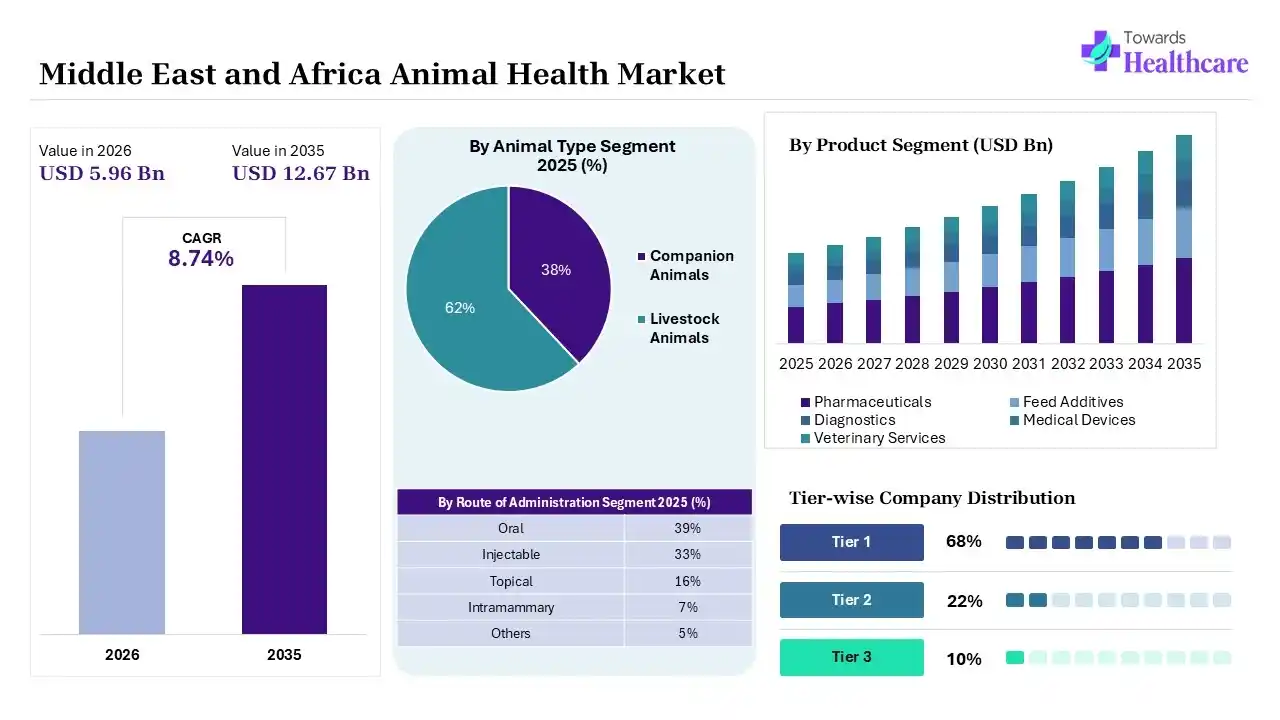
The Middle East and Africa animal health market size was USD 5.48 billion in 2025 and is predicted to increase from USD 5.96 billion in 2026 to approximately USD 12.67 billion by 2035, expanding at a CAGR of 8.74% from 2026 to 2035. Growing food security and livestock production initiatives, increasing pet ownership, growing zoonotic diseases, expanding vaccination companies, growing pet humanization trends, and expanding government support are promoting the market growth.
The Middle East and Africa animal health encompasses the development, manufacturing, and distribution of veterinary products for diagnosis, treatment, and prevention of animal diseases across the Middle East and Africa. They offer various veterinary treatment, diagnosis, and preventive care options, and their disease monitoring and control solutions also increase their use. They also help in enhancing livestock productivity, animal surveillance, disease surveillance, and food safety standards.
The graph represents a comparison between the pet insurance industry in the UAE for the years 2023 and 2030. It indicates that there will be an expansion in the pet insurance industry, which will attract pet owners to leverage various veterinary services. This, in turn, will increase the accessibility of various animal health solutions, which will ultimately promote market growth.
By product type, the pharmaceuticals segment accounted for the highest revenue share of 41% of the Middle East and Africa animal health market in 2025, due to growth in infectious and zoonotic diseases. Growth in the livestock population also increased the demand for pharmaceuticals. The rise in pet healthcare spending also increased their adoption rates.
By animal type, the livestock animals segment held a major revenue share of 62% of the Middle East and Africa animal health market in 2025, due to growth in the demand for dairy, poultry, and meat products. The presence of a large livestock population also increased the demand for animal health solutions. Expansion of the commercial farming practices also increased their use.
By indication type, the infectious diseases segment contributed the biggest revenue share of 29% of the Middle East and Africa animal health market in 2025 and is expected to expand rapidly with a CAGR of 9.42% during the forecast period, driven by growth in infectious and parasitic diseases. The shift towards preventive healthcare also increased the demand for various pharmaceutical products. Expansion of the livestock trades and awareness has also increased the demand for animal health products.
By distribution channel type, the veterinary hospitals & clinics segment held the largest revenue share of 42% of the Middle East and Africa animal health market in 2025, as they are considered the primary care centre. Their direct access to the veterinarian's guidance and emergency services also increased their use. Growth in government support also increased the adoption of advanced pharmaceuticals.
By end user, the veterinary hospitals segment led the Middle East and Africa animal health market with a 31% share in 2025, driven by a high volume of animal treatment visits. Growth in preventive healthcare has also increased its adoption rates. The rise in infectious diseases and veterinary healthcare infrastructure has also increased their adoption.
The Middle East and Africa animal health market held a significant share in 2025 and is expected to show considerable growth during the predicted time due to increasing pet ownership and veterinary healthcare. A growing focus on livestock development and enhancing food safety standards is also increasing their use. Growing animal diseases and tele-veterinary services are also enhancing the market growth.
Zoetis Inc. dominated the market with its CattleMaster Gold, Vanguard, and Synulox Apoquel, while Boehringer Ingelheim Animal Health was its closest competitor, which provided NexGard Spectra, Troccoxil, and Vaxxitek. MSD Animal Health also sustained its position by offering Bravonil, Bovilis, Bravecto, and Panacus, where Ceva Santé Animale also contributed to the market growth with its Cevac, Feliway, and Veramix
By Product Type
By Animal Type
By Indication
By Distribution Channel
By End User
By Route of Administration
By Region


