


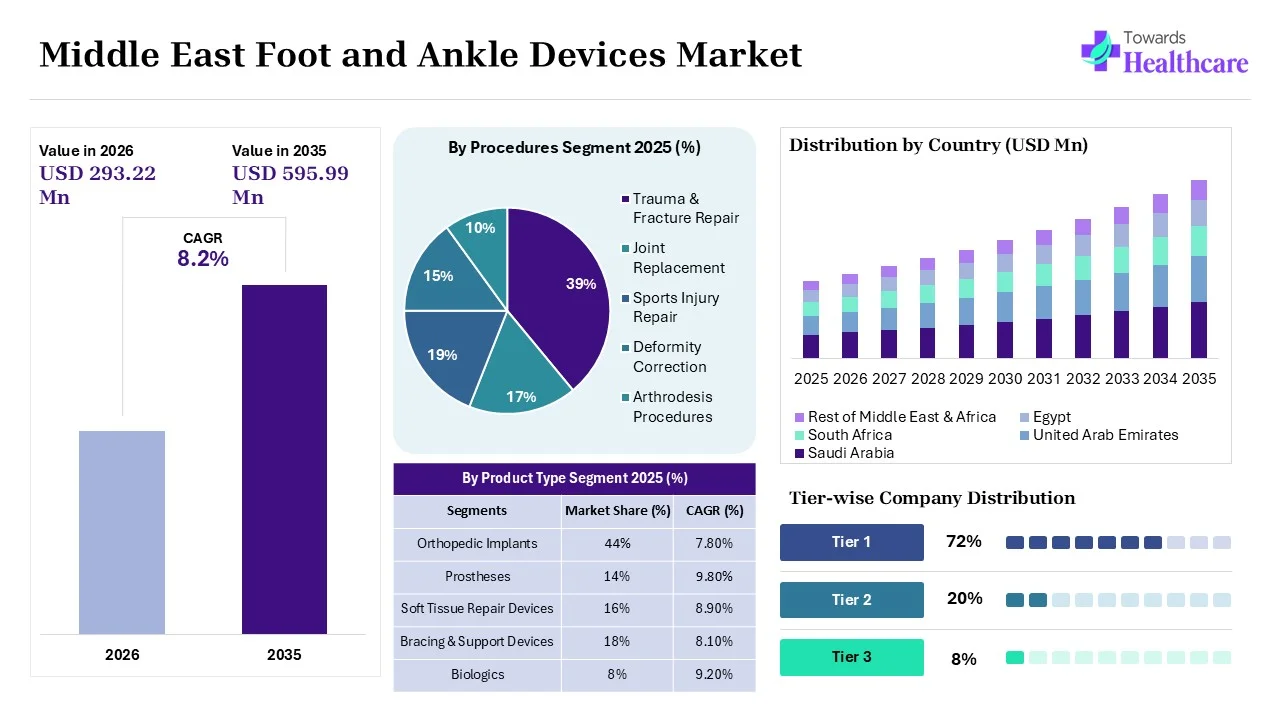
The Middle East foot and ankle devices market size accounted for USD 271 million in 2025 and is predicted to increase from USD 293.22 million in 2026 to approximately USD 595.99 million by 2035, expanding at a CAGR of 8.2% from 2026 to 2035. Increasing cases of degenerative bone conditions, deformities, and arthritis are causing to increasing patient volumes, thus growing demand for implants and reconstructive tools, which drives the growth of the market.
Foot and ankle devices are worn to relieve pain related to different foot and ankle conditions. These devices involve everything from shoe inserts and ankle braces to traditional devices. A foot and ankle specialist recommends trying an over-the-counter orthotic tool if patients have mild indications related to their condition. A patient's foot and ankle specialist recommends orthotics for various foot and ankle conditions like bunions, corns and calluses, high arch feet, flat feet, foot tendonitis, forefoot pain, hammertoes, Morton’s neuroma, plantar fasciitis, patellofemoral pain syndrome, sprained ankle, and stiff big toe. Foot and ankle professionals recommend orthotic tools for various reasons, as orthotics align and help feet and ankles, preventing and managing foot deformities, and enhancing the overall functioning of the foot and ankle.
Recent advancements in 3D printing, robotic surgeries, and telemedicine, these developments are modernizing how physicians diagnose, manage, and prevent foot and ankle challenges. 3D printing technology for custom orthotics is now commonplace for producing personalized orthotics, implants, and surgical guides, resulting in better fit, greater comfort, and more precise surgeries. Additionally, AI plays a key role in diagnosing foot conditions by analysing medical images, patient histories, and gait patterns to detect early signs of issues like flat feet, bunions, and diabetic neuropathy. 3D printing has potentially advanced podiatry by enabling rapid manufacturing of custom orthotics and footwear tailored to patients' foot shape. Applying digital scans of the feet, clinicians make highly targeted support devices with enhanced fit, comfort, and biomechanical correction.
By product type, the orthopedic implants segment contributed the largest Middle East foot and ankle devices market share of 44% in 2025, as these implants restore function and flexibility to patients with musculoskeletal conditions, allowing them to perform daily actions with reduced pain and improved independence. Orthopedic implants are intended to facilitate specific surgical technology, confirming precise placement of implants and optimum alignment of bones.
By procedures, the trauma & fracture repair segment contributed the largest market share of 39% in 2025, as trauma and fracture surgeries are needed to manage bone challenges that occur during vehicular accidents, traumatic scenarios, falls, and various conditions. Trauma and fracture surgery are significant in managing fractures caused by trauma or other reasons. Trauma and fracture surgeries support in managing any complicated or serious traumatic injuries or fractures which resilient to healing.
By application, the trauma injuries segment held a major share of 31% in the Middle East foot and ankle devices market in 2025, as it helps add stability, lowers swelling, and provides warmth while enabling natural foot movement. These devices and services are a suitable, minimally invasive management that speeds up healing and can bring pain relief in the process. These devices are used to relieve the pain related to different foot and ankle situations. They involve everything from shoe inserts and ankle braces to custom tools.
By end user, the hospitals segment contributed the largest market share of 56% in 2025, as orthotic hospitals support aligning and supporting patients' feet and ankles. They help prevent and manage foot deformities and various conditions, including feet. Research on the effectiveness of orthotics for the management of flat feet in adults demonstrates that there’s a lack of indication in the available research.
By material, the titanium alloys segment contributed the largest Middle East foot and ankle devices market share of 47%, as titanium is an important metal for healthcare uses because of its characteristics like durability and high strength-to-weight ratio. Titanium orthopedic devices rarely cause immune responses, which gives them an edge for permanent services. Titanium inspires bone cells to grow around it, enhancing stability.
By country, Saudi Arabia contributed the largest market share of 31%, as there is a growing incidence of bone health challenges in the country, significantly osteoporosis and serious osteoarthritis, which leave the aging population specifically vulnerable to foot and ankle breaks. Saudi Arabia has significantly invested in modernizing its healthcare services. The expansion of specialized orthopaedic hospitals and trauma centers.
Leading companies in the Middle East foot and ankle devices market include DePuy Synthes, Stryker Corporation, Zimmer Biomet, and Smith+Nephew. Meanwhile, DePuy Synthes, offering a broad array of reconstructive and incessant compression devices, Stryker Corporation, with its inclusive foot and ankle portfolio, involving the STAR Ankle and small bone innovation technology. Zimmer Biomet provides advanced foot and ankle fixation technology, plates, screws, and joint replacement implants, and Smith+Nephew offers a proprietary, comprehensive repair portfolio rapidly used in elective surgeries and trauma.
By Product Type
By Procedures
By Application
By End User
By Material
By Region


