


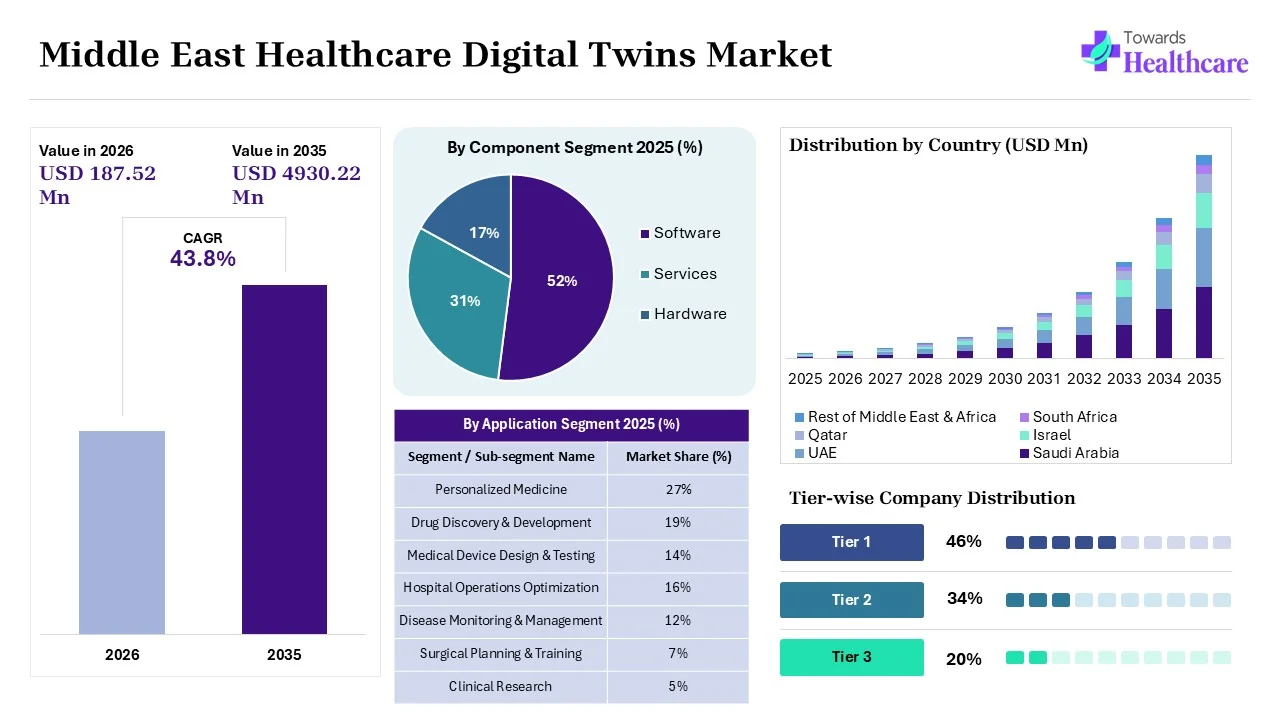
The Middle East healthcare digital twins market size accounted for USD 130.4 million in 2025 and is predicted to increase from USD 187.52 million in 2026 to approximately USD 4930.22 million by 2035, expanding at a CAGR of 43.8% from 2026 to 2035. Digital twins optimize healthcare operations by analysing workflows and resource distribution, leading to efficient technology and enhanced patient care, which drives the growth of the market.
Digital twin technology is transforming medical care by leveraging real-time data incorporation, progressive analytics, and virtual simulations to improve patient care, allowing predictive analytics, optimizing healthcare operations, and facilitating training and simulation. Digital twin (DT) technology is evolving as a transformative force in medical care, providing unprecedented opportunities for targeted medicine, treatment optimization, and disease prevention. DTs in medical care, analyzing their implementation in the different physiological levels from cellular to whole-body technology. DTs facilitate targeted medicine by allowing the construction of patient-driven models. These models incorporate data from electronic health records (EHR), imaging modalities, and Internet of Things (IoT) tools to account for patients' physiological and historical shades. DTs show a paradigm shift in medical care delivery and healthcare research, proving virtual replicas of physical entities which used for simulation, optimization, and prediction.
Digital twin (DT) technology offers ongoing monitoring and analysis of patient health, facilitating early detection of health issues and timely intervention. Modern DTs integrate data from wearable sensors, implantable devices, and environmental sensors to develop adaptable models that reflect the patient’s changing condition. This ongoing feedback enables the identification of subtle physiological shifts that may occur days or weeks before clinical symptoms appear, providing opportunities for early intervention. DTs also allow healthcare professionals to simulate various treatment options safely, refining plans before actual application. By supporting virtual testing and optimization, DTs reduce healthcare expenses by reducing reliance on trial-and-error strategies.
By component, the software segment contributed the largest Middle East healthcare digital twins market share of 52% in 2025, as digital twin software is transforming healthcare technology by leveraging real-time data integration, advanced analytics, and virtual simulations to enhance patient care, allow predictive analytics, optimize healthcare operations, and enable training and simulation. Digital twins can optimize clinical operations by analyzing workflows and resource allocation, leading to efficient processes and improved patient care.
By digital twin type, the patient digital twin segment contributed the largest market share of 38% in 2025, as digital twin technology simulates different patient features and replicates how they behave and respond in particular situations. Digital twin technology has the strength to revolutionize the practice of clinical research. Digital twin services are more accessible and are transforming the healthcare industry, transforming the lives of the people they serve.
By technology, the artificial intelligence & machine learning segment held a significant share of 31% in the Middle East healthcare digital twins market. Through analysing patterns and trends, ML enhances the precision and predictive abilities of digital twins, supporting the forecast disease advancement, patient responses to behaviours, and potential challenges. These advanced algorithms improve the digital twin's ability to make accurate predictions related to patient results, support early diagnosis, and tailor targeted treatment plans.
By application, the personalized medicine segment contributed the largest market share of 27% in 2025, as targeted care supports digital twins (DTs), which are poised to renovate personalized medicine by allowing real-time, multiscale simulations of specific patients. By incorporating imaging, genomics, wearable sensor information, and clinical records, DTs provide a significant platform for predictive, adaptive, and patient-specific decision-making.
By end user, the hospitals & healthcare providers segment contributed the largest Middle East healthcare digital twins market share of 42%, as digital twins optimize healthcare operations by analysing workflows and resource allocation, leading to streamlined technologies and enhanced patient care. Digital twin technology helps physicians and researchers better understand population health and manage heart disorders. Scientists and experts predict the strength of digital twins to transform healthcare delivery, patient care, and health research.
By deployment mode, the cloud-based segment contributed the largest market share of 61% in 2025, as cloud-based digital twins provide enterprises an advanced level of flexibility impossible with outdated solutions. Cloud-driven solutions allow real-time data processing and analysis, resulting in lowered operational expenses and enhanced patient results. Cloud solutions like Virtual Machines (VMs) and containers confirm that computational resources match precisely what the digital twin platform requires.
By country, Saudi Arabia contributed the largest Middle East healthcare digital twins market share of 34%, as adopting advance digital twin technology in factories and energy solutions, Saudi Arabia enhances productivity and lowers expenses. Conducting megaprojects such as NEOM and The Line, Saudi Arabia is constructing smart cities that rely on advanced technologies. Digital twins create virtual models of these cities to assess urban planning, enhance energy consumption, and enhance consumers' quality of life, which drives the growth of the market.
Leading companies in the Middle East healthcare digital twins market include Microsoft Corporation, Siemens Healthineers, Dassault Systèmes, and GE HealthCare. Meanwhile, Microsoft Corporation offers real-time tracking of HVAC technology, energy optimization, and prognostic maintenance for healthcare infrastructure. Siemens Healthineers provides a digital twin of the cardiac technology, making patient-driven anatomical replicas to simulate challenging cardiovascular technology, detect challenges, and develop targeted treatment plans. Dassault Systèmes offers modeling for hospital logistics and patient flow treatment, utilizing industrial AI-based technology in collaboration with NVIDIA to create virtual twins, and GE HealthCare, which supports hospitals in simulating various operational scenarios, tracking patient bed obtainability.
By Component
By Digital Twin Type
By Technology
By Application
By End User
By Deployment Mode
By Region


