

Pipeline Programs

CGT Companies Tracked

Manufacturing Facilities


The global personalized medicine market was evaluated at US$ 620.14 billion in 2025 and is expected to attain around US$ 1368.89 billion by 2035, growing at a CAGR of 8.24% from 2026 to 2035.
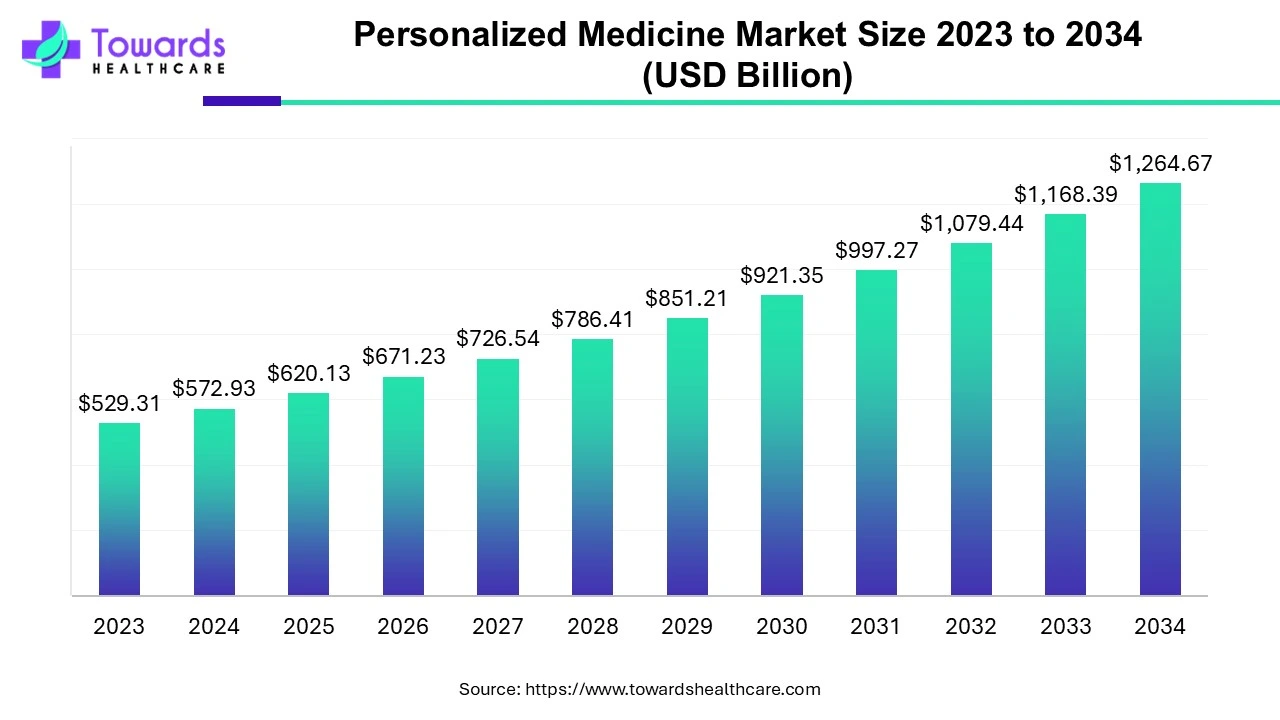
The personalized medicine market is growing rapidly as personalized medicine is used in many ways to help prevent, diagnose, and treat diseases. Personalized medicine is a field of medicine that determines the prevention, diagnosis, and treatment of patients based on information obtained from genetic and genomic information. The basic idea of personalized medicine is that information about a patient's genes and genome enables doctors to make smarter, better patient care decisions. Advances in health technology have contributed to the emergence of personalized medicine, which requires the electronic processing and storage of patient information, especially the use of personalized drugs through translation and clinical research.
The integration of AI with personalized medicine is opening up new opportunities for research and treatment. AI algorithms can analyze large amounts of data in a short period, detecting subtle patterns and relationships that might otherwise be overlooked. The personalized medicine market driven by AI has the potential to improve immunity. By analyzing a person’s genetic predispositions, lifestyle choices, and environment, intelligent algorithms can identify individuals at high risk for certain diseases. This early detection allows doctors to implement preventive measures and interventions that reduce disease and improve overall health. The integration of AI in personalized medicine is a possibility for continuous learning and adaptation. AI algorithms can instantly analyze treatment outcomes and patient responses to optimize and refine treatment plans. This iterative process allows interventions to continue to evolve and improve, leading to better outcomes for patients over time.
Driver
Recent Advances in Personalized Medicine
Recent advances in genetic analysis molecular diagnostics, and personalized medicine represent a revolution in healthcare. The shift from single-gene testing to a widely used clinical tool using genetic and molecular biomarkers is enabling new changes in the drug discovery process. Pharmacogenomics integrates clinical and patient data into early data sets, accelerating the path to disease treatment and enabling appropriate treatment. This personalized approach is revolutionizing the management of many diseases, including infectious diseases, cancer, autoimmune diseases, neurological diseases, bladder dysfunction, and gynecological conditions. Through the use of genetics, epigenomics, and clinical insights, personalized medicine is not only understanding the disease but also enabling the rapidly expanding personalized medicine market with the ability to the repair process.
Restraint
Challenges in the Personalized Medicine
Despite its transformative potential, the personalized medicine market faces significant challenges that limit its growth. The complexity of genomic variation is a major concern because individual genomes contain millions of variants compared to the HGP used, requiring multidisciplinary analysis to correlate variations with disease or response to treatment. Geographic and ethnic diversity further complicate matters, as genetic variation resulting from environmental and demographic factors can affect individuals differently. Limitations in data analysis and integration continue to hinder progress, while ethical issues, including privacy and fairness, add another layer of complexity. Addressing these various limitations is critical to unlocking the potential of personalized medicine.
Opportunity
Growing Adoption of Imperative of Personalized Medicine
Personalized medicine is changing health by using genetic, environmental, and lifestyle information to optimize disease prevention, diagnosis, and treatment. This approach increases diagnostic accuracy, identifies the best treatment options based on individual characteristics, and simplifies treatment to improve outcomes while reducing side effects. By promoting better immunity and encouraging patient engagement, personalized medicine can not only reduce healthcare costs but also accelerate drug discovery and innovation. The ability to reduce drug toxicity, increase treatment efficiency, and balance the medical system makes personalized medicine a key driver of healthcare advancements worldwide. As technology and knowledge continue to advance, this dynamic field promises to revolutionize healthcare models and deliver better outcomes for patients and providers, which this caused growth of the personalized medicine market.
For Instance,
| Key Elements | Scope |
| Market Size in 2026 | USD 671.24 Billion |
| Projected Market Size in 2035 | USD 1368.89 Billion |
| CAGR (2026 - 2035) | 8.24% |
| Leading Region | North America |
| Historical Data | 2020 - 2023 |
| Base Year | 2025 |
| Forecast Period | 2026 - 2035 |
| Measurable Values | USD Millions/Units/Volume |
| Market Segmentation | By Product, By End-use and By Region |
| Top Key Players | GE Healthcare, Illumina, Inc., ASURAGEN, INC., Abbott, Dako A/S, Exact Sciences Corporation, Danaher Corporation (Cepheid, Inc.), Decode Genetics, Inc., QIAGEN, Exagen Inc., Precision Biologics, Celera Diagnostics LLC., Biogen, Genelex, International Business Machines Corporation (IBM), Genentech, Inc., 23andMe, Inc. |
Why Did the Personalized Nutrition & Wellness Segment Dominate in the Personalized Medicine Market?
By Product, the personalized nutrition & wellness segment recorded a dominant personalized medicine market share in 2025, as they provide health advice by combining genetic, phenotypic, and other health-related information. This is essential even for patients who are not genetically susceptible to a particular disease. Personalized nutrition is important when aiming to improve public health. Personalized nutrition brings health recommendations closer to the individual’s daily life. Therefore, recommended dietary patterns are more flexible and long-lasting.
Personalized Medicine Therapeutics Segment: Fastest CAGR
By product, the personalized medicine therapeutics segment is projected to record the fastest CAGR during the forecast period as it tailors treatments to each patient’s characteristics. The approach is based on a scientific understanding of how an individual’s molecular identity and genetic characteristics predispose them to certain diseases. Personalized medicine uses genetic, environmental, and lifestyle factors to determine the best treatment for a particular individual.
Which End-use Type Segment Held the Dominating Share of the Personalized Medicine Market?
By End-use, the hospital segment led the personalized medicine market with a dominant market share in 2025 as it is a new type of treatment that uses an individual’s genetic makeup to guide decisions about disease prevention, diagnosis, and treatment. Understanding a patient’s genetics can help doctors choose a medication or treatment and provide them with the right dose or regimen. Personalized medicine, including reducing the risk of drug toxicity, increasing the efficacy of medicines, promoting equity in healthcare, and supporting drug discovery and development.
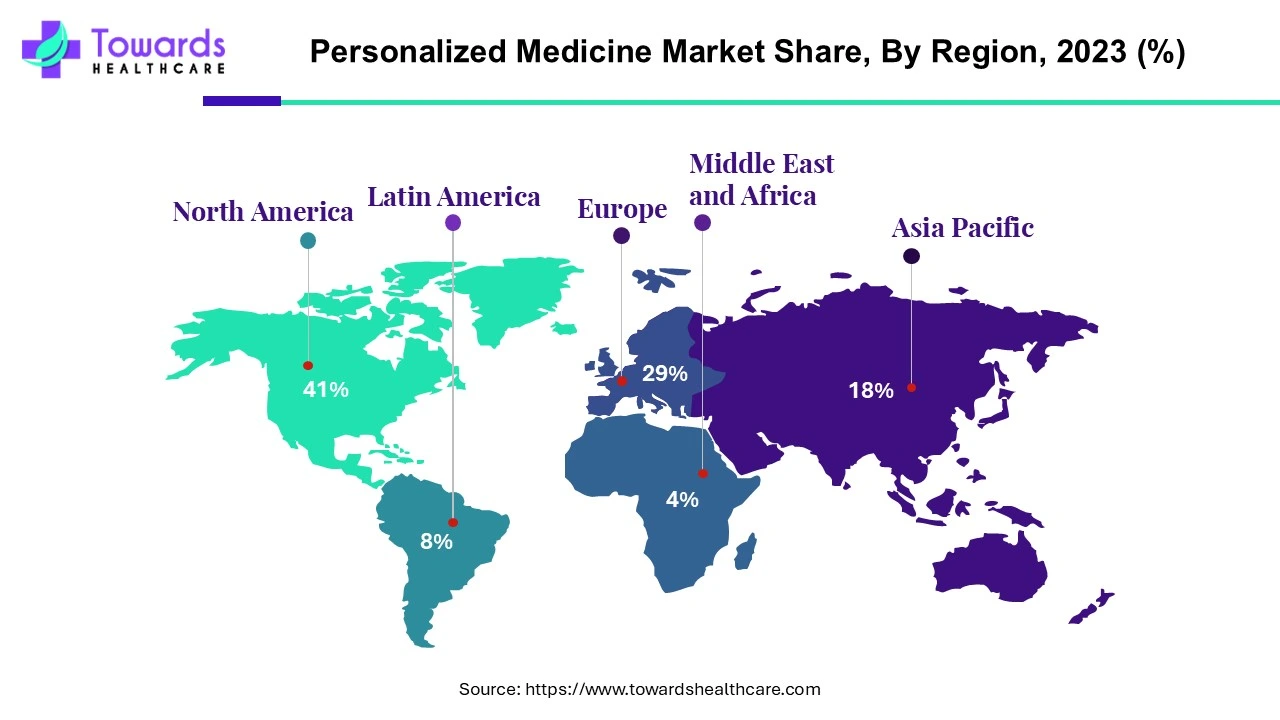
North America accounted for the largest share of the personalized medicine market by 41% in 2025 as the development of next-generation sequencing technology and the use of health information systems are helping to expand the North American specialty medicine market. North America has a well-developed healthcare system that is highly advanced in innovation and the use of new technologies. Concerns over chronic diseases such as cancer, heart disease, and diabetes in North America have increased the demand for personalized medicines that can provide more effective and efficient treatment. The region has seen progress in self-diagnosis. The United States and Canada are the major countries in the market. The advancements in science leading to personalized medicine can bring awareness to the public. Personalized medicine is a growing practice that promises to improve patient care while improving treatment outcomes, accelerating the growth of the personalized medicine market.
U.S. Personalized Medicine Market Trends
The U.S. consists of an advanced healthcare sector, which increases the use of personalized medicines. Additionally, the growing chronic diseases and demand for targeted treatment options are also increasing the use of personalized medications. Moreover, healthcare investments are also encouraging their development.
Asia Pacific’s personalized medicine market is expected to grow at the fastest CAGR during the forecast period, as rising clinical trials of new drugs and diagnostics in this region are highly valued and attract investment from abroad. The need for personalized medicine and new treatments is also increasing in response to the increasing number of diseases in the region. Rising healthcare expenditures and improved healthcare services in developing countries are driving the growth of the economy in this region. The Asia Pacific Personalized Care Index measures the readiness of 11th regional healthcare systems to adopt personalized care. Innovation in precision medicine has skyrocketed, with the Asia Pacific region leading the way. China has begun making advances in genomic research and technology by announcing its precision medicine plans, which has led to the growth of the personalized medicine market.
China Personalized Medicine Market Trends
The growing government health initiatives across China are increasing the use of personalized medicines. The growing focus on genomics and AI technologies is also increasing their innovations. Additionally, the presence of large populations is increasing the disease burden, driving their demand.
Europe is expected to grow significantly in the personalized medicine market during the forecast period. The rising awareness about the effectiveness of personalized medications is driving the demand for their use in Europe. At the same time, rising genetic disorders also contribute to the same. Thus, all these factors drive the market growth.
UK Market Trends
The industries as well as institutes are focusing on personalized treatment options in the UK. This, in turn, increases the research as well as innovation of the same. This further increases the collaboration between them. Moreover, this is also supported by the government investments.
Germany Market Trends
The increasing awareness, as well as diseases, are increasing the demand for the use of personalized medications. Thus, the hospitals are adopting various personalized treatment approaches. Furthermore, to make them safe and effective, they are in compliance with the regulations of regulatory bodies.
South America is expected to grow significantly in the personalized medicine market during the forecast period, due to growing healthcare investments and expanding healthcare infrastructure. At the same time, the companies are developing next-generation technologies, which are increasing the production of personalized medicines. Moreover, the government support, increasing health awareness, and new collaborations are also promoting the market growth.
Brazil Personalized Medicine Market Trends
The growing adoption of genomic and molecular diagnostic techniques is driving the demand for personalized medicines across Brazil. The expanding healthcare and growing diseases are also increasing their demand. Furthermore, the growing R&D and faster approval are also encouraging their innovations.
The Middle East & Africa are expected to grow at a considerable CAGR in the upcoming period. The rising prevalence of rare and genetic disorders encourages researchers to develop novel, personalized medicines. The rapidly changing demographics and growing awareness among the general public potentiate the development and use of personalized medicines. Government organizations support market growth through various initiatives and funding policies. The growing research activities and the rising adoption of advanced technologies contribute to market growth.
UAE Personalized Medicine Market Trends
In the UAE, about 669 genetic diseases have been reported, with 399 diseases being autosomal recessive. It has the sixth-highest prevalence of birth defects per 1000 live births. Thus, the UAE government has launched the Emirati Genome Program and the National Genome Strategy to promote personalized medicine development.
Strengths
Weaknesses
Opportunities
Threats
R&D
Clinical Trials and Regulatory Approvals
Formulation and Final Dosage Preparation
Packaging and Serialization
Distribution to Hospitals, Pharmacies
Patient Support and Services
In October 2024, Chicago GE HealthCare is pleased to partner with University Medicine Essen (UME) in the creation of a new Theranostics Center of Excellence with the goal of expanding access to precision care. Ken Herrmann, MD, director and chair of the scientific advisory board at the Clinic for Nuclear Medicine, University Medicine Essen, says that theranostics has transformed the way we approach patient care by fusing precise diagnostic tools with targeted therapy and providing a customized treatment plan. We are able to provide therapies that are customized to the unique situation of each patient because of this expanding practice. In order to improve and extend customized medicine and help guarantee even better results for patients in the future, we must work with industry leaders, such as GE HealthCare, and invest in innovation.
By Product
By End-use
By Region





Reviewed By
Aditi Shivarkar is a seasoned professional with over 14 years of experience in healthcare market research. As a content reviewer, Aditi ensures the quality and accuracy of all market insights and data presented by the research team.
Learn more about Aditi Shivarkar










