


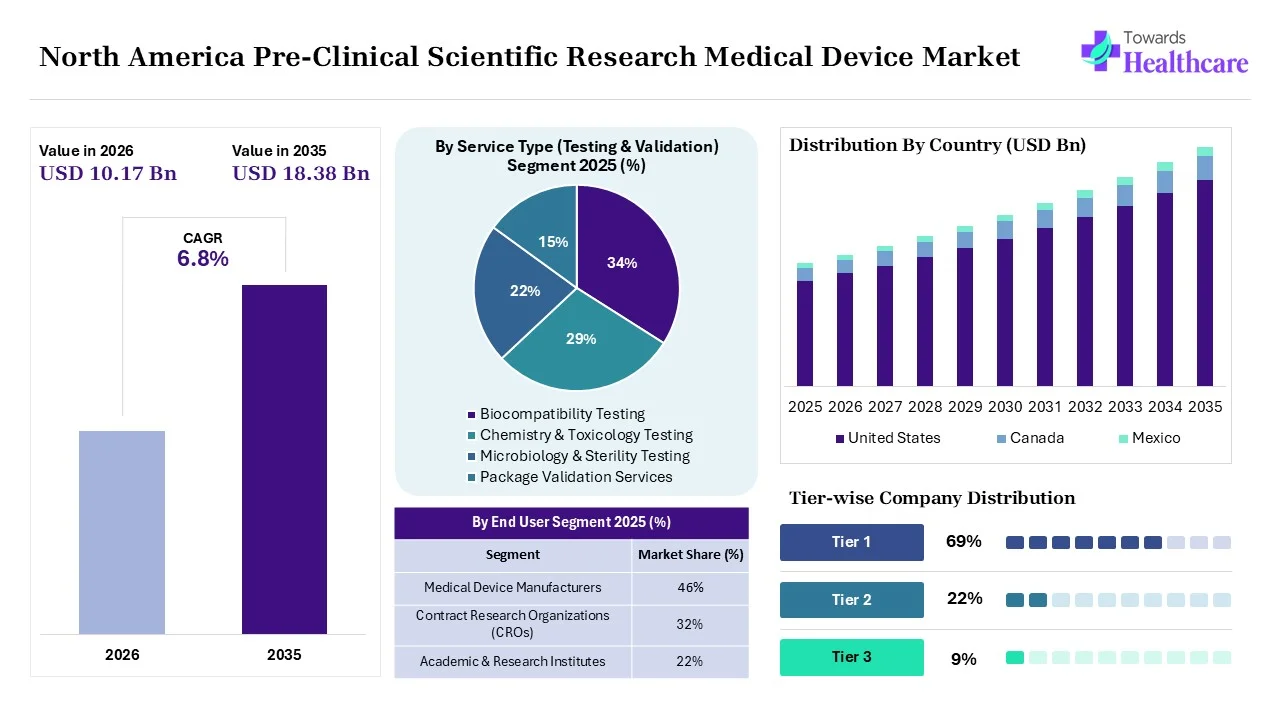
The North America pre-clinical scientific research medical device market size accounted at USD 9.52 billion in 2025 and is predicted to increase from USD 10.17 billion in 2026 to approximately USD 18.38 billion by 2035, expanding at a CAGR of 6.8% from 2026 to 2035. A surge in R&D expenditure, expanding stringent regulations, rising adoption of translational research models, growing demand for high-throughput accelerated drug discovery, expanding digital technologies, growing outsourcing trends, and a shift towards alternative research models are promoting the market growth.
North America pre-clinical scientific research medical devices refer to the medical and laboratory devices utilized in preclinical research for the evaluation of performance, efficacy, and safety of various medical products. They are used for drug discovery, medical device development, safety testing, and toxicology testing. Additionally, they are also utilized for translational research, biomedical research, disease modelling, and precision medicine research.
The graph represents the estimated number of U.S. cancer deaths and new cases in the year 2026. It indicates that there will be a growth in the cancer burden in the U.S., which will increase the R&D for the development of accurate diagnosis and effective treatment options. This, in turn, will drive the adoption of pre-clinical scientific research medical devices, which will ultimately promote market growth.
By product type, the pre-clinical in-vitro diagnostic (IVD) systems & reagents segment accounted for the highest revenue share of 24% of the North America pre-clinical scientific research medical device market in 2025, due to their increased use in R&D activities. Their rapid analysis and affordability also increased their use for a wide range of applications. They were also used in disease modelling, precision medicine development, and biomarker-based research.
By service type (testing & validation) type, the biocompatibility testing segment held a major revenue share of 34% of the North America pre-clinical scientific research medical device market in 2025, as they were essential for evaluating product safety. Their compliance with ISO standards and device materials also increased their use. They were also essential for assessing allergic or adverse reactions.
By application type, the oncology segment contributed the biggest revenue share of 36% of the North America pre-clinical scientific research medical device market in 2025 and is expected to expand rapidly with a CAGR of 7.6% during the forecast period, due to growth in cancer burden. This increased R&D activities, where a rise in investments also supported their expansion. Demand for target therapies also promoted the use of pre-clinical scientific research medical devices for various applications.
By end user, the medical device manufacturers segment led the North America pre-clinical scientific research medical device market with 46% share in 2025, driven by high investment and extensive product development. Stringent regulations and prototype testing activities also increased their demand. Focus on minimally invasive devices has also increased their use.
North America pre-clinical scientific research medical device market held a notable share of 86% in 2025, due to the presence of advanced industries and the R&D sector. The growth in investments and government funding also increased pre-clinical scientific research, medical device adoption, and innovations. Additionally, a rise in R&D activities, partnerships, and the adoption of advanced technologies also enhanced the market growth.
Bruker Corporation registered dominance over the market with its Albira II and SkyScan 1276, while Revvity, Inc. was its closest competitor, which offered IVIS Spectrum CT and Quantum GX2. Siemens Healthineers also maintained its position by offering the Inveon System, where MILabs B.V. also contributed to the market growth with its U-SPECT CT and VECTor products.
By Product Type
By Service Type (Testing & Validation)
By Application
By End User
By Region


