
Towards Healthcare Research & Consulting

Global Pulmonary Function Testing Systems Market to Grow Rapidly with AI and Home-Based Solutions

Explore the global pulmonary function testing systems market, expected to grow rapidly by 2035. Learn about AI-driven, home-based, and portable solutions, market trends, key players, and regional analysis.
Author: Towards Healthcare Published Date: 9 April 2026
Share : Healthcare Services Healthcare Services Healthcare Services Healthcare Services Healthcare Services

The global pulmonary function testing systems market size accounted for USD 5.3 billion in 2025 and is predicted to increase from USD 5.66 billion in 2026 to approximately USD 10.23 billion by 2035, expanding at a CAGR of 6.8% from 2026 to 2035. A substantial growth in respiratory disease prevalences, & vast demand for portable, home-based & AI-driven solutions fuel the overall market growth.

Market At a Glance

The pulmonary function testing systems market encompasses diverse, robust non-invasive diagnostic tools, like spirometers, plethysmography boxes, & gas analyzers to capture lung volume, capacity, airflow, & gas exchange. These solutions have pivotal role in categorizing lung concerns as obstructive or restrictive by recording FEV1, FVC, & TLC. Also, they have a key significance in monitoring the growth of chronic respiratory diseases & evaluating the efficacy of treatments.

Market Projections

Eventual developments will pose emphasis on handheld spirometers and portable systems to enable testing in physician offices, clinics, & at the bedside. Moreover, the market will increasingly shift towards home testing, enhancing disease management for chronic issues & minimizing the need for in-person hospital visits. Specifically, the wider use of machine learning will support the analysis of consistent data, like complete flow-volume loops, to offer detailed insights into small airway function.
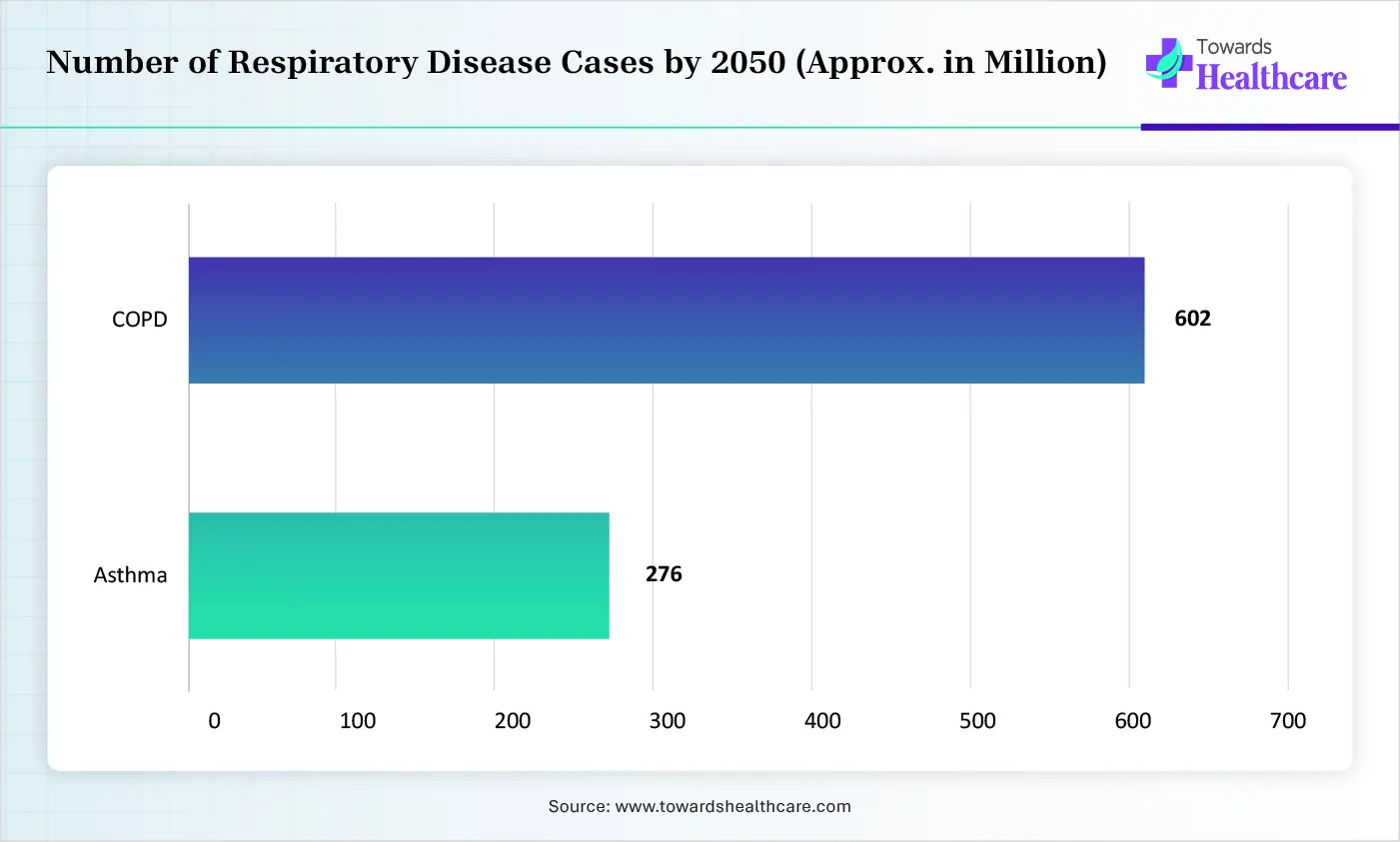
Number of Respiratory Disease Cases by 2050 (Approx. in Million)

Number of Respiratory Disease Cases by 2050 (Approx. in Million)

The above estimations show the higher need for regular spirometry, which enables monitoring the long-term decline in lung function, & for further finding prognosis & the acceleration of disease progression. Besides this, these systems will foster pre-surgical risk assessment, occupational health surveillance, & determine physiological changes. 

Market Segmentation Overview

  • By type, the spirometers segment led with 45% share of the pulmonary function testing systems market in 2025. Dominance is fueled by their robustness in ensuring diagnosis, staging disease severity, evaluating treatment response, tracking growth, & performing preoperative risk assessments. Innovations are exploring smartphone-connected, home-based spirometry systems that enable patients to conduct tests at home.
  • By end-user, the hospitals segment dominated with 50% share of the market in 2025, due to the massive rise in various respiratory issues, like asthma, COPD, COVID, etc. An immersive effort covers the use of comprehensive, digital, & cloud-based PFT systems that combine directly with hospital information systems (HIS) or Electronic Health Records (EHR) in hospitals.
  • By application, the chronic obstructive pulmonary disease (COPD) segment held a major share of 35% of the pulmonary function testing systems market in 2025. Globally surging exposure to pollutants, biomass fuel, & tobacco smoking is elevating the incidence of COPD, which requires regular lung function assessment. The market is highly implementing FOT/Oscillometry for severe COPD, coupled with dynamic chest radiography (DCR).

Regional Analysis

North America held the largest share of 40% of the market in 2025, due to the presence of a well-developed medical system & increased healthcare spending. Many U.S. giant firms are emphasizing integration of AI for automatic interpretation, quality control, & predictive analysis to enhance diagnostic accuracy. Impressive steps include the widespread adoption of compact, cabinless, & digital testing devices to facilitate full-body plethysmography results.

Asia Pacific held 20% share of the pulmonary function testing systems market in 2025 & is expected to register rapid growth at 7.00% CAGR in the studied years. A huge rise in urbanization & broader awareness regarding respiratory health & early diagnosis, coupled with extensive healthcare infrastructure, impels the use of PFT systems in hospitals & outpatient clinics. China is heavily fostering AI-powered quality checks for spirometry, Electrical Impedance Tomography (EIT) for imaging, & domestic production of specialized sensors.

Top Companies in the Pulmonary Function Testing Systems Market

This market has four leading firms, called MGC Diagnostics Corporation, Vyaire Medical, COSMED srl, and ndd Medical Technologies. From these companies, MGC Diagnostics is the largest shareholder & also a part of CAIRE Inc., which emphasizes emerging advanced software for interpreting data & enhancing the accuracy of gas exchange testing. 

Segments Covered in the Report

By Type

  • Spirometers
  • Handheld Spirometers
  • Desktop Spirometers
  • Peak Flow Meters
  • Gas Analyzers
  • Oximeters
  • Others

By End-User

  • Hospitals
  • Clinics
  • Home Care
  • Ambulatory Surgical Centers (ASCs)

By Application

  • Chronic Obstructive Pulmonary Disease (COPD)
  • Asthma
  • Cystic Fibrosis
  • Other Respiratory Diseases

By Region

  • North America
    • U.S.
    • Canada 
    • Mexico 
    • Rest of North America
  • Latin America
    • Brazil
    • Argentina
    • Rest of Latin America
  • Europe 
    • Western Europe 
      • Germany 
      • Italy
      • France
      • Netherlands
      • Spain
      • Portugal 
      • Belgium
      • Ireland
      • UK 
      • Iceland 
      • Switzerland
      • Poland
      • Rest of Western Europe
    • Eastern Europe 
      • Austria
      • Russia & Belarus 
      • Türkiye
      • Albania 
      • Rest of Eastern Europe 
  • Asia Pacific
    • China 
    • Taiwan
    • India 
    • Japan 
    • Australia and New Zealand
    • ASEAN Countries (Singapore, Malaysia)
    • South Korea 
    • Rest of APAC 
  • MEA 
    • GCC Countries
      • Saudi Arabia 
      • United Arab Emirates (UAE)
      • Qatar 
      • Kuwait 
      • Oman 
      • Bahrain 
    • South Africa
    • Egypt 
    • Rest of MEA
