


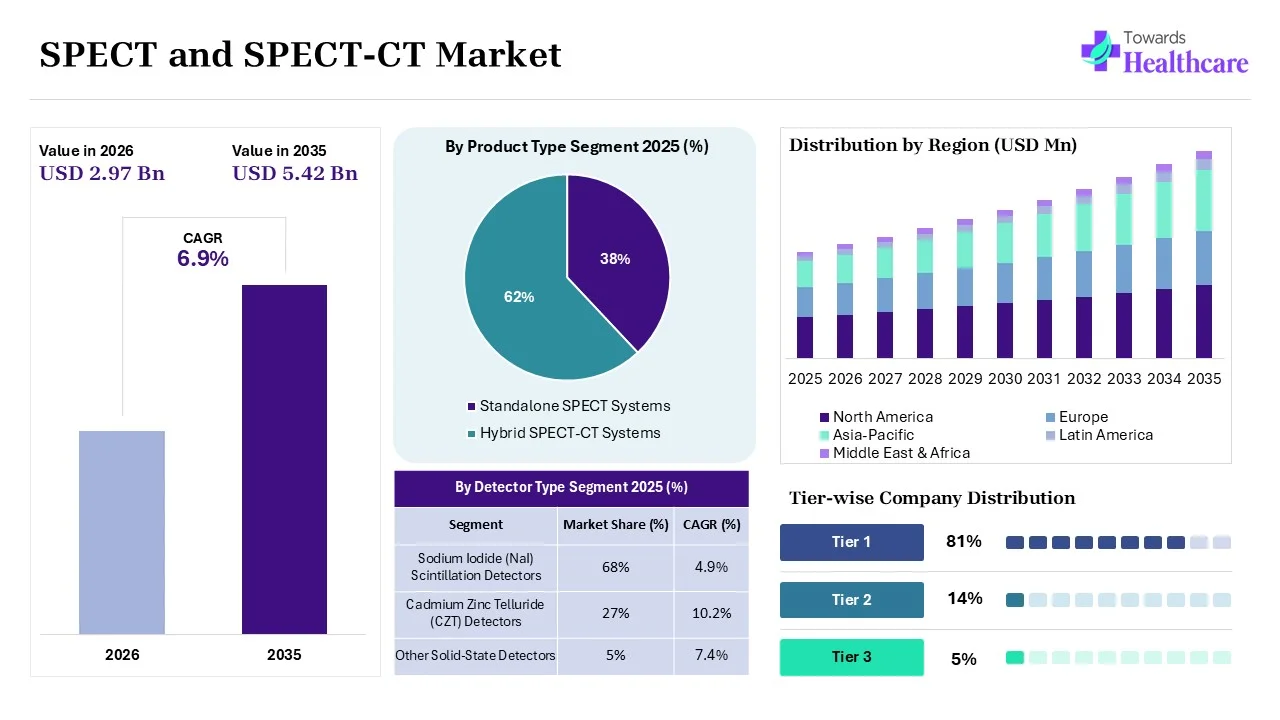
The SPECT and SPECT-CT market size accounted for USD 2.78 billion in 2025 and is predicted to increase from USD 2.97 billion in 2026 to approximately USD 5.42 billion by 2035, expanding at a CAGR of 6.9% from 2026 to 2035. Growing chronic disease burden, expansion of?theranostics, rise in technological shift from standalone to hybrid systems, expanding applications, increasing health awareness, rising demand for personalized medicines, and increasing technological advancements are promoting the market growth.
SPECT and SPECT-CT refer to imaging systems offering functional and anatomical information of organs and tissues. The SPECT system utilizes radioactive tracers and gamma cameras for 3D images, whereas the SPECT-CT combines SPECT and CT technologies for detailed anatomy. This drives their use for the diagnosis, disease progression monitoring, and treatment planning of cancer, infectious diseases, neurological, cardiovascular, and musculoskeletal disorders.
The graph represents an estimated number of U.S. cancer deaths and new cases for the year 2026. It indicates that there will be a rise in cancer burden, which will drive the demand for their early and accurate diagnostic and treatment options. This, in turn, will increase the adoption of SPECT and SPECT-CT systems for the accurate diagnosis and effective treatment planning of multiple cancer types, which will ultimately promote the market growth.
By product type, the hybrid SPECT-CT systems segment accounted for the highest revenue share of 62% of the SPECT and SPECT-CT market in 2025, and is expected to witness the fastest growth with a CAGR of 8.3% during the forecast period, due to their high diagnostic accuracy. Their functional and anatomical imaging in a single scan also increased their use. Their enhanced application in various disease diagnoses and molecular imaging also increased their adoption rates.
By detector type, the sodium iodide (NaI) scintillation detectors segment held a major revenue share of 68% of the SPECT and SPECT-CT market in 2025, driven by their high efficiency. Their reliable image quality and affordability also increased their use. Enhanced performance and durability also increased their use.
By application type, the cardiology segment contributed the biggest revenue share of 41% of the SPECT and SPECT-CT market in 2025, due to growth in cardiovascular diseases. The rise in the geriatric population also increased the use of SPECT and SPECT-CT systems for cardiac imaging. Additionally, their accurate evaluation and non-invasive approach also increased their use.
By radiopharmaceutical type, the technetium-99m (Tc-99m) segment held the largest revenue share of 72% of the SPECT and SPECT-CT market in 2025, as they support high-quality diagnostic images. Their short half-life reduces radiation exposure, which increases their use. Their widespread availability and high diagnostic accuracy also increased their adoption rates.
By end user, the hospitals segment led the SPECT and SPECT-CT market with a 58% share in 2025, due to high patient volume. Availability of advanced healthcare professionals and facilities also attracted patients. Robust reimbursement support also enhanced the accessibility of the SPECT and SPECT-CT devices.
North America dominated the SPECT and SPECT-CT market with 39% in 2025, due to the presence of well-established healthcare centres and advanced technology providers. The growth in chronic disease burden and healthcare expenditures also increased the adoption and innovations of SPECT and SPECT-CT systems. Favourable reimbursement policies also increased accessibility to these systems, which enhanced market growth.
Siemens?Healthineers?registered dominance over the market with its Symbia?Pro. Specta,?Symbia?Evo, and?Symbia?Intevo, while GE HealthCare?was its closest contender, which offered the NM/CT 800 Series. Philips Healthcare?also sustained its position by providing Incisive CT,?Vereos, and BrightView XCT, where Spectrum Dynamics Medical?also contributed to the market growth with its VERITON-CT and D-SPECT.
By Product Type
By Detector Type
By Application
By Radiopharmaceutical
By End User
By Region


