


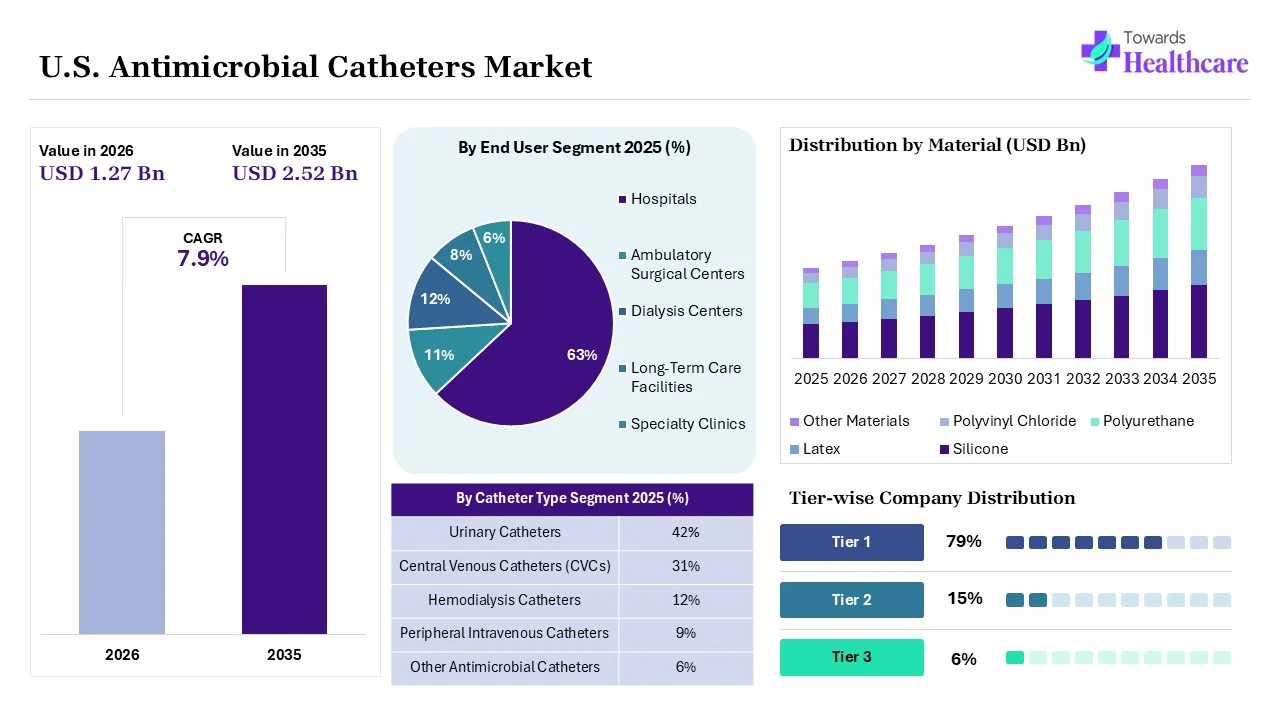
The U.S. antimicrobial catheters market size was estimated at USD 1.18 billion in 2025 and is predicted to increase from USD 1.27 billion in 2026 to approximately USD 2.52 billion by 2035, expanding at a CAGR of 7.9% from 2026 to 2035. Catheters are massively used as primary or secondary devices in a broad range of biomedical applications for addressing numerous medical requirements and purposes, which drives the growth of the market.
Antimicrobial catheters are coatings and materials that are impregnated with antimicrobial agents, like chlorhexidine, silver sulfadiazine, and rifampicin-minocycline, intended to lower the rate of catheter-associated infections by preventing bacterial colonization. They are typically impregnated with either minocycline or clindamycin, combined with rifampin. Catheters are available as antimicrobial catheters in clinics. They inhibit the replication of DNA, resulting in the inhibition of the growth and formation of biofilm. The use of antimicrobial-impregnated catheters has become a popular yet controversial process for the prevention of catheter-related BSI. Major catheters are available as antimicrobial catheters in hospitals. They prevent the replication of DNA, which prevents the growth and formation of biofilm. This antibacterial activity against the mainstream of the UTI-causing pathogens also prevents biofilm formation; therefore, it controls the spread of infection and lessens the challenges of HAIs.
More than 30 million bladder catheters are inserted in the US every year, whereas 2.7 million peripherally inserted central catheter (PICC) insertion procedures are performed each year in the United States.
| Application Area | Quantity (million) |
| Bladder Catheters | 30 |
| Peripherally Inserted Central Catheter | 2.7 |
A novel polymer–nanocomposite coating offers rapid antimicrobial and anti-biofilm properties for urinary catheters. This stable, bio-based nanocomposite is created through a simple, environmentally friendly nonchemical process. Recent research has explored metal nanoparticles, polymer-stabilized coatings, and functionalization of catheter surfaces through sonochemistry. The technology is assisted by a high surface-area-to-volume ratio, which increases antimicrobial interactions, offers sustained effects without rapid depletion, and efficiently targets biofilms and multidrug-resistant bacteria. These advanced coatings integrate metallic nanoparticles, hybrid nanocomposites, enzyme-responsive technology, and antifouling polymers to stop infection and biofilm formation.
By catheter type, the urinary catheters segment contributed the largest U.S. antimicrobial catheters market share of 42% in 2025, as urinary catheters are significant healthcare tools that empty the bladder. They supports to reduce the challenges of infections and damage to your bladder or kidneys. It is used to manage urinary retention and various conditions requiring bladder drainage.
By antimicrobial coating type, the silver alloy-coated segment contributed the largest market share of 34%, as these alloy catheters are potentially more efficient in preventing urinary tract infections as compared to silver oxide catheters. Using silver alloy catheters in hospitalized patients needs short-term urinary catheterization lowers the incidence of symptomatic UTI and bacteraemia.
By material, the silicone segment held a significant share of 38% in the U.S. antimicrobial catheters market, as silicone catheter is that it is non-allergenic and work well for those with delicate skin. Silicone catheters are suitable for long-term use because of their lower encrustation and degradation rate in the urinary environment. Silicone provides advanced biocompatibility and avoids tissue irritation.
By application, the urinary tract infection prevention segment contributed the largest market share of 39%, as coated catheters potentially lower the prevalence of catheter-related bacteriuria throughout short-term catheterization compared to uncoated catheters. By reducing pathogens, these catheters lessen the challenges of more severe secondary complications like pyelonephritis.
By end user, the hospitals segment contributed the largest U.S. antimicrobial catheters market share of 63%, as catheters offer different benefits like prolonged intravenous access, versatility for diverse treatments, simple maintenance, affordability relative to other central venous access tools, and customizable lengths to meet individual patient needs
Leading companies in the U.S. Antimicrobial Catheters Market are Teleflex Incorporated, Becton, Dickinson and Company, Cook Medical, and B. Braun SE. Meanwhile, Teleflex Incorporated, this company, launched this center to spearhead device innovation and education to reduce healthcare-acquired infections (HAIs). Becton, Dickinson and Company has leveraged its worldwide medical care footprint to increase adoption of its silver-ion-coated catheters across emerging markets (TCAP). Cook Medical, this recently provided Bedal FlexGRIP® catheter securement devices support lowering the challenges of dislodgment, infection, and kinking of the catheter. B. Braun SE's Introcan Safety 3 IV Catheters are a practical option for busy healthcare environments where safety and effectiveness both matter
By Procedure Type
By Antimicrobial Coating Type
By Material
By Application
By End User


