Growing neurological disorders, increasing geriatric population, shift towards minimally invasive procedures, expanding healthcare infrastructure, and technological advancements are promoting the market growth.
Market Overview: Decoding the U.S. DBS Market
The deep brain stimulation (DBS) devices are the implantable medical devices utilized for the stimulation of the brain to control abnormal signals and treat brain disorders, improving the quality of life. These devices help enhance mobility, daily functions, and lower medication dependence. This increases their use in the control and treatment of movement disorders, muscle contractions, severe tremors, neurological symptoms, depression, epilepsy, and other mental health conditions.
Global Market Trends
The global deep brain stimulation devices market size was estimated at USD 2.15 billion in 2025 and is predicted to increase from USD 2.34 billion in 2026 to approximately USD 5.04 billion by 2035, expanding at a CAGR of 8.9% from 2026 to 2035.
Emerging Opportunities: Unlocking Next U.S. DBS Trends
- The growing incidences of neurological disease and increasing geriatric population are increasing the demand for deep brain stimulation (DBS) systems.
- Expanding applications of these devices is increasing the adoption rates for the treatment of depression, chronic pain, and OCD.
- Growing R&D activities and collaboration among industries and institutes are increasing their innovations and approval rates.
- The increasing shift towards minimally invasive surgeries is also increasing their use due to their less invasive nature and shorter recovery times.
- Expanding healthcare infrastructure is also increasing its adoption across various hospitals and clinics, increasing their availability.
- Growing technological advancements are also increasing their innovations and integration with cloud or AI-based technologies to enhance their effectiveness and applications.
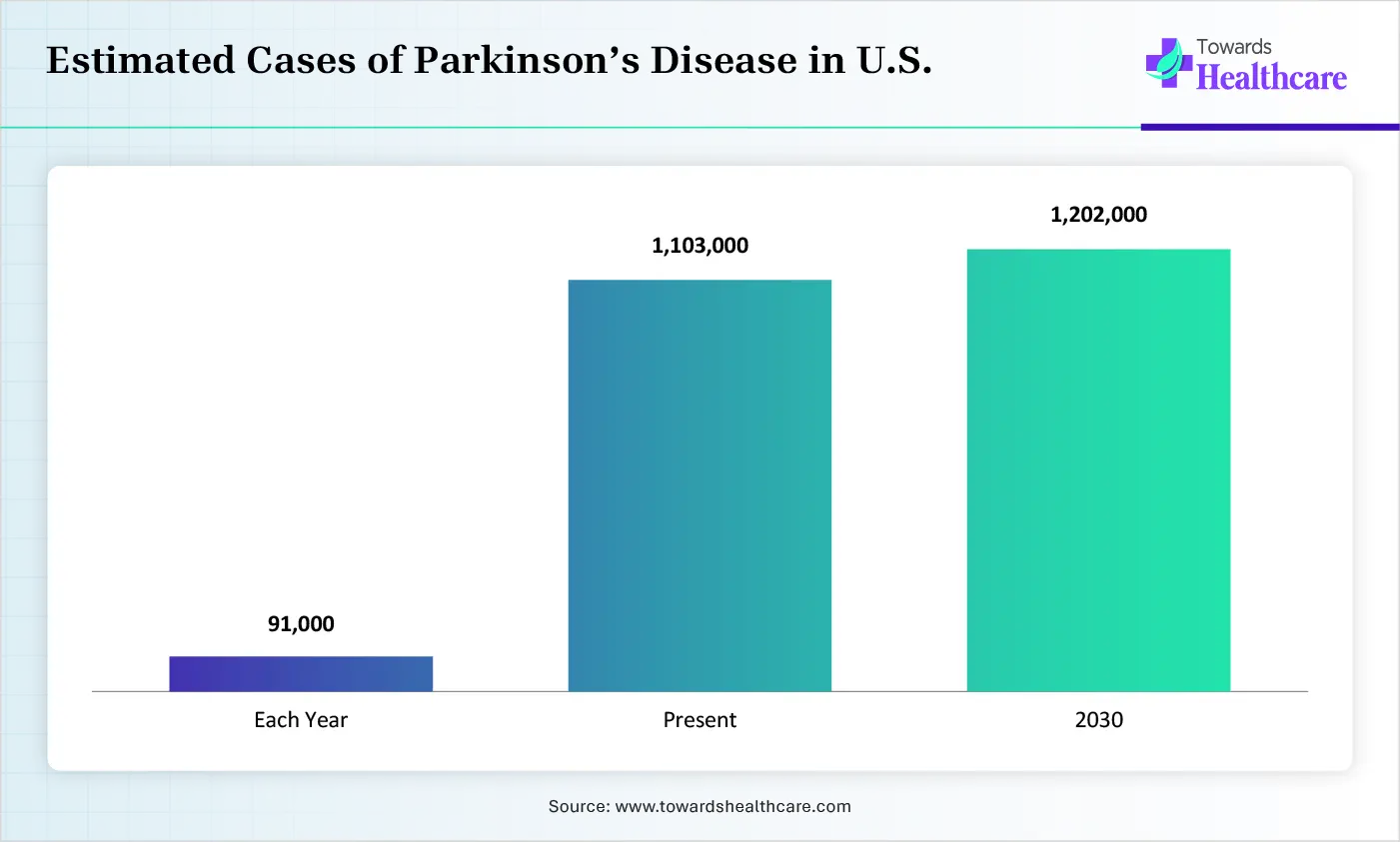
The graph represents a comparison between the Parkinson’s disease cases reported in the U.S. for every year, at present, and for the year 2030. It indicates that there will be a rise in Parkinson’s disease cases, which will drive the demand for effective monitoring, management, and treatment devices. This, in turn, will increase the adoption of deep brain stimulation devices for the monitoring, management, and treatment of Parkinson’s disease, which will ultimately promote the market growth.
Market Segmentation Overview
- By product type, the implantable pulse generator (IPG) segment contributed the biggest revenue share of 52% of the U.S. deep brain stimulation devices market in 2025, as it is the core power source for controlling and generating electrical impulses. Their high effectiveness and recyclable options also increased their adoption rates. Fewer replacements and smart programming features also attracted the patients.
- By application type, the Parkinson’s disease segment accounted for the highest revenue share of 48% of the market in 2025, driven by growth in the patient population. Their ability to reduce tremors, movement problems, and rigidity also increased their use. Proven and evidence-based treatment also increased their acceptance rates.
- By end user, the hospitals segment held the largest revenue share of 68% of the U.S. deep brain stimulation devices market in 2025, due to the presence of specialized infrastructure and skilled neurosurgeons. Additionally, the presence of emergency management facilities and post-surgery care also increased the use of deep brain stimulation devices. High patient volume also increased their use.
- By technology type, the conventional deep brain stimulation segment held a major revenue share of 50% of the market in 2025, due to its proven clinical effectiveness. Their long-term clinical evidence, simple and reliable design, and low technical risks also increased their use. Their widespread availability and affordability also increased their adoption rates.
Regional Analysis
The U.S. deep brain stimulation devices market held 85% share in 2025 and is expected to show significant growth during the forecast period due to the presence of advanced healthcare infrastructure, R&D ecosystem, and key market players. The presence of reimbursement policies and experienced neurosurgeons also increased the use of deep-brain stimulation devices. Additionally, early adoption of advanced neurotechnologies and implantable devices has also increased their use and availability, where growth in neurological conditions and innovations has also increased their use and adoption rates, which has enhanced the market growth.
The Top Innovators: The Power Players Dominating the U.S. Market
The U.S. deep brain stimulation devices market was dominated by Medtronic plc., with its Percept PC, Percept RC, BrainSense technology, and adaptive DBS system, where Boston Scientific Corporation was its closest contender, which offered Vercise Genus, Genus R16, and Genus Pi6. Abbott Laboratories also withheld its position with its Infinity DBS and Liberta RC systems, where NeuroPace Inc. also contributed to the market growth with the RNS System.
Segments Covered in the Report
By Product Type
- Implantable Pulse Generator (IPG)
- Rechargeable IPG
- Non-rechargeable IPG
- Leads
- Directional Leads
- Conventional Leads
- Extensions
By Application
- Parkinson’s Disease
- Essential Tremor
- Dystonia
- Epilepsy
- Obsessive-Compulsive Disorder (OCD)
- Others
By End User
- Hospitals
- Specialty Clinics
- Ambulatory Surgical Centers
By Technology
- Conventional Deep Brain Stimulation
- Directional Deep Brain Stimulation
- Adaptive (Closed-loop) Deep Brain Stimulation




