
Towards Healthcare Research & Consulting

U.S. Dental Inlays and Onlays Market Grows with Demand for Aesthetic and Durable Restorations

The U.S. dental inlays and onlays market is growing due to rising demand for aesthetic, durable restorations and advanced dental technologies.
Author: Towards Healthcare Published Date: 21 April 2026
Share : Healthcare Services Healthcare Services Healthcare Services Healthcare Services Healthcare Services

Increasing patient demand for tooth-colored, aesthetically attractive materials such as ceramic and zirconia over outdated amalgam restorations, which drives the growth of the market.

What are Dental Inlays and Onlays?

Inlays and onlays are two processes of restoring normal tooth structure after decay or other damage. It offers patients a well-fitting, stronger, and longer-lasting repair for tooth decay or other structural fractures. Dental inlays and onlays are tailored to fit effortlessly with minimal preparation. This makes cleaning a dental onlay simpler than cleaning a crown. It provides patients with less expensive substitutes to a full coverage crown. Inlays and onlays are preloaded in a lab and then fitted and bonded to the tooth. Dental specialists use onlays when a less destructive restoration is needed to preserve more of the tooth’s structure, whereas crowns cover the complete tooth, requiring significant redesigning. Inlays and onlays are extremely durable and long-lasting dental services, with a predictable lifespan of 5 to 30 years. Inlays and onlays are used to repair tooth decay by satisfying in cavities and hollows in a tooth.

Global Market Growth

The global dental inlays and onlays market size was estimated at USD 3.42 billion in 2025 and is predicted to increase from USD 3.65 billion in 2026 to approximately USD 6.6 billion by 2035, expanding at a CAGR of 6.8% from 2026 to 2035. The dental inlays and onlays market is growing because of the increasing prevalence of dental caries and tooth damage, which raises the demand for durable restorative treatments.

Recent Advancements in Nanoceramics:

Nanoceramics are tiny ceramic particles smaller than 100 nm. In dentistry, they provide significant advantages over traditional ceramics, like higher hardness, advanced wear resistance, and improved biocompatibility. These materials are utilized in different dental measures, with fillings, crowns, and implants, delivering long-lasting and attractive results. Furthermore, nanoceramics can be intended to release therapeutic agents, supporting the prevention of tooth decay and gum disease. Inclusive, nanoceramics are a promising advancement in dental materials, enhancing performance and patient outcomes.
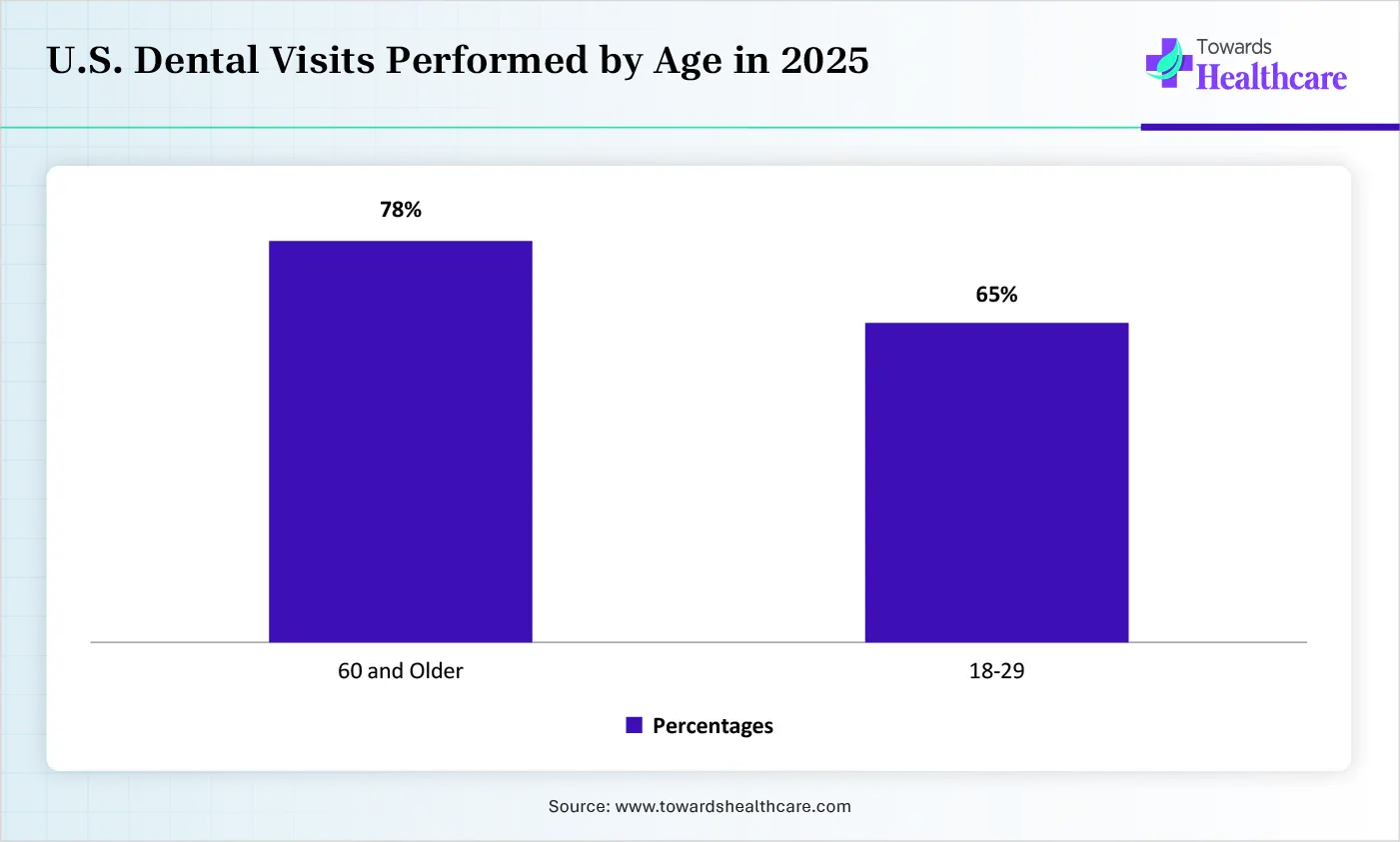
U.S. Dental Visits Performed by Age in 2025

U.S. Dental Visits Performed by Age in 2025

Age Percentages
60 and Older 77%
18–29 63%

Market Segmentation Overview

  • By material type, the ceramic segment contributed the largest U.S. dental inlays and onlays market share of 62% in 2025, as ceramic inlays and onlays are durable and stain-resistant, making them appropriate for both front and back teeth. This material is extremely durable and standard for preserving heavily damaged teeth. Ceramic inlays have no metal core and are therefore translucent.  Ceramic inlays provide an aesthetic substitute to metal class I or II renovations.
  • By type, the inlays segment contributed the largest market share of 58% in 2025, as inlays offer additional support to the tooth by bonding straight to it, making it more resistant to fractures and future damage. This is particularly advantageous for patients with weakened or cracked teeth who want to prevent further deterioration. Dental inlays are an extra conservative treatment option compared to crowns.
  • By fabrication method, the CAD/CAM fabricated segment contributed the largest U.S. dental inlays and onlays market share of 68%, as with CAD/CAM technology, restorations are often completed in a single visit. Instead of waiting weeks for a dental lab to fabricate a restoration, patients receive their custom-designed services on the same day. CAD/CAM enables the creation of more personalized dental restorations tailored to the exclusive contours and features of every patient’s mouth, causing to enhanced comfort and aesthetics.
  • By end user, the dental clinics segment contributed the largest market share of 64% in 2025, as these clinics offer regular check-ups and cleanings that support preventing oral health challenges such as cavities, bad breath, and gum disease. Major clinics are equipped with advanced technology, like digital X-rays, 3D imaging, and laser treatments, which improve diagnostic precision and treatment outcomes. Major clinics adopt a holistic strategy, considering the patient’s overall health and well-being in their treatment strategies.

Top Companies in the U.S. Dental Inlays and Onlays Market

The top five companies in this group dominate the U.S. dental inlays and onlays market. Meanwhile, Glidewell Dental is leading in volume and offering full-service CAD/CAM, zirconia, and curative materials. National Dentex, national network of dental laboratories that works closely with dentists to offer high-quality dental restorations and appliances. DDS Lab delivers targeted expert help to dental clinics of all types and sizes. Dental Services Group, the organization, provides a spectrum of removable, fixed, orthodontic, and sleep dentistry products and services to self-governing dentists. Dandy is providing a broad array of services, including 5-day zirconia crowns, eMax crowns, PFM crowns, metal crowns, and dental bridges.

Segments Covered in the Report

By Material Type

  • Ceramic
    • Lithium Disilicate
    • Zirconia
    • Feldspathic Porcelain
  • Composite Resin
    • Direct Composite
    • Indirect Composite
  • Gold
    • High Noble Gold
    • Low Noble Gold

By Type

  • Inlays
  • Onlays

By Fabrication Method

  • CAD/CAM Fabricated
    • Chairside CAD/CAM
    • Lab-based CAD/CAM
  • Traditional Fabrication
    • Lost-wax Technique
    • Pressed Ceramics

By End User

  • Dental Clinics
    • Solo Practices
    • Group Practices
  • Dental Laboratories
  • Hospitals
