


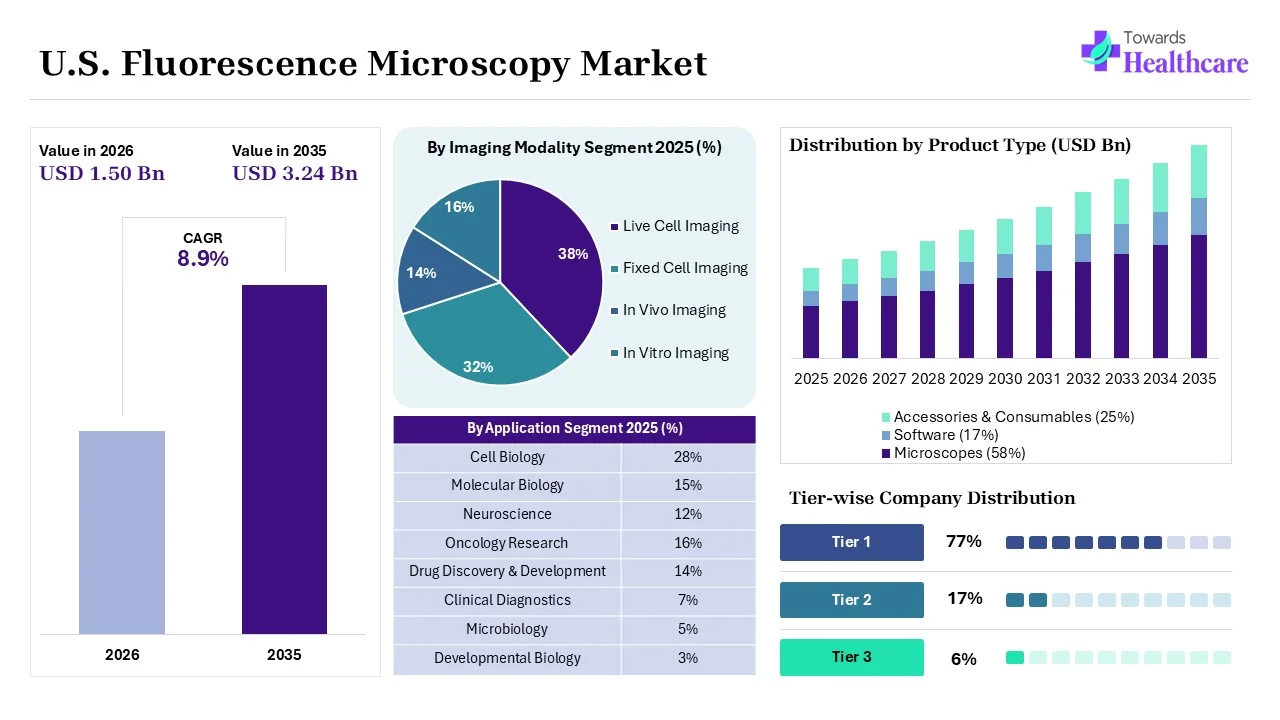
The U.S. fluorescence microscopy market size was estimated at USD 1.38 billion in 2025 and is predicted to increase from USD 1.5 billion in 2026 to approximately USD 3.24 billion by 2035, expanding at a CAGR of 8.9% from 2026 to 2035. Rise in R&D funding, increasing integration of AI into high-throughput cell imaging, growing biomarker research, increasing demand for precision medicines, and advancements in fluorescence microscopy solutions are promoting the market growth.
Fluorescence microscopy refers to the advanced imaging techniques utilizing fluorescent substances for the visualization and analysis of cellular structures, molecular interactions, and biological pathways. They are being used for cell biology research, cancer research, and infectious disease research. Furthermore, they are also being used for molecular biology, neuroscience, immunology, clinical diagnostics, and genetics applications.
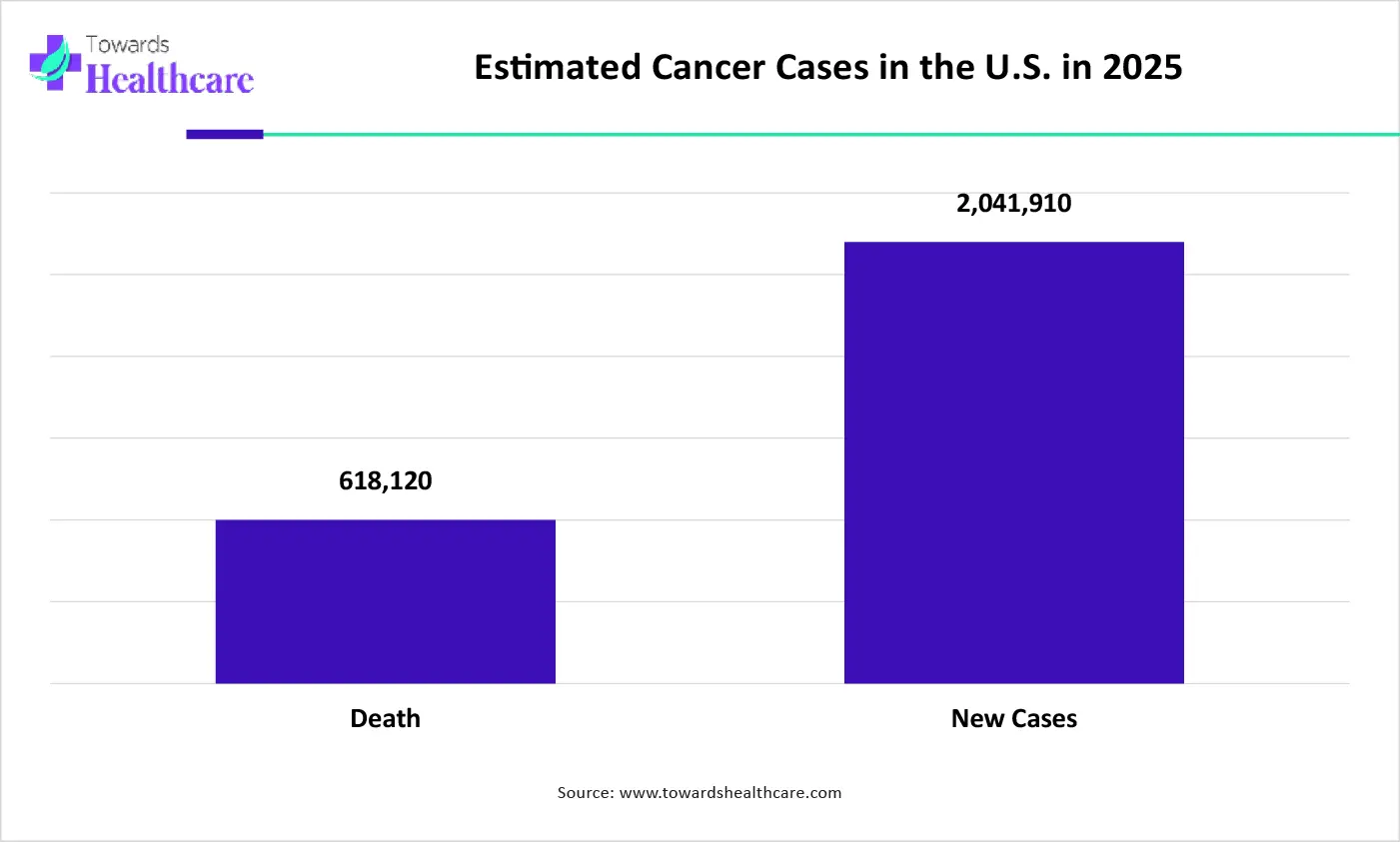
The graph represents the estimated number of U.S. cancer deaths and new cases in the year 2026. It indicates that there will be a growth in the cancer burden in the U.S., which will increase the demand for accurate diagnosis and effective treatment options. This, in turn, will drive the adoption of fluorescence microscopy for the diagnosis and precision medicine development for multiple cancer types, which will ultimately promote market growth.
By product type, the microscopes segment accounted for the highest revenue share of 58% of the U.S. fluorescence microscopy market in 2025, as it is the core instrument in fluorescence microscopy applications. Their high resolution and multiple imaging technologies also increased their demand. They were also used for cell biology, drug discovery, and molecular biology research.
By technology type, the widefield fluorescence microscopy segment held a major revenue share of 24% of the U.S. fluorescence microscopy market in 2025, due to its easy handling and affordability. Their fastest image acquisition and less complex instrumentation also increased their adoption. Their enhanced performance also contributed to their live cell imaging studies.
By application type, the cell biology segment contributed the biggest revenue share of 28% of the U.S. fluorescence microscopy market in 2025, driven by its high efficiency in the visualization of cellular and subcellular structures. The growth in investments also increased their use for various cell biology studies. Their live cell imaging also contributed to their increased usage.
By end user, the academic & research institutes segment held the largest revenue share of 42% of the U.S. fluorescence microscopy market in 2025, due to an expansion in R&D activities. Growth in government funding also supported the adoption of these microscopy techniques. Growth in the demand for advanced imaging tools and expanding collaborations also increased their use.
By fluorophore type, the organic fluorophores segment led the U.S. fluorescence microscopy market with a 40% share in 2025, driven by high fluorescence sensitivity and brightness. Their broad range of emission and excitation wavelengths also increased their use in a wide range of applications. Their enhanced compatibility and affordability also increased their use.
The U.S. fluorescence microscopy market held a significant share in 2025 and is expected to show notable growth during the predicted time, due to the presence of robust industries. The growing R&D investments and funding are also increasing the use and innovation of fluorescence microscopy. Additionally, they are also being used in the development of personalized and precision medicines, which is enhancing the market growth.
Carl Zeiss AG dominated the market with its LSM 980, Zeiss Axio Observer, and Axio Imager, where Nikon Corporation was its closest contender, which offered AX/AX R, Nikon ECLIPSE Ji, and ELIPSE Ti2. Lecia Microsystems sustained its position by providing Lecia Mateo FL, Stellaris, and THUNDER Imager, where Evident Corporation also contributed to the market growth with its Evident FLUOVIEW FV4000, BX53, and IXplore.
By Product Type
By Technology
By Application
By End User
By Fluorophore Type
By Imaging Modality


