


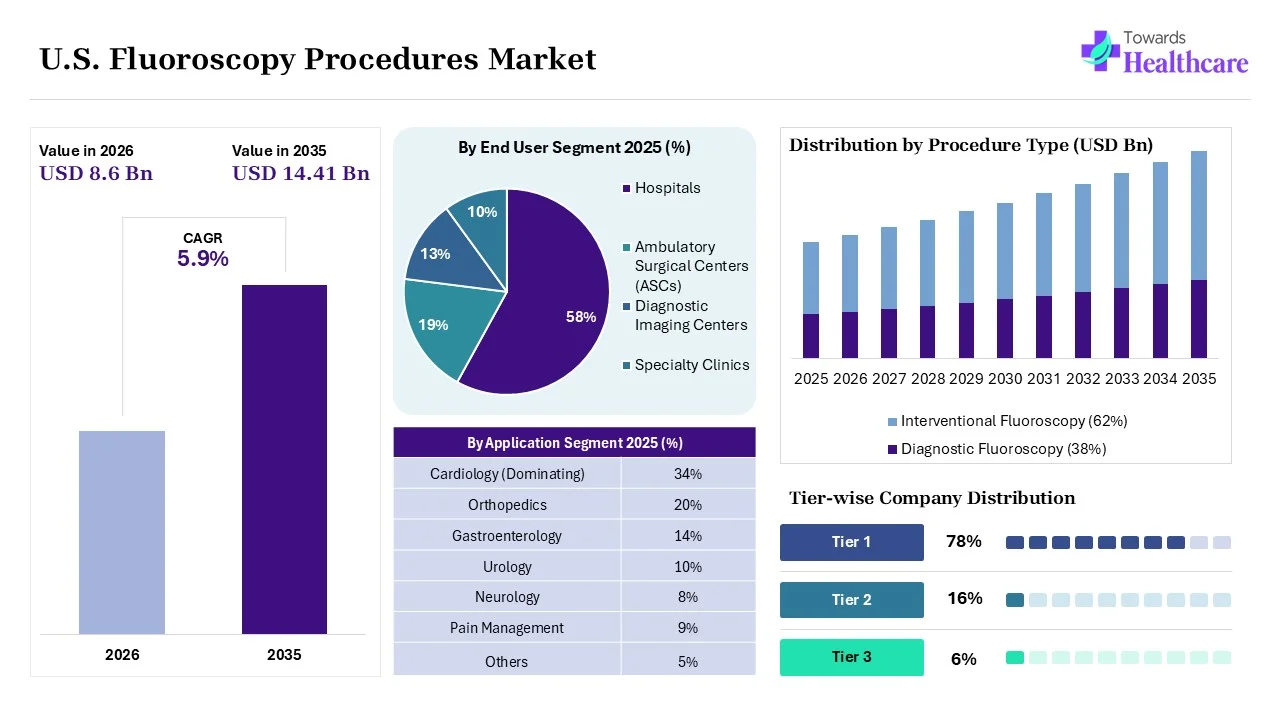
The U.S. fluoroscopy procedures market size was estimated at USD 8.12 billion in 2025 and is predicted to increase from USD 8.6 billion in 2026 to approximately USD 14.41 billion by 2035, expanding at a CAGR of 5.9% from 2026 to 2035. Fluoroscopy is an application in various types of check-ups and technology, like pyelograms, biopsies, and hysterosalpingograms, which drives the growth of the market.
Fluoroscopy is a form of healthcare imaging that uses a series of X-rays to demonstrate the inside of the body in real time, such as a video. This is a healthcare technology that enables physicians to see real-time movements inside a part of the body. Fluoroscopy is a medical technology that makes a real-time video of the movements in a part of the body. Images are captured by passing X-rays through the body over a period of time. X-rays are a method of ionizing radiation. Fluoroscopy is used for diagnosing health challenges, such as heart or intestinal disease. It can also be used to guide management, such as implants or injections, or in an orthopaedic operation. It supports the healthcare provider in looking inside joints, organs, muscles, and bones.
| Technology | Percentage |
| Conventional Diagnostic Radiology | 62.6% |
| Interventional Radiology | 0.6% |
| Computed Tomography | 9.6% |
| Dental Radiology | 26.3% |
| Diagnostic Nuclear Medicine | 1% |
Advancements in flat-panel detectors have made them lighter, more durable, and capable of faster image acquisition, improving image quality and system flexibility. The key development was the integration of flat-panel detectors into X-ray units, enabling a wide range of procedures. These detectors are now replacing image intensifiers in angiography and fluoroscopy, enhancing diagnostic accuracy and patient safety. In industrial imaging, especially in non-destructive testing and component inspection, flat-panel detectors provide higher resolution and improved defect detection. Second-generation and future hybrid FPD systems aim to address existing issues. Presently, flat-panel detector technology is particularly valuable for enhancing workflow, image quality, and significantly reducing patient radiation doses.
By procedure type, the interventional fluoroscopy segment held the largest market share of 62% in 2025 in the U.S. fluoroscopy procedures market, driven by the increasing adoption of minimally invasive procedures across cardiology, orthopedics, pain management, and vascular interventions. Its dominance reflects the growing preference for real-time imaging guidance, which enhances procedural accuracy, reduces recovery times, and improves overall patient outcomes.
By application, the cardiology segment contributed the largest U.S. fluoroscopy procedures market share of 34%, as fluoroscopy supports the real-time imaging of blood vessels, specifically for coronary angiography, which detects blockages in the coronary arteries. Fluoroscopy offers a clearer picture of complex heart conditions, like congenital heart defects, collapsing trachea, and vascular irregularities.
By end user, the hospitals segment held a significant share of 58% in the market, as fluoroscopy supports the medical care provider to look inside joints, organs, muscles, and bones. Fluoroscopy-driven injections provide a multitude of benefits for pain management. The high level of accuracy, real-time imaging, and precise targeting make these strategies highly efficient and safe.
By equipment type, the fixed fluoroscopy systems segment contributed the largest U.S. fluoroscopy procedures market share of 67%, as the significant benefits of fixed fluoroscopy technology over mobile fluoroscopy units involve advanced image quality, smaller image intensifiers, and lower radiation exposure. Fixed fluoroscopy technology are lastingly installed medical imaging machine.
By technology, the digital fluoroscopy segment contributed the largest market share of 78%, as digital fluoroscopy (DF) provides benefits over conventional fluoroscopy, involving rapid image acquisition and increasing image contrast via post-processing. Digital radiography is vast in terms of dynamic range, speed, and reusability.
Leading companies in the U.S. fluoroscopy procedures market are Siemens Healthineers, GE HealthCare, Koninklijke Philips N.V., and Canon Medical Systems. Meanwhile, Siemens Healthineers, it has received Food and Drug Administration clearance for two multifunctional imaging platforms for fluoroscopy and radiography, or real-time 2D imaging. GE HealthCare launched a new progressive X-ray technology to allow access and surge effectiveness in the high-throughput sector. Koninklijke Philips N.V. Philips fluoroscopy systems provide excellent workflow and quality images to drive throughput and prompt diagnoses. Canon Medical Systems provides a digital fluoroscopy technology that brings high image quality, low dosage, and unrivalled versatility to Tokyo Women's Medical University Yachiyo Medical Center.
By Procedure Type
By Application
By End User
By Equipment Type
By Technology


