


Growing crime rates, increasing DNA databases, a shift towards high-throughput NGS, expanding healthcare digitalization, growing R&D activities, increasing government support, expanding patient volumes, and growing technological innovations are also promoting the market growth.
Human identification is a process of identifying and verifying a person’s identity by using their physical, behavioral, and biological characteristics. These systems are used for patient registration, maintaining medical records, enhancing hospital access, improving medical safety, and promoting emergency care. They are also used for diagnostic testing, insurance verification, and other telemedicine services.
The global human identification market size was estimated at USD 2.94 billion in 2025 and is predicted to increase from USD 3.17 billion in 2026 to approximately USD 6.25 billion by 2035, expanding at a CAGR of 7.84% from 2026 to 2035.
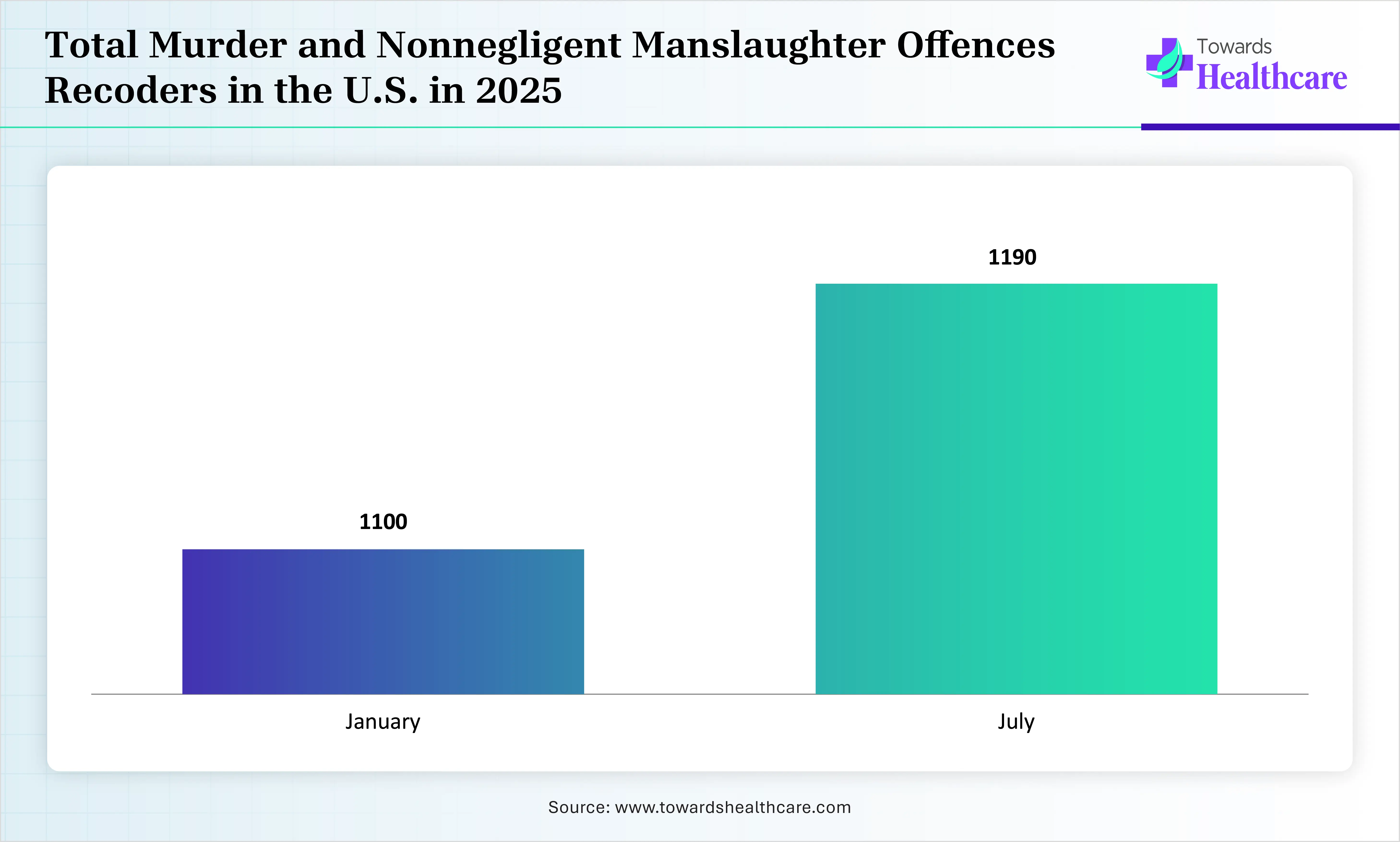
The graph represents a comparison between the murder and nonnegligent manslaughter offences recorded in the U.S. in January and July 2025. It indicates that there will be a rise in these offences, which will drive the demand for forensic investigations. This, in turn, will increase the adoption of human identification solutions, which will ultimately promote market growth.
By technology type, the PCR-based human identification segment accounted for the highest revenue share of 41% of the U.S. human identification market in 2025, due to its high sensitivity and accuracy. Their faster results and requirement of a small sample size also increased their use. Their standardized STR analysis and affordability also increased their use.
By product type, the consumables segment held a major revenue share of 46% of the U.S. human identification market in 2025, driven by the recurring demand. growth in the DNA, forensic, and paternity testing volume also increased their adoption. Their single-use nature also contributed to their recurrent use.
By application type, the forensic applications segment contributed the biggest revenue share of 44% of the U.S. human identification market in 2025, due to the growth of crime investigation. Rise in the crime rates and government funding also increased the use of human identification solutions. They were also used for forensic data matching and victim identification.
By end user, the forensic laboratories segment held the largest revenue share of 38% of the U.S. human identification market in 2025, due to growth in sample volume. The human identification solutions were also used for investigation and DNA profiling. They were also used for the identification of missing persons and crime scene analysis.
By sample type, the blood samples segment led the U.S. human identification market with 34% share in 2025, as it consists of high DNA volume. Their compatibility and consistent results also increased their adoption rates. Their easy storage and wide range of applications also increased their use.
The U.S. human identification market held 78% share and is expected to show significant growth during the forecast period, due to high healthcare digitalization. The presence of advanced healthcare infrastructure and growth in patient volume also increased the use of human identification for accurate patient identification and maintaining health records. Growth in government support and investment from various sources also increased their use, which contributed to the market growth.
Thermo Fisher Scientific Inc. registered dominance over the market with its specialized Applied Biosystems Human Identification systems, where Promega Corporation was its closest competitor, which provided PowerPlex STR amplification kits. QIAGEN N.V. also sustained its position by providing automated DNA purification kits and STR assays, where Illumina, Inc. also contributed to the market growth with its MiSeq FGx Frensic Genomics Systems.
By Technology
By Product
By Application
By End User
By Sample Type


