


Immunohistochemistry has broad-ranging uses in healthcare diagnostics, involving cancer diagnosis and subtyping, detecting cancer markers, autoimmune disease diagnosis, investigation, and staging cancer, which drives the growth of the market.
Immunohistochemistry (IHC) is a significant technology that exploits the precise binding between an antibody and antigen to detect and localize particular antigens in cells and tissue, most commonly identified and examined with the light microscope. IHC is a general laboratory test used to diagnose tumours. IHC uses modified antibodies that recognize and bind to precise proteins in and on the cell. Immunohistochemistry is a form of immunostaining. It includes the technology of selectively identifying antigens in cells and tissues by exploiting the principle of antibodies binding precisely to antigens in biological tissues. Immunohistochemistry (IHC) is used in histology to identify the presence of a precise protein marker that can assist with accurate tumour classification and diagnosis.
The global immunohistochemistry market size was estimated at USD 3.42 billion in 2025 and is predicted to increase from USD 3.73 billion in 2026 to approximately USD 8.05 billion by 2035, expanding at a CAGR of 8.94% from 2026 to 2035.
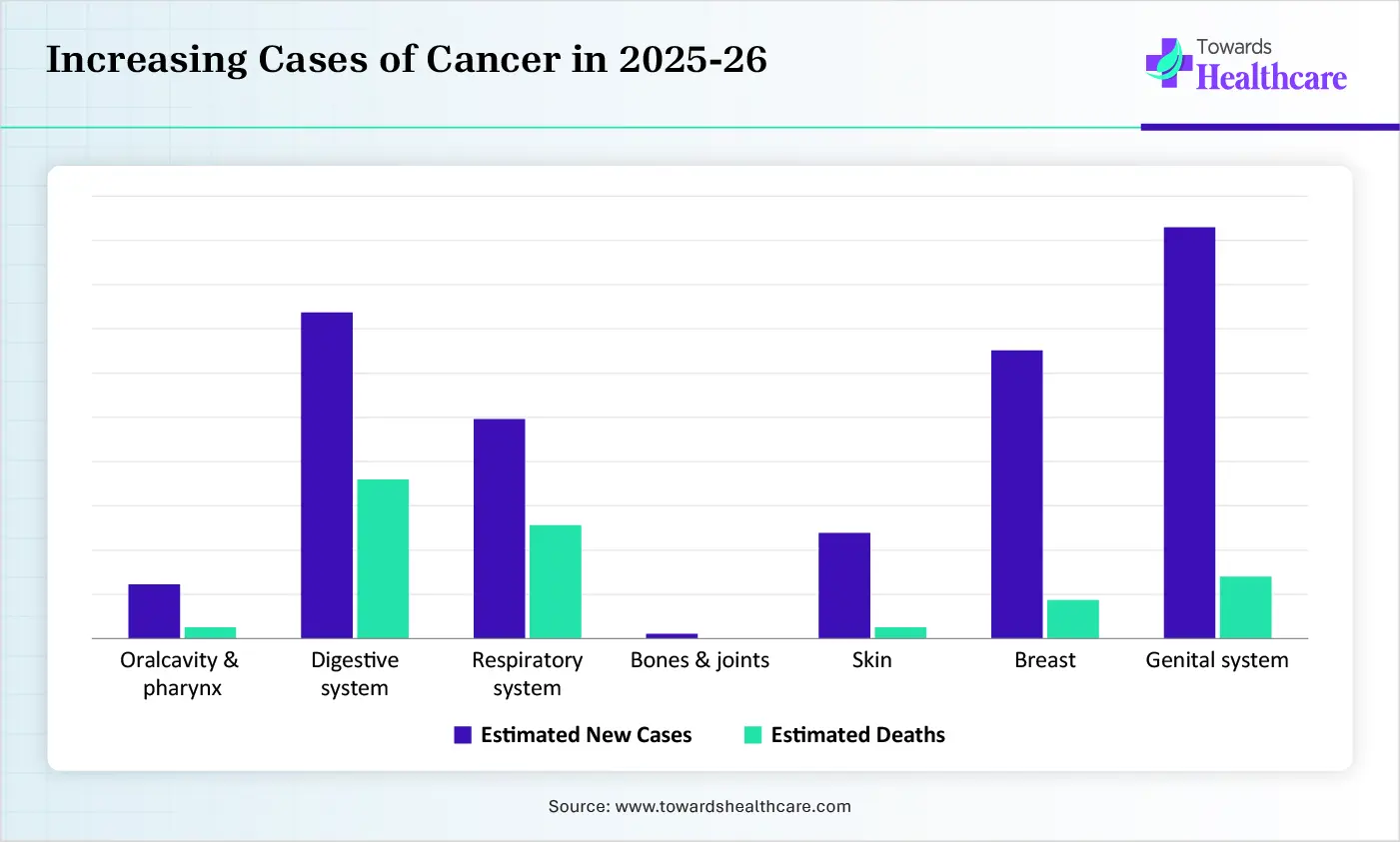
| Various Types of Cancer | Estimated New Cases | Estimated Deaths |
| Oral cavity & pharynx | 60,480 | 13,150 |
| Digestive system | 369,970 | 178,700 |
| Respiratory system | 247,820 | 130,550 |
| Bones & joints | 4110 | 2210 |
| Skin | 119,750 | 14,570 |
| Breast | 324,580 | 42,670 |
| Genital system | 463,560 | 71,970 |
Multiplex Immunohistochemistry (MIHC) is an advanced technology that allows the simultaneous analysis of multiple biomarkers in a single tissue section. This process employs different antibodies linked to various chromogens, allowing scientists to assess multiple protein expressions at once. MIHC maintains the spatial context of biomarkers in the tissue, which improves the accuracy of assessments by pathologists and provides advantageous diagnostic pathology. It is a significant strategy for customizing therapeutic strategies for patients, potentially lowering the number of drugs required for treatment.
By product, the antibodies segment accounted for the largest U.S. immunohistochemistry market share of 34% in 2025, as advanced-quality antibodies are required for their high specificity and low cross-reactivity, allowing reliable and successful staining. Antibodies are becoming a great tool for identifying and characterizing various proteins in various model systems using the technology of immunohistochemistry.
By application, the diagnostics segment contributed the largest market share of 48%, as IHC technology is used to identify organisms in cytological preparations like fluids, sputum samples, and material obtained from fine needle aspiration technology. IHC is used to regulate the function of specific gene products in essential biological processes like development and apoptosis.
By technique, chromogenic IHC segment held a significant share of 46% in the market, as chromogenic stains have advanced resistance to photobleaching as compared to fluorochromes, which supports generating longer-lasting signals. Chromogenic procedure is that it has increasing sensitivity when paired with signal amplification protocols, such as incubation with either avidin-biotin complex.
By end user, the hospitals & diagnostic laboratories segment contributed the largest U.S. immunohistochemistry market share of 44%, as immunohistochemistry (IHC) supports the detection of proteins in tissue samples, supporting disease diagnosis and biomedical investigation. Immunohistochemistry uses antibodies to detect antigens, increasing the specificity of the stain for the tissue with which it reacts.
By end user, the antibody incubation segment held a significant share of 24% in the market, as it achieves higher binding specificity and assay sensitivity, enabling precise identification and visualization of target proteins.
The four organizations in this market dominate the U.S. immunohistochemistry market. Meanwhile, Agilent Technologies., it offers automated staining instruments, a massive catalog of primary antibodies, and specializes in companion diagnostics used. Danaher Corporation has a broad range of identification systems, antibodies, and digital pathology slide scanners. Thermo Fisher Scientific Inc. provides a significant catalog of primary and secondary antibodies, antigen retrieval buffers, and detection kits. Bio-Techne Corporation specializes in high-specificity reagents for both standard IHC and advanced multiplexing.
By Product
By Application
By Technique
By End User
By Workflow
By Distribution Channel


