


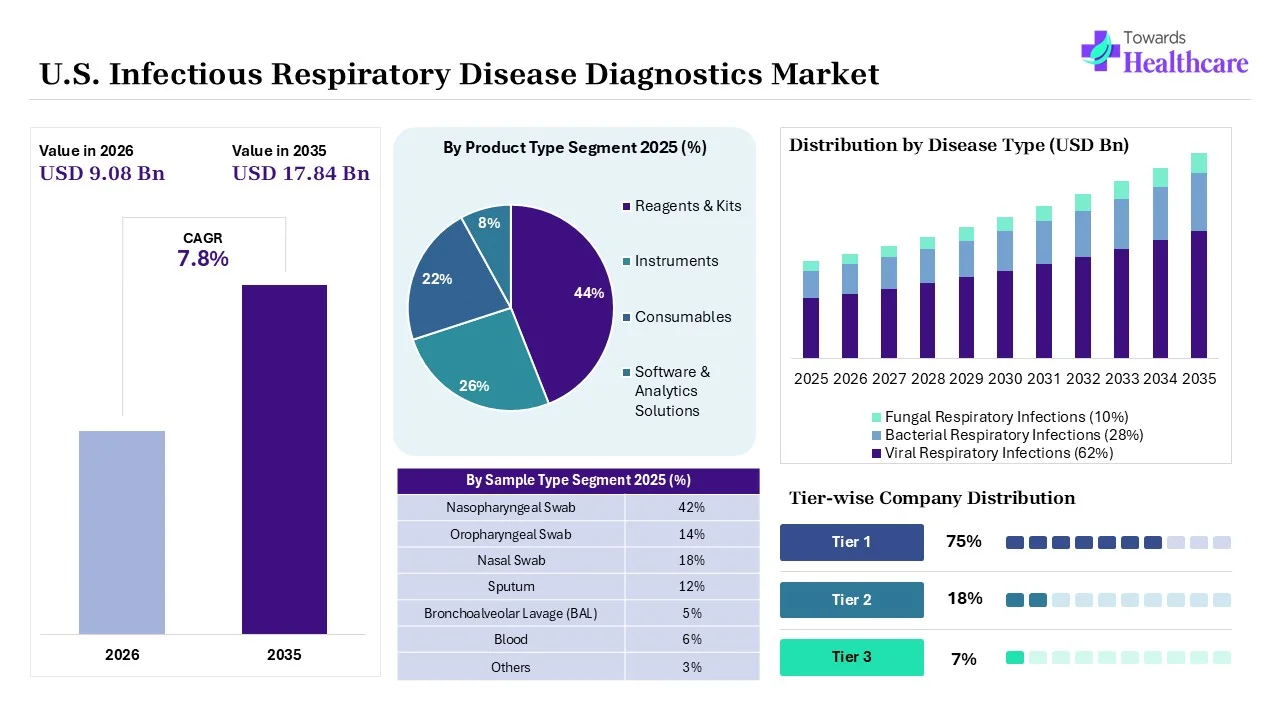
The U.S. infectious respiratory disease diagnostics market size was reported at US$ 8.42 billion in 2025 and is expected to rise to US$ 9.08 billion in 2026. According to forecasts it will reach US$ 17.84 billion by 2035 growing at a CAGR of 7.8%. Continuous growth in bacterial infections, a shift towards decentralized healthcare settings, a strong focus on public health surveillance, rapid advancements in multiplex and POC molecular technologies, growing investments, and rising health awareness are promoting the market growth.
The U.S. infectious respiratory disease diagnostics refers to the use of diagnostic tests, kits, reagents, and instruments for the detection of various respiratory infectious diseases across the U.S. These diagnostics help in the detection of various bacteria, viruses, fungi, and other pathogens. They also promote the accurate diagnosis of infections, control disease outbreaks, initiate appropriate treatment, and support public health surveillance.
The graph represents a comparison between the TB cases in the U.S. for the years 2020 and 2025. It indicates that there will be a rise in TB cases, which will drive the demand for accurate and fast diagnostic devices as well as monitoring solutions. This, in turn, will increase the adoption of various infectious respiratory disease diagnostics solutions for the accurate detection and effective management of TB, which will ultimately promote the market growth.
By disease type, the viral respiratory infections segment accounted for the highest revenue share of 62% of the U.S. infectious respiratory disease diagnostics market in 2025, driven by their high incidence rates. Their frequent outbreaks also increased the demand for their rapid diagnostic tests. Growth in health awareness and public health awareness programs also increased their use.
By diagnostic technology type, the molecular diagnostics segment held a major revenue share of 48% of the U.S. infectious respiratory disease diagnostics market in 2025 and is expected to show the highest growth with a CAGR of 9.3% during the forecast period, due to high sensitivity and specificity. Their accurate pathogen detection and faster results also increased their use in the identification of various respiratory infections. Growth in their innovations also increased their advancements.
By product type, the reagents & kits segment contributed the biggest revenue share of 44% of the U.S. infectious respiratory disease diagnostics market in 2025, as they were essential for every diagnostic test. High test volumes and the development of new test kits also increased their use. Growth in the use of POC tests and rapid diagnostic tests has also increased their demand.
By test type, the laboratory-based testing segment held the largest revenue share of 55% of the U.S. infectious respiratory disease diagnostics market in 2025, due to its high sensitivity, specificity, and accuracy. Their ability to process large sample volumes also increased their use. They also supported multiplex and molecular testing, which increased their demand.
By end user, the hospitals segment led the U.S. infectious respiratory disease diagnostics market with a 39% share in 2025, driven by a large volume of patients. Routine infection control testing also increased the use of infectious respiratory disease diagnostics. Skilled personnel and reimbursement coverage also increased their preference.
The U.S. infectious respiratory disease diagnostics market held a significant share in 2025 and is expected to show lucrative growth during the predicted time, due to growing incidences of respiratory infections. Advanced healthcare and major diagnostic companies are also driving the adoption and development of new, rapid, and molecular diagnostic platforms. Increasing awareness is also driving the demand for point-of-care testing solutions, enhancing the market growth.
Abbott Laboratories registered dominance over the market with its ID NOW Influenza A&B/COVID-19/RSV and Alinity m Resp 4-Plex products, where F. Hoffmann-La Roche Ltd was its closest competitor, which offered Cobas Respiratory 4-flex and Cobas Liat Influenza A/B & COVID-19. Cepheid also sustained its position by providing Xpert Xpress MVP and Xpert Xpress CoV-2/Flu/RSV plus, where bioMérieux also contributed to the market growth with its BIOFIRE Respiratory Panel 2.1 and BIOFIRE SPOTFIRE Respiratory Panel.
By Disease Type
By Diagnostic Technology
By Product
By Test Type
By End User
By Sample Type


