


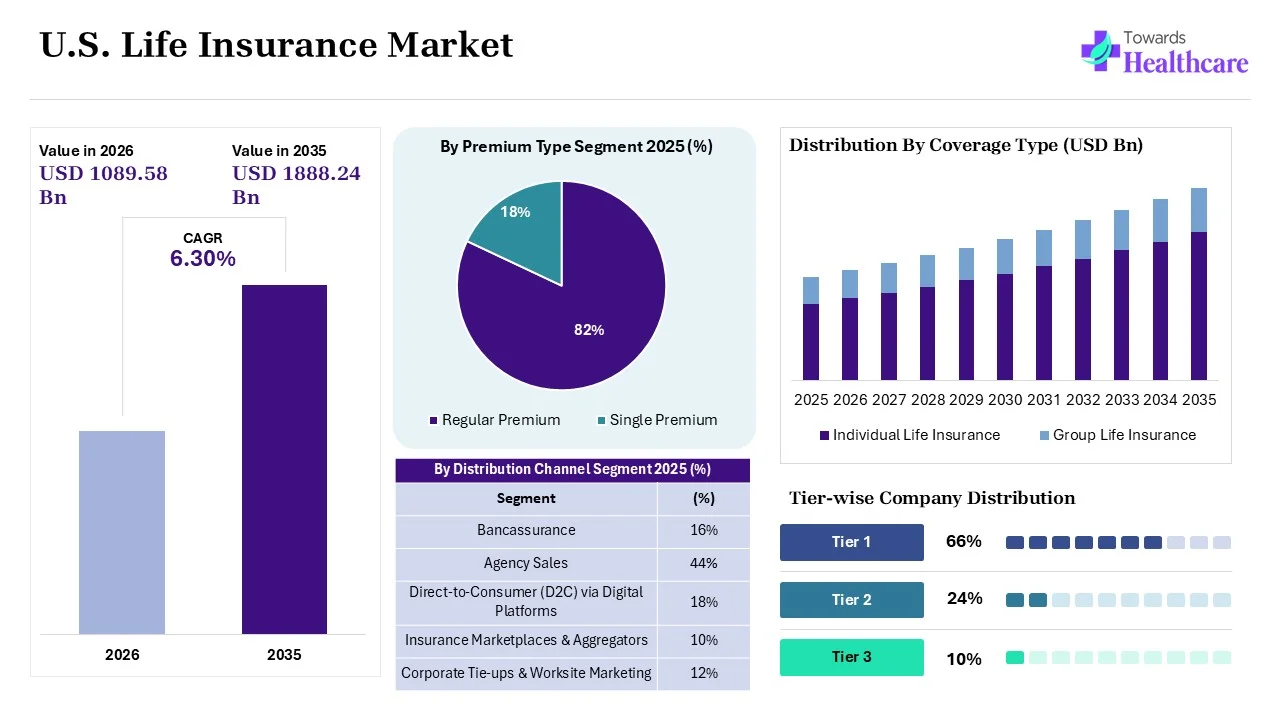
The U.S. life insurance market size accounted at USD 1025 billion in 2025 and is predicted to increase from USD 1089.58 billion in 2026 to approximately USD 1888.24 billion by 2035, expanding at a CAGR of 6.3% from 2026 to 2035. A rise in digital-first customer distribution, accelerated algorithmic underwriting, integrated health incentives, growing retirement planning, increasing digital insurance platforms, and expanding personalized insurance products are promoting market growth.
U.S. life insurance refers to a financial protection contract using regular premium payments to offer death benefits after the policyholder's death to the designated beneficiary. It helps in covering funeral expenses, debts, replacement of lost income, and other financial expenses. It offers different types of policies such as term life insurance, whole life insurance, variable life insurance, and universal life insurance.
By solution type, the term life insurance segment accounted for the highest revenue share of 38% of the U.S. life insurance market in 2025, driven by its simple and easy coverage structure. Flexible policy terms also increased their use. Their high coverage amounts and widespread availability on online platforms also increased their use.
By coverage type, the individual life insurance segment held a major revenue share of 74% of the U.S. life insurance market in 2025 and is expected to show the highest growth with a CAGR of 6.8% during the forecast period, due to its personalized coverage. They also offer long-term financial security, which increased their adoption. They were also preferred for retirement planning and estate planning.
By distribution channel type, the agency sales segment contributed the biggest revenue share of 44% of the U.S. life insurance market in 2025, driven by personalized guidance. They also helped in selecting appropriate policy plans, which increased trust among the policyholders. They also assisted policy application and claim processing, which increased their acceptance rates.
By premium type, the regular premium segment held the largest revenue share of 82% of the U.S. life insurance market in 2025 and is expected to gain the highest share with a CAGR of 6.5% during the forecast period, driven by widespread availability. Their flexible payment schedules also increased their use. They were also preferred for long-term policy retention.
By end users, the individuals segment led the U.S. life insurance market with a 79% share in 2025 and is expected to grow with the fastest CAGR of 6.8% during the forecast period, due to growth in the demand for financial protection. A rise in retirement and wealth accumulation plans also increased the use of life insurance policies. They also utilized policies for covering educational expenses.
The U.S. life insurance market held a considerable share in 2025 and is expected to show lucrative growth during the predicted time, due to high disposable income. Growth in financial protection awareness also increased their use, where the presence of major insurance companies also attracted clients. Expansion in digital solutions also enhanced the market growth.
Northwestern Mutual dominated the market with its Northwestern Mutual Level Term, Northwestern Mutual Whole Life, and Northwestern Mutual Custom Universal Life, while MetLife was its closest competitor, which offered MetLife One Year Term, MetLife Group Whole Life Solutions, and MetLife Variable Universal Life. New York Life also sustained its position, where it provided New York Life Yearly Renewable Term, New York Life Custom Whole Life, and New York Life Custom Universal Life Guarantee, while Prudential Financial also contributed to the market growth with its Prudential Term Essential, Prudential PruLife Custom Whole Life, and Prudential PruLife Founders Plus UL
By Solution Type
By Coverage Type
By Distribution Channel
By Premium Type
By End Users


