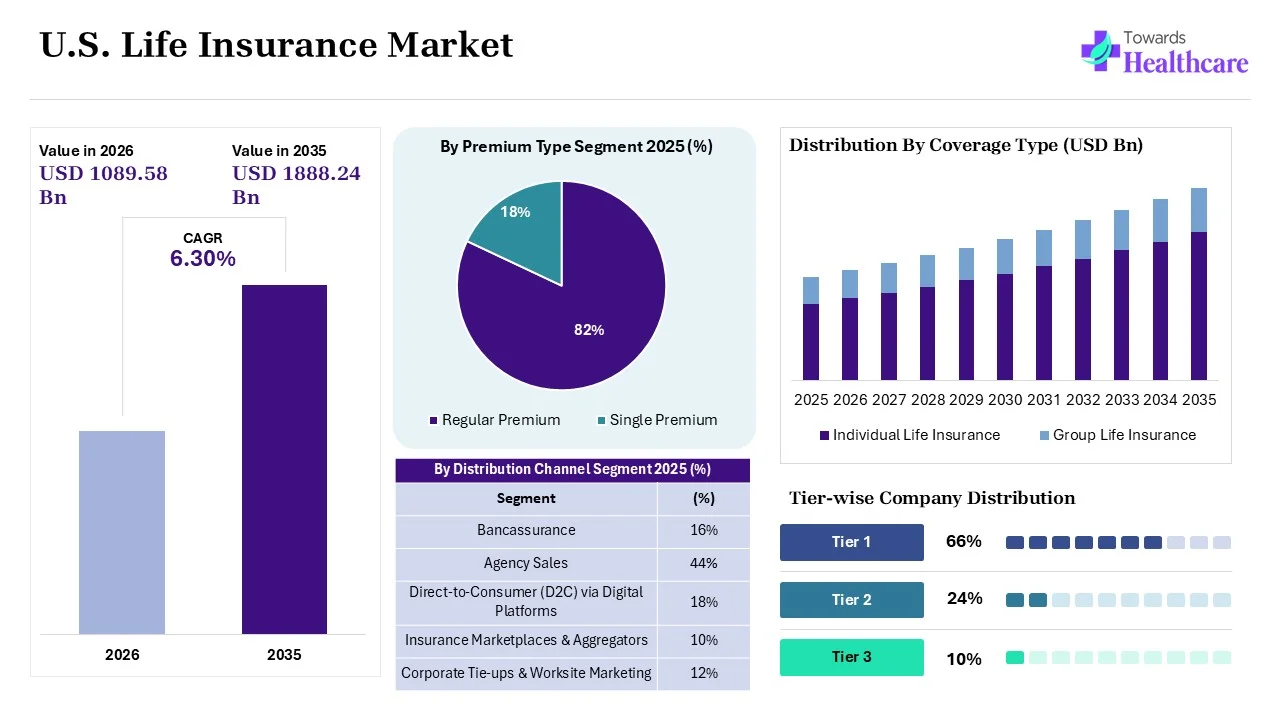
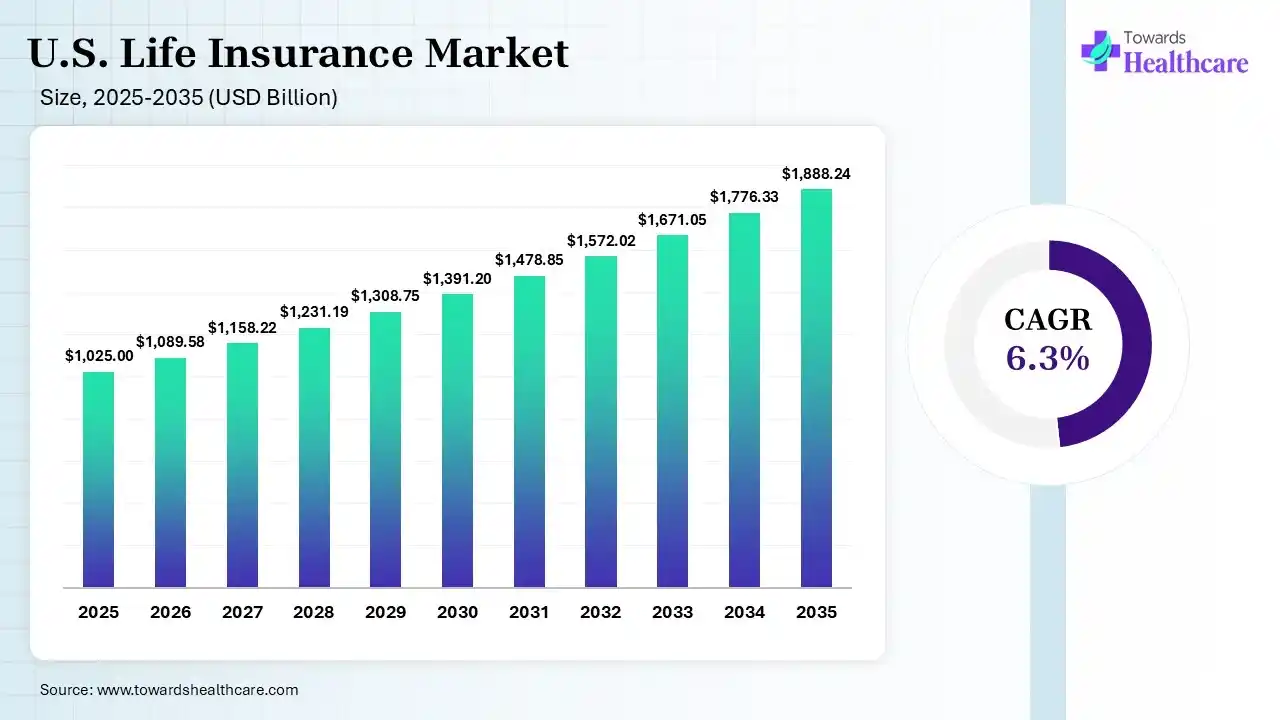
The U.S. life insurance market size is calculated at USD 1025 billion in 2025, driven by increasing digital-first customer distributions. The market continues to grow USD 1089.58 billion in 2026 due to rising financial protection awareness, accelerated algorithmic underwriting, and integrated health incentives. It is expected to reach USD 1888.24 billion by 2035, expanding at a CAGR of 6.3%.As a rise in AI integration, personalized insurance products, and wellness program integration accelerates market expansion.
The U.S. life insurance market is driven by a rise in digital-first customer distribution, accelerated algorithmic underwriting, and integrated health insurance incentives. The U.S. life insurance encompasses the financial contracts offering death benefits to the designated beneficiary after the policyholder's death. It helps in offering financial protection to the family members, covering the funeral expenses, debts, replacement of lost income, and other financial expenses, as well as can also be used for estate planning, business succession planning, and long-term wealth accumulation. It offers different types of policies such as term life insurance, whole life insurance, variable life insurance, and universal life insurance.
Thus, the growing awareness is increasing the use of various life insurance policies across the U.S. At the same time, the growing healthcare and educational costs are also increasing their adoption, where their expanding benefits and accessibility are also encouraging their use. Additionally, to offer simplified policies with an enhanced customer experience, new digital solutions are also being integrated, which is creating new opportunities. Growing retirement planning, disposable income, digital insurance platforms, and personalized insurance products are also contributing to the market expansion.
AI is used in life insurance policies to offer automated underwriting, which accelerates policy approval. It also helps in risk assessment and fraud detection, which enhances accuracy. AI is also used for claim processing, reducing the turnaround time, where its predictive analytics and chatbots also help in detecting future risks and offer 24/7 assistance, respectively. It also helps in reducing manual workload and enhances operational efficiency.
Competitive Rivalry
Competitive rivalry is high in the U.S. life insurance market. Many insurers compete through pricing, product variety, service quality, and brand strength. Digital platforms have increased competition. Companies also invest in technology and customer retention.
Threat of New Entrants
The threat of new entrants is low. New insurers face strict regulations, licensing rules, capital requirements, and reserve standards. They also need strong technology, skilled professionals, and trusted distribution networks. Building customer trust takes time.
Bargaining Power of Buyers
Buyer power is moderate. Customers can compare policies and prices online. However, life insurance products can be complex. Underwriting requirements can also make switching difficult. Customers with better financial knowledge have greater choice.
Bargaining Power of Suppliers
Supplier power is moderate. Insurers depend on agents, brokers, reinsurers, technology providers, and skilled workers. Large insurers have stronger negotiating power because of their scale. Rising technology and reinsurance costs can increase supplier influence.
Threat of Substitutes
The threat of substitutes is moderate. Savings, investments, employer benefits, and annuities can meet some financial needs. However, these options do not provide the same long-term death benefit as life insurance.
Personalized Insurance Products on the Rise
Growing demand for tailored insurance products among U.S. consumers is increasing the use of personalized insurance products. They are tailored by considering the customers' age, health status, income, and financial goals, which helps in enhancing customer satisfaction. A rise in the demand for financial planning solutions and value-added insurance solutions are also increasing their use. Moreover, they also offer customized benefits and pricing, flexible coverage options, which attract a wide range of younger and tech-savvy consumers.
Increasing Integration with Wellness Programs
The growing integration of wellness incentives into life insurance policies is increasing their adoption rates. This, in turn, is driving a shift towards preventive healthcare and healthier lifestyles to reduce potential health risks and lower claim costs. The companies are therefore developing new wearable and digital health technologies, which will offer real-time health insights and strengthen customer engagement, as well as improve risk management and promote healthy lifestyles.
Rapid Digital Transformation
The rise in the launch of online platforms and digital health insurance technologies is driving the purchase of online life insurance policies. They also help in streamlining claims submissions, policy issuance, account management, faster policy approvals, and reduced operational costs. At the same time, a rise in self-service portals, virtual assistance, and distribution channels are also increasing their accessibility as well as enhancing customer experience.
| Table | Scope |
| Market Size in 2026 | USD 1089.58 Billion |
| Projected Market Size in 2035 | USD 1888.24 Billion |
| CAGR (2026 - 2035) | 6.3% |
| Historical Data | 2020 - 2023 |
| Base Year | 2025 |
| Forecast Period | 2026 - 2035 |
| Measurable Values | USD Millions/Units/Volume |
| Market Segmentation | By Solution Type, By Coverage Type, By Distribution Channel, By Premium Type, By End Users |
| Top Key Players | Northwestern Mutual, Massachusetts Mutual, MetLife, State Farm, New York Life, Lincoln Financial Group, Prudential Financial |
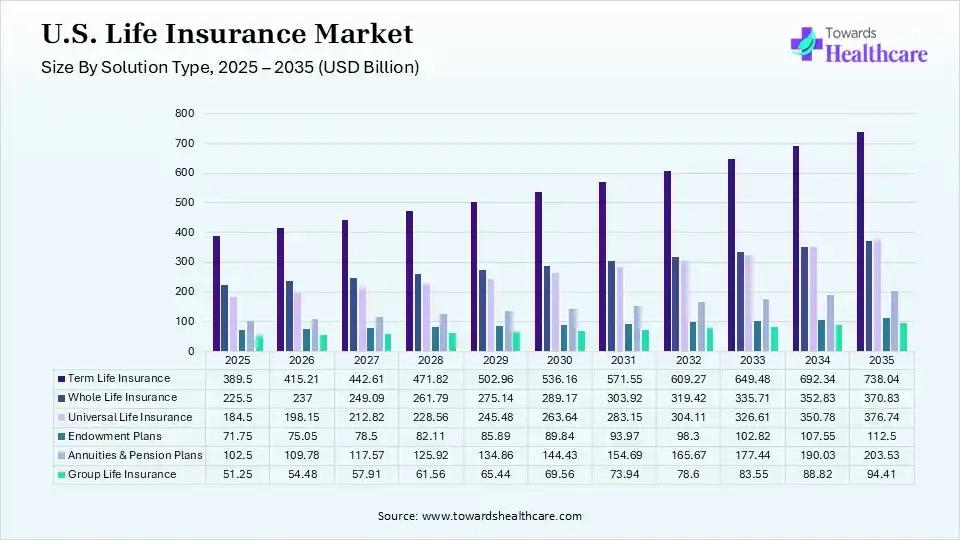
| Segment | Share 2025 (%) |
| Term Life Insurance | 38% |
| Whole Life Insurance | 22% |
| Universal Life Insurance | 18% |
| Endowment Plans | 7% |
| Annuities & Pension Plans | 10% |
| Group Life Insurance | 5% |
The Term Life Insurance Segment Dominated the Market With 38% in 2025
The term life insurance segment led the U.S. life insurance market with 38% share in 2025, driven by affordable premiums, which increased adoption among younger households. Digital underwriting accelerated policy issuance, which increased its use. Financial awareness continues to expand protection demand, which promoted its use.
The whole life insurance segment held the second-largest share of 22% of the market in 2025, due to enhanced lifetime protection attracting wealth preservation customers. Cash-value accumulation also supports long-term planning. Stable returns encourage conservative buyers. They are also being used for wealth accumulation and estate planning.
The universal life insurance segment held 18% of the U.S. life insurance market share in 2025 and is expected to witness the fastest growth with a CAGR of 7.4% during the forecast period, due to flexible premiums and investment-linked features that attract affluent customers. Rising retirement planning also boosts their adoption. Product innovation also enhances policy customization.
The annuities & pension plans segment held 10% of the market share in 2025, driven by a rise in the aging population, which drives retirement income planning. Interest in guaranteed lifetime income also increases their adoption rate. Their longer wealth accumulation benefits also encourage their use. Retirement reforms also support market expansion.
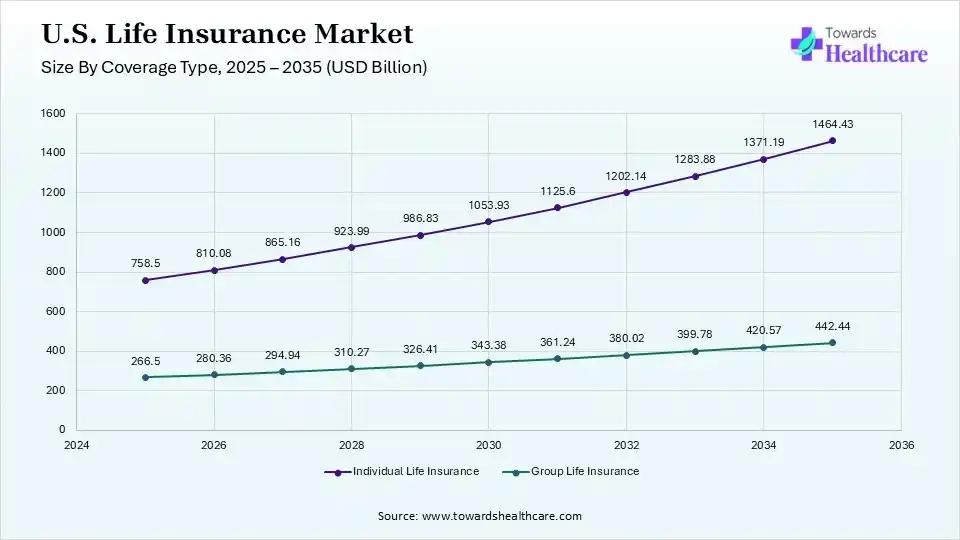
| Segment | Share 2025 (%) |
| Individual Life Insurance | 74% |
| Group Life Insurance | 26% |
The Individual Life Insurance Segment Dominated the Market With 74% in 2025
The individual life insurance segment accounted for the highest revenue share of 74% of the U.S. life insurance market in 2025 and is expected to show the highest growth with a CAGR of 6.8% during the forecast period, due to growth in financial literacy, which encouraged personal protection. Digital distribution expanded its accessibility. Rising household income also supported their purchases.
The group life insurance segment held the second-largest share of 26% of the market in 2025, driven by employers strengthening benefit offerings. Employee retention strategies also support a rise in their demand. Corporate insurance adoption continues expanding, increasing their use. Simplified enrollment and convenient deductions also encourage their adoption.
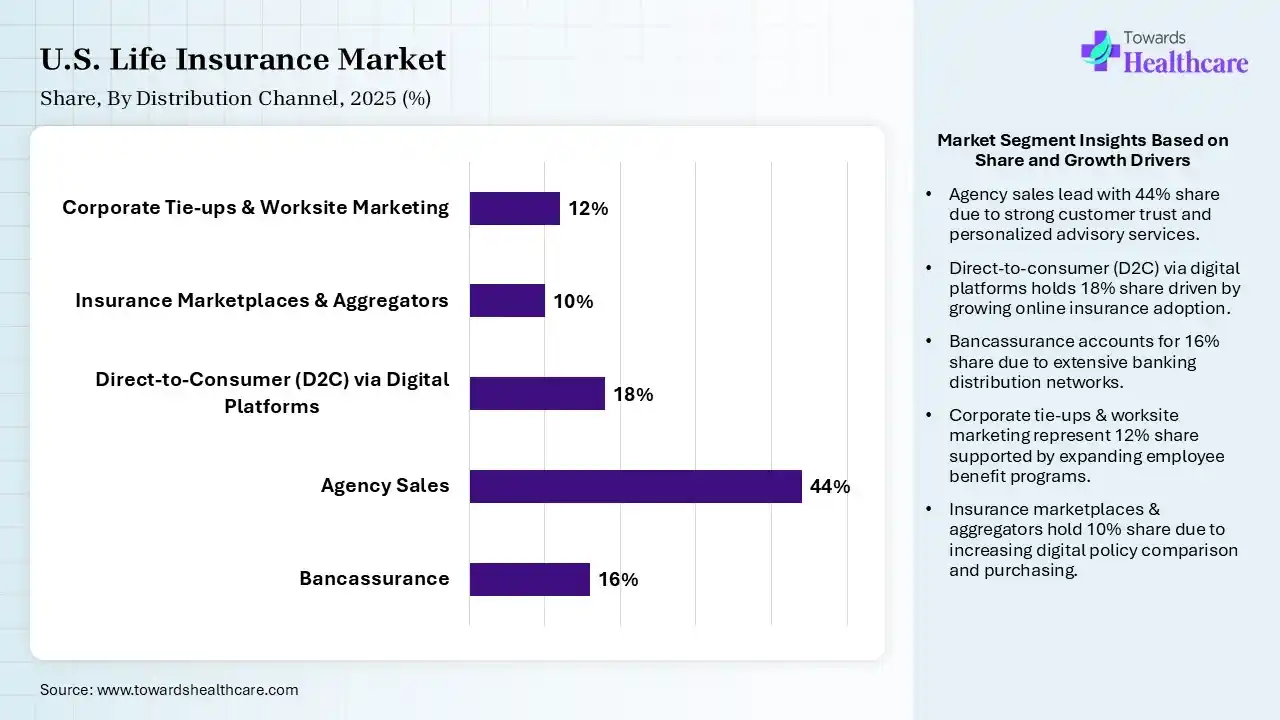
| Segment | Share 2025 (%) |
| Bancassurance | 16% |
| Agency Sales | 44% |
| Direct-to-Consumer (D2C) via Digital Platforms | 18% |
| Insurance Marketplaces & Aggregators | 10% |
| Corporate Tie-ups & Worksite Marketing | 12% |
The Agency Sales Segment Dominated the Market With 44% in 2025
The agency sales segment held a major revenue share of 44% of the U.S. life insurance market in 2025, driven by personalized financial advice that enhanced consumer confidence. Established agent networks also supported policy conversion, which increased their preference. Complex products benefiting from advisory services also contributed to their expansion.
The direct-to-consumer (D2C) via digital platforms segment held the second-largest share of 18% of the market in 2025 and is expected to expand rapidly with a CAGR of 9.2% during the forecast period, due to online comparison tools simplifying buying decisions. AI-enabled underwriting also reduces approval time, driving adoption. Digital-first consumers also fuel adoption rates.
The bancassurance segment held 16% of the U.S. life insurance market share in 2025, due to banks leveraging customer relationships for policy sales. Integrated financial services improve convenience, increasing their acceptance rates. Cross-selling opportunities also increase penetration. Large customer bases and enhanced trust also increased their preference.
The corporate tie-ups & worksite marketing segment held 12% of the market share in 2025, driven by employer-sponsored enrollment, which expands insurance access. Workplace financial wellness initiatives improve awareness, increasing the use of various life insurance policies. At the same time, HR partnerships also increase participation.
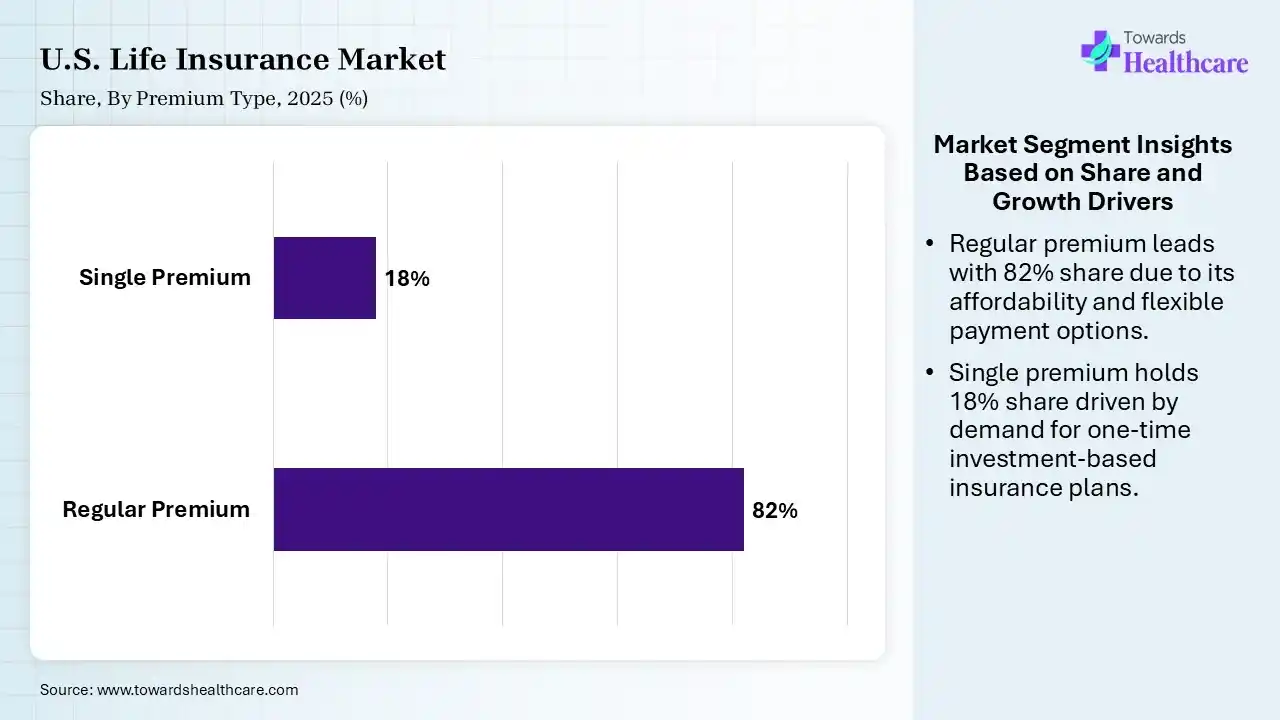
| Segment | Share 2025 (%) |
| Regular Premium | 82% |
| Single Premium | 18% |
The Regular Premium Segment Dominated the Market With 82% in 2025
The regular premium segment contributed the biggest revenue share of 82% of the U.S. life insurance market in 2025 and is expected to gain the highest share with a CAGR of 6.5% during the forecast period, driven by flexible payment schedules, which improved affordability. Automatic payment options also enhanced retention. Long-term policies also favored recurring premiums.
The single premium segment held the second-largest share of 18% of the market in 2025, due to high-net-worth individuals seeking lump-sum investments. Estate planning supports a rise in their demand. Tax-efficient wealth transfer remains attractive, which drives their adoption rates. Their immediate life insurance coverage also attracts consumers.
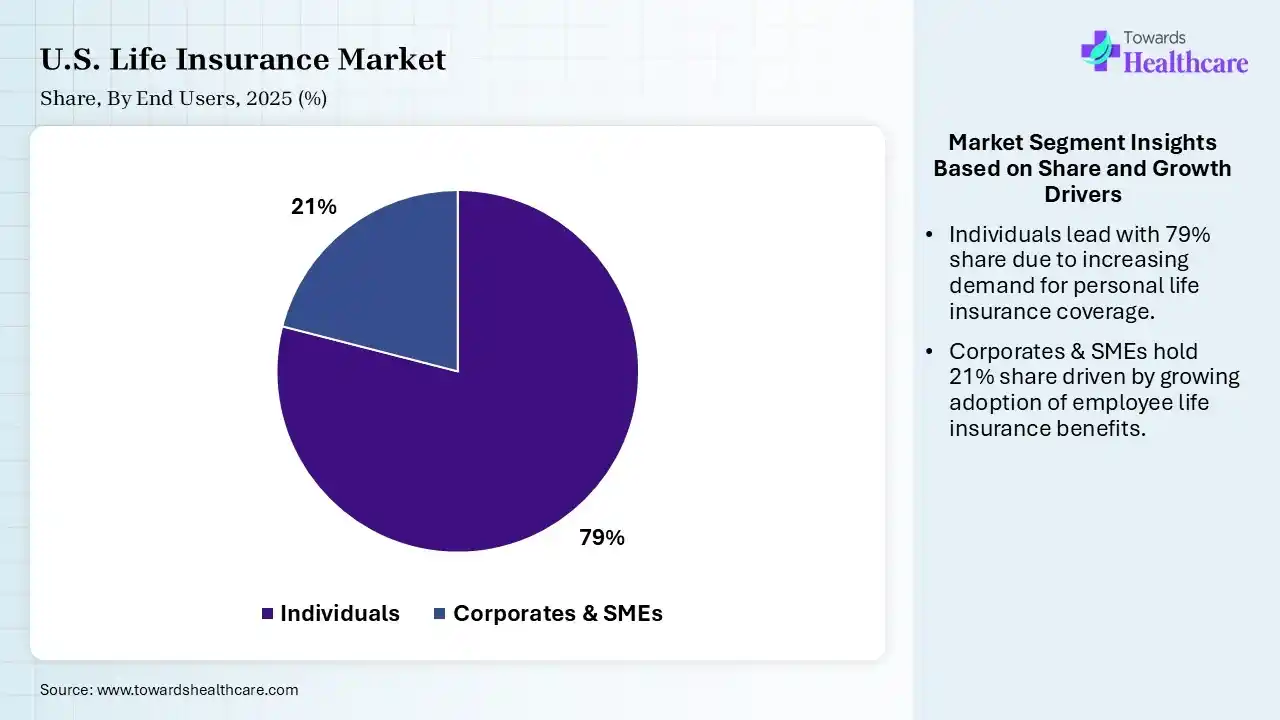
| Segment | Share 2025 (%) |
| Individuals | 79% |
| Corporates & SMEs | 21% |
The Individuals Segment Dominated the Market With 79% in 2025
The individuals segment held the largest revenue share of 79% of the U.S. life insurance market in 2025 and is expected to grow with the fastest CAGR of 6.8% during the forecast period, due to a rise in awareness of financial protection, which increased purchases. Family income protection remained a priority. Digital policy access also improved penetration.
The corporates & SMEs segment held the second-largest share of 21% of the market in 2025, driven by businesses strengthening employee welfare programs. SME formalization is also expanding insurance adoption. Workforce growth is also supporting policy issuance. Expanding collaborations are also increasing their use for financial security.
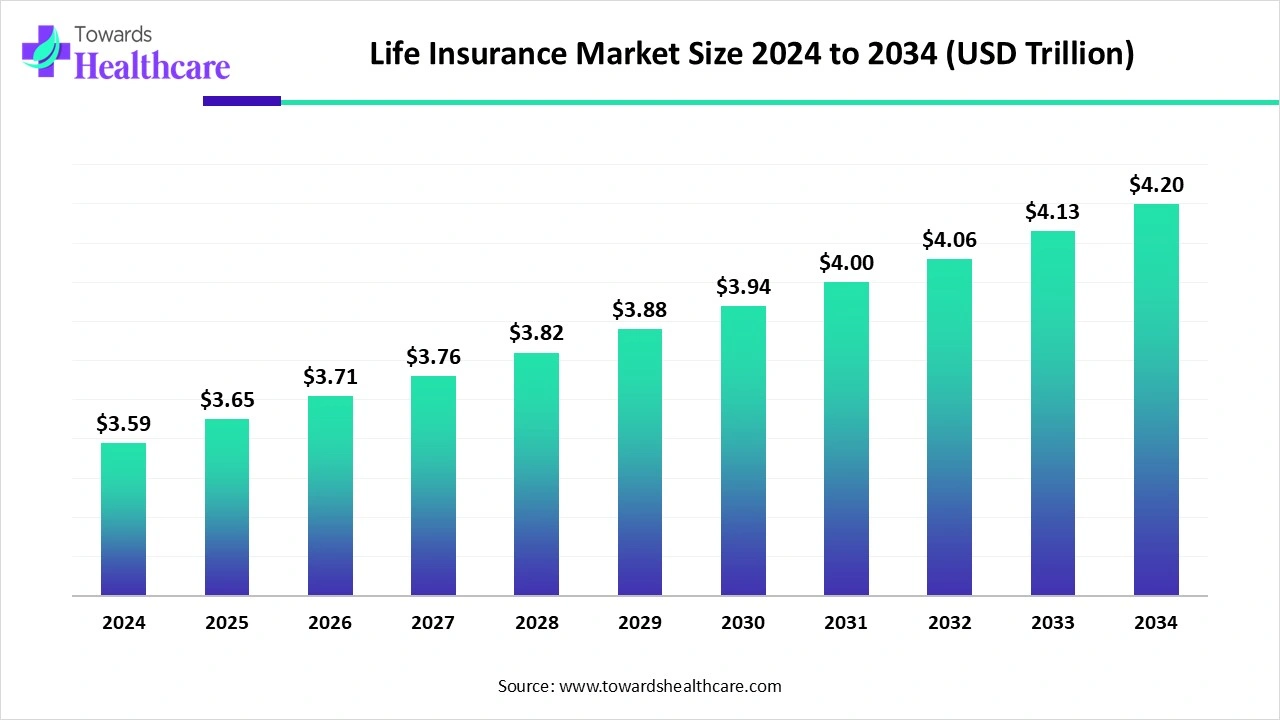
The global life insurance market size is estimated at US$ 3.65 trillion in 2025, is projected to grow to US$ 3.71 trillion in 2026, and is expected to reach around US$ 4.25 trillion by 2035. The market is projected to expand at a CAGR of 1.54% between 2026 and 2035.
The U.S. life insurance market held a significant share in 2025 and is expected to show considerable growth during the forecast period, due to high awareness. This increased the number of insured populations, where a rise in demand for retirement planning also increased the use of life insurance policies. The presence of major insurance companies also expanded the distribution of various insurance policies, where high disposable income also supported their adoption. At the same time, growth in technological advancements also increased the development and launch of new digital insurance policies, along with the expansion of flexible and personalized insurance solutions with improved underwriting, which contributed to the market growth.
R&D
Regulatory Approvals
Patient Support and Services
| Companies | Headquarters | Solutions |
| Northwestern Mutual | Milwaukee, Wisconsin | Northwestern Mutual Level Term, Northwestern Mutual Whole Life, and Northwestern Mutual Custom Universal Life |
| Massachusetts Mutual | Springfield, Massachusetts | MassMutual Vantage Term, MassMutual Legacy 100, and MassMutual Universal Life Guard |
| MetLife | New York City, U.S. | MetLife One Year Term, MetLife Group Whole Life Solutions, and MetLife Variable Universal Life |
| State Farm | Bloomington, Illinois | State Farm Select Term, State Farm Single Premium Whole Life, and State Farm Survivorship Universal Life |
| New York Life | New York City, U.S. | New York Life Yearly Renewable Term, New York Life Custom Whole Life, and New York Life Custom Universal Life Guarantee |
| Lincoln Financial Group | Radnor, Pennsylvania | Lincoln LifeElements Level Term, Lincoln WealthAccumulate Whole Life, and Lincoln WealthPreserve IUL |
| Prudential Financial | Newark, New Jersey | Prudential Term Essential, Prudential PruLife Custom Whole Life and Prudential PruLife Founders Plus UL |
In January 2025, after the launch of Lincoln AssetEdge and the all-new Lincoln AssetEdge SVUL, the senior vice president and head of Insurance Solutions Distribution for Lincoln, Jared Nepa, stated that “Our new AssetEdge solutions offer clients looking for growth potential an opportunity to build a portfolio with optionality and the flexibility to meet multiple planning goals in a tax-advantaged way.” “With performance-based products representing 70% of VUL products sold in 20231, these new offerings round out our suite of VUL products and demonstrate Lincoln’s commitment to offering flexible life insurance solutions that deliver both protection and the freedom to pursue long-term, market-driven wealth accumulation potential.”
Strengths
Weaknesses
Opportunities
Threats
By Solution Type
By Coverage Type
By Distribution Channel
By Premium Type
By End Users









Principal Consultant
Payal Rabde is a Healthcare Market Research Analyst at Towards Healthcare Research & Consulting with 4+ years of experience in pharmaceuticals, biotechnology, medical devices, and life sciences.
Learn more about Payal Rabde

Reviewed By
Aditi Shivarkar is a seasoned professional with over 14 years of experience in healthcare market research. As a content reviewer, Aditi ensures the quality and accuracy of all market insights and data presented by the research team.
Learn more about Aditi Shivarkar