In the U.S., the government & private funding in brain research, along with a focus on 3D organoids, impel the overall market expansion.
Market Overview
The U.S. in-vitro and in-vivo micro electrode array market is defined as the adoption of specialized neurotechnology tools that employ multiple conductive, micrometer-sized electrodes to record/stimulate the electrical activity of neural populations. Particularly, in vitro MEA have broader uses in the study of neural network connectivity, neuronal pathology & high-throughput drug screening. However, in vivo MEA are widely utilized in long-term electrophysiological recording in animals & in human patients for Brain-Computer Interfaces (BCIs).
Global Market Growth
The global in-vitro and in-vivo micro electrode array market size was estimated at USD 1.35 billion in 2025 and is predicted to increase from USD 1.47 billion in 2026 to approximately USD 3.17 billion by 2035, expanding at a CAGR of 8.9% from 2026 to 2035.
Market Prospects
Day by day, the U.S. in-vitro and in-vivo micro electrode array market is putting efforts to promote innovations, with robust results, including prevention of foreign body reaction, i.e. glial scarring, by applying flexible high-density microelectrode arrays (FHD-MEAs). The latest opportunities or incentives regarding MEA are emphasizing chronic recordings in rodents & primates to assess long-term neural dynamics & disease progression.
Number of Neurological Disorders Cases in the U.S. by 2050 (Approx. In Million)
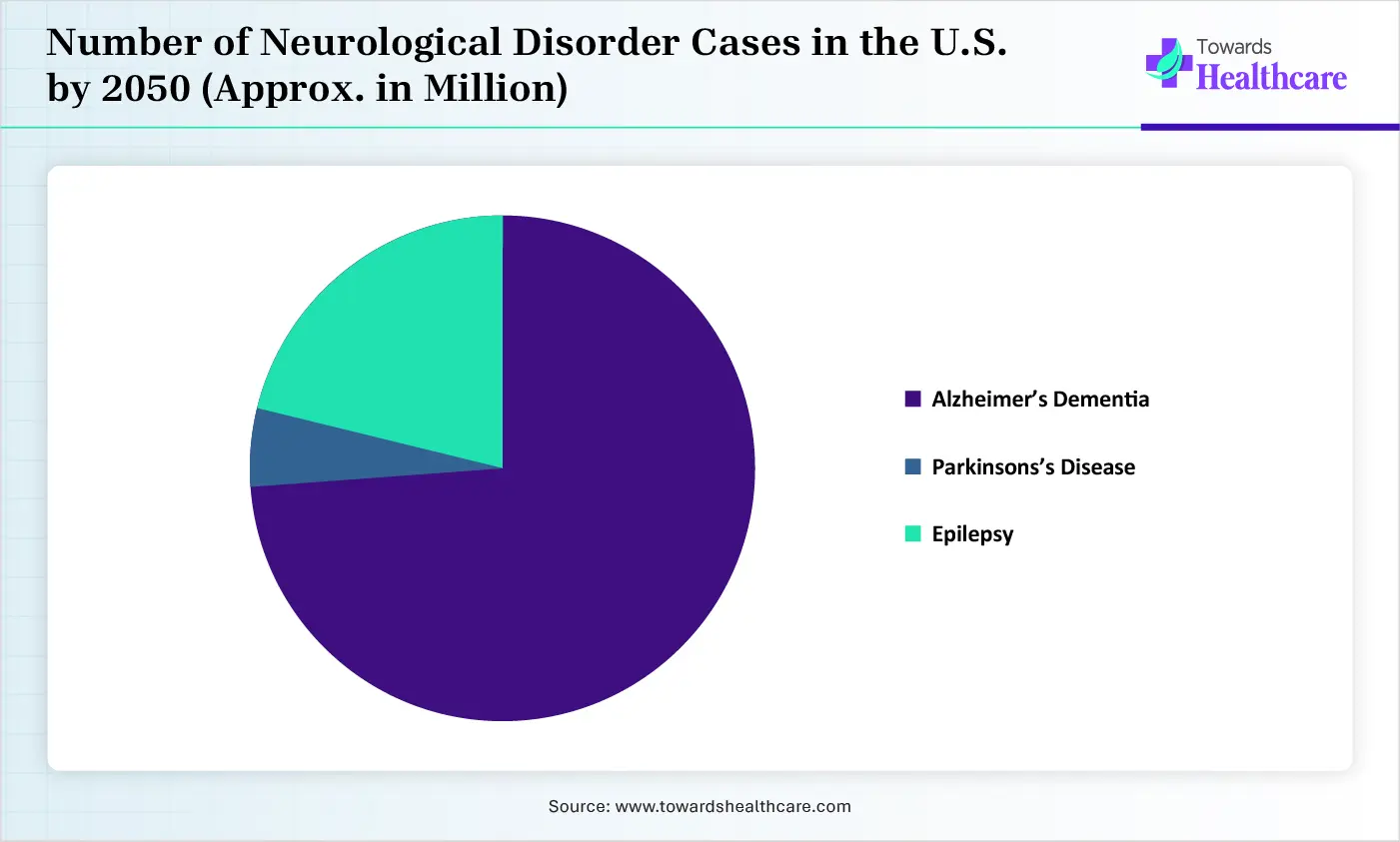
In 2050, the respective market will have above numbers of the various instances, which will demand advanced MEA solutions. While in vitro MEAs will be routinely employed with patient-derived iPSC (induced pluripotent stem cells) to develop 3D organoids, modeling AD, Parkinson’s, & epilepsy in a dish. In the future, High-throughput MEAs will be standard for screening large compound libraries to find drugs for treating neurodegenerative concerns.
Market Segmentation Overview
- By type, the in-vitro MEA segment led with 58% share of the U.S. in-vitro and in-vivo micro electrode array market in 2025. Along with the escalating incidences, the U.S. market is focusing on drug discovery & demand for brain-computer interfaces (BCIs). Whereas the NIH & the BRAIN Initiative in the U.S. fuel the growth of in-vitro MEA. The latest advances include modern CMOS-based MEAs that provide high spatial resolution.
- By material, the silicon-based MEA segment held a major share of 34% in 2025. Its dominance is propelled by microfabrication-enabled affordability, scalability, precision, and localised, deep-tissue monitoring. The market is shifting towards enhancing channel density, optimizing chronic stability for long-term implantation, & boosting biocompatibility through flexible designs.
- By application, the neuroscience research segment captured a 36% share of the U.S. in-vitro and in-vivo micro electrode array market in 2025. The segmental growth is fueled by rising brain research funding, which fosters the adoption of MEAs. Alongside, this area provides a highly realistic representation of neural dynamics in a living condition, with high-precision data on memory, perception, & motor control.
- By end-user, the academic & research institutes segment dominated with 38% share in 2025. This mainly covers the University of Michigan (Ann Arbor), Johns Hopkins University, University of Pittsburgh, Caltech, & MIT. These institutions are aiming to innovate neural interfaces, evolve high-density recording technology, & conducting systems neuroscience research in freely behaving animal models.
Top Companies in the In-Vitro And In-Vivo Micro Electrode Array Market
In the U.S., Blackrock Neurotech, Axion BioSystems, Plexon Inc., and NeuroNexus Technologies are four progressing & key firms in the market. From these, Blackrock Neurotech executed its prominent innovation, called its next-generation, high-density, long-term stable neural implants.
Segments Covered in the Report
By Type
- In-Vitro Micro Electrode Arrays
- Planar MEA
- Single-well MEA
- Multi-well MEA
- 3D MEA
- Scaffold-based MEA
- Organoid-integrated MEA
- In-Vivo Micro Electrode Arrays
- Implantable MEA
- Neural Probes
- Silicon-based Probes
- Polymer-based Probes
- Wireless MEA
- Surface MEA
- EEG-based Arrays
- ECoG Arrays
By Material
- Silicon-based MEA
- Polymer-based MEA
- Glass-based MEA
- Metal-based MEA
- Carbon-based MEA
- Graphene
- Carbon nanotubes
By Application
- Neuroscience Research
- Brain mapping
- Synaptic activity studies
- Drug Discovery & Development
- Toxicology screening
- Efficacy testing
- Cardiac Research
- Electrophysiology studies
- Arrhythmia analysis
- Disease Modeling
- Neurodegenerative Diseases
- Rare genetic disorders
- Brain-Computer Interface (BCI)
- Prosthetics control
- Cognitive Enhancement
By End-User
- Academic & Research Institutes
- Pharmaceutical & Biotechnology Companies
- Contract Research Organizations (CROs)
- Hospitals & Diagnostic Centers
- Medical Device Companies




