


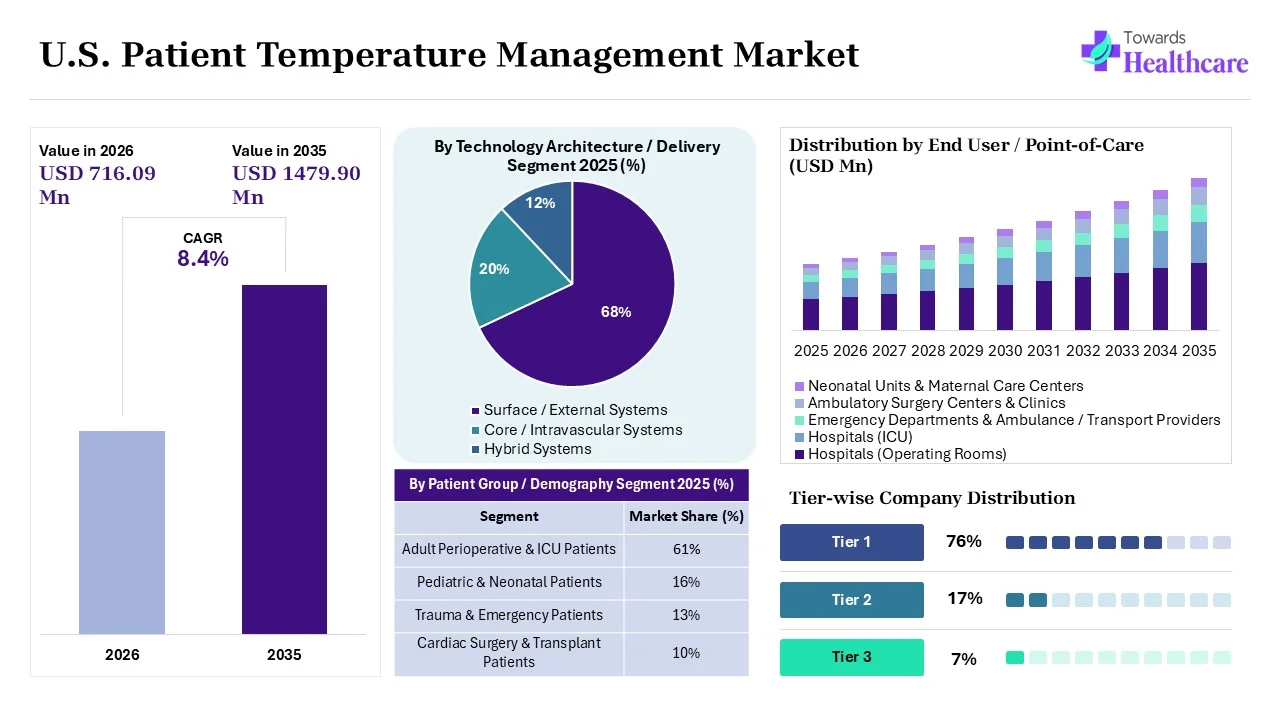
The U.S. patient temperature management market size accounted for USD 660.6 million in 2025 and is predicted to increase from USD 716.09 million in 2026 to approximately USD 1479.9 million by 2035, expanding at a CAGR of 8.4% from 2026 to 2035. Maintaining proper body temperature lowers surgical problems, supports patient recovery, and enhances clinical results, driving growth in the U.S. patient temperature management market.
Maintaining an appropriate body temperature in normal ranges assists in optimising metabolic processes and bodily functions. So, reducing environmental factors in the hospital setting that result in unnecessary body temperature fluctuations is significant. Temperature management is a noteworthy component of the care needed for neonatal and paediatric patients. Infants and children are susceptible to temperature differences due to physiological and anatomical differences. This includes their larger surface area to volume ratio and immature thermoregulatory tools. Patient temperature management is significant for optimum clinical results and involves active body surface warming (ABSW) to preserve normothermia. The close monitoring, manipulation, and regulation of body temperature form an imperative part of the care of the critically ill patient.
Intravascular temperature management (ITM) is applied for temperature control in stroke, cardiac arrest, and traumatic brain injury patients. While ITM technology has been found to have a rapid time-to-target-temperature as compared to other progressive targeted temperature management technologies, they have also been associated with infectious and non-infectious problems. While the rates of thrombolytic complications are high (up to 90%), the occurrence of major adverse events (AEs) is less acute. The advanced intravascular temperature management technology allows to effectively, safe, and rapid management of the core body temperature of a patient in a fraction of time. Intravascular temperature management technology finds major claims in perioperative care and critical care, which drives the growth of the U.S. patient temperature management market.
By product, the forced-air (convective) warming systems segment contributed the largest market share of 31% in 2025, as forced-air warming efficiently lowered the incidence of hypothermia and speed up the recovery of postoperative core temperature although no statistical changes in the incidence of surgical site infection and postoperative shivering and thermal comfort.
By application, the perioperative normothermia prevention segment contributed the largest market share of 42%, as efficient perioperative temperature management lowers hypothermia-associated challenges, lowers healthcare expenses, and offers substantial social and organizational advantages. It increases patient comfort, enhances the healing of wounds, and ultimately accelerates recovery and discharge from the hospital.
By end user, the hospitals (operating rooms) segment held a significant share of 47% in the market. Targeted temperature management in a hospital is the practice of rapidly lowering the body's core temperature from 32°C to 34°C in an effort to reduce neurological harm post-cardiac incident. PTM shows simple, affordable, and evidence-driven approaches to enhance patient safety, lower challenges, and lower expenses.
By technology, the surface / external systems segment contributed the largest market share of 68%, as surface and external temperature control or monitoring technology increases by offering non-invasive, localized, and highly accessible thermal management. They are specifically advantageous for their informal retrofitting onto current infrastructure, specific zone-specific control, and zero disruption to interior operations.
By patient group, the adult perioperative & ICU patients segment contributed the largest market share of 61%, as efficient perioperative temperature management in adult and ICU patients reduces hypothermia-associated problems, reduces medical care expenditures, and offers substantial social and organizational advantages, which contribute to the growth of the U.S. patient temperature management market. It improves patient comfort, enhances the healing of wounds, and eventually accelerates recovery and discharge from the hospital.
Leading companies in the U.S. patient temperature management market include 3M Company, ZOLL Medical Corporation, Stryker Corporation, and Gentherm Medical. Meanwhile, 3M Company offers the 3M Bair Hugger system, an industry standard for convective (forced-air) warming blankets. ZOLL Medical Corporation, provides the Thermogard XP system, offering targeted intravascular temperature management. Stryker Corporation delivers a range of perioperative warming systems, including the armTouch convective warming system, and Gentherm Medical manufactures localized and systemic technologies such as the Blanketrol III hyper-hypothermia system.
By Product
By Application
By End User
By Technology Architecture
By Patient Group


