Growing environmental regulations, rising demand for energy-efficient cold chain infrastructure, growing shift towards sustainability trends, increasing vaccination programs, expanding food & beverage industries, growing e-commerce platforms, and technological advancements are promoting the market growth.
Green Cold Chain: A Deep Dive into U.S. Sustainable Refrigeration Trends
Sustainable refrigeration technology refers to energy-efficient cooling systems consisting of eco-friendly refrigerants and smart technologies to minimize environmental impact and enhance long-term sustainability. Their efficient temperature control promotes their use across the pharmaceutical sector, healthcare facilities, food processing industries, the agriculture sector, and the marine industry. They are also being used in cold chain logistics, supermarkets, retail stores, residential use, and data centres.
Global Market Growth
The global sustainable refrigeration technology market size was estimated at USD 48.6 billion in 2025 and is predicted to increase from USD 52.93 billion in 2026 to approximately USD 114 billion by 2035, expanding at a CAGR of 8.9% from 2026 to 2035.
Forecasting Opportunities: The Rise of Green Refrigeration Bloom
- Rapid expansion of the cold chain logistics in the U.S. is increasing the adoption of sustainable refrigeration technology across various sectors.
- Growing use of biologics and vaccines is also increasing their demand across the pharmaceutical and healthcare sectors.
- Increasing government regulations are promoting the adoption of sustainable refrigeration technologies.
- Growing sustainability trends are increasing the shift towards natural refrigerants, fueling the demand for these technologies.
- Increasing investments and rising demand for last-mile refrigerated deliveries are also increasing their use.
- Expanding technological advancements are also promoting the development of smart monitoring and advanced cooling technologies.
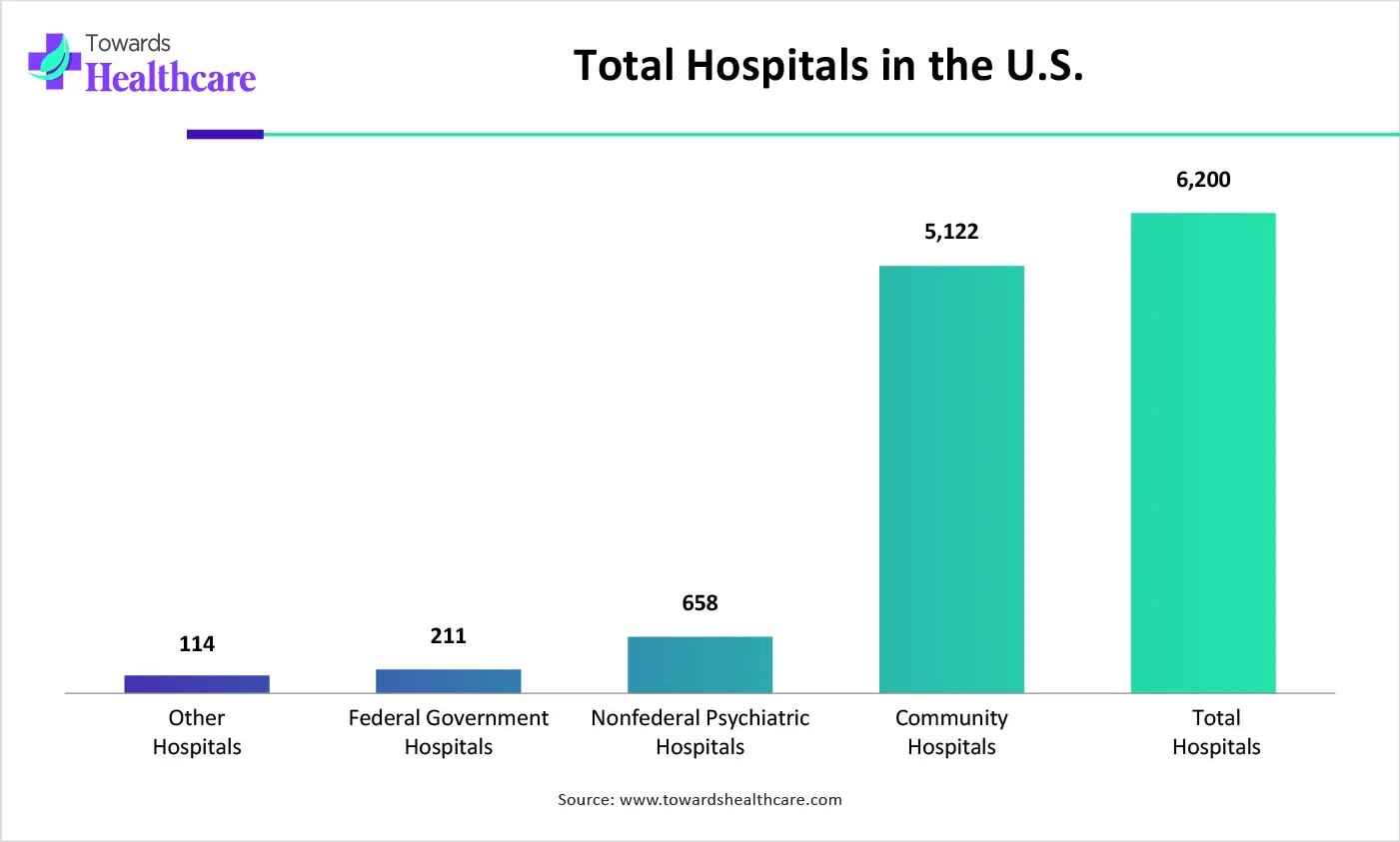
The graph represents a comparison between the total number of hospitals in the U.S. It indicates that there will be a rise in hospitals, which will drive the demand for various healthcare products. This, in turn, will increase the adoption of sustainable refrigeration technology for the effective storage and distribution of healthcare products, which will ultimately promote market growth.
Market Segmentation Overview
- By technology type, the vapor compression refrigeration segment accounted for the highest revenue share of 62% of the U.S. sustainable refrigeration technology market in 2025, due to its high energy efficiency. Their easy maintenance, along with proven and reliable technology, also increased their use. Their strong cooling performance also increased their adoption rates.
- By application type, the commercial refrigeration segment held a major revenue share of 34% of the U.S. sustainable refrigeration technology market in 2025, driven by large-scale food storage needs. Growth in food services and cold chain logistics has also increased their use. Their efficient cooling systems and regulatory compliance also increased their adoption.
- By end-user industry type, the food & beverage segment contributed the biggest revenue share of 38% of the U.S. sustainable refrigeration technology market in 2025, due to high demand for temperature control to prevent product spoilage. Growth in the adoption of processed and frozen food also increased their use. Sustainable refrigeration technology was also used for product storage and transportation.
- By system type, the standalone systems segment held the largest revenue share of 28% of the U.S. sustainable refrigeration technology market in 2025, driven by their easy installation and lower cost. Their simple maintenance and flexible deployment also increased their adoption rates. Their enhanced energy efficiency and scalability also increased their use across supermarkets and restaurants.
- By energy source type, the electric-powered segment led the U.S. sustainable refrigeration technology market with a 58% share in 2025, due to widespread availability and high energy efficiency. Their automation control and lower operating costs also increased their use. Their lower emissions and simple system design also increased their adoption.
Regional Analysis
The U.S. sustainable refrigeration technology market held an 18% share in 2025 and is expected to show notable growth during the forecast period, due to well-established cold chain industries. Stringent environmental regulations and growth in the focus towards net-zero emission operations have also increased the adoption of sustainable refrigeration technologies. A rise in the development of pharmaceuticals, vaccines, and the expansion of retail and food services also increased their use, which enhanced the market growth.
The Cooling Giants: The U.S. Sustainable Refrigeration Leaders
Carrier Global Corporation registered dominance over the market with its BluEdge digital platform, where Dover Corporation was its closest competitor, which offered Hillphoenix brand CO2 transcritical racks. Emerson Electric Co. also sustained its position by providing transcritical CO2 scroll compressors, where Lennox International Inc. also contributed to the market growth with its low-GWP refrigerants.
Segments Covered in the Report
By Technology Type
- Vapor Compression Refrigeration
- Hydrofluorocarbon (HFC)-based
- Hydrofluoroolefin (HFO)-based
- Natural Refrigerant-based
- CO? (R744)
- Ammonia (R717)
- Hydrocarbons (R290, R600a)
- Absorption Refrigeration
- Lithium Bromide Systems
- Ammonia-Water Systems
- Thermoelectric Refrigeration
- Magnetic Refrigeration
- Solar-powered Refrigeration
- Solar Direct Drive
- Solar-assisted Systems
By Application
- Commercial Refrigeration
- Supermarkets & Hypermarkets
- Convenience Stores
- Food Service (Hotels, Restaurants, Cafes)
- Industrial Refrigeration
- Food & Beverage Processing
- Chemical & Petrochemical
- Pharmaceutical Manufacturing
- Residential Refrigeration
- Domestic Refrigerators
- Freezers
- Transportation Refrigeration
- Refrigerated Trucks
- Containers
- Rail Refrigeration
- Cold Chain Logistics
- Warehousing
- Distribution Centers
By End-User Industry
- Food & Beverage
- Healthcare & Pharmaceuticals
- Retail
- Chemicals
- Logistics & Transportation
- Hospitality
By System Type
- Standalone Systems
- Centralized Systems
- Condensing Units
- Packaged Systems
By Energy Source
- Electric-powered
- Solar-powered
- Hybrid Systems
- Waste Heat-driven Systems
By Refrigerant Type
- Natural Refrigerants
- Synthetic Refrigerants
- HFCs
- HFOs
- Blends (HFC/HFO blends)




