


 Request Consultation
At a Glance:
An acceleration of gene therapy approvals in 2026 mainly includes the FDA approval of Otarmeni (lunsotogene parvec-cwha) in April for OTOF-related genetic hearing loss, in just 61 days. Specific coverage of this product covers the fastest biologics license application approval in the agency's history & the sixth product approved under the National Priority Voucher pilot program. Also, it is known as the first disease-modifying treatment ever available for this kind of deafness, which restores hearing in 80% of evaluable clinical trial patients. Meanwhile, the approved gene therapy field has expanded to sixteen products ranging across spinal muscular atrophy, inherited retinal disease, hemophilia A & B, Duchenne muscular dystrophy, and epidermolysis bullosa. Moreover, the global market is estimated to surge from nearly $13.2 billion in 2026 to $63.5 billion by 2035, coupled with a 19.1% CAGR.
At the same time, in November 2025, the FDA disclosed a boxed warning for Sarepta's Elevidys after two pediatric patients died of acute liver failure, which restricts the Duchenne muscular dystrophy therapy to ambulatory patients only. Along with this, Novartis's Zolgensma, i.e. once gene therapy's commercial flagship at $1.35 billion in peak annual sales, logged its first-ever annual decrease in 2025. This indicates a one-time-dose cure model runs into a tough ceiling once the treatable population has largely been dosed. However, every approved gene therapy so far faces the same unanswered question: with per-patient costs exceeding $2 million, no healthcare financing system was developed to absorb a single curative payment of that size.
This briefing reflects today’s approved ground & its market trajectory, which tracks how the National Priority Voucher program is compressing regulatory timelines, describes the Elevidys safety warning and what it reveals about risk-stratified regulation, and lays out the financing and manufacturing limitations that will decide how far gene therapy's scientific confidence actually extends. Besides this, the landscape has confirmed that the science can operate rapidly compared with any prior therapeutic modality; what remains unproven is whether the systems evolved to pay for & produce these cures can keep speed.
Gene Therapy Industry Outlined on Two Concepts in 2026
The above frameowkr reflects the breakthrough case, which encloses record-fast approvals, an expanding approved product base, strong market growth, and a maturing accelerated-review pathway, versus the challenge case, which addresses a serious safety warning, a landmark commercial sales decline, unresolved cost and financing questions, and manufacturing bottlenecks.
Key Insight: Regardless of one narrative, in 2026, gene therapy is showcasing that it can shift rapidly compared with any prior therapeutic modality, especially through regulatory review. Alongside this, the sector is facing struggle to verify that faster approval converts into durable clinical and commercial progression.
Source: FDA; AJMC-style industry analysis; STAT; PharmaVoice, 2026.
In Recent Era, Sixteen Approved Gene Therapies, Specifically to Treat Rare Diseases
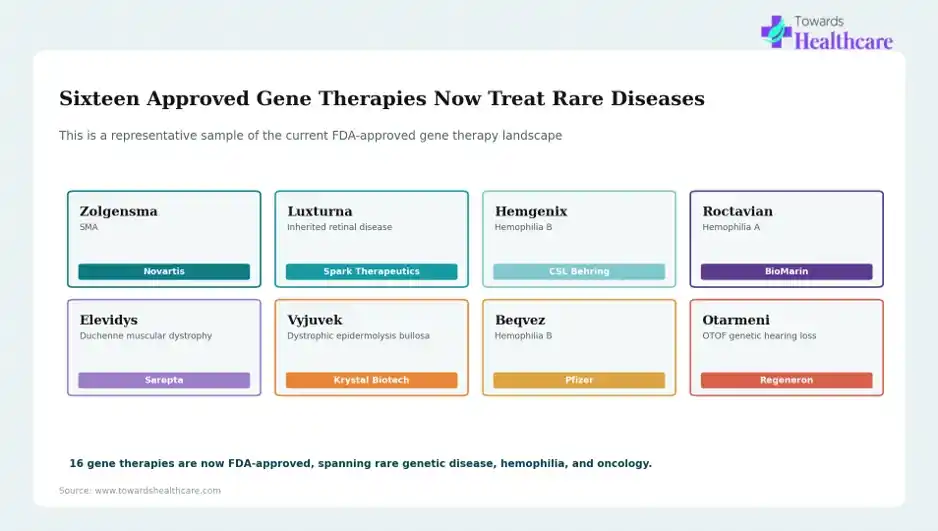
This representation shows the current FDA-approved gene therapy landscape, extending across spinal muscular atrophy, inherited retinal disease, hemophilia A & B, Duchenne muscular dystrophy, epidermolysis bullosa, and genetic hearing loss.
Key Insight: Recent years have brought a variety of approvals, more than the single-indication programs that defined the field a decade ago. However, each novel approval approach is pushing gene therapy into a truly diverse patient population instead of rivalling for the same one.
Source: FDA Approved Cellular and Gene Therapy Products database, 2026.
By 2035, Gene Therapy Market Commenced to Surge From $13.2B to $63.5B
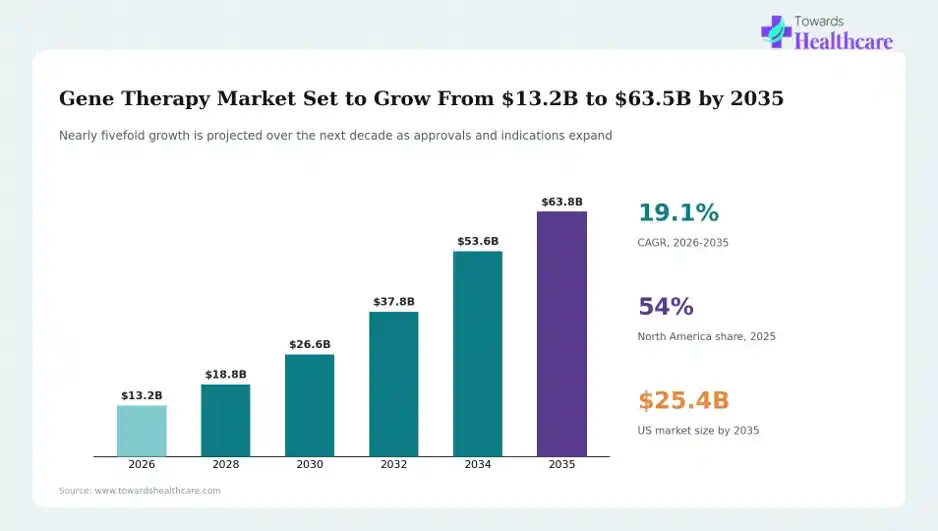
The graph displays anticipated gene therapy market value from 2026 to 2035 at a 19.09% CAGR, coupled with regional share and the US-specific market trajectory.
Key Insight: According to our senior analyst, North America registered dominance with a 54% share in 2025, which is mainly driven by mature regulatory infrastructure and reimbursement capacity compared with other regions. This precise difference will decide how evenly this progression is actually distributed.
Source: Towards Healthcare, Gene Therapy Market Size and Growth, 2026.
Across the Globe, In Vivo Delivery Is Known as Both the Largest & Rapidly Expanding Solution
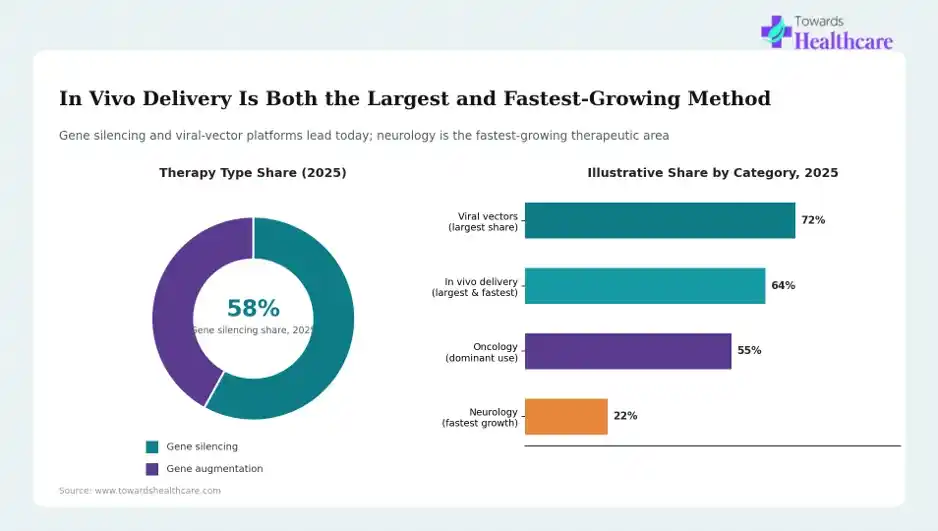
This chart illustrates 2025 market share by therapy type, vector category, and therapeutic area, along with the fastest-growing current categories.
Key Insight: An unexpected growth in both today’s share & expansion rate of in vivo delivery indicates the area has massively shifted toward direct-delivery approaches rather than ex vivo cell modification, especially for most new indications. This is further aligned with real manufacturing implications.
Source: Towards Healthcare, 2026.
Meanwhile, Otarmeni Led as the Fastest Gene Therapy Across Entire FDA Review
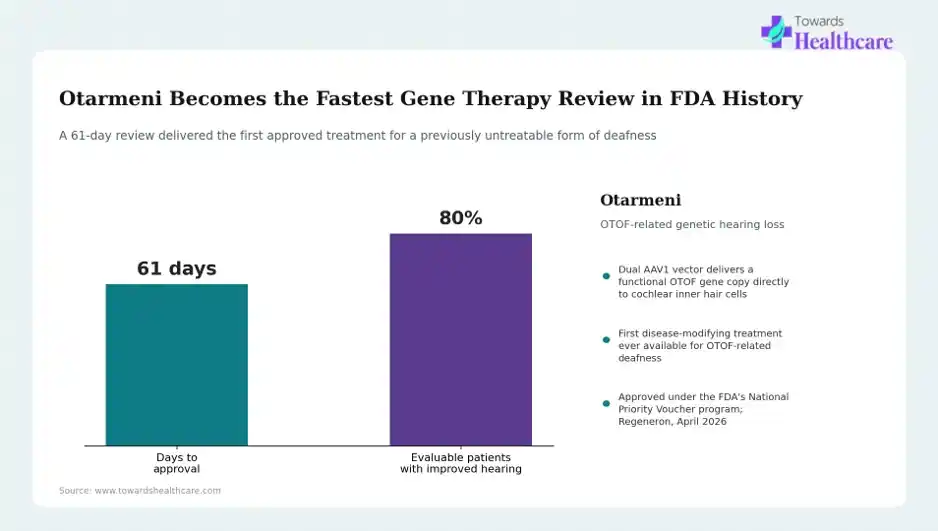
The above graph reflects a 61-day FDA review timeline and an 80% patient-improvement rate for Otarmeni (lunsotogene parvec-cwha), the first gene therapy approved for OTOF-related genetic hearing loss.
Key Insight: Based on the complete analysis, the approval of the respective drug is not restricted to treating a single rare disease. Following validation of the National Priority Voucher program, a key focus area is new therapy for an unmet need, while FDA review can be completed in approximately two months without cutting corners on safety data.
Source: FDA press announcement, April 2026.
Across a Year-Mentioned Contraindications, It Expedited Records & Safety Warning Similarly
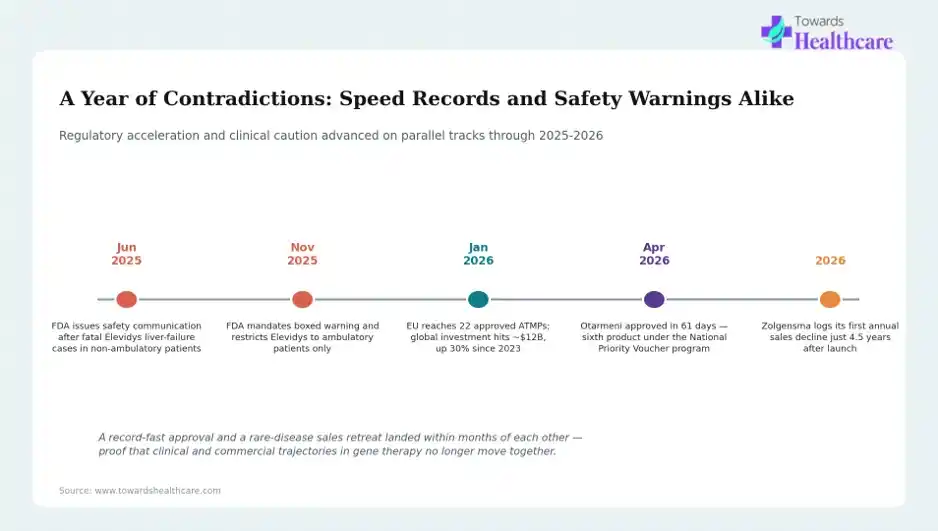
This periodic dictation mainly extends from the June 2025 Elevidys safety communication through the November 2025 boxed warning, January 2026 EU approval milestone, April 2026 Otarmeni approval, and the 2026 Zolgensma sales decline.
Key Insight: An execution of the timeline from June 2025 to now highlights that the sector has seen its fastest-ever approval & its most significant safety restriction. Meanwhile, gene therapy’s regulatory landscape should not just be addressed as a single arc of progress or a single arc of caution in 2026, as both are true simultaneously.
Source: FDA; company disclosures, 2025-2026.
Boxed Warning of Elevidys Represents the Core Edge of Gene Therapy Risk
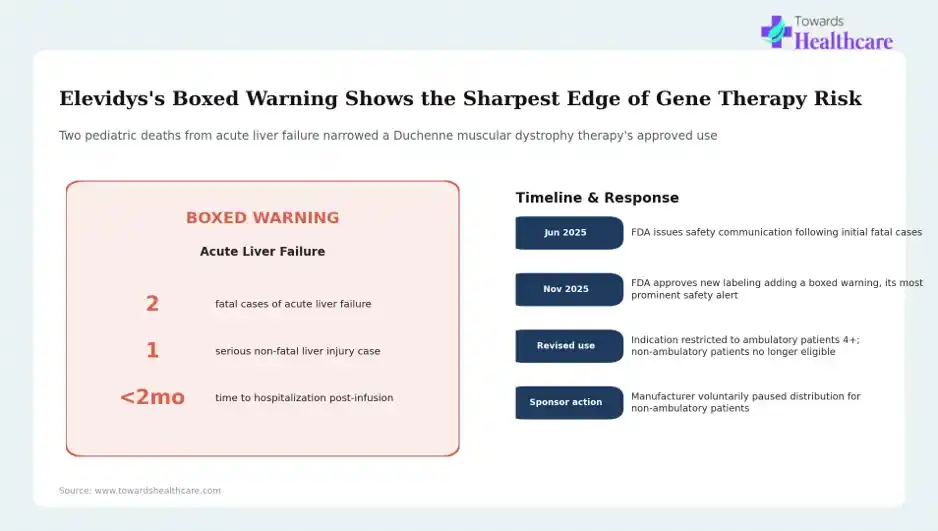
Specific representation encompasses two fatal and one serious non-fatal acute liver failure cases that led the FDA to include a boxed warning and limit Elevidys to ambulatory Duchenne muscular dystrophy patients only.
Key Insight: Regardless of withdrawing the therapy completely, the field restricted use to ambulatory patients, which represents a narrower, risk-stratified approach to gene therapy safety. However, the FDA is widely looking for preservation of access, prominently for lower-risk populations, while reducing use where risk clearly outweighs benefit.
Source: FDA press announcement, November 2025.
Decrease in Zolgensma's Sales Shows Ceiling of the Rare-Disease
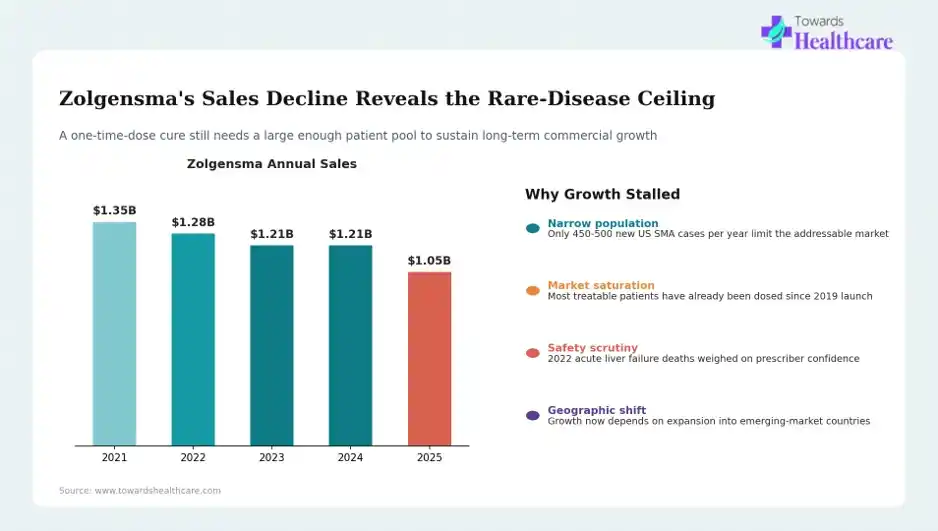
The chart indicates Zolgensma's overall annual sales pathway from its 2021 peak of $1.35 billion through its first-ever annual decline in 2025, coupled with the structural reasons growth has halted.
Key Insight: A showcase of a one-time-dose cure model cannot depend on recurring prescriptions to continue revenue. Hence, once the treatable population is hugely dosed, growth mathematically necessitates new regions or novel indications, as there is no natural approach back to peak sales across the same patient pool.
Source: Novartis financial disclosures; PharmaVoice, 2026.
One of the Pivotal Questions Across the $2M is: Who Pays for a One-Time Cure?
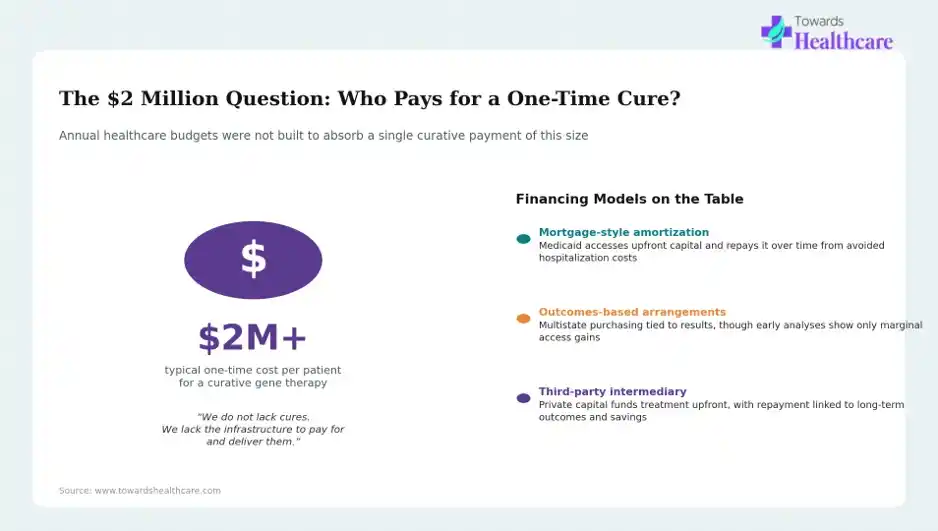
This is a general representation of the per-patient cost of a curative gene therapy, along with three financing models under active discussion, i.e. mortgage-style amortization, outcomes-based arrangements, and third-party intermediary financing.
Key Insight: As per our analyst, every proposed financing model slots the same basic assumption that a cure's value must be expanded over years to be paid for at all. Thus, the limitation on gene therapy's access is currently financial infrastructure as much as it is science.
Source: STAT News; USC Schaeffer Center, 2026.
Manufacturing Capacity Becomes Gene Therapy's Substantial Constraint
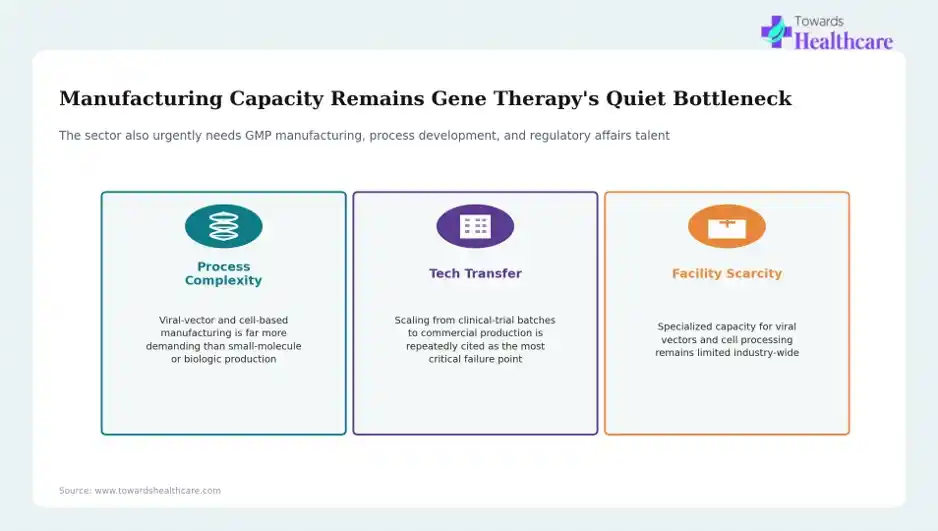
These are the three most-cited operational constraints in gene therapy manufacturing: process complexity relative to conventional pharmaceuticals, tech-transfer risk when scaling to commercial production, and scarcity of specialized viral-vector and cell-processing facilities.
Key Insight: Despite the safety & financing challenges, manufacturing capacity is also considered a key concern of the industry, which can be resolved with capital & time rather than new science. This is defensibly the most remarkable of gene therapy’s current limitations, if investment maintains acceleration with approvals.
Source: Technology Networks; Pharma Focus America, 2026.
Redrafting Approval Timelines Based on The National Priority Voucher
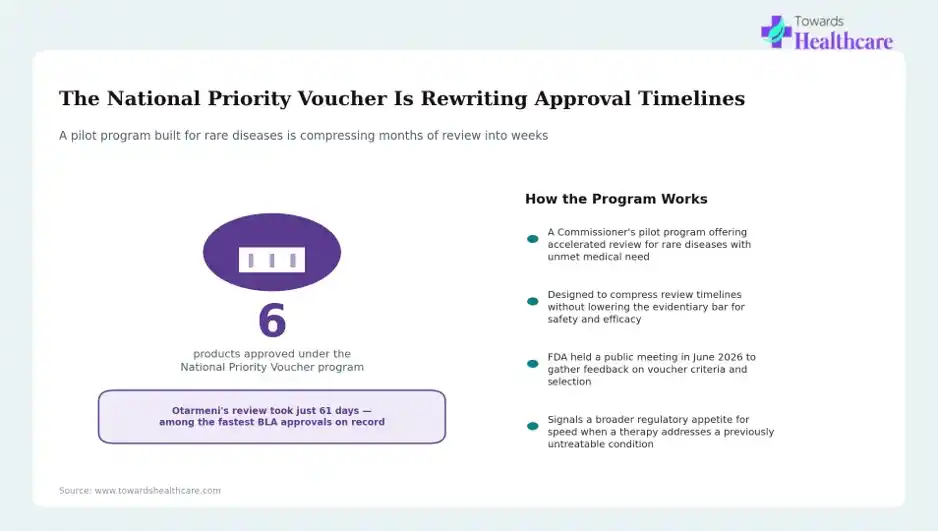
This assessment indicates six gene therapy products approved under the FDA's National Priority Voucher pilot program and how the program compresses review timelines for rare diseases with unmatched medical need.
Key Insight: Th implementation has explored a 61-day review for Otarmeni signals, which is not a one-off accommodation. This is a recurrent trajectory, and the FDA's June 2026 public meeting on program criteria reflects that the agency needs to formalize and likely expand it instead of treating it as an experiment.
Source: FDA; CGTlive, 2026.
Limited Number of Players Are Still Leading Approved Gene Therapy
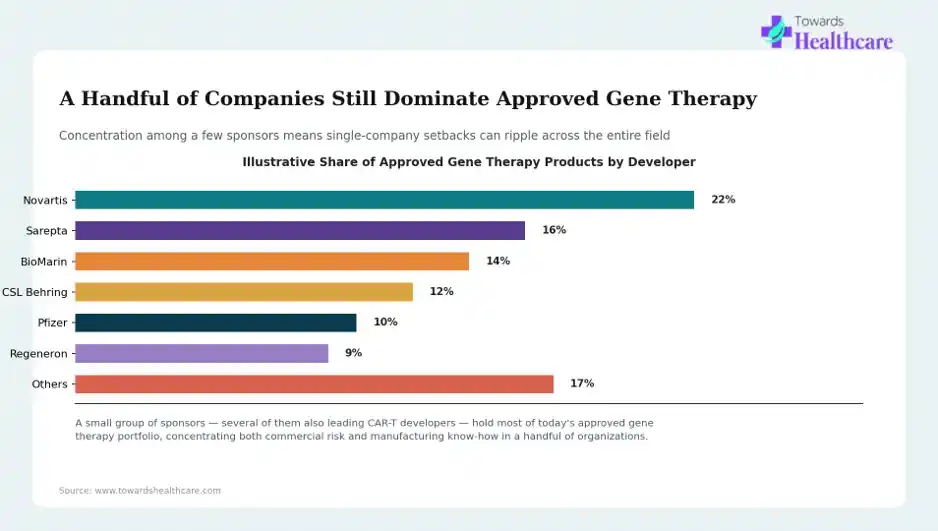
This fragmented demonstration indicates approved gene therapy products by developer, which represents an emphasis on Novartis, Sarepta, BioMarin, CSL Behring, Pfizer, and Regeneron.
Key Insight: Highly focused on a handful of sponsors, whereas a single firm’s safety hurdle or commercial stumble, as with Sarepta's Elevidys warning or Novartis's Zolgensma decline. This can transform investor and regulator sentiment toward the comprehensive therapeutic class, not only one candidate.
Source: Towards Healthcare analysis, 2026.
Three Forces Will Determine Gene Therapy's Upcoming Transformation
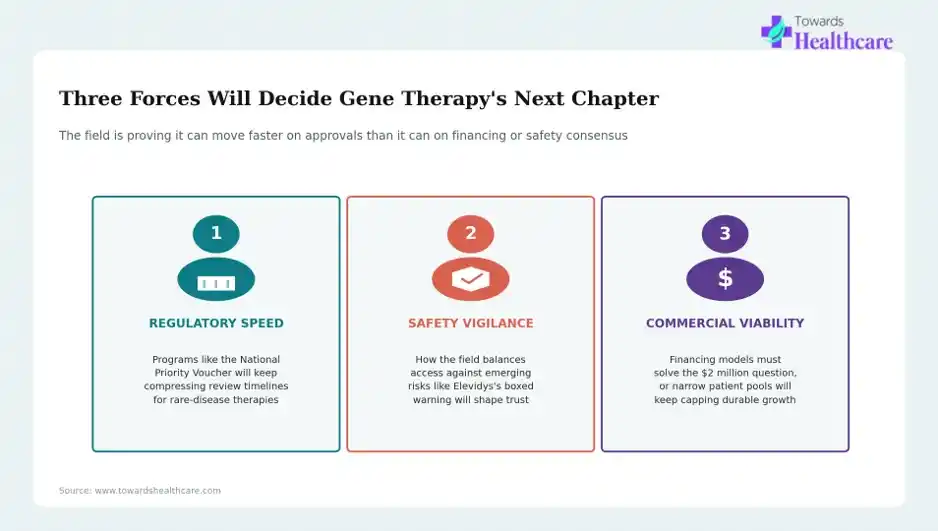
This framework highlights three major variables, which are considered to decide gene therapy’s pathway, including consistent regulatory speed through programs such as the National Priority Voucher, safety vigilance following incidents like Elevidys's boxed warning, and commercial viability given the $2 million cost question.
Key Insight: Recently, gene therapy has confirmed the science works & that operators can step faster when a therapy is truly new. The remaining unproven area covers whether the health system can pay for these cures at scale without years of trial and error on financing models.
Source: Towards Healthcare analysis, 2026.
Glimpse of Approved Gene Therapies
| Brand Name | Generic Name | Developer | Approved Indication |
| Zolgensma | onasemnogene abeparvovec-xioi | Novartis Gene Therapies | Spinal muscular atrophy |
| Luxturna | voretigene neparvovec-rzyl | Spark Therapeutics | Inherited retinal disease |
| Hemgenix | etranacogene dezaparvovec-drlb | CSL Behring | Hemophilia B |
| Roctavian | valoctocogene roxaparvovec-rvox | BioMarin Pharmaceutical | Hemophilia A |
| Elevidys | delandistrogene moxeparvovec-rokl | Sarepta Therapeutics | Duchenne muscular dystrophy (ambulatory) |
| Vyjuvek | beremagene geperpavec-svdt | Krystal Biotech | Dystrophic epidermolysis bullosa |
| Beqvez | fidanacogene elaparvovec-dzkt | Pfizer | Hemophilia B |
| Otarmeni | lunsotogene parvec-cwha | Regeneron Pharmaceuticals | OTOF-related genetic hearing loss |
Recent Updates About Gene Therapies in 2026
In September 2026, the US FDA approved Fayuvi, developed by Ultragenyx, to treat pediatric patients with mucopolysaccharidosis type IIIA (MPS IIIA), also known as Sanfilippo syndrome Type A.
In September 2026, Beacon Therapeutics reported positive topline results for its registration-enabling VISTA trial assessing laruparetigene zovaparvovec (laru-zova) in patients with X-linked retinitis pigmentosa (XLRP).
In September 2026, Ionis Pharmaceuticals revealed positive key results from its Phase 3 FUSION study of ulefnersen, a gene-targeting RNA therapy that improves functional impairment and survival for individuals living with FUS-ALS, a rare & aggressive form of amyotrophic lateral sclerosis.
In September 2026, Lexeo Therapeutics agreed to acquire Mantle Therapeutics & also announced multiple new alliances to reinforce leadership in Friedreich Ataxia & assists the cerebellar-targeted development of frataxin gene therapy.
Prospective Pipelines of Gene Therapies in 2027
| Therapy/Company | Indication | Goal of 2027 |
| Regenxbio (RGX-202) | Duchenne muscular dystrophy (DMD) | Scheduled for FDA Approval |
| Ultragenyx (UX111) | Sanfilippo syndrome type A (MPS IIIA) | Expected FDA approval in 2027 |
| Sarcomatrix (S-969) | Targeting alpha-7 beta-1 integrin to repair muscle fibers | Disclose its first-in-human clinical trial in 2027 |
| Intellia Therapeutics (NTLA-2002) | Hereditary Angioedema (HAE) | Through its Phase 2/3 pipeline toward 2027 regulatory stages. |
| Ocugen OCU400 | Retinitis Pigmentosa | Predicted Q1 2027 & subsequent BLA submission. |
| Ocugen OCU410ST | Stargardt disease | Scheduled its significant top-line trial readouts in Q2 2027. |
| AbbVie & Regenxbio (ABBV-RGX-314) | wet age-related macular degeneration (nAMD) | Anticipated late 2026 and H2 2027 to move nAMD from chronic eye injections to a one-time durable treatment. |
| Opus Genetics (OPGx-MERTK & OPGx-RHO) | A variety of retinitis pigmentosa | Abu Dhabi trials beginning in Q1 2027 and global dominant trials following in H2 2027. |
Strategic Question for Industry Leaders
- How should companies design post-market surveillance to catch delayed safety signals like Elevidys's liver toxicity before they reach a boxed-warning stage?
- What patient-selection criteria should govern gene therapies where risk clearly varies by disease severity or ambulatory status?
- Should manufacturers pursue the National Priority Voucher pathway proactively for pipeline candidates, or does its selection criteria remain too narrow to plan around?
- How should companies price future one-time-dose cures to avoid the sales-ceiling pattern now visible in Zolgensma's trajectory?
- What financing model, i.e. mortgage-style amortization, outcomes-based contracts, or third-party intermediaries, is most likely to gain payer traction first?
- How should health systems track long-term outcomes for gene therapy patients who change insurance plans mid-contract under an outcomes-based arrangement?
- What manufacturing investments would most directly reduce tech-transfer risk when scaling from clinical trial to commercial-scale viral vector production?
- Should companies build in-house manufacturing capacity or rely on contract development and manufacturing organizations as approval volume increases?
- How should regulators balance faster review timelines against the risk of safety signals emerging only after broader post-approval use?
- What lessons from Otarmeni's 61-day review are transferable to accelerating other rare-disease gene therapy candidates?
- How should companies communicate boxed-warning risk to patient communities without undermining confidence in the broader gene therapy modality?
- What role should government-backed financing vehicles play in absorbing upfront gene therapy costs for public payers like Medicaid?
- How should the industry address workforce shortages in GMP manufacturing, process development, and regulatory affairs as approval volume accelerates?
- Should gene therapy developers prioritize expansion into emerging markets as domestic patient pools become saturated, as Novartis has signaled?
- What combination of real-world evidence and long-term registries would best reassure regulators considering label expansions for restricted therapies?
- How should companies weigh geographic expansion against the added complexity of navigating multiple reimbursement systems simultaneously?
- What early warning indicators should sponsors monitor to detect a Zolgensma-style sales plateau before it affects investor confidence?
- How should the field define acceptable risk-benefit thresholds differently for pediatric versus adult gene therapy populations?
- What role should specialized viral-vector manufacturing hubs play in solving the industry's facility scarcity problem?
- How should companies structure R&D investment between expanding into new rare diseases versus deepening indications within existing approved therapies?
Data & Intelligence Pointers
- Track FDA MedWatch filings and post-marketing surveillance reports for emerging safety signals across all approved AAV-vector gene therapies.
- Monitor the FDA's National Priority Voucher program criteria updates following its June 2026 public meeting for signs of program expansion.
- Follow Novartis, Sarepta, and BioMarin quarterly earnings for gene therapy sales trends as a leading indicator of rare-disease market saturation.
- Watch state Medicaid programs piloting the Cell and Gene Therapy Access Model for early outcomes-based payment results.
- Track EMA advanced therapy medicinal product approval counts alongside FDA approvals to compare transatlantic regulatory pace.
- Review company pipeline disclosures for progress on in vivo delivery platforms as the fastest-growing segment of the gene therapy market.
- Monitor specialized viral-vector manufacturing capacity announcements and CDMO expansions as a proxy for easing the industry's facility bottleneck.
- Follow academic and health-system publications on real-world Elevidys outcomes in the newly restricted ambulatory patient population.
- Track private capital and venture financing deals structured around outcomes-based or amortized gene therapy payment models.
- Monitor workforce and hiring trends in GMP manufacturing, process development, and regulatory affairs as a signal of industry capacity constraints.
- Watch for label expansion filings on approved gene therapies as companies seek to broaden addressable patient populations beyond initial narrow indications.
- Track gene therapy CAGR revisions in market research updates as new approvals and safety events shift analyst forecasts.
References
- U.S. Food and Drug Administration. "FDA Approves First-Ever Gene Therapy for Treatment of Genetic Hearing Loss Under National Priority Voucher Program." Press announcement, April 2026.
- U.S. Food and Drug Administration. "FDA Approves New Safety Warning and Revised Indication that Limits Use for Elevidys Following Reports of Fatal Liver Injury." Press announcement, November 2025.
- U.S. Food and Drug Administration. "Approved Cellular and Gene Therapy Products." FDA database, accessed September 2026.
- Aristo Group. "Gene Therapy 2026: New Approvals and Their Significance." 2026.
- Towards Healthcare. "Gene Therapy Market Size, Share, Growth Report." 2026.
- STAT News. "$2 Million Gene Therapy Cures Require a Financing Model." June 2026.
- USC Schaeffer Center. "High-Stakes Medicine: Rethinking Policies for the Cost and Value of Cell and Gene Therapies." March 2026.
- PharmaVoice. "Novartis' Zolgensma Sales Fall Again as Gene Therapy Market Woes Persist." 2026.
- Technology Networks. "The Evolving Challenges Shaping Cell and Gene Therapy Manufacturing." 2026.
- Pharma Focus America. "Challenges and Opportunities in Cell and Gene Therapy Manufacturing." 2026.