



Let's See Which Companies are Leading in the Necrotizing Fasciitis Market
- Astellas Pharma
- Pfizer, Inc.
- Eli Lilly and Company
- Grifols SA
- Sanofi
- Roche Holding AG
- Bayer AG
- Amgen, Inc.
Necrotizing Fasciitis: Rapid Response, Rising Demand
The necrotizing fasciitis market is experiencing robust growth, driven by the rising incidence of NF, the increasing number of surgeries, and the growing demand for personalized medicines. It encompasses the development, manufacturing, and provision of services for the prevention, diagnosis, and treatment of NF. NF is a rare bacterial disorder that causes inflammation of the fascia. It is diagnosed using blood tests, specimen culture, tissue biopsy, and imaging tests.
Market Growth
The global necrotizing fasciitis market size is calculated at USD 1.12 billion in 2025, grew to USD 1.21 billion in 2026, and is projected to reach around USD 2.49 billion by 2035. The market is expanding at a CAGR of 8.34% between 2026 and 2035.
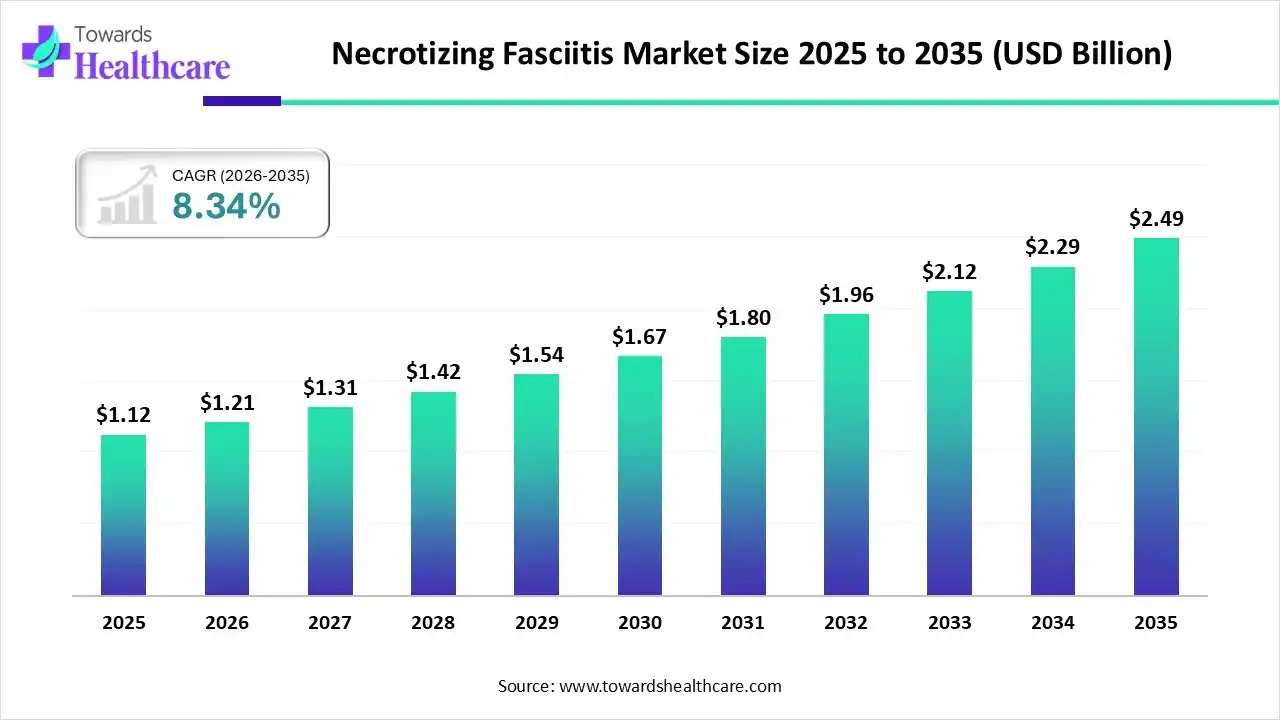
Necrotizing Fasciitis Market Outlook
- Industry Growth Overview: The market is expected to accelerate in the coming years, due to innovations in imaging tools and advances in genomic technologies. The next-generation sequencing technique is used to identify bacterial species responsible for infections in patients with NF.
- Global Expansion: Key players collaborate to develop novel diagnostics and therapeutics and aim to deliver their proprietary products across diverse geographical locations. This helps them expand their geographical presence and strengthen their necrotizing fasciitis market position.
- Major Investors: Government and private investors provide funding to support rare disease research and clinical trials, leading to the development of personalized medicines. Funding also enables companies to set up their manufacturing facilities and provide tailored research and manufacturing services.
Company Landscape
Pfizer Inc.
Company Overview
Description: A global biopharmaceutical company focusing on the discovery, development, manufacturing, and marketing of healthcare products, including medicines, vaccines, and consumer healthcare products. It has a significant presence in the anti-infective space, which is critical for NF treatment.
Corporate Information (Latest Available)
- Headquarters: New York, New York, U.S.
- Year Founded: 1849
- Ownership Type: Public (NYSE: PFE)
History and Background
Overview: Founded by Charles Pfizer and Charles Erhart. Initially a chemical company, it expanded into pharmaceuticals, notably mass-producing penicillin during WWII, establishing its role as a key player in anti-infectives. It grew through organic innovation and strategic M&A to become one of the world's largest biopharmaceutical firms.
Key Milestones/Timeline
- 1849: Company founded.
- 1940s: Becomes a major supplier of penicillin.
- 2000: Merges with Warner-Lambert.
- 2003: Acquires Pharmacia.
- 2020s: Key role in the COVID-19 pandemic response (vaccines, antivirals), generating significant revenue for reinvestment.
Business Overview
Focus: Innovative medicines and vaccines across therapeutic areas like oncology, inflammation & immunology, rare diseases, internal medicine, and anti-infectives.
Business Segments/Divisions
- Pfizer Biopharmaceuticals Group (PBG): Includes key anti-infective products relevant to NF treatment.
- Internal Medicine (Infectious Disease sub-area)
- Oncology, Vaccines, Hospitals (injectable anti-infectives)
Geographic Presence
Global: Products are available in over 180 countries worldwide, with major operations in North America, Europe, and Asia.
Key Offerings (Relevant to NF)
Anti-Infective Drugs: A broad portfolio of intravenous (IV) antibiotics used for empiric broad-spectrum coverage and targeted therapy in NF, such as Zosyn (piperacillin/tazobactam), Tygacil (tigecycline), and antifungals.
End-Use Industries Served
- Healthcare Providers: Hospitals (primary consumers of IV antibiotics for NF), Clinics, Ambulatory Surgical Centers.
- Patients
Key Developments and Strategic Initiatives
Mergers & Acquisitions
- 2023: Completed acquisition of Seagen to enhance Oncology portfolio (less direct impact on NF, but shows M&A focus).
- 2022: Completed acquisition of Biohaven Pharmaceutical and Arena Pharmaceuticals.
Partnerships & Collaborations
Ongoing collaborations with governments and NGOs for global access to medicines, including essential antibiotics.
Product Launches/Innovations
Continuous focus on developing and supplying novel anti-infective agents to combat Antimicrobial Resistance (AMR), which is critical for NF.
Capacity Expansions/Investments
Ongoing investments in manufacturing and supply chain to ensure global availability of critical medicines, including hospital injectables.
Regulatory Approvals
Routine approvals for new indications, generic anti-infectives, and manufacturing process changes for various products globally.
Distribution channel strategy
Primary: Direct sales to Hospital Pharmacies and wholesalers due to NF treatment's critical, acute, and inpatient nature.
Secondary: Retail and Online Pharmacies for post-discharge oral medications (less common for acute NF).
Technological Capabilities/R&D Focus
- R&D Focus: Significant investment in anti-infective R&D, focusing on novel mechanisms to address drug-resistant pathogens (AMR), a major factor in NF morbidity.
- Core Technologies/Patents: Patents covering key antibiotics, combination therapies, and drug delivery systems.
Competitive Positioning
Strengths & Differentiators:
- One of the most comprehensive and established anti-infective portfolios.
- Strong global manufacturing and distribution footprint ensuring supply of life-saving IV antibiotics.
- Deep expertise in clinical development for infectious diseases.
- Market presence & ecosystem role: A critical supplier of first-line, broad-spectrum antibiotics in hospital settings globally.
SWOT Analysis (NF Focus)
- Strengths: Wide portfolio of crucial IV antibiotics; global reach; strong hospital presence.
- Weaknesses: Many NF-relevant products are older/genericized, limiting revenue growth; dependence on external M&A for pipeline renewal.
- Opportunities: Developing next-generation antibiotics to combat multi-drug resistant NF pathogens; immunomodulators (adjunctive therapy).
- Threats: Antibiotic price erosion (generics); increasing Antimicrobial Resistance (AMR) rendering current drugs ineffective.
Recent News and Updates (2024-2025)
- 2024-2025: Company focuses heavily on its innovative pipeline and integration of recent acquisitions, while maintaining the supply of essential hospital products.
- Press Releases: Ongoing updates regarding financial performance and strategic realignments to optimize its business segments.
- Industry Recognitions/Awards: Frequently recognized for R&D innovation and global health contributions.
Merck & Co., Inc. (MSD)
Company Overview
Description: A global healthcare company, operating as Merck & Co., Inc. in the U.S. and Canada, and as MSD everywhere else. It focuses on prescription medicines, vaccines, biologic therapies, and animal health products. It is a major player in the hospital and anti-infective sector.
Corporate Information (Latest Available)
- Headquarters: Rahway, New Jersey, U.S.
- Year Founded: 1891 (as a U.S. subsidiary of a German company; independent since WWI)
- Ownership Type: Public (NYSE: MRK)
History and Background
Overview: Known for its long history of biomedical innovation. It has maintained a strong commitment to infectious disease research and has pioneered several vaccines and antibiotics. Its history includes significant contributions to antimicrobial development.
Key Milestones/Timeline
- 1930s-1940s: Key player in early penicillin and streptomycin development.
- 2009: Acquires Schering-Plough, expanding its drug portfolio.
- 2014: Spinoff of the legacy non-prescription consumer products.
- 2020s: Continued strong focus on oncology and infectious diseases.
Business Overview
Focus: Innovative solutions for human and animal health. The Human Health segment includes pharmaceutical and vaccine products, with a major focus on oncology, virology, and anti-infectives.
Business Segments/Divisions
- Pharmaceutical: Includes key anti-infective products, which are vital for treating NF.
- Hospital Acute Care (where IV antibiotics for NF are primarily used).
- Animal Health
Geographic Presence
Global: Operates in over 140 countries, with significant revenue generation in the U.S. and internationally (as MSD).
Key Offerings (Relevant to NF)
Anti-Infective Drugs: Portfolio includes broad-spectrum, hospital-based antibiotics essential for NF, such as Primaxin (imipenem/cilastatin) and Recarbrio (imipenem, cilastatin, and relebactam) and Zerabaxa (ceftolozane and tazobactam), used for difficult-to-treat Gram-negative infections.
End-Use Industries Served
- Healthcare Providers: Hospitals (especially acute care and ICU settings for NF), Clinics.
- Patients, Researchers
Key Developments and Strategic Initiatives
Mergers & Acquisitions
2023: Acquired Prometheus Biosciences to boost its Immunology pipeline.
Partnerships & Collaborations
Active in public-private partnerships to address global AMR, including the development of new antibiotics.
Product Launches/Innovations
Focus on developing new antibiotics/combination therapies to combat emerging resistance (e.g., through its hospital acute care unit).
Capacity Expansions/Investments
Continued expansion and modernization of its manufacturing network to support the global supply of its products.
Regulatory Approvals
2024: Gained approvals for new indications or formulations for key infectious disease products in various regions.
Distribution channel strategy
- Primary: Strong focus on Hospital Pharmacies and specialized distributors for their high-value, critical-care injectable products.
- Secondary: Government tenders and programs for vaccine and essential medicine access.
Technological Capabilities/R&D Focus
- R&D Focus: A core commitment to anti-infective research, including novel drug targets for multi-drug resistant organisms, particularly Gram-negative bacteria, which are often involved in NF.
- Core Technologies/Patents: Patents on novel $beta$-lactamase inhibitors and new antibiotic molecules designed to overcome resistance.
- Research & Development Infrastructure: Global R&D centers dedicated to infectious diseases and vaccines.
Competitive Positioning
Strengths & Differentiators:
- Premium antibiotic portfolio (e.g., Zerbaxa, Recarbrio) targeting drug-resistant pathogens highly relevant to NF management.
- Strong historical and ongoing commitment to infectious disease R&D.
- Deep market access within the hospital acute care setting.
- Market presence & ecosystem role: A leader in developing and supplying "last-resort" antibiotics for complex hospital-acquired and severe community-acquired infections like NF.
SWOT Analysis (NF Focus)
- Strengths: Cutting-edge antibiotics for resistant pathogens; high quality and trust in critical care.
- Weaknesses: Higher cost of proprietary anti-infectives compared to generics; R&D pipeline competition from smaller biotech firms.
- Opportunities: Expanding use of their advanced antibiotics as empiric therapy; developing adjunctive therapies (e.g., anti-toxins or immunomodulators).
- Threats: Regulatory hurdles for new anti-infectives; pricing pressures from healthcare systems.
Recent News and Updates (2024-2025)
- 2024-2025: Continued strong performance driven by its oncology portfolio, supporting R&D in other areas like infectious diseases.
- Press Releases: Announcements of clinical trial progress for novel anti-infective candidates.
- Industry Recognitions/Awards: Recognized for leadership in AMR efforts and global health.
Top Companies & Their Offerings in the Necrotizing Fasciitis Market
1. Vertex Pharmaceuticals (Massachusetts, United States)
-
Focuses on discovering, developing, and producing innovative medicines for patients with serious diseases.
2. Gilead Sciences, Inc. (California, United States)
-
Offers Vemlidy (tenofovir alafenamide), an antiviral medication.
3. Basilea Pharmaceutica (Basel, Switzerland)
-
Specializes in providing drugs for several invasive fungal infections and bacterial infections.
4. CSL Behring (Australia)
-
A global leader in developing and delivering high-quality medicines that treat people with rare and serious diseases.
5. Boehringer Ingelheim (Rhein, Germany)
-
Develops and delivers new therapies that treat serious conditions and fulfill unmet needs.
Recent Developments in the Necrotizing Fasciitis Market
- In March 2025, scientists from Marshall University, Washington University, and Central China Normal University developed a pyruvate dehydrogenase inhibitor to reduce tissue damage in a mouse model of necrotizing skin infection, thereby impairing immune cell function, delaying bacterial clearance, and slowing wound healing.
- In August 2024, researchers from the Washington University School of Medicine developed a novel compound, ring-fused 2-pyridone, that effectively clears bacterial infections in mice, including flesh-eating illnesses. The compound can be a first-of-its-kind antibiotic that is effective against pathogens that are becoming more resistant to current drugs.
Collaborate with our experts to explore the Necrotizing Fasciitis Market at [email protected]
Keypoints
- Company Overview
- Locations Subsidiaries/Geographic reach
- Key Executives
- Company Financials
- Patents registered
- SWOT Analysis
- Applications Catered
- Strategic collaborations
- Recent Developments
- Competitive Benchmarking