

Pipeline Programs

CGT Companies Tracked

Manufacturing Facilities


The global necrotizing fasciitis market size is calculated at USD 1.12 billion in 2025, grew to USD 1.21 billion in 2026, and is projected to reach around USD 2.49 billion by 2035. The market is expanding at a CAGR of 8.34% between 2026 and 2035.
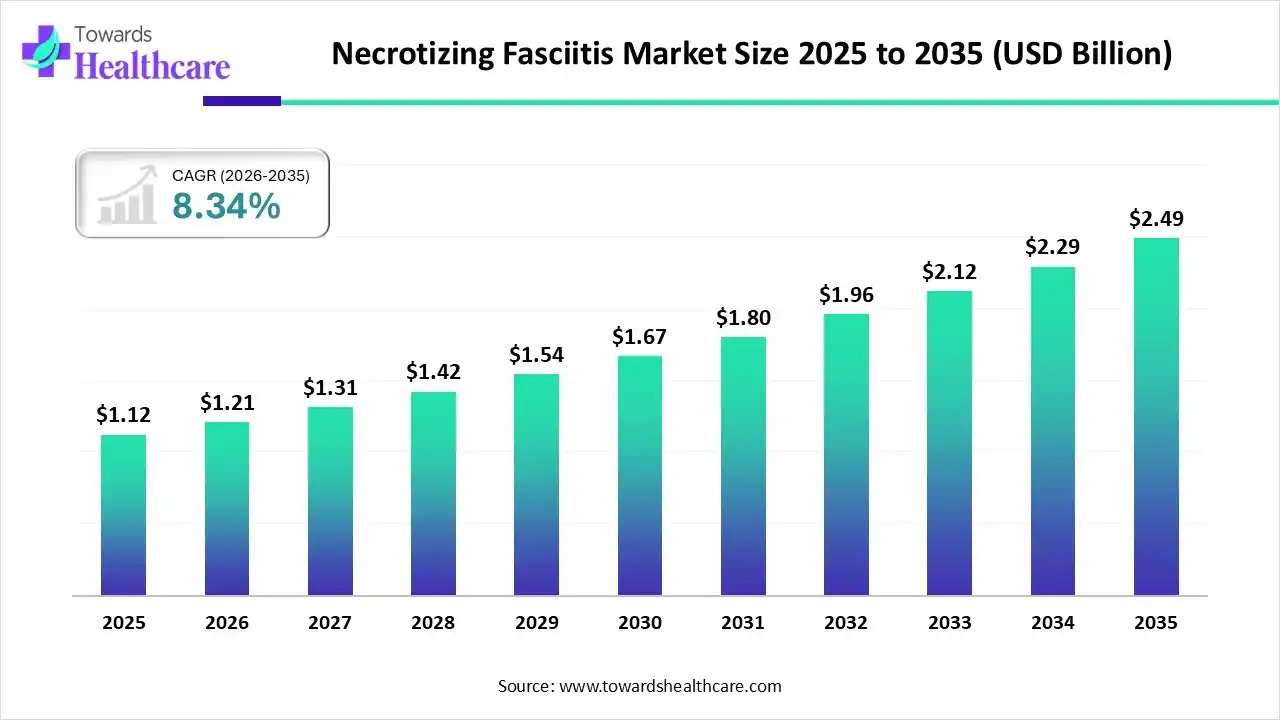
The necrotizing fasciitis market is primarily driven by the increasing incidence of necrotizing fasciitis and growing research activities. Patients suffering from obesity, diabetes, alcohol use disorder, cancer, and pregnancy have a high risk of developing necrotizing fasciitis (NF). Government bodies launch initiatives for the screening, diagnosis, and early intervention of rare diseases. Numerous healthcare organizations leverage artificial intelligence (AI) to transform diagnosis and treatment.
The necrotizing fasciitis market is experiencing robust growth, driven by the rising incidence of NF, the increasing number of surgeries, and the growing demand for personalized medicines. It encompasses the development, manufacturing, and provision of services for the prevention, diagnosis, and treatment of NF. NF is a rare bacterial disorder that causes inflammation of the fascia. It is diagnosed using blood tests, specimen culture, tissue biopsy, and imaging tests.
AI revolutionizes the necrotizing fasciitis market by facilitating early diagnosis and treatment of NF. AI and machine learning (ML) algorithms analyze vast amounts of data and aid in the disease classification of NF, enhancing diagnostic accuracy and precision. This allows healthcare professionals to make effective clinical decisions. AI and ML also suggest appropriate treatment regimens and predict treatment outcomes based on patients’ conditions. Thus, integrating AI and ML in NF treatment improves patient treatment outcomes and overall well-being.
Necrotizing fasciitis is a severe, rapidly progressing bacterial infection that causes extensive damage to skin, connective tissue, and underlying soft tissues, requiring immediate medical intervention. The market is growing as healthcare systems focus on faster diagnosis and aggressive management of life-threatening soft tissue infections. Key trends include rapid diagnostic testing, antimicrobial stewardship, advanced wound care, and multidisciplinary treatment approaches. Technological advancements in molecular diagnostics, imaging systems, automated microbiology, and wound-monitoring technologies are improving infection identification and treatment decisions. Future opportunities include AI-assisted diagnosis, novel antimicrobial therapies, targeted drug delivery, and advanced tissue-regeneration solutions. Rising incidence of diabetes, increasing infections, and improvements in emergency-care infrastructure are supporting market expansion. Growing research into antibiotic-resistanc pathogens is also encouraging the development of innovative treatment optionse encouraging the development of innovative treatment option. Increasing adoption of negative-pressure wound therapy and sophisticated reconstructive procedures is further creating opportunities for comprehensive patient management.
| Key Elements | Scope |
| Market Size in 2026 | USD 1.21 Billion |
| Projected Market Size in 2035 | USD 2.49 Billion |
| CAGR (2026 - 2035) | 8.34% |
| Leading Region | North America |
| Historical Data | 2020 - 2023 |
| Base Year | 2025 |
| Forecast Period | 2026 - 2035 |
| Measurable Values | USD Millions/Units/Volume |
| Market Segmentation | By Type, By Treatment, By Diagnosis, By Risk Factors, By End-User, By Region |
| Top Key Players | Astellas Pharma, Pfizer, Inc., Eli Lilly and Company, Grifols SA, Sanofi, Roche Holding AG, Bayer AG, Amgen, Inc. |
Which Type Segment Dominated the Necrotizing Fasciitis Market?
Type I
The type I segment held a dominant position in the market in 2025. This segment dominated because type I, or polymicrobial infection, is more common, with cultures yielding a mixture of aerobic and anaerobic organisms. Immunocompromised patients, such as patients with diabetes mellitus and chronic renal failure, are more prone to developing type I NF. It is estimated that diabetes is the major cause of NF in 44.5% to 72.3% of NF patients. The International Diabetes Federation (IDF) reported that 589 million people had diabetes in 2024.
Type II
The type II segment is expected to grow at the fastest CAGR in the necrotizing fasciitis market during the forecast period. Type II, or monomicrobial infection, is less common and is mainly caused by S pyogenes or S aureus. It typically occurs in the limbs and affects patients with a history of trauma. The World Health Organization (WHO) estimates that around 70% of people will experience a potentially traumatic event during their lifetime.
Type III
The type III segment is expected to grow in the coming years, due to its high severity and the increasing number of surgeries worldwide. Type III NF is the least common, which is caused by Clostridium perfringens or Clostridium septicum. It occurs due to a significant injury or surgery and results in gas gangrene. Although it is less common, it carries a high mortality rate of 30-40%, necessitating healthcare professionals to provide advanced treatment and care.
Why Did the Intravenous Antibiotics Segment Dominate the Necrotizing Fasciitis Market?
Intravenous Antibiotics
The intravenous antibiotics segment held the largest revenue share of the market in 2025, due to the need to kill infectious pathogens and high affordability. The growing demand for minimally invasive treatment potentiates the use of intravenous (i.v.) antibiotics. Healthcare professionals provide i.v. Antibiotics are used to stabilize patients and prevent systemic spread of bacteria. IV treatment is more affordable and convenient to patients, enhancing treatment accessibility and saving exorbitant treatment costs.
Surgery
The surgery segment is expected to grow with the highest CAGR in the necrotizing fasciitis market during the studied years. Surgery is conducted to remove dead tissue from the infection site. It is the foremost treatment option for patients with NF that requires extensive, wide debridement of all necrotic tissues. Early surgery may help minimize tissue loss and eliminate the need for amputation of a gangrenous limb. Continuous advances in surgical technologies improve treatment outcomes and patient compliance.
Hyperbaric Oxygen Treatment
The hyperbaric oxygen treatment segment is expected to show lucrative growth. Hyperbaric oxygen is provided as an adjunctive therapy, along with surgery and IV. antibiotics. It increases tissue oxygen tension in necrotizing fasciitis wounds, salvaging critically ischemic areas. Several studies have demonstrated that hyperbaric oxygen can significantly reduce mortality and incidence rates of complications.
How the CT Scan Segment Dominated the Necrotizing Fasciitis Market?
The CT scan segment contributed the biggest revenue share of the market in 2025, due to widespread availability and high spatial resolution. A CT scan is the most commonly used imaging modality for the evaluation of NF. It has a higher speed and can evaluate the sensitivity for gas in soft tissues. It can produce detailed images and is used to detect NF at an early stage. Additionally, a CT scan can help healthcare professionals visualize the location of the rapidly spreading infection.
Laboratory Tests
The laboratory tests segment is expected to witness the fastest growth in the necrotizing fasciitis market over the forecast period. Laboratory tests include complete blood count, serum chemistry studies, arterial blood gas measurement, urinalysis, and blood and tissue cultures. They are more affordable and provide quantitative measurement of the biomarkers involved. Advancements in diagnostics have led to the development of point-of-care diagnostics, enhancing patient convenience.
MRI
The MRI segment is expected to grow significantly, driven by high sensitivity and the ability to detect minor changes. MRI is the gold standard imaging modality for investigating NF. It can overcome several limitations of CT scans, such as eliminating the need to expose patients to ionizing radiation, making it a safer option for people who need repeated scans. MRI is a more advanced technology compared to a CT scan or ultrasound.
What Made Diabetes the Dominant Segment in the Necrotizing Fasciitis Market?
The diabetes segment accounted for the highest revenue share of the market in 2025, due to the rising prevalence of diabetes and its associated complications. People having a long-term diabetes condition are more prone to developing NF during their lifetime. Diabetic patients are more susceptible to infections and delayed wound healing. Government organizations launch initiatives to prevent diabetic complications and conduct screening programs for diabetics.
Obesity
The obesity segment is expected to expand rapidly in the necrotizing fasciitis market in the coming years. Obesity is a serious condition, affecting over 1 in 8 people in the world. It can cause skin conditions and other health problems that may increase the likelihood of getting NF. The chances of NF rise in obese people due to the increasing overweight people and the known effects of obesity on the immune system.
Intravenous Drug Use
The intravenous drug use segment is expected to grow at a notable CAGR. Intravenous drug users (IDUs) have a high risk of developing skin and soft tissue infections, including NF, and may be aggravated by contamination with oral microorganisms. This is mainly caused by non-sterile injection practices, contaminated substances, and the use of contaminated needles.
Which End-User Segment Led the Necrotizing Fasciitis Market?
The hospitals segment led the market in 2025, due to favorable infrastructure and the presence of skilled professionals. Skilled professionals have multidisciplinary expertise, providing advanced treatment and care to patients. Hospitals are also part of clinical trials, benefiting patients with novel therapeutics before market approval. Patients prefer hospitals due to favorable reimbursement policies. Numerous government and public hospitals provide affordable treatment to patients from low- and middle-income groups.
Diagnostic Centers
The diagnostic centers segment is expected to show the fastest growth over the forecast period. Suitable capital investments enable diagnostic centers to adopt advanced diagnostic equipment. Diagnostic centers have specialized equipment to assess NF at different stages. They have specific infrastructure for imaging tests and laboratory tests. They provide tailored services to patients and healthcare professionals.
Surgical Centers
The surgical centers segment is expected to grow in the necrotizing fasciitis market in the upcoming years. The increasing number of surgical centers and the availability of advanced equipment augment the segment’s growth. Surgical centers have the desired equipment to conduct minor or major surgeries for treating NF.
North America dominated the global market in 2025. The availability of state-of-the-art research and development facilities, a robust healthcare infrastructure, and the presence of key players are factors that govern market growth in North America. Favorable regulatory policies support the development of novel NF therapeutics and diagnostics. The increasing prevalence of NF and the growing demand for personalized medicines propel the market.
Increasing NF Cases Dominated the U.S.
The U.S. reported the first human case of the New World screwworm, a flesh-eating parasite, in August 2025. This encouraged health officials to ramp up prevention efforts to shield humans and animals from the parasite. The Centers for Disease Control and Prevention (CDC) estimates that 700 to 1,200 cases of NF occur annually in the U.S. Key players, such as Vertex Pharmaceuticals, Pfizer, Inc., and Gilead Sciences, are the major contributors to the market in the U.S.
Canada’s Advancing Necrotizing Fasciitis Treatment Market
Canada is significantly growing in the necrotizing fasciitis market due to its strong emergency-care infrastructure and advanced infectious-disease management capabilities. Increasing access to rapid microbiological diagnostics is supporting earlier identification of severe infections. Well-equipped hospitals are adopting advanced wound-care technologies and multidisciplinary treatment approaches. Growing research into antimicrobial resistance, improved surgical capabilities, and greater awareness of life-threatening soft-tissue infections are further supporting market expansion.
Asia-Pacific is expected to host the fastest-growing market in the coming years. The rising prevalence of chronic disorders and the growing geriatric population potentiates the risk of NF. The growing research and development activities and the burgeoning healthcare sector foster market growth. Countries like China, India, and Japan are at the forefront of developing and manufacturing innovative diagnostics and therapeutics for rare diseases. Key players located in the region are proficient in developing generic alternatives to cater to a huge population.
Rising Chronic Disease Prevalence Fuels India’s Growth
India has a higher prevalence rate of diabetes and obesity in the world, potentiating the chances of NF. In 2024, approximately 947 million people, or 10.5% of the total population, were estimated to have diabetes. Obesity is also a growing concern among Indians, affecting around 24% of women and 23% of men. The Indian government is making constant efforts to raise awareness and combat disease risk.
China’s Expanding Necrotizing Fasciitis Treatment Market
China is notably expanding in the necrotizing fasciitis market due to its large patient population and rapidly developing hospital infrastructure. Increasing availability of advanced emergency and surgical services is improving treatment capabilities for severe soft-tissue infections. Growing adoption of rapid diagnostic technologies and modern wound-care solutions is supporting timely intervention. Rising healthcare expenditure, improvements in infectious-disease management, and increasing research into antimicrobial resistance are further creating opportunities for market growth.
Europe is expected to grow at a considerable CAGR in the upcoming period. Government bodies launch initiatives and provide funding for screening and early diagnosis of rare diseases. The increasing collaborations and public-private partnerships among key players and research institutes contribute to market growth. European nations like Germany, the UK, France, and Switzerland have advanced healthcare infrastructure, allowing patients to seek precision care.
Favorable Government Support to Drive Friance
The French government actively supports the prevention, diagnosis, and treatment of rare diseases. It launched the “Fourth National Rare Diseases Plan (PNMR4)” to improve care for people with rare diseases, accelerate research, and support innovation in healthcare. As part of the plan, the government has established a total of 603 centers across the country. The government also allocated €36 million to help these centers operate effectively.
The necrotizing fasciitis market in South America is seeing solid expansion. Increased health awareness and better diagnostic capabilities are driving this trend. Growing healthcare expenditure and government programs addressing infectious diseases are contributing to market acceleration across the region.
Brazil's Growing Healthcare Investment
Brazil, a key player in South America, is experiencing market growth fueled by rising cases of chronic conditions like diabetes, which increase susceptibility. Better access to advanced therapeutic interventions, including surgical debridement and broad-spectrum antibacterials, propels this market segment.
Argentina Significant Necrotizing Fasciitis Market Share
Argentina holds a significant market share in the necrotizing fasciitis market due to its established healthcare network and availability of specialized surgical services. Increasing demand for emergency treatment of severe infections is supporting market development. Improvements in hospital-based wound management and diagnostic capabilities are enabling faster clinical intervention. Growing awareness of serious soft-tissue infections, expanding access to specialized care, and increasing adoption of advanced wound-care technologies are further strengthening Argentina’s market position.
The Middle East and Africa NF market is steadily advancing. Rising investments in hospital infrastructure and specialized care centers in GCC nations are key drivers. Heightened clinical awareness regarding the rapid nature of the infection ensures timely treatment and better patient results.
GCC Advances in Targeted Therapies
GCC countries show a growing emphasis on adopting advanced treatment protocols for necrotizing fasciitis. There is increasing demand for advanced therapeutics, including targeted antibiotic therapies and specialized wound care devices. These technological improvements are expanding the regional market.
UAE’s Expanding Necrotizing Fasciitis Treatment Market
The UAE is notably expanding in the necrotizing fasciitis market due to rapid modernization of healthcare infrastructure and increasing access to specialized surgical services. Investments in advanced hospitals are improving emergency and critical-care capabilities for severe infections. Growing adoption of modern wound-care technologies and rapid diagnostic methods is supporting timely treatment. Increasing healthcare expenditure, medical tourism, and the development of specialized infection-management services are further creating opportunities for market growth.
Company Overview
Description: A global biopharmaceutical company focusing on the discovery, development, manufacturing, and marketing of healthcare products, including medicines, vaccines, and consumer healthcare products. It has a significant presence in the anti-infective space, which is critical for NF treatment.
Corporate Information (Latest Available)
History and Background
Overview: Founded by Charles Pfizer and Charles Erhart. Initially a chemical company, it expanded into pharmaceuticals, notably mass-producing penicillin during WWII, establishing its role as a key player in anti-infectives. It grew through organic innovation and strategic M&A to become one of the world's largest biopharmaceutical firms.
Key Milestones/Timeline
Business Overview
Focus: Innovative medicines and vaccines across therapeutic areas like oncology, inflammation & immunology, rare diseases, internal medicine, and anti-infectives.
Business Segments/Divisions
Geographic Presence
Global: Products are available in over 180 countries worldwide, with major operations in North America, Europe, and Asia.
Key Offerings (Relevant to NF)
Anti-Infective Drugs: A broad portfolio of intravenous (IV) antibiotics used for empiric broad-spectrum coverage and targeted therapy in NF, such as Zosyn (piperacillin/tazobactam), Tygacil (tigecycline), and antifungals.
End-Use Industries Served
Key Developments and Strategic Initiatives
Mergers & Acquisitions
Partnerships & Collaborations
Ongoing collaborations with governments and NGOs for global access to medicines, including essential antibiotics.
Product Launches/Innovations
Continuous focus on developing and supplying novel anti-infective agents to combat Antimicrobial Resistance (AMR), which is critical for NF.
Capacity Expansions/Investments
Ongoing investments in manufacturing and supply chain to ensure global availability of critical medicines, including hospital injectables.
Regulatory Approvals
Routine approvals for new indications, generic anti-infectives, and manufacturing process changes for various products globally.
Distribution channel strategy
Primary: Direct sales to Hospital Pharmacies and wholesalers due to NF treatment's critical, acute, and inpatient nature.
Secondary: Retail and Online Pharmacies for post-discharge oral medications (less common for acute NF).
Technological Capabilities/R&D Focus
Competitive Positioning
Strengths & Differentiators:
SWOT Analysis (NF Focus)
Recent News and Updates (2024-2025)
Company Overview
Description: A global healthcare company, operating as Merck & Co., Inc. in the U.S. and Canada, and as MSD everywhere else. It focuses on prescription medicines, vaccines, biologic therapies, and animal health products. It is a major player in the hospital and anti-infective sector.
Corporate Information (Latest Available)
History and Background
Overview: Known for its long history of biomedical innovation. It has maintained a strong commitment to infectious disease research and has pioneered several vaccines and antibiotics. Its history includes significant contributions to antimicrobial development.
Key Milestones/Timeline
Business Overview
Focus: Innovative solutions for human and animal health. The Human Health segment includes pharmaceutical and vaccine products, with a major focus on oncology, virology, and anti-infectives.
Business Segments/Divisions
Geographic Presence
Global: Operates in over 140 countries, with significant revenue generation in the U.S. and internationally (as MSD).
Key Offerings (Relevant to NF)
Anti-Infective Drugs: Portfolio includes broad-spectrum, hospital-based antibiotics essential for NF, such as Primaxin (imipenem/cilastatin) and Recarbrio (imipenem, cilastatin, and relebactam) and Zerabaxa (ceftolozane and tazobactam), used for difficult-to-treat Gram-negative infections.
End-Use Industries Served
Key Developments and Strategic Initiatives
Mergers & Acquisitions
2023: Acquired Prometheus Biosciences to boost its Immunology pipeline.
Partnerships & Collaborations
Active in public-private partnerships to address global AMR, including the development of new antibiotics.
Product Launches/Innovations
Focus on developing new antibiotics/combination therapies to combat emerging resistance (e.g., through its hospital acute care unit).
Capacity Expansions/Investments
Continued expansion and modernization of its manufacturing network to support the global supply of its products.
Regulatory Approvals
2024: Gained approvals for new indications or formulations for key infectious disease products in various regions.
Distribution channel strategy
Technological Capabilities/R&D Focus
Competitive Positioning
Strengths & Differentiators:
SWOT Analysis (NF Focus)
Recent News and Updates (2024-2025)
| Companies | Headquarters | Offerings |
| Vertex Pharmaceuticals | Massachusetts, United States | It focuses on discovering, developing, and producing innovative medicines for patients with serious diseases. |
| Gilead Sciences, Inc. | California, United States | It offers Vemlidy (tenofovir alafenamide), an antiviral medication. |
| Basilea Pharmaceutica | Basel, Switzerland | The company specializes in providing drugs for several invasive fungal infections and bacterial infections. |
| CSL Behring | Australia | It is a global leader in developing and delivering high-quality medicines that treat people with rare and serious diseases. |
| Boehringer Ingelheim | Rhein, Germany | It develops and delivers new therapies that treat serious conditions and fulfill unmet needs. |
By Type
By Treatment
By Diagnosis
By Risk Factors
By End-User
By Region


Principal Consultant
Payal Rabde is a Healthcare Market Research Analyst at Towards Healthcare Research & Consulting with 4+ years of experience in pharmaceuticals, biotechnology, medical devices, and life sciences.
Learn more about Payal Rabde

Reviewed By
Aditi Shivarkar is a seasoned professional with over 14 years of experience in healthcare market research. As a content reviewer, Aditi ensures the quality and accuracy of all market insights and data presented by the research team.
Learn more about Aditi Shivarkar









