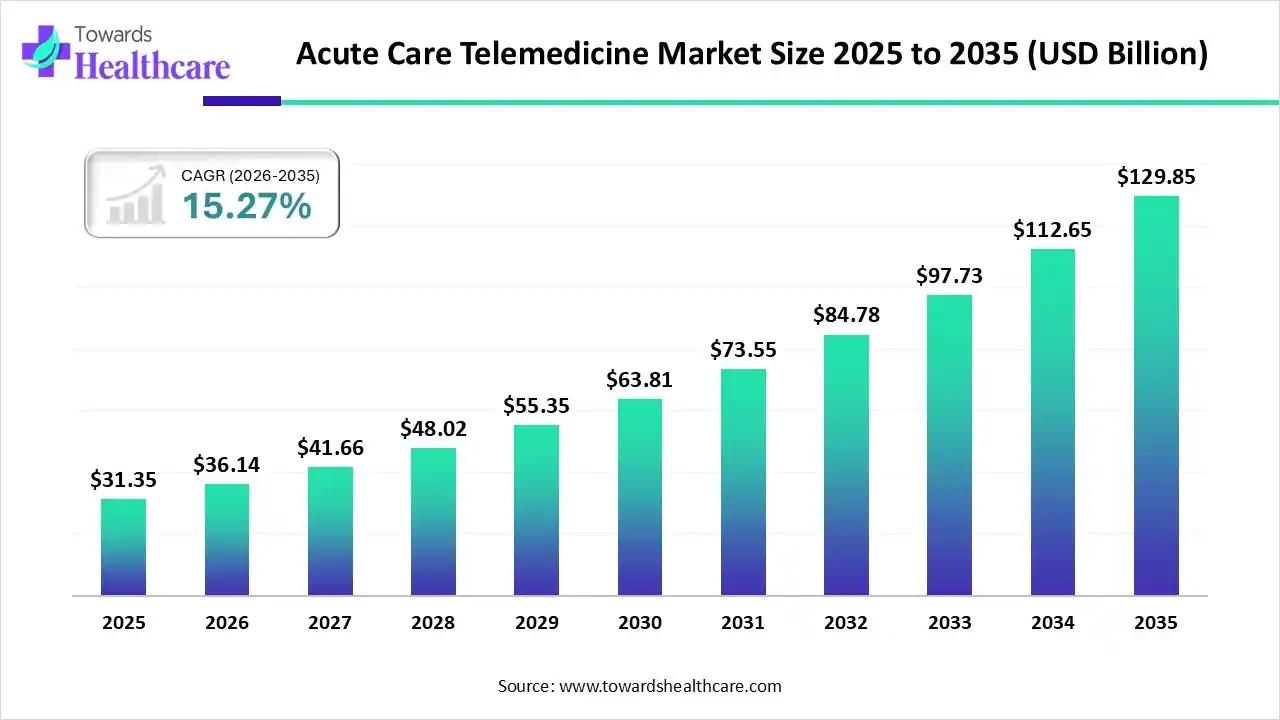
The global acute care telemedicine market size was estimated at USD 31.35 billion in 2025 and is predicted to increase from USD 36.14 billion in 2026 to approximately USD 129.85 billion by 2035, expanding at a CAGR of 15.27% from 2026 to 2035. The worldwide increase in diverse chronic disease cases is propelling the need for sophisticated and immediate diagnostic and treatment solutions. This further supports breakthroughs in telemedicine, like AI-assisted diagnosis, virtual and audio consultations, especially to resolve barriers to rural or underserved regions.
The rapid adoption of acute care telemedicine is fundamentally transforming emergency medical services and critical care delivery globally. By leveraging advanced telecommunication technologies, healthcare facilities can instantly bridge the gap between suburban clinics and top-tier medical specialists located thousands of miles away. This immediate access is particularly vital for time-sensitive emergencies like traumatic brain injuries, severe sepsis, and acute cardiac events, where every second saved directly correlates with higher patient survival rates.
Furthermore, integrating these digital platforms helps mitigate severe clinician burnout by optimizing the daily workflows of intensive care doctors and reducing unnecessary patient transfers between regional facilities. As hospital systems continue to modernize their infrastructure, the deployment of high-definition streaming devices and integrated electronic health records ensures seamless, real-time collaboration. This continuous technological evolution ultimately establishes a more resilient, highly connected healthcare ecosystem capable of delivering superior clinical outcomes across diverse populations.
Firstly, the global acute care telemedicine market enables patients to access specialists instantly, remotely, for urgent, severe, or life-threatening conditions in hospitals & emergency settings. These solutions are increasingly allowing for real-time, audio-visual consultations to detect & treat acute issues, such as strokes or overdoses, thereby raising patient outcomes, accelerating care delivery, & lowers the need for on-site specialist presence.
The worldwide involvement of AI solutions is supporting the prospective research activities, such as in the respective market, where AI is used by integrating it into centralized command centers, which assist in tracking ICU patients remotely, and enable AI-powered risk stratification. Alongside, AI-assisted systems are fostering the process of medical images, i.e., CT scans, X-rays, in real time during a teleconsultation to support with immediate, high-stakes decisions, especially identification of intracranial hemorrhage or pneumothorax.
Promoting Hybrid Care Models
The globe is pushing integration of virtual consultations with in-person visits to enhance effectiveness and patient convenience.
Surging Telestroke & Tele-ICU
Due to the shortage of specialists in rural or underserved hospitals, the market is stepping towards remote specialists to allow instant, high-quality, acute interventions for vital instances.
Revolutionizing Study Designs
Researchers are shifting towards more randomized controlled trials (RCTs) & multi-site studies instead of before-and-after studies for the extensive development of evidence of efficacy.
| Table | Scope |
| Market Size in 2026 | USD 36.14 Billion |
| Projected Market Size in 2035 | USD 129.85 Billion |
| CAGR (2026 - 2035) | 15.27% |
| Leading Region | North America by 42% |
| Historical Data | 2020 - 2023 |
| Base Year | 2025 |
| Forecast Period | 2026 - 2035 |
| Measurable Values | USD Millions/Units/Volume |
| Market Segmentation | By Delivery, By Application, By End Use, By Region |
| Top Key Players | ScienceSoft USA Corporation, AMN Healthcare, Orbit Health GmbH, Access TeleCare, LLC, Eagle Telemedicine, Enghouse Video (Vidyo, Inc.), Teladoc Health |
Which Delivery Dominated the Acute Care Telemedicine Market in 2025?
The clinician-to-patient segment held the largest share of the market in 2025. This is mainly propelled by a rise in immediate access to emergency physicians or specialists, specifically in rural or underserved areas. An immersive breakthrough includes portable tele-echography robots, which allow physicians to perform FAST (Focused Assessment with Sonography for Trauma) exams when a patient is still in the ambulance.
Clinician-To-Clinician
In the coming era, the clinician-to-clinician segment is anticipated to witness the fastest expansion. Certainly, the rising need for expedited evaluation in emergencies such as stroke (telestroke) & cardiac arrest, where minutes are significant for patient results, supports the segmental growth. Nowadays, the world is stepping from a pandemic-era emergency tool to a mainstream, specialized component of healthcare, which emphasizes expert consultation, faster diagnostics, & workflow effectiveness.
How did the Teleradiology Segment Lead the Market in 2025?
In 2025, the teleradiology segment dominated with the biggest share of the acute care telemedicine market. The dominance is driven by a shortage of radiologists, and its benefits, like instant, around-the-clock, robust interpretation of scans for stroke, trauma, and other crucial cases. However, the emergence of cloud-based Picture Archiving and Communication Systems (PACS) and Radiology Information Systems (RIS) is enabling rapid image transfer, & finally enhances scalability & accessibility, especially for rural or underserved areas.
Telepsychiatry
During the prospective period, the telepsychiatry segment will expand rapidly. Globally accelerating anxiety, depression, and substance abuse disorders are demanding immediate, scalable, & remote interventions. The latest specialized teletherapy programs for children in acute care units have shown success in boosting access and lowering the burden on emergency services. Also, the emergence of AI is fostering automation of documentation & natural language processing to evaluate psychiatric risk.
Which End Use Led the Acute Care Telemedicine Market in 2025?
The hospitals and clinics segment registered dominance in the market and is estimated to expand at the fastest CAGR. The broader adoption of advanced telemedicine in these facilities is providing minimal operational expenditures, lowered emergency department (ED) wait times, and optimized management of critical, high-acuity, & infectious patients. They are also unveiling 5G, which enables perfect HD video & real-time transmission of huge data sets, like radiology images, ultimately improving high-resolution virtual consults & remote robotic surgeries.
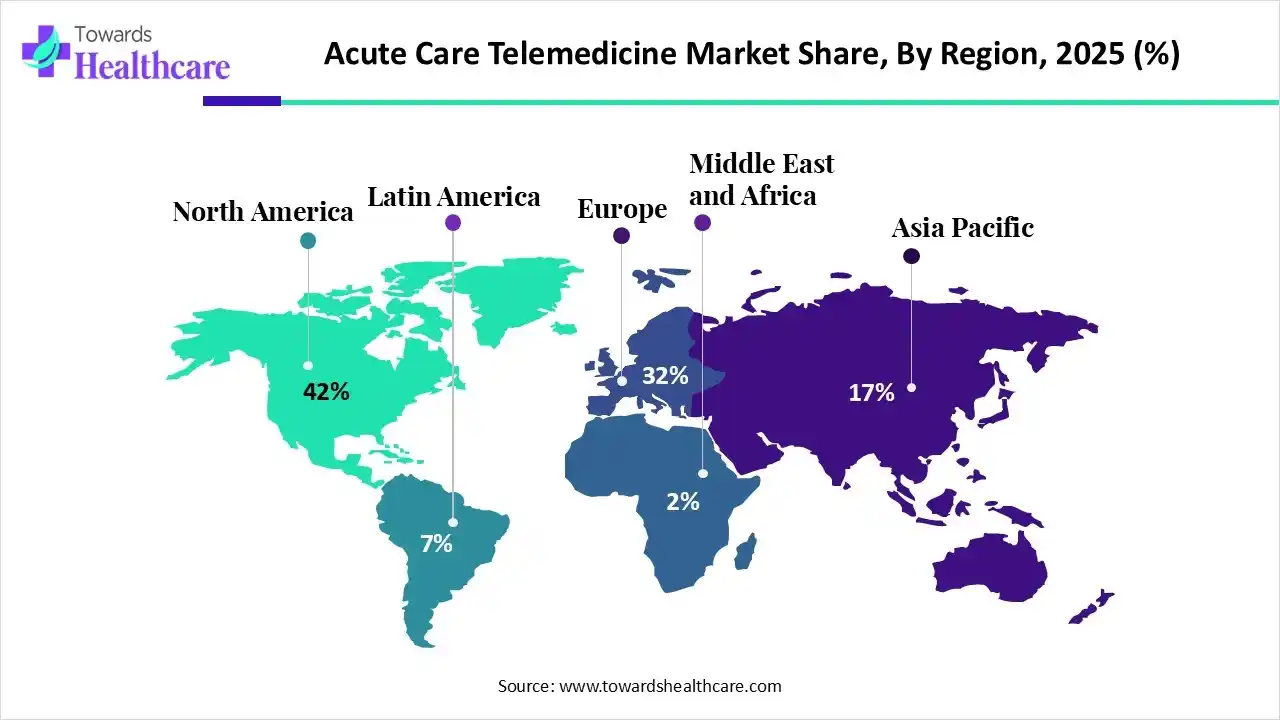
In 2025, North America accounted for the biggest share of 42% of the acute care telemedicine market. Major catalysts are a rise in chronic disease incidence, suitable reimbursement policies, and the wider use of AI-powered, remote monitoring technologies. Whereas, Canada is pushing the evolution of virtual paediatric ED (V-PED), enabling families to self-refer for urgent concerns through online triage & video visits.
For instance,
U.S. Market Trends
The U.S. market dominance is fueled by its widening tele-nephrology, tele-oncology, and tele-triage within emergency departments to minimize rush. Besides this, the American Medical Association (AMA) rolled out new CPT codes (98000-98016), particularly for reporting synchronized audio-video and audio-only assessment & management.
Canada Market Trends
Canada is expected to grow at a significant rate during the forecast period due to technological advancements and demand for acute care in rural areas. The expansion of acute care telemedicine in Canada centers on bridging immense geographical barriers. Rural and indigenous communities often lack direct access to emergency healthcare professionals. Digital health tools are now able to connect local emergency units to the intensive healthcare professionals in the city in real-time. High-definition video devices and portable vital-sign monitors allow swift triaging for critical conditions like stroke or cardiac arrest. Mobile health applications further support these local systems. This remote network saves vital travel time, optimizes regional hospital beds, and ensures consistent quality of critical care across every province.
In the coming era, the Asia Pacific will expand rapidly by 17% share in the acute care telemedicine market. APAC has many key companies, like Philips, Teladoc Health, Medtronic, and other substantial players, including Ping An Good Doctor, Doctor Anywhere, and Practo, which are advancing telemedicine solutions. Additionally, China and India are extensively promoting suitable government policies, like China’s Internet+ Healthcare & India’s Ayushman Bharat Digital Mission (ABDM), respectively.
China Market Trends
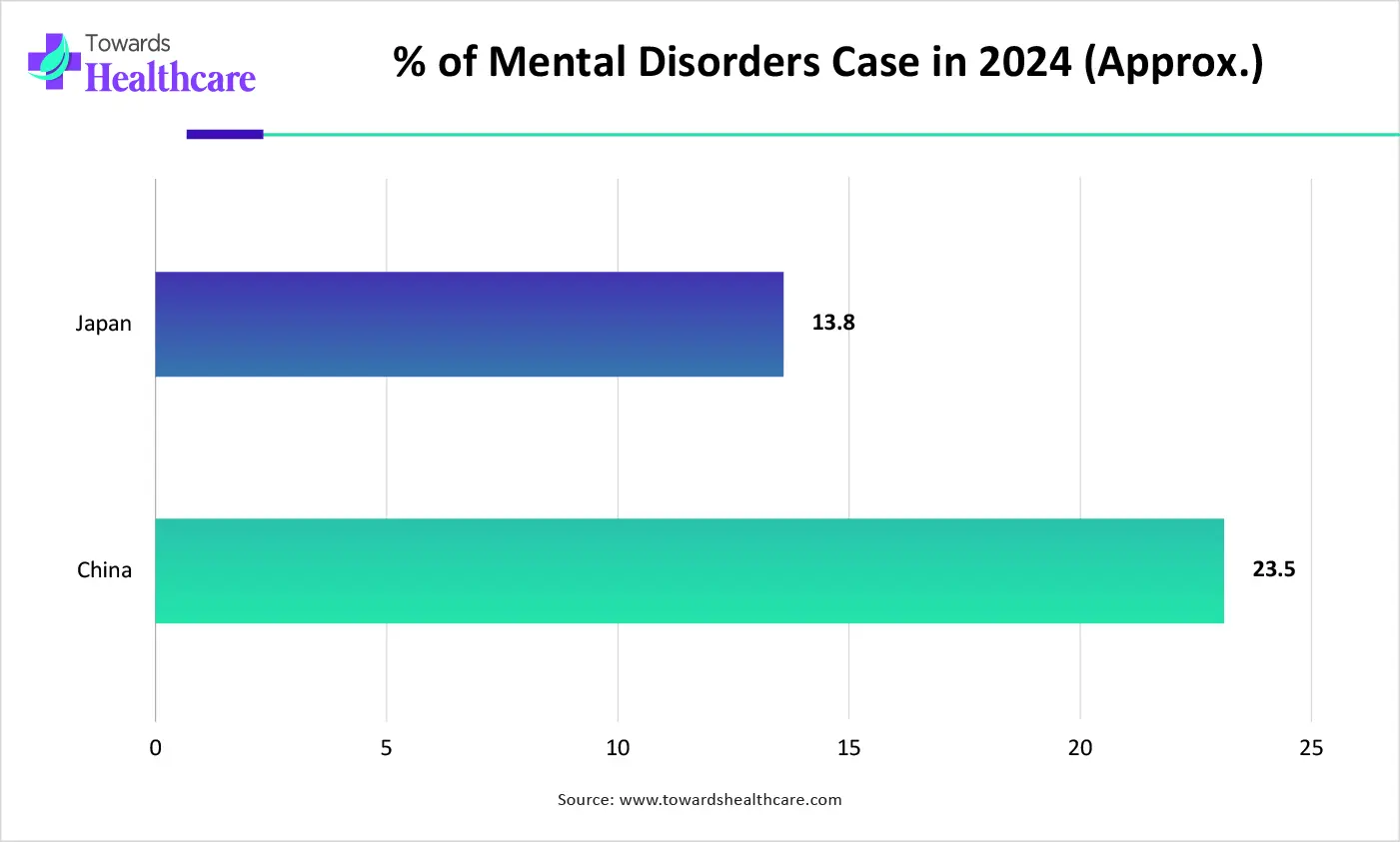
Day by day, China’s healthcare sector is highly utilizing 5G and IoT in acute care for real-time, high-resolution remote monitoring, lowering false alarms in intensive care units by 68% and allowing expedited emergency responses. China is also encouraging a trend of remote diagnostic services for electrocardiography (ECG) & pathology, which are widely employed high-volume services.
India Market Trends
In India, the acute care telemedicine market is expanding rapidly due to a wide urban-rural healthcare divide. Most emergency specialists practice in major cities. This leaves small towns and rural areas underserved. The government is actively building a massive digital framework to link village health centers with top medical institutes. Clinician-to-clinician emergency consults have grown immensely via cloud-based platforms. Mid-sized cities are experiencing a massive surge in adopting these digital platforms. This quick video connection allows doctors to manage urgent trauma and poisoning cases locally.
Europe is experiencing a notable growth in the acute care telemedicine market by 32% share during the forecast period. This is spurred by the emergence of the Digital Healthcare Act (DVG) & Digital Care and Nursing Modernization Act (DVPMG), which established a fast-track approval process for digital health applications (DiGA), which enable them to be prescribed & referred by statutory health insurance.
Germany Market Trends
Whereas Germany is predicted to expand at a lucrative CAGR, due to the well-developed "hub-and-spoke" networks by German institutions. This primarily assists in critical care in underserved areas, employing specialised telemedical carts for joint intensive care rounds.
UK Market Trends
The UK relies heavily on telemedicine to ease crushing pressure on the National Health Service (NHS). Hospitals face serious shortages of beds and physical space. To combat this, the nation is aggressively scaling up high-tech virtual wards. Patients recovering from major surgeries or acute illnesses receive continuous remote tracking at home. Wearable sensors automatically send live health statistics directly to central hospital dashboards. This approach frees up critical ward beds, lowers emergency readmissions, and keeps high-risk patients safe at home.
South America has a rapidly expanding role in the growth of the acute care telemedicine market. The growth is primarily driven by government health modernization, post-pandemic digital habits, and increasing mobile connectivity. Clinician-to-clinician delivery remains the largest revenue generator for acute care, helping bridge severe specialist shortages in remote or rural areas. Meanwhile, clinician-to-patient emergency and episodic care represent the fastest-growing delivery segment. Governments across the region have introduced supportive frameworks, digital health agendas, and initiatives to integrate remote triage and acute management into public networks.
Brazil Market Trends
Brazil serves as a primary economic and infrastructural engine for the Latin American acute care and broader digital health market. Brazil accounts for a dominant share of Latin America's telehealth spending, with acute care and broader digital health ecosystems scaling rapidly. Growing population of the region along with a growing internet penetration allowing users to access remote clinical applications. Clinician-to-clinician delivery represents the largest revenue-generating segment in Brazil allowing rural or unstaffed primary care units to link up with emergency and specialist physicians, helpful for the growth of the market.
Argentina Market Trends
Argentina’s contribution to the growth of the market is reflected by strong national digital health policies, high mobile and internet penetration, and rapid adoption by urban healthcare providers. National Digital Health Strategy launched by the government to establish universal coverage and integrate electronic health records (EHR) across provinces, creating a centralized infrastructure that supports real-time remote care also helps to fuel market’s growth. Concentrated commercial and clinical activity in Greater Buenos Aires and major cities allows private providers, insurers, and tech teams to pilot and scale acute and virtual services before expanding to rural areas, which are also some of the major market growth factors.
Middle East and Africa’s contribution to the growth of the market is reflected through factors such as government-backed digital health transformations, increasing smartphone and cloud adoption, and efforts to bridge severe specialist shortages in rural or underserved areas. Countries in the Gulf Cooperation Council lead regional adoption. Saudi Arabia alone drives a significant share of digital diagnostic and teleradiology expansion under national transformation programs like Saudi Vision 2030.
Saudi Arabia Market Trends
Saudi Arabia has a major contribution to the market’s growth through massive government investments, centralized digital infrastructure, and national health transformation policies. Saudi Vision 2030 drives strategic national policies, regulatory support, and large-scale funding to modernize the healthcare system and build digital-first care channels, propelling the market’s growth. Seha Virtual Hospital (SVH) acts as a central pillar by connecting more than 242 hospitals across the Kingdom to specialist expertise based in Riyadh.
South Africa Market Trends
South Africa’s contribution to the growth of the market is reflected in pioneering digital health integration, mobile connectivity, and policy reforms across Sub-Saharan Africa. High smartphone penetration and expanding 5G networks have made mobile health (mHealth) central to care delivery. South Africa leads the region in leveraging remote monitoring for chronic conditions including HIV, diabetes, and mental health challenges reducing severe strain on physical infrastructure.
| Company | Description |
| ScienceSoft USA Corporation | A firm emphasizes linking on-site emergency teams with remote specialists to manage critical issues, including stroke, trauma, & cardiac emergencies. |
| AMN Healthcare | This usually provides a comprehensive, HIPAA-compliant Virtual Care Management platform. |
| Orbit Health GmbH | A player specializes in tailored chronic care management, specifically through AI-enabled remote monitoring. |
| U.S. Acute Care Solutions, LLC | This company focuses on 24/7/365 remote tele-emergency, tele-urgent care, & a "failsafe" program for high-risk, on-site, clinician-to-clinician assistance. |
| Access TeleCare, LLC | This offers board-certified specialists to high-acuity settings through a unified clinical model. |
| SynergenX | A firm facilitates Telemedicine Services for acute care, which enables patients to consult with licensed medical providers remotely. |
| Eagle Telemedicine | Its offerings include 24/7, on-call, or scheduled virtual consultations in over 15+ specialties, like Tele-ICU, Tele-Stroke, & Hospitalist/Nocturnist services. |
| Enghouse Video (Vidyo, Inc.) | A company’s specialized suite offers integrated high-definition video into hospital workflows. |
| RelyMD | This explores acute-care-focused telemedicine, especially composed of board-certified emergency medicine physicians. |
| Teladoc Health | It provides extensive emergency-response specialty care for consistent inpatient monitoring. |
Strengths
Weaknesses
Opportunities
Threats
By Delivery
By Application
By End Use
By Region






Reviewed By
Aditi Shivarkar is a seasoned professional with over 14 years of experience in healthcare market research. As a content reviewer, Aditi ensures the quality and accuracy of all market insights and data presented by the research team.
Learn more about Aditi Shivarkar