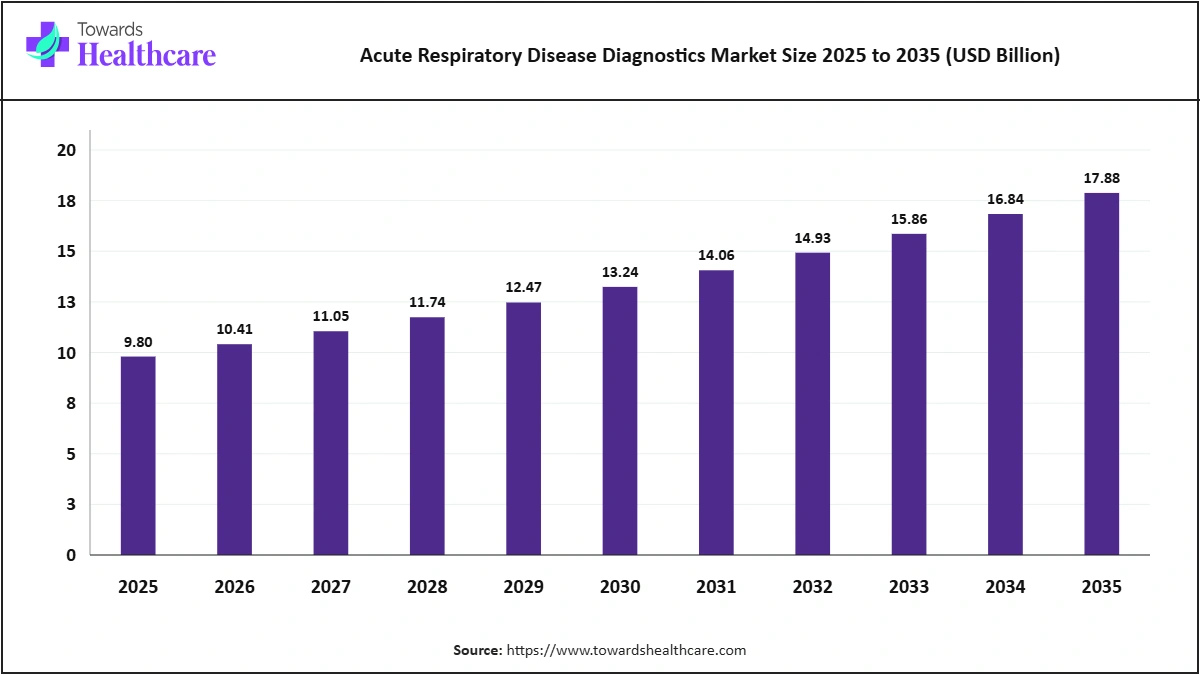
The acute respiratory disease diagnostics market is projected to increase from USD 9.80 billion in 2025 to USD 17.88 billion by 2035, supported by the persistent global burden of acute respiratory infections and the growing requirement for accurate and timely pathogen identification. Influenza, COVID-19, RSV, and bacterial pneumonia are significant causes of respiratory illness, prompting high diagnostic testing demand. Seasonal outbreaks, combination respiratory panels, antimicrobial stewardship, and aging populations drive the need for advanced diagnostic technologies.
Healthcare providers are increasingly using multiplex molecular assays for efficient pathogen identification from a single specimen, enhancing diagnostic efficiency and treatment decisions. Additionally, point-of-care molecular testing is gaining adoption because shorter turnaround times enable faster identification of respiratory pathogens of respiratory infections.
These developments are expected to increase market revenue to USD 13.24 billion by 2030 and sustain a CAGR of 6.2% from 2026 to 2035. Integration of respiratory testing with telehealth consultations, AI-assisted imaging, and next-generation sequencing-based surveillance is expected to expand the market's technological scope.
Analyst View: Our market estimate is based on respiratory diagnostic test volumes across technologies, disease categories, end users, and geographical markets, together with average testing prices and relevant system revenues. Our assessment includes molecular PCR assays, syndromic respiratory panels, rapid antigen tests, immunoassays, microbial culture, chest imaging, pulse oximetry, and blood gas testing. The market estimate was validated using revenues from respiratory diagnostics and key suppliers' product ranges. It includes imaging and respiratory severity assessment technologies, along with pathogen identification tests, ensuring alignment with published evaluations focused on infectious disease diagnostics.
| Driver | Impact | ≈ CAGR Contribution | Time Horizon | Key Regions |
| Seasonal outbreaks recur | High | +2.42 pp | Short to long term | Global, strongest in North America |
| Combination testing grows | Medium | +2.04 pp | Medium to long term | Global, fastest uptake in Asia Pacific |
| Antibiotic stewardship needs pathogen ID | Medium | +1.74 pp | Short to medium term | Global |
| Ageing populations are vulnerable | Low | +1.36 pp | Long term | Developed and emerging markets |
Note: Contributions are indicative estimates of each factor's effect on annual growth.
Sources: Expert interviews, secondary sources, Towards Healthcare database and Towards Healthcare analysts.
The identified growth drivers contribute an estimated 7.56 percentage points to the forecast CAGR before accounting for restraints, including seasonal outbreaks of influenza, RSV, and COVID-19. The rise in combination testing is facilitating the use of multiplex diagnostic platforms. Antimicrobial stewardship initiatives promote accurate pathogen identification, while an ageing population increases the need for respiratory assessments. Their influence is strongest in North America, while Asia Pacific is expected to experience faster adoption due to improvements in diagnostic infrastructure and molecular testing capacity.
| Restraint | Impact | ≈ Negative CAGR Contribution | Time Horizon | Key Regions |
| Post-pandemic volume drop | High | -0.61 pp | Short to medium term | Global |
| Reimbursement limits for large panels | High | -0.45 pp | Medium term | Price-sensitive and emerging markets |
| Price pressure | Medium | -0.30 pp | Short term | North America and other mature markets |
Note: Contributions are indicative estimates of each factor's effect on annual growth.
Sources: Expert interviews, secondary sources, Towards Healthcare database and Towards Healthcare analysts.
Declining post-pandemic testing volumes, reimbursement limitations, and pricing pressure are anticipated to reduce the forecast CAGR by an estimated 1.36 percentage points. A significant factor is the drop in routine COVID-19 testing, affecting suppliers that increased manufacturing capacity during the pandemic. Reimbursement limitations on multiplex panels may lead providers to favor cheaper antigen tests. Additionally, competition in mature markets is putting pressure on test prices and profit margins. However, the rising demand for combination respiratory testing, better clinical evidence, and expanding point-of-care applications are expected to alleviate some of these challenges. The market is consequently projected to maintain a net CAGR of 6.2% from 2026 to 2035.
The rise of home-based molecular testing, enhanced RSV diagnostics, multiplex panels, and AI-assisted imaging offers substantial opportunities for the market. Growing consumer demand for convenient respiratory testing is prompting manufacturers to create over-the-counter molecular diagnostic solutions providing reliable results outside of traditional labs.
RSV testing presents a growth opportunity fueled by heightened awareness of the disease among healthcare providers and the public, alongside increased availability of vaccines and preventive measures, necessitating accurate diagnosis in at-risk groups.
Asia Pacific offers significant potential for diagnostic manufacturers due to its large population and increasing respiratory disease burden. Key strategies for market strength include affordable molecular platforms, targeted mini-panels, hospital partnerships, and investments in regional manufacturing and distribution.
Note: 2025 is the base year; 2035 shares and CAGRs are forecasts.
Sources: Expert interviews, secondary sources, Towards Healthcare database and Towards Healthcare analysts.
Molecular diagnostics (PCR and syndromic panels) accounted for 46% of the market in 2025 and are projected to expand at a CAGR of 6.63% from 2026 to 2035. Molecular diagnostics, utilizing PCR and multiplex panels, effectively identify various viral and bacterial pathogens from a single respiratory specimen, especially during overlapping symptom presentations of influenza, COVID-19, and RSV. The adoption of automated platforms and rapid PCR instruments is fueling growth in the segment, which is anticipated to outpace the overall market growth during the forecast period.
Rapid antigen tests are popular in various healthcare settings due to their quick results and lower equipment requirements compared to molecular tests. Their affordability and ease of use bolster ongoing demand. Nevertheless, growth in this segment is anticipated to be slower than the overall market, as molecular combination tests become more widely adopted.
Immunoassays and microbial culture are key diagnostic methods for respiratory pathogens, aiding in antigen and antibody detection and identifying bacterial pathogens. While established infrastructure supports demand, growth in this segment is expected to lag behind the overall market due to the rising adoption of molecular diagnostic technologies.
Chest X-ray and CT imaging are essential for assessing pneumonia, pulmonary issues, and respiratory disease severity, especially in patients with suspected lower respiratory tract infections. AI integration and enhanced digital radiology workflows are advancing technology adoption, though growth in imaging is projected to lag behind the overall market.
Blood gas testing, pulse oximetry, and related technologies are crucial for assessing oxygenation and respiratory complications, especially in emergency and intensive care settings. The rising need for patient monitoring and critical care is anticipated to drive ongoing growth in these assessments.
Increasing adoption of multiplex testing, rapid PCR platforms, and combination respiratory panels is strengthening its position.
Note: 2025 is the base year; 2035 shares and CAGRs are forecasts.
Sources: Expert interviews, secondary sources, Towards Healthcare database and Towards Healthcare analysts.
Influenza accounted for 24% of the market in 2025 and is projected to expand at a CAGR of 5.69% from 2026 to 2035. Influenza increases the demand for respiratory diagnostics during seasonal outbreaks, resulting in high testing volumes. Common identification methods include rapid antigen tests, molecular assays, and combination panels for influenza, COVID-19, and RSV. However, growth in influenza is expected to lag behind the overall market.
COVID-19 testing is crucial for respiratory diagnostics, even as routine testing volumes have declined. Key methods include molecular assays, rapid antigen tests, and combination respiratory panels, particularly for high-risk and hospitalized patients. The integration of COVID-19 detection into multiplex respiratory panels is expected to drive sector growth.
RSV is expected to rapidly grow as a disease segment due to increased awareness regarding its impact on infants, older adults, and those with respiratory issues. The availability of preventive measures and vaccines is enhancing focus on RSV identification and surveillance. Additionally, healthcare providers are improving the use of molecular and rapid antigen tests for RSV detection and management, facilitating this segment's faster growth relative to the overall market.
Diagnostic testing for bacterial pneumonia is essential for identifying pathogens, which informs antibiotic choices and treatment. Methods such as molecular assays, microbial culture, and chest imaging are used for assessment. Increased emphasis on antimicrobial stewardship and prompt identification of bacterial infections is expected to promote growth during the forecast period.
Other respiratory infections include pertussis, Mycoplasma pneumoniae, rhinovirus, adenovirus, and additional viral and bacterial pathogens. Growing adoption of multiplex diagnostic panels is improving the identification of less commonly tested respiratory pathogens. Increasing surveillance and demand for comprehensive respiratory testing are expected to support this segment.
However, RSV is projected to record the highest CAGR of 7.59%. Increasing clinical awareness, preventive interventions, and the need for accurate diagnosis among vulnerable populations are expected to strengthen RSV testing demand. Combination respiratory panels are expected to support the identification of multiple respiratory pathogens within a single testing workflow.
Note: 2025 is the base year; 2035 shares and CAGRs are forecasts.
Sources: Expert interviews, secondary sources, Towards Healthcare database and Towards Healthcare analysts.
Hospitals are the largest end-users of diagnostic technologies, accounting for 44% of the market in 2025, due to the management of severe respiratory conditions such as influenza, COVID-19, RSV, and pneumonia. The demand for rapid diagnosis in emergency and intensive care units is projected to drive adoption. Hospital segment growth is projected at a CAGR of 5.8% from 2026 to 2035, slightly slower than the overall market.
Diagnostic laboratories are crucial for high-volume molecular testing, identifying respiratory pathogens, and analyzing infectious diseases. Their robust infrastructure and capacity for handling numerous specimens enhance the effectiveness of PCR and multiplex respiratory panels. The need for combination testing and automated molecular platforms is anticipated to strengthen during the forecast period.
Point-of-care clinics are adopting rapid antigen tests and molecular diagnostic platforms for efficient assessment of respiratory infections, improving patient care by providing nearby results and reducing dependency on centralized laboratories. The growing demand for decentralized testing and swift clinical decisions is expected to fuel sector growth.
Home-care respiratory diagnostics are expected to record the fastest growth as consumers increasingly seek convenient and accessible testing solutions. Over-the-counter antigen tests and new molecular testing platforms are improving access to respiratory diagnostics. Combination tests for influenza, COVID-19, and RSV enable home testing, with telehealth and remote consultations expected to drive further growth during the forecast period.
However, home care is projected to record the highest CAGR of 8.2%, supported by increasing availability of over-the-counter combination tests and home-based molecular diagnostic technologies.
Analyst View: In our analysis, segment shares were allocated using diagnostic demand, product portfolios, testing volumes, and average prices across each category. Molecular diagnostics (PCR and syndromic panels), influenza, and hospitals lead their respective segments because they address the core requirements of respiratory disease identification and clinical management. However, RSV, home care, and advanced molecular testing are expected to gain market share as diagnostic technologies, preventive healthcare initiatives, and decentralized testing applications expand.
Note: 2025 is the base year; 2035 shares and CAGRs are forecasts.
Sources: Expert interviews, secondary sources, Towards Healthcare database and Towards Healthcare analysts.
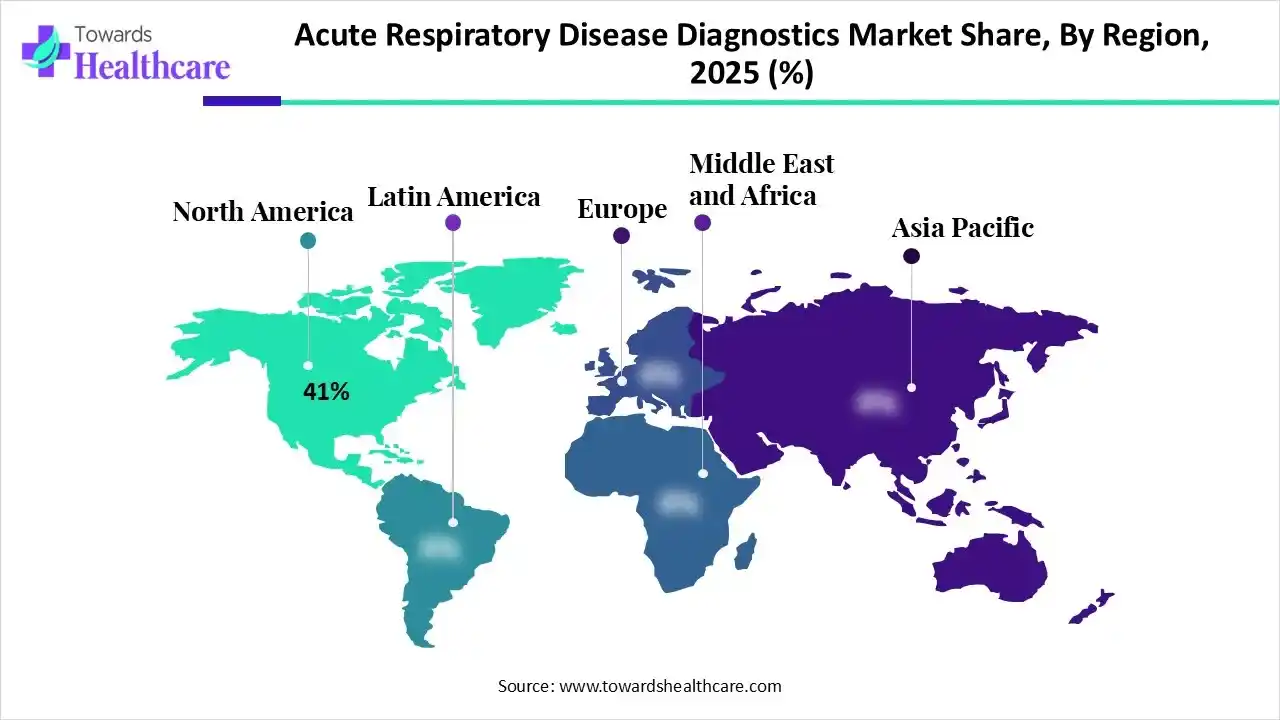
North America accounted for 41% of the market in 2025 and is projected to expand at a CAGR of 5.65% from 2026 to 2035. North America leads the healthcare market, driven by its strong infrastructure, high diagnostic testing volumes, and access to advanced technologies, particularly in the United States. With extensive hospital networks, FDA-approved respiratory testing platforms, and favorable reimbursement policies, the market thrives in North America. Future growth is anticipated from multiplex respiratory panels and rapid molecular testing, although North America's growth is expected to lag behind the overall market during the forecast period.
Europe growth is supported by clinical laboratory networks, public healthcare systems, and respiratory disease surveillance, with multiplex diagnostic technologies gaining traction. Strong hospital infrastructure in key European countries such as Germany, the UK, France, Italy, and Spain enhances diagnostic resources. The demand for combination respiratory panels and antimicrobial stewardship initiatives is expected to drive market growth in Europe.
Asia Pacific supported by its large population, recurring respiratory disease outbreaks, and expanding diagnostic infrastructure. Countries such as China, India, Japan, and South Korea are enhancing laboratory networks and hospital testing capabilities. Increased awareness of respiratory infections, higher healthcare spending, and better access to point-of-care diagnostics are facilitating this expansion. Additionally, local diagnostic manufacturing and distribution improvements are projected to enhance product availability.
Latin America demand for respiratory diagnostic products is bolstered by enhanced laboratory infrastructure, rising awareness of respiratory diseases, and greater access to molecular testing. Brazil and Argentina are significant markets due to their robust healthcare networks and increasing demand. However, variations in healthcare spending, reimbursement policies, and access to advanced diagnostic equipment may hinder adoption in specific countries.
Middle East and Africa development for advanced respiratory diagnostics is enhanced by investments in hospital infrastructure and laboratory capacity, especially in GCC countries and South Africa. The COVID-19 pandemic has intensified focus on infectious disease surveillance, with rising healthcare spending and modern hospital networks expected to promote the adoption of molecular testing, rapid antigen assays, and respiratory imaging technologies.
Analyst View: Regional market shares were developed by evaluating respiratory diagnostic demand, healthcare infrastructure, testing volumes, diagnostic expenditure, reimbursement conditions, and supplier presence across geographical markets. According to our analysis, North America maintains its leading position because of its mature diagnostic market and strong presence of established manufacturers. Asia Pacific is expected to receive the highest growth premium because laboratory investment, molecular testing capacity, and healthcare access are expanding rapidly.
| Rank | Company Name | 2025 Share (%) | Key Products / Business | Headquarters |
| 1 | Roche Diagnostics | 122.45% | cobas molecular and antigen respiratory tests | Switzerland |
| 2 | Abbott | 112.24% | ID NOW, BinaxNOW and Alinity m tests | United States |
| 3 | Cepheid (Danaher) | 112.24% | GeneXpert respiratory tests | United States |
| 4 | bioMérieux | 102.04% | BIOFIRE respiratory and pneumonia panels | France |
| 5 | Hologic | 51.02% | Panther Fusion respiratory assays | United States |
| 6 | QuidelOrtho | 51.02% | Sofia antigen and Savanna tests | United States |
| 7 | Siemens Healthineers | 40.82% | Imaging and laboratory tests | Germany |
| 8 | GE HealthCare | 40.82% | X-ray and CT imaging | United States |
| 9 | BD | 30.61% | BD MAX and Veritor tests | United States |
| 10 | QIAGEN | 30.61% | QIAstat-Dx syndromic panels | Netherlands |
Note: Company shares are 2025 estimates.
Sources: Company press releases, expert interviews, secondary sources, Towards Healthcare database, and Towards Healthcare analysts.
Roche Diagnostics, Abbott, and Cepheid (Danaher) are among the major participants in the global acute respiratory disease diagnostics market, supported by their established molecular testing platforms, rapid antigen products, and extensive healthcare distribution networks. Roche Diagnostics, Abbott, and Cepheid are major competitors in respiratory testing, with Roche emphasizing its cobas portfolio, Abbott offering ID NOW, BinaxNOW, and Alinity m solutions, and Cepheid employing its GeneXpert systems for rapid pathogen detection.
Other key market players include bioMérieux, Hologic, QuidelOrtho, Siemens Healthineers, GE HealthCare, BD, and QIAGEN. They engage in competition via multiplex respiratory panels, molecular assays, rapid antigen tests, laboratory diagnostics, and imaging technologies. Notably, bioMérieux has its BIOFIRE panels, Hologic offers Panther Fusion assays, and QIAGEN contributes with its QIAstat-Dx platform.
The competitive landscape features companies focused on infectious disease diagnostics alongside broader medical technology providers in respiratory imaging and patient assessment. Key competitive factors include panel breadth, analytical accuracy, turnaround time, installed instrument base, regulatory clearances, reimbursement coverage, and pricing. Firms with integrated molecular platforms and strong laboratory relationships are well-positioned to benefit from the adoption of combination respiratory testing.
Roche Diagnostics: Roche Diagnostics, a subsidiary of F. Hoffmann-La Roche Ltd based in Switzerland, specializes in respiratory diagnostics with a portfolio that includes cobas molecular and antigen testing solutions. Leveraging its established clinical diagnostics business and extensive laboratory relationships, the company supports the identification of common respiratory pathogens and is recognized as a Leader in the Towards Healthcare Companies Quadrant.
Abbott: Abbott, based in the United States, offers a respiratory diagnostic portfolio that includes ID NOW, BinaxNOW, and Alinity m testing solutions, catering to rapid molecular, antigen-based, and laboratory testing. The company leverages its established diagnostic business, strong hospital relationships, and extensive distribution network, placing it as a Leader in the Towards Healthcare Companies Quadrant.
Cepheid (Danaher): Cepheid, part of Danaher, is headquartered in the United States. Its respiratory diagnostic portfolio centres on GeneXpert molecular testing systems and respiratory pathogen assays. The company leverages its molecular diagnostic instruments to provide swift pathogen detection via cartridge-based testing. In September 2026, Cepheid received FDA clearance for its 13-pathogen Xpert Respiratory Panel. In the Towards Healthcare Companies Quadrant, it is categorized as a Leader.
bioMérieux: bioMérieux, based in France, specializes in respiratory diagnostics with products like BIOFIRE panels for syndromic molecular testing. Its emphasis on infectious disease diagnostics and strong laboratory partnerships enhance its competitive edge, earning it a 'Leader' position in the Towards Healthcare Companies Quadrant.
Hologic: Hologic is headquartered in the United States. Its respiratory diagnostics portfolio includes Panther Fusion respiratory assays, which support molecular testing applications. The company's established molecular diagnostics infrastructure and laboratory customer relationships contribute to its market participation. In the Towards Healthcare Companies Quadrant, it is categorized as a Leader.
QuidelOrtho: QuidelOrtho is headquartered in the United States. Its respiratory diagnostic portfolio includes Sofia antigen testing solutions and Savanna molecular diagnostic technologies. The company is active in both rapid antigen and molecular testing sectors, providing diagnostic applications in hospitals, laboratories, and point-of-care environments. It is recognized as a Leader in the Towards Healthcare Companies Quadrant.
Siemens Healthineers: Siemens Healthineers, headquartered in Germany, engages in the acute respiratory disease diagnostics market with imaging technologies and laboratory diagnostic solutions, including medical imaging systems for pneumonia evaluation. It is recognized as an Innovator in the Towards Healthcare Companies Quadrant.
GE HealthCare: GE HealthCare is headquartered in the United States. Its participation in the market is supported by X-ray and CT imaging technologies used to evaluate pulmonary abnormalities, pneumonia, and respiratory complications. The company benefits from an established medical imaging business and extensive hospital relationships. In the Towards Healthcare Companies Quadrant, it is placed as an Innovator.
BD: BD, a subsidiary of Becton, Dickinson and Company, is based in the U.S. and focuses on respiratory diagnostics, featuring BD MAX and Veritor testing technologies. Its solid diagnostic infrastructure and healthcare customer relationships enable its role in respiratory pathogen detection. BD is categorized as an Innovator in the Towards Healthcare Companies Quadrant.
QIAGEN: QIAGEN is headquartered in the Netherlands. Its respiratory diagnostic offering includes QIAstat-Dx syndromic panels, which support molecular detection of multiple respiratory pathogens. The company's expertise in molecular diagnostics and sample-based testing technologies strengthens its market position. In the Towards Healthcare Companies Quadrant, it is recognized as an Innovator.
The acute respiratory disease diagnostics ecosystem links reagent & component suppliers, diagnostic makers, imaging vendors, users, and regulators & public health, with each stage adding value before products reach end users.
| Ecosystem Stage | Role in the Market | Key Companies |
| Reagent & Component Suppliers | Supply enzymes, primers and cartridges | Reagent makers |
| Diagnostic Makers | Make tests and instruments | Roche, Abbott, Cepheid, bioMérieux, Hologic |
| Imaging Vendors | Supply X-ray and CT | GE HealthCare, Siemens Healthineers, Philips |
| Users | Test patients | Hospitals, labs, clinics, consumers |
| Regulators & Public Health | Clear tests and monitor outbreaks | FDA, CDC, WHO |
Sources: Company press releases, expert interviews, secondary sources, Towards Healthcare database and Towards Healthcare analysts.
Reagent & Component Suppliers: Participants supply vital components like enzymes, primers, antibodies, and cartridges for respiratory diagnostic products, which are essential in developing molecular assays, antigen tests, and immunoassays. A consistent supply of these components is critical for maintaining the quality and production capacity of diagnostic products.
Diagnostic Makers: Diagnostic manufacturers create and sell respiratory testing products, such as kits, instruments, reagents, and automated systems. Key players include Roche Diagnostics, Abbott, Cepheid, bioMérieux, and Hologic, offering solutions for rapid antigen testing, molecular pathogen detection, and multiplex diagnostics.
Imaging Vendors: Imaging vendors, including GE HealthCare, Siemens Healthineers, and Philips, provide X-ray and CT systems to evaluate pneumonia and other respiratory issues, aiding in assessing disease severity and pulmonary complications.
Users: Respiratory diagnostic technologies are utilized by hospitals, diagnostic laboratories, point-of-care clinics, and consumers, who depend on molecular testing, antigen assays, imaging, and respiratory monitoring to identify infections and assess patient conditions.
Regulators & Public Health: Regulatory authorities and public health organizations, including the FDA, CDC, and WHO, play crucial roles in product approvals, diagnostic standards, and respiratory disease surveillance, alongside monitoring infectious diseases and guiding public health actions.
The value chain in the global acute respiratory disease diagnostics market begins with raw material and reagent suppliers, followed by diagnostic manufacturers, imaging vendors, distribution partners, and healthcare end users. Software providers and digital healthcare platforms also contribute by connecting diagnostic results with telehealth services and clinical decision-making systems. Companies that integrate molecular testing, rapid diagnostics, imaging technologies, and strong healthcare relationships are better positioned to capture value across the ecosystem.
The Towards Healthcare Companies Quadrant positions key participants in the acute respiratory disease diagnostics market by market strength, reflecting revenue scale, market share, and geographic reach, and by innovation and growth strategy, reflecting product portfolio breadth, R&D intensity, and partnerships. Positions reflect each company's estimated 2025 share of the acute respiratory disease diagnostics market and our assessment of its product innovation, portfolio breadth, and partnerships.
Sources: Company press releases, expert interviews, secondary sources, Towards Healthcare database, and Towards Healthcare analysts.
Leaders: Roche Diagnostics, Abbott, Cepheid (Danaher), bioMérieux, Hologic, and QuidelOrtho combine high market share with broad portfolios and strong innovation.
Innovators: Siemens Healthineers, GE HealthCare, BD, and QIAGEN bring newer technologies and specialised products.
By Technology
By Disease
By End User
By Region
The global acute respiratory disease diagnostics market was estimated using a bottom-up approach based on respiratory diagnostic testing volumes, technology mix, average selling prices and revenues from relevant diagnostic instruments, assays and consumables. The analysis considers demand across influenza, COVID-19, RSV, bacterial respiratory infections and other acute respiratory pathogens, with testing volumes allocated across hospitals, diagnostic laboratories, point-of-care clinics and home-care settings. Combination-panel revenues are allocated using a consistent methodology to prevent double counting across pathogen categories. Instrument and consumable revenues are assessed separately, while general-purpose imaging and respiratory assessment equipment are included only to the extent that their revenues can be attributed to acute respiratory disease applications. The resulting estimates are cross-checked against supplier disclosures, product portfolios, regulatory clearances, regional testing activity and expert assessments.
All estimates for segments and regions were standardized to a 2025 base year. The 2026-2035 forecast incorporates expected changes in testing demand for respiratory infections, adoption of molecular diagnostics, use of combination panels, healthcare infrastructure, and average testing prices, aligning with a market growth assumption of 6.2%. Company-specific market shares need reevaluation, as initial percentages surpassed 100%, necessitating calculations based on verified acute respiratory disease diagnostics revenue instead of overall company or product portfolio revenue.
Analyst View: The acute respiratory disease diagnostics market is expected to grow steadily due to the rise in respiratory infections and the need for precise pathogen identification. Key pathogens such as influenza, COVID-19, RSV, and bacterial pneumonia drive testing demand across various healthcare settings. Molecular diagnostics, especially PCR and syndromic panels, will remain central to advanced testing. The market will benefit from improvements in rapid tests and AI-assisted imaging. North America is poised to lead the market, while Asia Pacific is predicted to experience the fastest growth. Opportunities lie in multiplex panels and over-the-counter tests, despite challenges like declining COVID-19 testing volumes and reimbursement issues. Overall, continued respiratory outbreaks and advancements in diagnostic technology will fuel market expansion through 2035.