


The animal-derived ECM-based tissue devices market size was estimated at USD 1.67 billion in 2025 and is predicted to surge at a CAGR of 12.45% from 2026 to 2035. An analysis also reflects that overall market growth is mainly propelled by increasing demand for regenerative medicine, a rise in geriatric chronic concerns, surgical procedure volumes, & broader benefits of animal tissues.
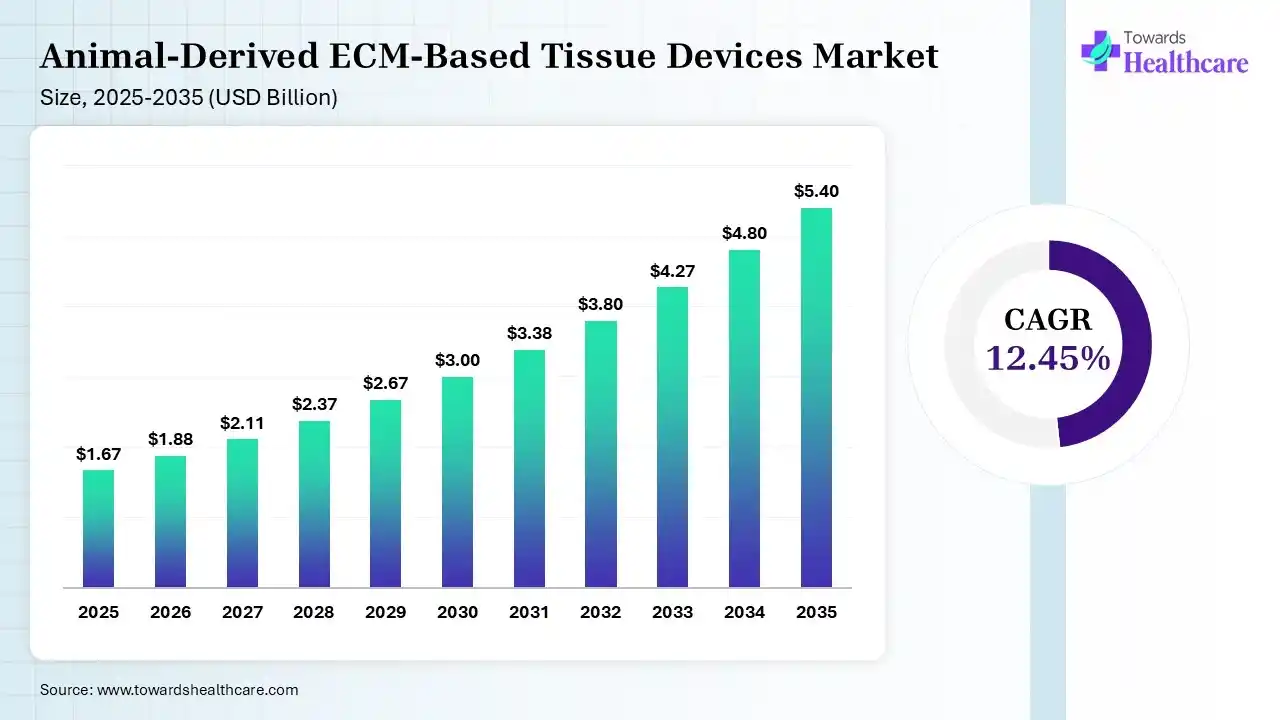
The animal-derived ECM-based tissue devices market is situated at the conjunction of advanced wound care, biologic tissue repair, surgical reinforcement, regenerative medicine, and tissue-engineering technologies. Animal-derived extracellular matrix (ECM) products use decellularized tissues, like porcine small intestinal submucosa (SIS), porcine urinary bladder matrix (UBM), dermis, pericardium, ovine forestomach, and other tissue sources to achieve the structural and biochemical characteristics of native ECM.
On the other hand, the surrounding tissue-engineering opportunity is significantly vast. According to Towards Healthcare projects the global tissue-engineering market is projected to reach US$22.29 billion in 2025, witnessing US$74.53 billion by 2034 at 14.35% CAGR. Meanwhile, scaffolds are referred to as both the dominant and fastest-growing product category & North America dominates regionally, while Asia-Pacific is anticipated to grow fastest.

Moreover, the wider tissue-regenerative-therapy market was found at US$15.04 billion in 2025 and is expected to reach US$46.88 billion by 2035, showcasing a 12.04% CAGR. Hospitals captured nearly 55% of that broader market in 2025.
| Leading Segments | Coverage | Percentage |
| Leading animal source | Porcine | 58.0% |
| Fastest-growing animal source | Ovine | 14.1% CAGR |
| Leading ECM material | SIS | 30.0% |
| Fastest-growing ECM material | Forestomach ECM | 14.6% CAGR |
| Leading product type | Sheets & Membranes | 27.0% |
| Fastest-growing product type | Hydrogels | 14.8% CAGR |
| Leading processing technology | Detergent-Enzymatic Decellularization | 39.0% |
| Fastest-growing processing technology | Hybrid Decellularization | 15.2% CAGR |
| Leading application | Wound Care | 29.0% |
| Fastest-growing application | Urologic Reconstruction | 15.1% CAGR |
| Leading end user | Hospitals | 58.0% |
| Fastest-growing end user | ASCs | 14.3% CAGR |
| Leading region | North America | 42.5% |
| Fastest-growing region | Asia-Pacific | 15.1% CAGR |
| Largest country market | United States | 38.0% |
| Fastest-growing listed country | India | 17.2% CAGR |
| Segment/Sub-segment | Market Share | CAGR | Growth Driver |
| Porcine | 58.00% | 12.20% | Well-established porcine tissue, broader clinical applications, & strong SIS and UBM product portfolios. |
| Bovine | 24.00% | 11.80% | Durable collagen-rich matrices, wider use by manufacturers, & higher availability. |
| Ovine | 11.00% | 14.1% | Specific use of forestomach ECM, advanced wound care adoption, & novel ovine ECM products. |
| Equine | 5.00% | 10.90% | Strong collagen-based structural features, specialty surgical applications & product development. |
| Other Animal Sources | 2.00% | 13.20% | Availability of alternative tissues, mechanical & biological properties & specialty applications. |
| Total | 100% |
Porcine tissue is the dominant commercial source. For instance, Cook Biotech represents its SIS products as processed porcine small-intestinal submucosa, which comprises a naturally occurring ECM architecture. Its processing discards viable cells while retaining the fibrous & porous matrix. However, Aroa offers a counterpoint to porcine lead position through its ovine forestomach-derived ECM platform, with products such as Myriad and Endoform. For FY2025, Aroa generated NZ$84.7 million in product revenue, including NZ$32.3 million from Myriad, NZ$39.7 million from OviTex/OviTex PRS, and NZ$11.7 million from Endoform.
Analyst View: Animal Source
According to our senior Aman Singh's study, Porcine ECM has the largest installed commercial base, as SIS, UBM, and dermal matrices have advanced surgical applications. Meanwhile, Ovine ECM indicates a robust diversification opportunity because forestomach-derived matrices have stepped beyond niche research toward commercial wound and soft-tissue products. Availability of animal tissue is not only a concern but also encompasses source-specific clinical evidence, traceability, decellularization quality, regulatory documentation, and product differentiation.
| ECM Material/Tissue Type | Market Share | CAGR | Growth Drivers |
| SIS | 30.00% | 12.00% | A three-dimensional collagen-rich architecture enhances tissue infiltration, remodelling & cellular attachment and extends clinical use. |
| Dermal ECM | 24.00% | 12.40% | Offers structural support, higher demand in complex wounds, and also provides expansive product portfolios. |
| UBM | 14.00% | 14.00% | Gives a biologically active scaffold with widespread adoption by manufacturers, and injectable UBM measures offer broader clinical use. |
| Pericardial ECM | 12.00% | 11.90% | Higher mechanical strength, collagen density, wider use in cardiovascular & vascular reconstruction, with increased neurological & specialty patch purposes. |
| Forestomach ECM | 10.00% | 14.6% | Preserves collagen, elastin, & other ECM components, higher advanced wound-care adoption, & novelty in formulations |
| Other Organ-Derived ECM | 10.00% | 13.10% | Diversified ECM platforms, enhanced tissue-specific matrices, & developing clinical applications. |
| Total | 100% |
Specifically, Cook Biotech's regulatory documentation ensures that its Biodesign devices comprise processed porcine SIS, which is featured as a three-dimensional, acellular, collagen-based ECM material. Surging commercial acceptance of tissue-specific ECM is mainly fueled by various source tissues that facilitate diverse combinations of collagen, glycosaminoglycans, proteoglycans, growth factors, and mechanical characteristics. In addition, Cook highlights SIS as retaining collagen and non-collagenous ECM components after processing.
Analyst View: ECM Material
According to our analyst Payal Rabde, SIS registers its dominance across the globe due to its expansive commercial and clinical footprint. At the same time, Forestomach ECM is growing rapidly as ovine-derived matrices facilitate a diversified platform for wound management. Moreover, UBM and other organ-derived ECMs are expanding notably, with additional opportunities where tissue-specific biochemical characteristics can foster specialized reconstruction. On the other hand, product innovators are increasingly challenging retained ECM composition, mechanical performance, pore structure, residual DNA levels, and remodeling behavior, instead of source tissue alone.
| Product Type | Share | CAGR | Growth Drivers |
| Sheets & Membranes | 27.00% | 10.90% | Conforming to irregular wound surfaces, wider use in hospitals, & broader availability. |
| Patches | 24.00% | 12.70% | Offering biologically active reinforcement, increased demand in CVS, orthopedic, vascular, & dural procedures, with the highest clinical familiarity. |
| Meshes & Reinforcement Devices | 18.00% | 11.80% | ECM meshes strengthen weakened soft tissue, while boosting hernia & abdominal-wall reconstruction & higher preference. |
| Hydrogels | 12.00% | 14.8% | Increased use of injectable & topical hydrogels, wider assistance in cellular migration & localized modeling, and also surging developments of MIS. |
| Powders & Particulates | 8.00% | 12.10% | Key role of micronized ECM, easy storage & procedural handling, with progression in injectable & topical applications. |
| Sponges & Foams | 6.00% | 11.40% | Strong surface area for tissue integration, greater demand in hemostatic & wound-management procedures, and seeking novel pore architectures. |
| Injectable ECM Devices | 5.00% | 14.50% | Enabling minimally invasive delivery, addressing sites that are difficult & bolstering clinical development. |
| Total | 100.00% |
As per our senior analyst Aditi’s assessment, Cook Biotech's commercial portfolio has been showcasing the breadth of SIS-based product formats, which consist of tissue grafts, hernia grafts, plastic-surgery matrices, fistula plugs, dural grafts, and staple-line reinforcement products. Moreover, TELA Bio's OviTex portfolio reflects the commercial significance of reinforcement devices. In 2025, TELA reported US$80.3 million in revenue, such as US$51.224 million from OviTex and US$27.306 million from OviTex PRS. OviTex unit sales expanded to 22,063 in 2025 from 18,121 in 2024, whereas OviTex PRS unit sales rose to 5,189.
Analyst View: Product Type
According to the comprehensive analysis, the sheets and membranes segment indicates dominance, as they are used in multiple wound and surgical procedures without any need for specialized delivery systems. Furthermore, significantly growing formats, such as injectable devices, are driven by the fact that they can reach asymmetrical defects and probably assist minimally invasive procedures. Meanwhile, the commercial opportunity is massive, as manufacturers can offer ease of handling, predictable degradation/remodeling, procedural efficiency, and reproducible performance.
| Processing Technology | Share | CAGR | Growth Drivers |
| Detergent-Enzymatic Decellularization | 39.00% | 11.90% | Positive effect from combination approach, preservation of collagen architecture, & established protocols. |
| Enzymatic Decellularization | 20.00% | 12.80% | Efficient removal of residual cellular material, controlled processing, & optimized enzyme concentration & exposure time. |
| Chemical Decellularization | 17.00% | 11.60% | Agents allow strong disruption of cellular membranes, enabling scalable processing & elevated process optimization. |
| Physical & Mechanical Processing | 12.00% | 12.60% | Mechanical solutions enhance tissue penetration, wider support from freeze-thaw & agitation, with raised combination processing. |
| Hybrid Decellularization | 7.00% | 15.20% | Combined complementary removal mechanisms, improved decellularization, and surged demand. |
| Other Processing Technologies | 5.00% | 13.00% | Emerging methods, reduction in residual DNA & processing-related damage, and innovative automation & closed-system processing. |
| Total | 100.00% |
An extensive analysis shows that decellularization is strategically leading, as ECM products require discarding cellular components while retaining desirable structural and biochemical properties. However, Cook's SIS process explores the specific removal of viable cells while retaining the native fibrous and porous architecture. Meanwhile, the lucrative growth of the hybrid approach is driven by multi-stage processing & enhanced matrix preservation, while other processing technologies are expanding due to process automation & latest processing usage.
Analyst View: Processing Technology
Towards Healthcare’s evaluation says the competitive goal is shifting from foundational decellularization toward controlled, validated & reproducible processing. Along with this, hybrid measures are unifying chemical, enzymatic, and physical mechanisms to optimize cellular removal while overcoming damage to collagen and other ECM components. This further develops chances for closed-system processing, automated monitoring, standardized DNA-residual testing & source-to-batch traceability.
| Application | Share | CAGR | Growth Drivers |
| Wound Care | 29.00% | 11.70% | Broader demand in chronic wounds, assistance from ECM devices, and expansion in clinical usage. |
| Hernia & Soft-Tissue Reconstruction | 23.00% | 12.50% | ECM reinforcement, higher demand in hernia procedures, and the widespread adoption of biologic matrices. |
| Orthopedic & Musculoskeletal Repair | 18.00% | 13.20% | Progressive ECM scaffolds, rise in sports injuries, geriatric populations, and surge in clinical evidence. |
| Cardiovascular & Vascular Repair | 12.00% | 14.40% | Key benefits of ECM patches, broader demand in CVS procedures & rising new regenerative applications. |
| Dural & Neurosurgical Repair | 7.00% | 8.90% | Developing animal-derived collagen matrices, rising neurosurgical procedure volumes, and higher application of absorbable products. |
| Urologic Reconstruction | 5.00% | 15.1% | Increased use of ECM scaffolds, expanding regenerative urology research, and accelerating opportunities in injectable & tubular ECM formats. |
| Dental & Oral Reconstruction | 3.00% | 13.80% | Higher support from ECM membranes, rise in dental implant procedures, and improvement in biomaterial handling. |
| Other Applications | 3.00% | 12.90% | Broadened applications in ophthalmic, gynecological & trauma, coupled with newer indications. |
| Total | 100.00% |
Primarily, wound care has a specific, expansive pool. WHO states that the number of people living with diabetes increased from 200 million in 1990 to 830 million in 2022, and diabetes can lead to lower-limb amputation and other complications, which require chronic wound management. Moreover, Towards Healthcare estimates the wider wound-closure market at US$15.22 billion in 2025, reaching US$30.35 billion by 2035. It finds hybrid/bioengineered materials as a faster-growing material category, with nearly 10–12% CAGR, partly because these materials can mimic aspects of natural ECM.
According to TELA, the reported U.S. market opportunity also represents the scale of soft-tissue reconstruction: it projects nearly 1.2 million hernia repairs per year in the U.S., such as roughly 105,000 complex/moderate ventral hernia repairs, 395,000 simple ventral repairs, and 645,000 inguinal repairs.
Analyst View: Application
As per our overall study, wound care registers a dominant share in the commercial pool due to chronic wounds generating ongoing treatment demand & necessitating biologic materials in difficult-to-heal cases. Meanwhile, hernia and soft-tissue reconstruction facilitate a second major commercial base, with OviTex reflecting a measurable commercial market for ECM-based reinforcement. Moreover, urologic, cardiovascular and injectable applications indicate higher-growth opportunities but usually need more specialized evidence, clinical development and regulatory pathways.
| End User | Share | CAGR | Growth Drivers |
| Hospitals | 58.00% | 11.80% | High volume of complex reconstructive procedures. |
| Ambulatory Surgical Centers | 18.00% | 14.3% | Progressing outpatient orthopedic & soft-tissue surgery. |
| Specialty Clinics | 11.00% | 13.60% | Wound-care & reconstructive treatment specialization. |
| Trauma & Burn Centers | 8.00% | 12.90% | Complex wound & reconstructive requirements. |
| Research & Academic Institutions | 5.00% | 13.90% | Next-generation ECM development & translation research. |
| Total | 100.00% |
According to our senior analyst Aman Singh, the widespread tissue-regenerative-therapy market also highlights hospitals as the leading end-user category, at nearly 55% in 2025. Simultaneously, specialty clinics are expected to grow at a rapid rate during the forecast period.
Analyst View: End User
Dominance of hospitals is driven by their integrated wound care, general surgery, orthopedic, cardiovascular, neurosurgical, and reconstructive departments. On the other hand, ASCs showcase a substantial growth channel as more orthopedic and soft-tissue procedures shift into outpatient settings. Nowadays, suppliers are seeking ASCs that require products with short preparation times, predictable handling, compact packaging, shelf-life stability, and streamlined procedural workflows.
| Country | Global Share | Regional Share | CAGR |
| United States | 38.00% | 89.40% | 11.20% |
| Canada | 3.00% | 7.10% | 11.80% |
| Mexico | 1.50% | 3.50% | 13.40% |
Across the globe, North America led the animal-derived ECM-based tissue devices market with the largest share of 42.5% in 2025. This dominant position is mainly fueled by advanced biologic-device commercialization, sophisticated surgical infrastructure, & significant chronic wound & reconstructive procedure volumes. Moreover, the United States contributed a major share across this region because of the rising aged population, with 61.2 million people aged 65+ in 2024, which represents 18.0% of the population, i.e., higher by 3.1% from 2023.
Analyst View: North America
Based on my overall analysis, the U.S. is the primary commercial market and sustains the central launch environment for numerous ECM products. Meanwhile, Canada indicated a notable share with a smaller but well-developed healthcare market. On the other hand, Mexico provides a higher-growth opportunity within North America. Regional commercial success prominently relies on reimbursement, evidence generation, hospital contracting, surgeon adoption, and regulatory compliance.
| Country | Global Share | Regional Share | CAGR |
| Germany | 7.20% | 25.40% | 11.40% |
| United Kingdom | 5.00% | 17.70% | 11.90% |
| France | 4.20% | 14.80% | 11.60% |
| Italy | 3.10% | 11.00% | 11.80% |
| Spain | 2.40% | 8.50% | 12.00% |
| Netherlands | 1.80% | 6.40% | 12.20% |
| Switzerland | 1.40% | 4.90% | 11.90% |
| Rest of Europe | 3.20% | 11.30% | 12.10% |
Europe is registering notable growth with 28.3% in 2025 & is predicted to expand significantly at an 11.70% CAGR during 2026-2035 in the animal-derived ECM-based tissue devices market. Comprehensive evaluation indicates that Eurostat reported on 1 January 2025 that 99 million people aged 65+ accounted for 22% of the EU population, while people aged 80+ represented 6%.
Analyst View: Europe
As per our analyst Aditi, Germany, the U.K. and France are highlighted as core commercial markets in the supplied segmentation. However, across the region, the geriatric population is widely fostering wound-care, orthopedic, and reconstructive demand. The overall market progression is specifically driven by national reimbursement systems, procurement structures, and regulatory requirements, which raises the significance of country-specific commercialization strategies.
| Country | Global Share | Regional Share | CAGR |
| China | 7.10% | 37.00% | 15.00% |
| Japan | 3.80% | 19.80% | 13.70% |
| India | 3.10% | 16.10% | 17.20% |
| South Korea | 2.00% | 10.40% | 15.30% |
| Australia | 1.40% | 7.30% | 13.90% |
| Singapore | 0.80% | 4.20% | 14.80% |
| Rest of APAC | 1.00% | 5.20% | 16.10 |
In 2025, Asia Pacific accounted for a 19.2% share of the global animal-derived ECM-based tissue devices market. APAC is anticipated to witness rapid expansion at a 15.1% CAGR in the studied years. A market study shows that the regional expansion is primarily propelled by demographic change, healthcare infrastructure progression & accelerating adoption of regenerative technologies. As per WHO estimates, the global population aged 60+ will increase from 1.0 billion in 2019 to 1.4 billion by 2030 and 2.1 billion by 2050, with specifically rapid ageing in developing nations.
Particularly, India is also bolstering the development of domestic medical-device manufacturing capacity. Alongside this, India's medical-device PLI scheme has a ₹3,420 crore budgetary outlay and spurs incremental domestic production across specified device categories.
Analyst View: Asia-Pacific
Rapid growth of the APAC market covers vast patient populations and increasing healthcare capacity. Meanwhile, China offers a huge country opportunity by supplying market share, whereas India has the highest listed country CAGR. Moreover, Japan facilitates a well-established, ageing-market opportunity, while South Korea & Singapore benefit from advanced hospitals, specialist surgery and medical-tourism activity.
| Country | Global Share | Regional Share | CAGR |
| Brazil | 2.90% | 48.30% | 13.20% |
| Mexico | 1.30% | 21.70% | 14.10% |
| Argentina | 0.70% | 11.70% | 12.90% |
| Colombia | 0.50% | 8.30% | 14.00% |
| Chile | 0.30% | 5.00% | 13.70% |
| Rest of Latin America | 0.30% | 5.00% | 14.40% |
Latin America captured a 6.0% share of the market in 2025 and is anticipated to witness lucrative expansion at a 13.40% CAGR in the coming years. This significant growth is driven by a rise in massive investment in orthopedic & dental regenerative approaches, with support from private healthcare areas to bring premium biomaterials into regular clinical application.
Analyst View: Latin America
According to our analysis, Brazil offers the largest recognisable market within the supplied regional structure, whereas Mexico & Colombia registered higher expansion rates. However, distributor partnerships, private-hospital penetration and availability of imported biologic devices are especially vital commercial variables.
| Country | Global Share | Regional Share | CAGR |
| Saudi Arabia | 0.90% | 22.50% | 13.40% |
| UAE | 0.70% | 17.50% | 13.80% |
| Israel | 0.60% | 15.00% | 12.50% |
| South Africa | 0.50% | 12.50% | 12.70% |
| Turkey | 0.50% | 12.50% | 13.50% |
| Rest of MEA | 0.80% | 20.00% | 12.80% |
As per my evaluation, Middle East & Africa held a 4.0% share of the animal-derived ECM-based tissue devices market in 2025 and is predicted to expand notably at 13.00% CAGR during the forecast period. Regional major catalysts are the growing preference for natural animal-derived ECM scaffolds by surgeons and massive growth of medical tourism, particularly in the UAE & South Africa, as they attract international patients for modern surgical procedures, elevating demand for cutting-edge biomaterials.
Analyst View: MEA
According to our senior analyst Aman Singh, Saudi Arabia and the UAE showcase pivotal healthcare-investment and specialty-surgery markets. Meanwhile, Israel has a robust biomedical research base, whereas Turkey integrates specialty surgery with medical-tourism demand. The overall market growth outside crucial healthcare hubs will rely strongly on distributor coverage, specialist capacity, and procurement economics.
| Factor | Sub-segment/Metric | Real Market Evidence | Relevance |
| TAM | Global Tissue Engineering | US$22.29B in 2025 → US$74.53B by 2034; 14.35% CAGR | Broad ecosystem covering scaffolds, biological materials and tissue-engineering technologies. |
| TAM | Tissue Regenerative Therapy | US$15.04B in 2025 → US$46.88B by 2035; 12.04% CAGR | Broader tissue-repair and regenerative-technology revenue pool |
| SAM | Scaffold Products | Scaffold identified as dominant and fastest-growing tissue-engineering product category | Closest product ecosystem to ECM-based scaffolds |
| SAM | Biological Materials | Tissue engineering includes biological materials such as collagen and hydrogels. | Directly overlaps animal-derived ECM technologies. |
| SAM | Wound Closure | US$15.22B in 2025 → US$30.35B by 2035 | Important adjacent procedural market for biological wound-repair materials |
| SOM | Commercial ECM Platforms | Cook Biotech, TELA Bio, Aroa, and other companies commercialize SIS, ovine ECM, and reinforcement products. | Defines the commercially addressable ECM-device competitive environment |
Specifically, the tissue-engineering and regenerative-therapy figures are powered by Towards Healthcare's published market research.
Analyst View: TAM/SAM/SOM
Comprehensive study reflects that the market should not be treated as similar to the complete regenerative-medicine industry. However, the practical SAM is focused on decellularized biological scaffolds, wound-care matrices, biologic reinforcement, and tissue-specific repair products. On the other hand, the SOM is further restricted by regulatory clearance, clinical indication, reimbursement, manufacturing capacity, and surgeon adoption. This evolves a commercially significant but much smaller opportunity compared with the expansive regenerative-medicine TAM.
| Consumer/Clinical Behavior | Evidence | Market Implication |
| Preference for biologically active materials | ECM provides structural and biochemical cues supporting tissue remodeling | Biological performance is a key differentiator |
| Demand for tissue compatibility | Collagen-rich matrices are designed to interact with host tissue | Biocompatibility and remodeling evidence influence adoption |
| Increasing chronic-wound burden | Diabetes affected 830M people globally in 2022 | Supports recurring wound-care demand |
| Aging population | 60+ population projected to reach 2.1B by 2050 | Supports orthopedic, wound and reconstructive demand |
| Concern about animal-origin materials | FDA highlights infectious-disease and sourcing risks | Traceability and pathogen controls become purchasing criteria |
| Interest in non-animal alternatives | Recombinant and synthetic materials provide competitive alternatives | Animal-derived ECM suppliers must demonstrate clinical and economic differentiation |
| Demand for procedural efficiency | ASCs and outpatient surgery are expanding | Smaller, easy-to-use and ready-to-use formats gain relevance |
This underlines that WHO's diabetes data represents a strong chronic-wound demand indicator, while WHO's ageing projections push the widespread long-term tissue-repair demand pool.
Analyst View: Consumer Behavior
Across the animal-derived ECM-based tissue devices market, consumer behavior is primarily clinician & institutional adoption behavior, instead of direct patient purchasing. Day by day, surgeons are highly looking for clinical evidence, handling characteristics, tissue integration, complication profile, and procedural fit. Meanwhile, patients can impact demand indirectly through preferences for healing, reduced complications, and minimally invasive treatment, but purchasing decisions are heavily controlled by clinicians, hospitals & reimbursement systems.
| Buyer Group | Purchasing Priorities | Buying Signal |
| Hospitals | Clinical evidence, regulatory status, reimbursement, safety, handling, supply continuity | Adoption through surgical departments and value-analysis committees |
| ASCs | Procedure efficiency, shelf stability, ease of use, packaging and cost | Growth in outpatient orthopedic and soft-tissue procedures |
| Wound-care clinics | Wound closure/healing evidence, ease of application, reimbursement | Chronic wound and diabetic-foot caseload |
| Orthopedic centers | Mechanical strength, integration, remodeling and procedure-specific evidence | Tendon, ligament and soft-tissue repair |
| Plastic/reconstructive centers | Conformability, reinforcement, remodeling and cosmetic/functional outcomes | Complex reconstruction |
| Trauma/burn centers | Rapid availability, wound coverage, tissue compatibility | Complex wounds and reconstruction |
| Academic institutions | ECM composition, reproducibility, mechanical properties, cell response | Translational research and new applications |
| Medical-device distributors | Regulatory status, market demand, margin, shelf life, product differentiation | Expansion into regional specialty markets |
This strongly indicates that the FDA's animal-derived-material guidance especially highlights sourcing, storage, and manufacturing, as animal materials can develop infectious-disease risks. It references ISO 22442-1, -2 and -3 and recommends controls around sourcing and pathogen elimination/inactivation. Moreover, ISO 22442-1:2020 recognizes risk management for devices made employing animal tissues, including bacterial, viral, TSE, immunological & toxicological hazards. However, ISO 22442-2:2020 encompasses sourcing, collection, handling, storage and transport, with specific attention to TSE-risk species, such as bovine, ovine & caprine sources.
Analyst View: Buyer Intelligence
Nowadays, the market is moving from “Does the device contain ECM?” toward “Can the manufacturer prove consistent ECM quality, safety, traceability and clinical performance?” However, buyers are highly emphasising their requirement to connect evidence about source tissue, processing parameters, and final-device performance. Alongside, suppliers that can facilitate strong regulatory dossiers, batch consistency, clinical evidence, and reliable supply can lower procurement friction.
Recently, in February 2026, the FDA implemented the Quality Management System Regulation (QMSR), which includes ISO 13485:2016 by reference, further strengthening the significance of documented quality systems for finished-device manufacturers.
This firm has commercialized OviTex, an ECM-based soft-tissue reinforcement platform, with revenue in 2025 of US$80.275 million, i.e., higher by 16% from US$69.300 million in 2024. Let’s have an extensive look at the company’s revenue landscape in 2025:
This highlights that the company's revenue is heavily focused on OviTex products, with the 2025 filing describing that OviTex products generated the vast majority of revenue.
Commercial relevance: The framework represents the monetization of ECM-based reinforcement in hernia and soft-tissue reconstruction.
Aroa has executed its key platform, which substantially relies on ovine forestomach-derived ECM.
| FY2025 Metric | NZ$ Million |
| Total product revenue | 84.7 |
| Myriad | 32.3 |
| OviTex/OviTex PRS | 39.7 |
| Endoform | 11.7 |
| Symphony | 0.3 |
For FY2025, Aroa recorded 24% product-revenue growth, along with Myriad sales increasing 38% to NZ$32.3 million and OviTex/OviTex PRS sales rising 22% to NZ$39.7 million.
Commercial relevance: Specific validation of ovine forestomach ECM reflects a commercially scalable option to porcine SIS and dermal sources.
They generally conduct operations throughout advanced wound care & surgical/sports medicine. Comprehensive revenue ground of 2025 covers
In addition, the company’s portfolio includes PuraPly, a clinically relevant biologic wound-care platform, even though company-wide Advanced Wound Care revenue should not be considered revenue particularly attributable to animal-derived ECM devices.
Commercial relevance: This shows the scale of the broader advanced-wound-care ecosystem into which ECM products compete.
A leader reported US$418.63 million in 2025 net sales, which is divided between Wound & Surgical classes.
| Product Category | 2025 Sales | Share of Sales |
| Wound | US$276.326M | 66% |
| Surgical | US$142.304M | 34% |
| Total | US$418.630M | 100% |
This illustrates that wound sales increased by 19.6%, whereas surgical sales increased by 20.7%.
Commercial relevance: This offers a standard for the wider biologic wound and surgical-repair market, while its generated revenue should not be categorized as animal-derived ECM revenue without product-level evidence.
This overall revenue structure indicates that Advanced Wound Management grew 6.7% reported in 2025. Alongside, they stated strong first-half performance from its skin-substitute portfolio, although reimbursement modifications affected skin substitutes toward the end of the year.
Commercial relevance: This illustrates the size of the expansive advanced-wound-care platform surrounding ECM and biologic products.
This eminent player offers one of the purest instances of a mature SIS-based ECM platform. Their products are developed from porcine small intestinal submucosa, with commercial formats ranging across tissue grafts, hernia grafts, plastic-surgery matrices, fistula plugs, dural grafts & reinforcement products.
Analyst View: Competitive Landscape
The entire competitive field is divided among many product strategies, such as
Moreover, company revenue should be utilized as company-level commercial evidence, not as direct market share, unless the company clearly reports revenue for the relevant animal-derived ECM category.
Supply chain operations executed by animal-derived ECM manufacturers start with controlled animal sourcing and tissue collection & surpasses through cleaning, decellularization, processing, shaping, sterilization, packaging, and final device rollout.
| Stage | Key Control |
| Animal sourcing | Species, geography, herd/flock health |
| Tissue collection | Tissue identification and contamination control |
| Storage/transport | Temperature, traceability, chain of custody |
| Decellularization | Cellular removal and ECM preservation |
| Washing | Chemical/process residue control |
| ECM processing | Thickness, pore structure, mechanical properties |
| Sterilization | Sterility assurance and matrix preservation |
| Packaging | Barrier integrity and shelf life |
| Release testing | Bioburden, residual DNA, mechanical/physical specifications |
| Distribution | Temperature, inventory and product traceability |
Across the animal-derived ECM-based tissue devices market, ISO 22442-2 significantly covers sourcing, collection, handling, storage, and transport of animal tissues employed in medical devices.
Furthermore, FDA's 2019 guidance similarly aims at controlling animal sourcing and examining manufacturing solutions for pathogen removal/inactivation.
The FDA QMSR became effective February 2, 2026, which incorporates ISO 13485:2016 into the U.S. medical-device quality landscape.
Analyst View: Manufacturing
As per my evaluation, manufacturing diversity highly depends on the ability to secure native ECM features, while receiving reproducible decellularization & validated pathogen control. Meanwhile, manufacturers that possess vertically controlled tissue sourcing, automated processing, validated sterilization, and strong batch-release analytics can ultimately lower quality changes & regulatory risk.
Demand Indicators & Graph-Ready Intelligence
Source: WHO, U.S. Census Bureau, and Eurostat
| Company | Metric | 2024 | 2025 | Growth |
| TELA Bio | Total revenue | US$69.3M | US$80.3M | 16% |
| MiMedx | Net sales | US$348.9M | US$418.6M | 20% |
| Organogenesis | Net product revenue | US$482.0M | US$563.0M | 17% |
| Smith+Nephew | Advanced Wound Management | US$1.681B | US$1.793B | 6.70% |
By considering Aroa's FY2025 results indicate strong commercial traction for Myriad, its ovine forestomach-derived ECM platform. Meanwhile, Myriad sales showed NZ$32.3 million, up 38%, while total Aroa product revenue reached NZ$84.7 million.
The unveiling of TELA's OviTex business reported US$51.2 million in 2025 revenue, while OviTex PRS reached US$27.3 million. Alongside, unit sales also broadened year over year.
Specifically, Organogenesis recorded US$531.2 million in Advanced Wound Care product revenue in 2025, up 17%, which demonstrates consistent commercial demand for advanced biological wound-care solutions.
Eventually, Coloplast mentions that Kerecis has nearly 50 clinical studies on its fish-skin graft technology. Meanwhile, its Odinn randomized controlled trial covered 255 patients across 15 care centers in four nations. Even though fish skin is not considered in the supplied core animal-source segmentation, this illustrates the widespread trend toward emerging differentiated animal-derived biological matrices, led by clinical evidence.
| Opportunity | Commercial Rationale |
| Ovine ECM expansion | Higher supplied CAGR and differentiated source technology |
| Injectable ECM | Addresses difficult-to-reach defects and minimally invasive procedures |
| ECM hydrogels | Conformability and delivery potential |
| Hybrid ECM devices | Combination of biological remodeling with mechanical reinforcement |
| ASC-focused products | Growing outpatient surgical environment |
| Advanced wound care | Large chronic-wound demand pool |
| Emerging APAC markets | Higher growth and expanding healthcare infrastructure |
| Source traceability platforms | Increasing regulatory and buyer requirements |
| Automated decellularization | Greater consistency and scalability |
| Tissue-specific ECM | Opportunity to tailor products to clinical indications |
| Risk | Impact |
| Animal-origin pathogen risk | Raises sourcing, processing, and validation requirements |
| TSE/BSE controls | Particularly relevant for bovine/ovine/caprine materials |
| Batch variability | Can affect ECM composition and mechanical performance |
| Reimbursement pressure | Can limit adoption despite clinical advantages |
| High manufacturing costs | Tissue processing and quality testing increase COGS |
| Synthetic alternatives | Offer controlled composition and potentially lower variability |
| Recombinant collagen | Reduces dependence on animal sourcing |
| Human-derived alternatives | Compete where biologic integration is prioritized |
| Clinical evidence requirements | Slow expansion into new indications |
| Regulatory complexity | Animal-source products require extensive documentation |
| Supply-chain disruption | Tissue availability affects production continuity. |
Analyst View: Risks
According to Towards Healthcare’s assessment, the key strategic threat is not a limitation of applications but substitution & standardization. Additionally, animal-derived ECM products must explicitly demonstrate their additional sourcing and regulatory concern through representative clinical performance, handling advantages, remodeling characteristics or economic value. However, recombinant and synthetic materials may achieve market share where reproducibility and source independence are more crucial than native ECM complexity.
By Animal Source
By ECM Material / Tissue Type
By Product Type
By Processing Technology
By Application
By End User
By Region
The primary market research process was carried out by Payal Rabde, Senior Research Associate, who also designed the methodology and did market segmentation, regional trend analysis, recycling technologies, competitive analysis, and forecasts, laying the foundation for the analytical part of the report.
Aman, Head of Research, has gathered and checked regulatory policies, company financial information, information on recycling capacity, production information, commodity price information, and various other quantitative information sources, which are obtained independently, thereby increasing the quality of evidence supporting calculations of the market values.
Aditi, VP Research, has validated and refined the research material, verified facts, corrected inconsistencies, and completed the research document, making it accurate and to the point.
| 1 | How quickly can ovine ECM gain share against established porcine SIS and dermal ECM? |
| 2 | Which clinical indications provide the strongest commercial opportunity for UBM? |
| 3 | How much of ECM-device demand can shift from sheets/patches toward injectable formats? |
| 4 | Which processing technologies best preserve native ECM composition while minimizing residual cellular material? |
| 5 | What regulatory requirements create the largest barriers to commercialization of new animal-derived ECM sources? |
| 6 | How are reimbursement changes affecting biologic wound-care adoption? |
| 7 | Which ECM products demonstrate the strongest evidence in diabetic-foot-ulcer treatment? |
| 8 | What is the cost-per-procedure advantage of ECM reinforcement versus synthetic mesh? |
| 9 | Which APAC countries offer the strongest combination of surgical volume, regulatory accessibility, and domestic manufacturing? |
| 10 | How rapidly are recombinant and synthetic ECM alternatives replacing animal-derived materials? |
| 11 | Which animal sources offer the best combination of supply security, mechanical performance, and biological activity? |
| 12 | Which product formats are best suited to ASC migration? |
| 13 | What clinical evidence is required to expand existing ECM platforms into cardiovascular, urologic, or orthopedic indications? |
| 14 | Which manufacturers have vertically integrated tissue sourcing and processing? |
| 15 | How much of company revenue is directly attributable to animal-derived ECM rather than broader biologic or wound-care portfolios? |
| 16 | What product characteristics most influence hospital value-analysis committee decisions? |
| 17 | Which ECM platforms have the strongest patent and freedom-to-operate positions? |
| 18 | Where are manufacturing facilities concentrated relative to animal-tissue supply? |
| 19 | What sterilization method provides the best balance between sterility assurance and preservation of ECM structure? |
| 20 | Which emerging ECM technologies could reduce reliance on native animal tissue while retaining biological functionality? |



Principal Consultant
Payal Rabde is a Healthcare Market Research Analyst at Towards Healthcare Research & Consulting with 4+ years of experience in pharmaceuticals, biotechnology, medical devices, and life sciences.
Learn more about Payal Rabde

Reviewed By
Aditi Shivarkar is a seasoned professional with over 14 years of experience in healthcare market research. As a content reviewer, Aditi ensures the quality and accuracy of all market insights and data presented by the research team.
Learn more about Aditi Shivarkar









