Pipeline Programs

CGT Companies Tracked

Manufacturing Facilities


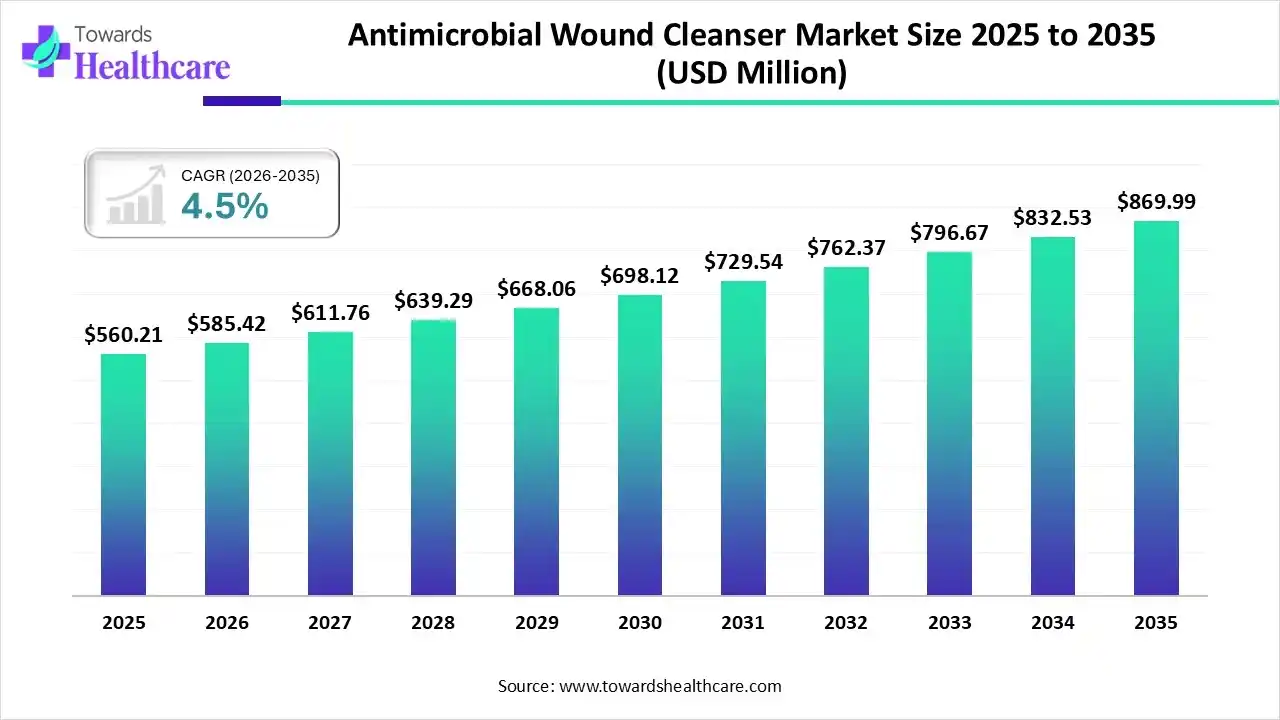
The global antimicrobial wound cleanser market size was estimated at USD 560.21 million in 2025 and is predicted to increase from USD 585.42 million in 2026 to approximately USD 869.99 million by 2035, expanding at a CAGR of 4.5% from 2026 to 2035.
The globally accelerating burden of surgical procedures, burns, and road accidents is propelling demand for advanced wound cleanser solutions. Moreover, the worldwide researchers are putting efforts into the breakthrough in the natural solutions, home-care measures, and other forms of these products.
The global antimicrobial wound cleanser market is primarily fueled by a rise in the geriatric population, and rising cases of diabetes, obesity & trauma. Alongside, the growing emphasis on the reduction of hospital-acquired infections (HAIs) and surgical site infections (SSIs) is accelerating demand for antiseptic & antimicrobial cleaners. To overcome certain demerits of these cleansers, the leading firms are focusing on natural and bio-inspired agents, like honey, propolis, and polyphenols, in 3D sponges and hydrogels.
A prominent advantage of AI algorithms is the use of computer vision to analyze wound images, enabling the precise detection of wound type, tissue composition, & surface area, with contactless features. Nowadays, research activities are pushing the development of AI-powered, bioelectronic, or hydrogel-based patches that can sense, diagnose, & treat infections in real-time and further support monitoring pH, temperature, and moisture levels, finding infections earlier.
Exploring Novel Agents & Biofilm Management
The market is increasingly stepping towards the use of non-antibiotic agents, including silver, PHMB, iodine, & stabilized hypochlorous acid (HOCl) to fight chronic infections & eliminate antimicrobial resistance.
Spurring Smart & Responsive Technology
Players are emphasizing the evolution of smart cleansers to respond to the wound environment, like pH, temperature, or enzyme levels, which allows targeted delivery & real-time monitoring of healing growth.
Researching Multifunctional Composite Materials
Researchers are putting efforts into the combination of various active ingredients to fight infection simultaneously, handle exudate, & foster tissue regeneration.
| Table | Scope |
| Market Size in 2026 | USD 585.42 Million |
| Projected Market Size in 2035 | USD 869.99 Million |
| CAGR (2026 - 2035) | 4.5% |
| Leading Region | North America by 39% |
| Key Applications | Chronic wound management, diabetic foot ulcers, pressure ulcers, venous leg ulcers, surgical site wound care, burns, trauma care, infection prevention |
| Primary End Users | Hospitals, wound care centers, ambulatory surgical centers, clinics, home healthcare providers, nursing facilities |
| Key Challenges | Product reimbursement limitations, regulatory requirements, antimicrobial resistance concerns, competition from traditional wound cleaning methods, pricing pressure |
| Measurable Values | USD Millions/Units/Volume |
| Market Segmentation | By Class, By Form, By Wound Type, By End Use, By Region |
| Top Key Players | 3M, Smith+Nephew, Urgo Medical, Medline Industries, Mölnlycke Health Care, Sonoma Pharmaceuticals, Johnson & Johnson (Band-Aid), MPM Medical, Beiersdorf |
| Segments | Shares % |
| Non-Silver Antimicrobial Wound Cleansers | 26% |
| Silver Antimicrobial Wound Cleansers | 18% |
| Polyhexamethylene Biguanide (PHMB) | 15% |
| Chlorhexidine Gluconate (CHG) | 12% |
| Iodophores (Iodine-Based) | 10% |
| Chlorine-based Compounds | 8% |
| Surfactant Only | 7% |
| Others | 4% |
Which Class Led the Antimicrobial Wound Cleanser Market in 2025?
In 2025, the non-silver antimicrobial wound cleansers segment dominated the market by 26% share and is predicted to expand rapidly. Its dominance is driven by its broad-spectrum effectiveness against pathogens, such as MRSA, biofilm destruction, minimal inflammation, & rapid healing. The emergence of innovative agents comprises polyhexanide (PHMB), like Prontosan, and also surfactant-based cleansers, such as Medline Skintegrity wound cleanser.
| Segments | Shares % |
| Liquid Solutions | 58% |
| Spray & Aerosol Systems | 24% |
| Pre-Saturated Wipes & Swabs | 18% |
How did the Liquid Solutions Segment Dominate the Market in 2025?
The liquid solutions segment held a major revenue share of 58% of the antimicrobial wound cleanser market in 2025. This form is primarily propelled by its easy application, cost-effectiveness, and greater efficacy in deep wound irrigation, soaking gauze, or as a moistening agent for dry wounds. Ongoing trend showing progression of sophisticated, biocompatible solutions to kill bacteria, discard biofilm, and encourage healing. One of the major instances is combining PHMB with betaine or octenidine, which effectively lowers bioburden in chronic wounds.
Pre-Saturated Wipes & Swabs
Moreover, the pre-saturated wipes & swabs segment is estimated to show the fastest growth. A significant driver is its uniqueness for on-the-go, first-aid, or faster, on-demand use without requiring extra, bulky liquid bottles. Also, they possess more efficiency to eradicate bacteria, and a uniform concentration of the antiseptic agent. The latest breakthrough includes robust swabs that characterize two-ply sponge designs, particularly for excellent mechanical debridement, which physically lifts debris and biofilms from the wound bed during the delivery of the cleanser.
| Segments | Shares % |
| Acute Wounds | 62% |
| Chronic Wounds | 38% |
Why did the Acute Wounds Segment Lead the Market in 2025?
The acute wounds segment captured the largest share of 62% of the antimicrobial wound cleanser market in 2025. This specifically occurs from some elective surgeries and trauma-related injuries, especially for post-operative incisions. Hypochlorous Acid (HOCl) is highly recommended by the WHO for these issues, which acts as a highly potent, environmentally safe disinfectant against diverse pathogens without contributing to antimicrobial resistance.
Chronic Wounds
On the other hand, the chronic wounds segment is anticipated to witness rapid expansion. A huge rise in diabetes, obesity, and vascular disorders is resulting in more chronic, non-healing wounds, which further demand advanced care. To overcome concerns with traditional silver sulfadiazine, researchers are fostering silver nanoparticles (AgNPs), which offer controlled, sustained antimicrobial release with reduced toxicity.
| Segments | Shares % |
| Hospitals | 52% |
| Wound Care Clinics/Centers | 20% |
| Home Care | 14% |
| Long-Term Care Facilities (LTCs) & Skilled Nursing Facilities (SNFs) | 9% |
| Others | 5% |
Which End Use Dominated the Antimicrobial Wound Cleanser Market in 2025?
In 2025, the hospitals segment was dominanted by 52% share in the market. The adoption of these agents is mainly propelled by the growing instances of diabetes-related foot ulcers, pressure sores, and surgical procedures, and also stricter infection control protocols for Surgical Site Infections (SSIs) in hospitals. Hospitals are widely utilizing cleansers to disinfect and control biofilm in first- and second-degree burns.
Home Care
However, the home care segment is predicted to expand rapidly. A crucial catalyst is the increasing preference for at-home wound management by patients and caregivers. This is reinforced by the accessibility of convenient, easy-to-use products, like ready-to-use sprays, gels, & pre-saturated wipes/swabs, which omit the requirement for complex, professional-level preparation.
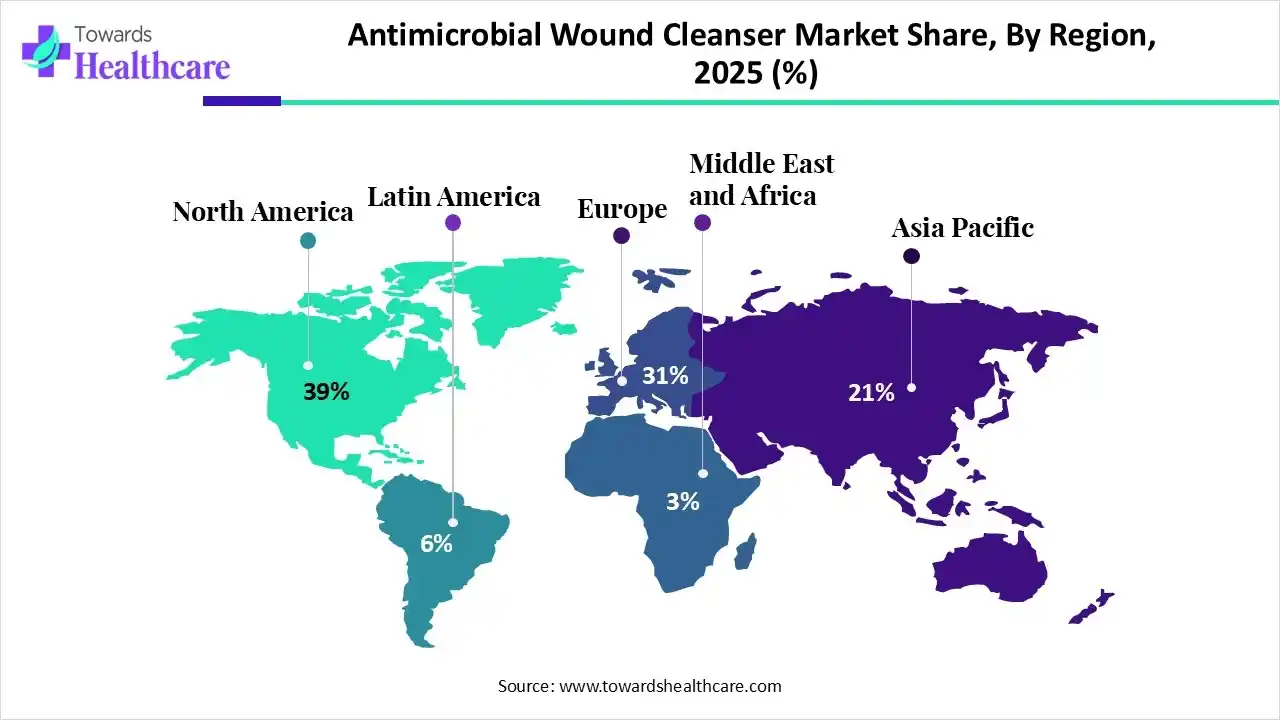
In 2025, North America held the biggest share of the antimicrobial wound cleanser market by 39% share. The region progression is driven by the escalating number of surgical procedures and rising demand for infection control. In this era, Health Canada has authorized many advanced products, which focus on the need for options to conventional, more cytotoxic antiseptics.
U.S. Market Trends
Whereas, the U.S. market captured a major share as it highly promotes the clearance of novel products through the US FDA guidelines. Also, raising emphasis on the transformation of ready-to-use solutions, like pre-saturated wipes & spray bottles.
For instance,
During the prospective period, the Asia Pacific is predicted to expand at a rapid CAGR in the antimicrobial wound cleanser market by 21% share. The region is facing a significant growth in orthopedic & cardiovascular procedures, which increasingly need pre- and post-operative antiseptic solutions to mitigate surgical site infections (SSIs). As well as certain countries, like India, are experiencing a notable rise in road traffic accidents and burns, demanding expedited, efficacious wound management.
China Market Trends
Whereas the Chinese market has been executing the use of TCM-derived exosome-like nanovesicles, which are combined with hydrogels for wound repair. These specifically facilitate anti-inflammatory, antioxidant, and antimicrobial properties, supporting the treatment of chronic wounds.
| Category | Market Participants / Examples | Role in Ecosystem |
| Technology Providers | Antimicrobial formulation developers, medical device companies | Develop active ingredients such as hypochlorous acid, PHMB, iodine, silver-based technologies, and advanced cleansing formulations |
| Product Manufacturers | 3M, Smith & Nephew, B. Braun | Manufacture wound cleansers, irrigation solutions, dressings, and wound management systems |
| Service Providers | Wound care clinics, hospital wound management programs | Provide clinical wound treatment and product utilization |
| Platform Providers | Digital wound monitoring and wound care management platforms | Support wound assessment, documentation, and remote monitoring |
| CROs/CDMOs | Specialized pharmaceutical and medical device manufacturers | Support formulation development, testing, sterilization, and manufacturing |
| Software Vendors | Wound imaging and AI wound assessment companies | Enable wound measurement, tracking, and clinical decision support |
| Research Institutions | Universities, wound healing research centers | Conduct antimicrobial technology and wound healing studies |
| End User Industries | Healthcare providers, home care, long-term care | Purchase and utilize wound cleansing products |
R&D
Clinical Trials & Regulatory Approvals
Patient Support & Services
| Tier 1 | Tier 2 | Tier 3 | |
| Typical Market Influence | 55% | 30% | 15% |
| Tier 1 | ||||
| Company Name | Headquarters | Country | Why Relevant to This Market | Key Products/Services |
| Smith & Nephew | Watford, England | United Kingdom | Global leader in advanced wound care with strong hospital presence and broad wound portfolio | ALLEVYN dressings, ACTICOAT antimicrobial products, wound cleansing solutions |
| 3M | Saint Paul, Minnesota | USA | Major healthcare technology company with established wound care business | 3M Skin & Wound Care solutions, antimicrobial wound products |
| Mölnlycke Health Care | Gothenburg | Sweden | Specialist wound care company with strong global penetration | Mepitel, Mepilex antimicrobial wound care portfolio |
| Tier 2 | ||||
| Company Name | Headquarters | Country | Why Relevant to This Market | Key Products/Service |
| Convatec | London, England | United Kingdom | Specialized wound care company with chronic wound expertise | AQUACEL Ag antimicrobial dressings, wound management products |
| Integra LifeSciences | Princeton, New Jersey | USA | Develops advanced wound reconstruction technologies | Wound matrices and regenerative wound solutions |
| Coloplast | Humlebæk | Denmark | Strong wound care and chronic care product portfolio | Biatain antimicrobial wound care products |
| Tier 3 | ||||
| Company Name | Headquarters | Country | Why Relevant to This Market | Key Products/Services |
| Anacapa Technologies | San Diego, California | USA | Develops antimicrobial wound technologies | Advanced antimicrobial wound care products |
| Next Science | Sydney | Australia | Focuses on biofilm management technologies in wound care | BlastX, Bactisure, antimicrobial wound solutions |
| Arobella Medical | Eden Prairie, Minnesota | USA | Develops wound cleansing and debridement technologies | Ultrasonic wound cleansing systems |
Strengths
Weaknesses
Opportunities
Threats
By Class
By Form
By Wound Type
By End Use
By Region





Principal Consultant
Rohan Patil is a seasoned market research professional with over 5+ years of focused experience in the healthcare sector, bringing deep domain expertise, strategic foresight, and analytical precision to every project he undertakes.
Learn more about Rohan Patil

Reviewed By
Aditi Shivarkar is a seasoned professional with over 14 years of experience in healthcare market research. As a content reviewer, Aditi ensures the quality and accuracy of all market insights and data presented by the research team.
Learn more about Aditi Shivarkar