
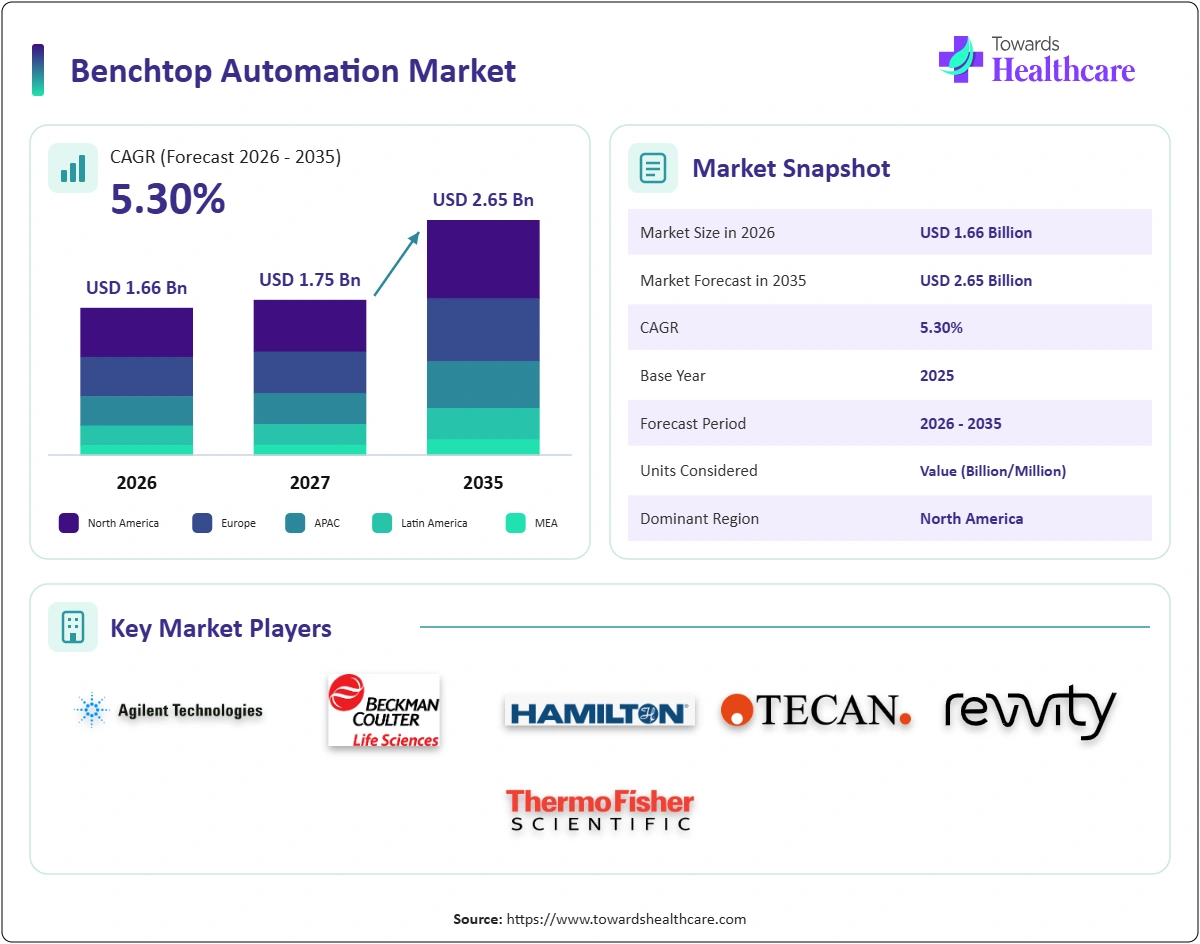
The market is projected to expand from USD 1.58 billion in 2025 to USD 2.65 billion by 2035 because laboratories of all sizes are increasingly automating pipetting and sample preparation to improve reproducibility and alleviate the issue of staff shortages. Benchtop systems make automation affordable without requiring a dedicated space. Growth in genomics and cell-based assays, easier software and pre-built protocols, lower-cost systems, and integration with AI and data platforms drive steady growth, propelling the market to USD 2.05 billion by 2030 and maintaining a CAGR of 5.30% over the forecast period.
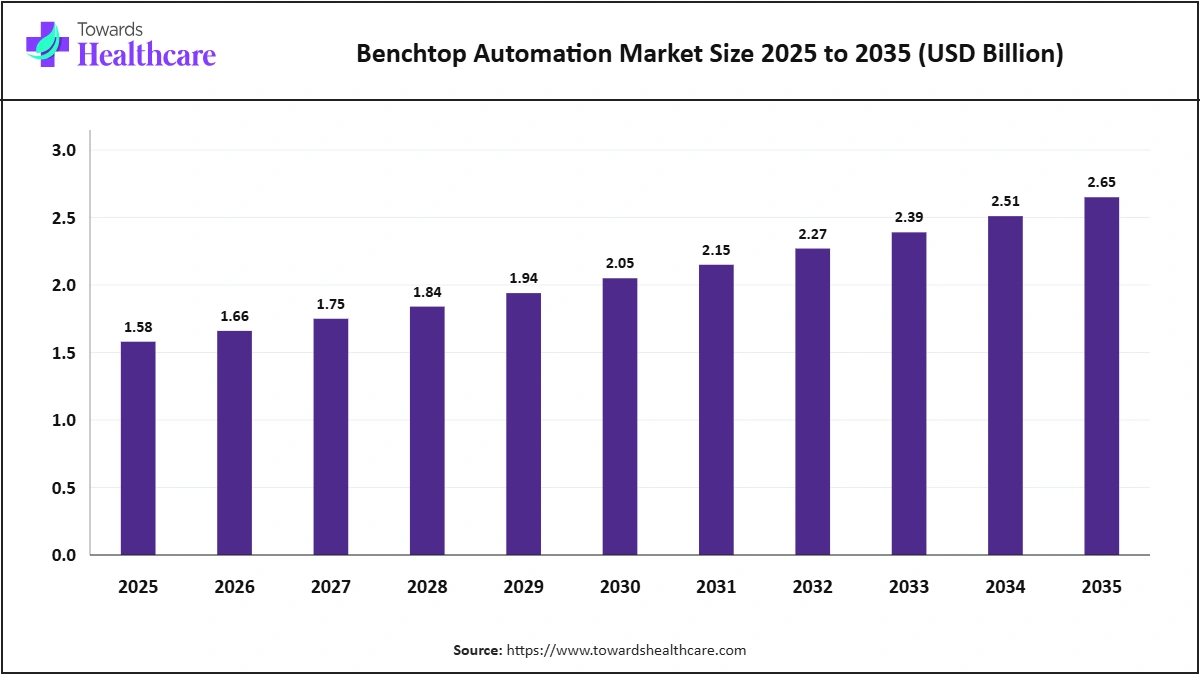
Analyst View: We built the estimate from benchtop system shipments by product, application, end user and region, multiplied by average selling prices, plus software, accessories and service. Shipments reflect laboratory numbers, research and development and diagnostic testing volumes, and the share of laboratories adopting automation, together with replacement cycles of about seven to ten years. The growth rate is a testament to broadening adoption beyond large laboratories, which supports a slightly higher rate than comparable estimates. The market growth rate is being throttled by budget pressure in academic and biotech laboratories.
Driver: Laboratories need reproducibility, and staff shortages drive the demand for automation. Genomics and cell assays are growing. Benchtop systems fit in small spaces, and the intricacies related to the operation of software used to operate benchtop automation equipment are decreasing.
Restraint: Budgets limit purchases, and programming skills act as a skill barrier. Integration with legacy instruments is hard, and consumable costs can be steep. Small labs often do not have enough sample processing volume to justify the costs of automation systems.
Opportunity: The development of affordable automation systems will help their adoption among small laboratories. Asian research and development growth adds demand, and AI has the capability to optimize workflows. Service and consumables add revenue, and diagnostics labs are increasingly automating specialty tests.
Note: 2025 is the base year; 2035 values are forecasts.
Sources: Expert interviews, secondary sources, Towards Healthcare database and Towards Healthcare analysts.
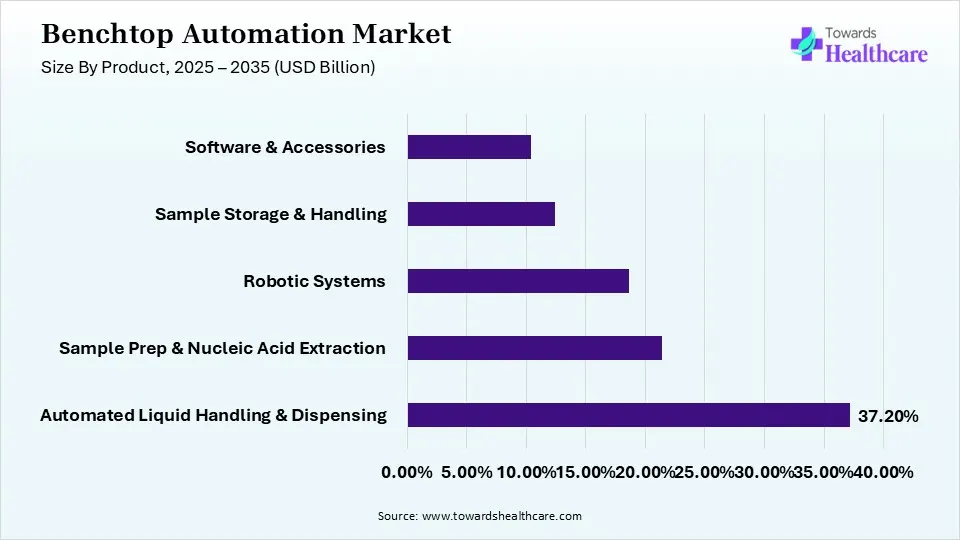
Automated liquid handling & dispensing held the largest market share of 37.20% (USD 0.59 billion) in 2025 and is projected to reach USD 0.94 billion by 2035, expanding at a CAGR of 4.81% during the forecast period. Automated liquid handling and dispensing includes benchtop pipetting workstations, 96- and 384-channel pipetting heads, non-contact dispensers, and pipetting assistants such as Agilent's Bravo, Tecan's Veya, Hamilton's Microlab Prep, Eppendorf's epMotion, INTEGRA's ASSIST PLUS, and Opentrons' Flex. This segment led because pipetting is repetitive and prone to errors, and benchtop liquid handlers provide fast returns in reproducibility and staff time.
Sample prep and nucleic acid extraction systems automate DNA and RNA purification, library preparation, and protein sample preparation, using magnetic bead and column methods. Systems such as Thermo Fisher's KingFisher, QIAGEN's QIAcube and Revvity's chemagic have achieved widespread adoption in genomics and diagnostic laboratories.
Robotic systems include compact collaborative arms, plate movers, and benchtop workcells that link instruments such as liquid handlers, readers, and incubators. This segment is growing at the fastest rate in the products category because laboratories seek walk-away operation and integration of several instruments without building large automation lines.
Sample storage and handling includes benchtop tube decappers, sorters, barcode readers, and small automated stores that improve sample tracking.
Software and accessories include scheduling and protocol software, laboratory information system integration, consumable racks and service, and the use of cloud and AI tools is increasing.
Note: 2025 is the base year; 2035 values are forecasts.
Sources: Expert interviews, secondary sources, Towards Healthcare database and Towards Healthcareanalysts.
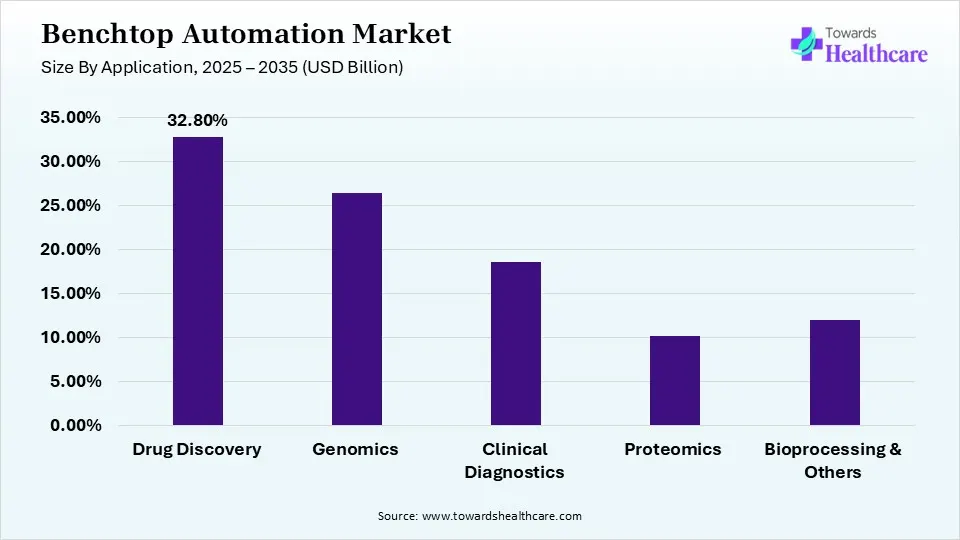
Drug discovery accounted for 32.80% (USD 0.52 billion) in 2025, genomics for 26.40% (USD 0.42 billion), clinical diagnostics for 18.60% (USD 0.29 billion), proteomics for 10.20% (USD 0.16 billion), and bioprocessing and others for 12.00% (USD 0.19 billion).
Clinical diagnostics makes use of benchtop systems for molecular testing, sample preparation, and specialty assays in hospital and reference laboratories. This segment is governed by IVD regulations, which set rules regarding tests that use medical samples procured from the human body.
Proteomics uses benchtop automation for various tasks such as protein digestion, cleanup, and mass spectrometry sample preparation, improving reproducibility.
Bioprocessing and others include cell line development, analytical testing in biomanufacturing, and food and environmental testing.
Note: 2025 is the base year; 2035 values are forecasts.
Sources: Expert interviews, secondary sources, Towards Healthcare database and Towards Healthcare analysts.
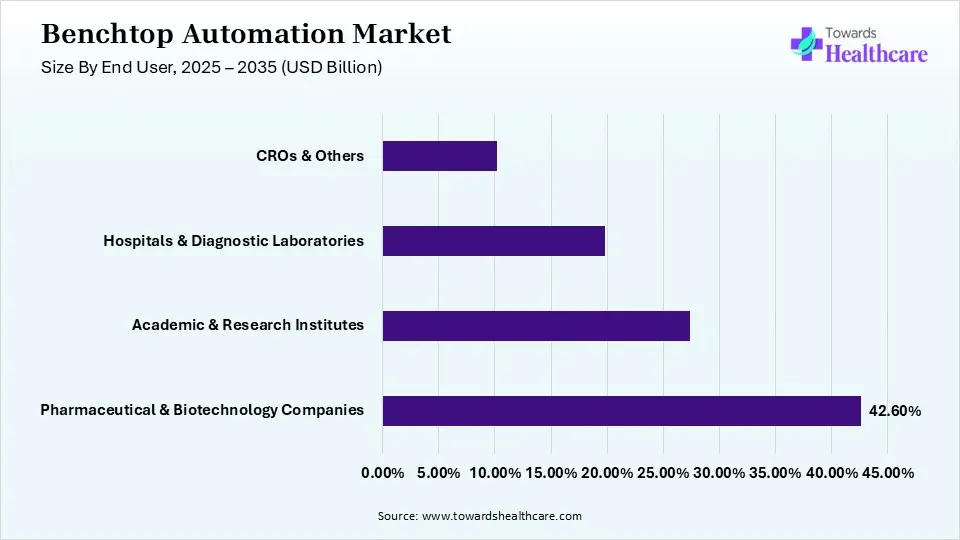
Pharmaceutical & Biotechnology Companies held the largest market share of 42.60% (USD 0.67 billion) in 2025 and are projected to reach USD 1.09 billion by the end of the forecast period, expanding at a CAGR of 4.96% from 2026 to 2035. Pharmaceutical and biotechnology companies are deploying benchtop systems across discovery, development and quality control laboratories to increase throughput and reproducibility.
Academic and research institutes buy benchtop systems for core facilities and laboratories. Low-cost and open-source systems are driving adoption among smaller groups.
Hospitals and diagnostic laboratories use benchtop automation for molecular diagnostics and specialty testing where volumes do not justify large automation lines.
CROs and others include contract research organizations, food and environmental testing laboratories. This is the fastest-growing end user as outsourcing gains traction and CROs adopt automation to improve efficiency in handling large volumes.
Analyst View: Segment values were allocated by matching shipments, prices and service revenue to products, applications and end users, using supplier portfolios and laboratory data. Liquid handling, drug discovery and pharmaceutical users hold a leading position. We expect the shares of robotic systems, genomics and CROs to increase.
| Region | 2025 Share | 2025 Value (USD Billion) | 2035 Value (USD Billion) | CAGR 2026–2035 |
| North America | 36.40% | 0.58 | 0.91 | 4.62% |
| Europe | 28.20% | 0.45 | 0.73 | 5.02% |
| Asia Pacific | 26.40% | 0.42 | 0.78 | 6.52% |
| Latin America | 5.00% | 0.08 | 0.13 | 5.02% |
| Middle East & Africa | 4.00% | 0.06 | 0.10 | 5.02% |
Note: 2025 is the base year; 2035 values are forecasts.
Sources: Expert interviews, secondary sources, Towards Healthcare database and Towards Healthcare analysts.
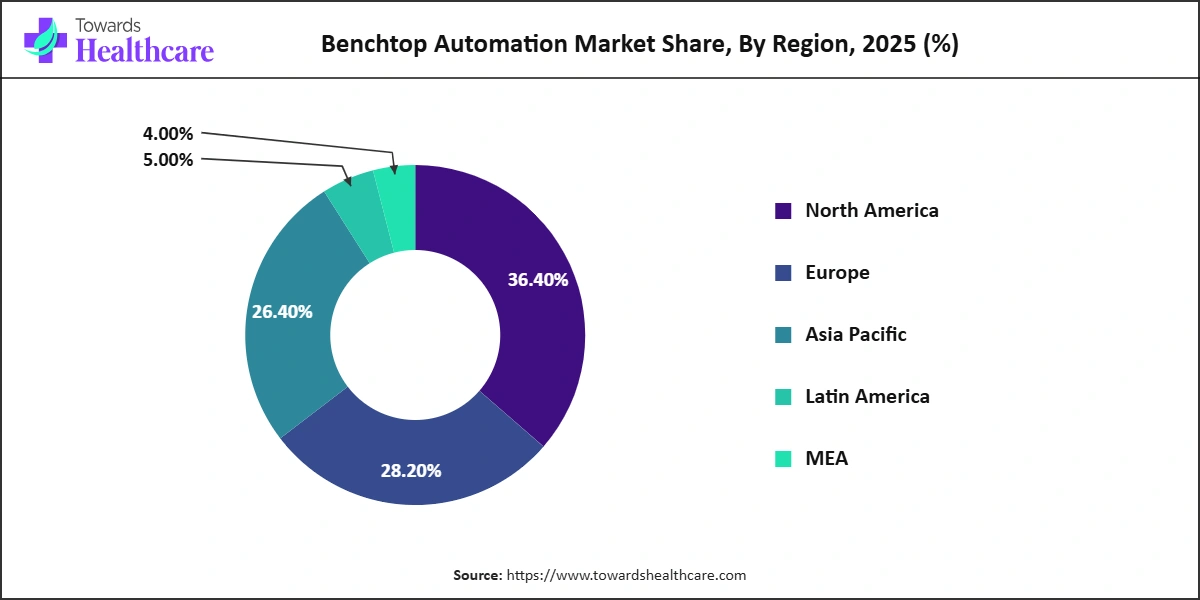
North America held a market share of 36.40% (USD 0.58 billion) in 2025 and is forecasted to reach USD 0.91 billion by 2035, expanding at a CAGR of 4.62% during the forecast period. The U.S. has the largest pharmaceutical and biotechnology research and development base, a significant presence of genomics and clinical laboratories, and widespread adoption of automation. The regional market ecosystem benefits from the presence of various key players such as Thermo Fisher, Agilent, Hamilton, Beckman Coulter and Opentrons. Laboratory staff shortages encourage investment in the adoption of automation technologies in routine workflows.
Europe accounted for 28.20% (USD 0.45 billion) of revenue in 2025 and is projected to expand to USD 0.73 billion by 2035, growing at a CAGR of 5.02% from 2026 to 2035. This region has well-established pharmaceutical, academic, and diagnostic sectors and is home to Tecan, INTEGRA, Eppendorf, and QIAGEN. Germany, the UK, Switzerland, and France are leaders in terms of regional automation adoption.
Asia Pacific held a market share of 26.40% (USD 0.42 billion) in 2025 and is forecasted to reach USD 0.78 billion by 2035, expanding at a CAGR of 6.52% over the forecast period. This region is growing at a faster rate than any other region across the globe, owing to rapid growth of pharmaceutical research and development, genomics and CROs in China, India, Japan, South Korea and Singapore, and government support for life science research. Domestic Chinese automation suppliers are expanding their operations.
Latin America accounted for 5.00% (USD 0.08 billion) of revenue in 2025 and is projected to reach USD 0.13 billion by 2035, expanding at a CAGR of 5.02% from 2026 to 2035. The regional market ecosystem is supported by diagnostic and research laboratories in Brazil and Mexico, although budget constraints throttle the pace of adoption.
Middle East & Africa held a 4.00% (USD 0.06 billion) share in 2025 and is projected to reach USD 0.10 billion by 2035, growing at a CAGR of 5.02% during the forecast period. Some of the key regional growth drivers include genomics programs and new research and diagnostic laboratories in Saudi Arabia, the UAE, and Israel.
Analyst View: Regional shares were built from shipments, prices, and service revenue in each region. North America leads because of research and development spending. We assign Asia Pacific the highest growth premium because research and development and genomics capacity are expanding at the fastest pace in this region.
| Rank | Company Name | Market-Specific Revenue (USD Billion) | 2025 Share | Key Products / Business | Headquarters |
| 1 | Thermo Fisher Scientific | 0.17 | 10.76% | KingFisher, benchtop liquid handlers and robots | United States |
| 2 | Tecan | 0.14 | 8.86% | Veya, DreamPrep and benchtop liquid handlers | Switzerland |
| 3 | Hamilton Company | 0.10 | 6.33% | Microlab Prep and STARlet | United States |
| 4 | Agilent Technologies | 0.10 | 6.33% | Bravo liquid handling and BioTek systems | United States |
| 5 | Revvity | 0.08 | 5.06% | chemagic, JANUS and benchtop automation | United States |
| 6 | Beckman Coulter Life Sciences | 0.08 | 5.06% | Biomek benchtop systems | United States |
| 7 | INTEGRA Biosciences | 0.07 | 4.43% | ASSIST PLUS and VIAFLO 96 | Switzerland |
| 8 | Eppendorf | 0.06 | 3.80% | epMotion liquid handlers | Germany |
| 9 | QIAGEN | 0.06 | 3.80% | QIAcube sample preparation | Netherlands |
| 10 | Opentrons | 0.04 | 2.53% | OT-2 and Flex robots | United States |
Note: Company revenues and shares are 2025 estimates.
Sources: Company press releases, expert interviews, secondary sources, Towards Healthcare database and Towards Healthcare analysts.
Thermo Fisher Scientific led the market with 10.76% (USD 0.17 billion) of revenue in 2025, followed by Tecan at 8.86% (USD 0.14 billion) and Hamilton Company at 6.33% (USD 0.10 billion).
The leadership of Thermo Fisher Scientific can be attributed to KingFisher extraction systems, benchtop liquid handlers, and laboratory robots. Tecan provides benchtop liquid handling, including the Veya platform launched in 2025, and Hamilton is a key supplier of compact Microlab systems. Agilent, Revvity, Beckman Coulter Life Sciences, INTEGRA, Eppendorf, QIAGEN and Opentrons compete through Bravo and BioTek systems, extraction and liquid handling, Biomek systems, pipetting assistants, epMotion, QIAcube and low-cost open robots.
The top 10 companies held a market share of 56.96% (USD 0.90 billion) in 2025, while the remaining 43.04% (USD 0.68 billion) was shared among specialized dispenser manufacturers, robotics companies and regional automation suppliers. The market is moderately concentrated, and competition revolves around accuracy, ease of programming, footprint, workflow coverage, integration, service, and price. Low-cost and open-source systems are widening access, while well-established suppliers emphasize validated workflows and connectivity.
The benchtop automation ecosystem links component and consumable suppliers with system manufacturers, software providers, distributors and laboratory users.
| Ecosystem Stage | Role in the Market | Key Companies |
| Components & Consumables | Supply pumps, motion parts, tips and plates | Component makers, consumable suppliers |
| System Makers | Build benchtop automation systems | Thermo Fisher, Tecan, Hamilton, Agilent, INTEGRA, Opentrons |
| Software & Integration | Provide scheduling, data and AI tools | System makers, Biosero, integration specialists |
| Distribution & Service | Sell, install and support systems | Direct sales, distributors |
| End Users | Automate laboratory work | Pharma companies, universities, clinical labs, CROs |
Sources: Company press releases, expert interviews, secondary sources, Towards Healthcare database and Towards Healthcare analysts.
The Towards Healthcare Companies Quadrant positions key participants in the benchtop automation market by market strength, reflecting revenue scale, market share and geographic reach, and by innovation and growth strategy, reflecting product portfolio breadth, research and development intensity and collaborations. Positions reflect each company's estimated 2025 benchtop automation revenue and our assessment of its technology, product launches, and partnerships.
Sources: Company press releases, expert interviews, secondary sources, Towards Healthcare database and Towards Healthcare analysts.
Leaders: Thermo Fisher Scientific, Tecan, Hamilton Company, Agilent Technologies, Revvity and Beckman Coulter Life Sciences bring together large benchtop revenue and broad portfolios, validated workflows and global service.
Innovators: INTEGRA Biosciences and Opentrons offer easily usable pipetting assistants and low-cost open robots.
Niche Players: Eppendorf and QIAGEN cater to the needs of narrower workflow segments.
By Product
By Application
By End User
By Region
The market is defined as benchtop liquid handlers, sample preparation and extraction systems, robotic systems, sample storage and handling devices, software and accessories for laboratories, worldwide. The 2025 base year was built bottom-up from benchtop system shipments by product, application, end user and region, average selling prices and service revenue, and checked top-down against the benchtop automation revenues of leading suppliers.
Segment, regional and company values were allocated from products, applications, end users and regional demand. Key estimates were verified by cross-checking company disclosures, regulatory and industry data and published third-party estimates, and inputs that could not be reconciled were excluded. All segment, regional and company figures were reconciled to the same 2025 base year, and the 2026–2035 forecast, which applies a constant CAGR from the 2025 base, was recalculated and validated.
Analyst View: The market is expanding the horizons of laboratory automation from just large screening centers to everyday laboratories, which supports steady demand. Our estimate links demand to shipments, prices, and service, so the forecast follows research and development budgets, testing volumes, and adoption rates. The main upside comes from robotic workcells, genomics and smaller laboratories, while the main risks are budget pressure and integration challenges.