
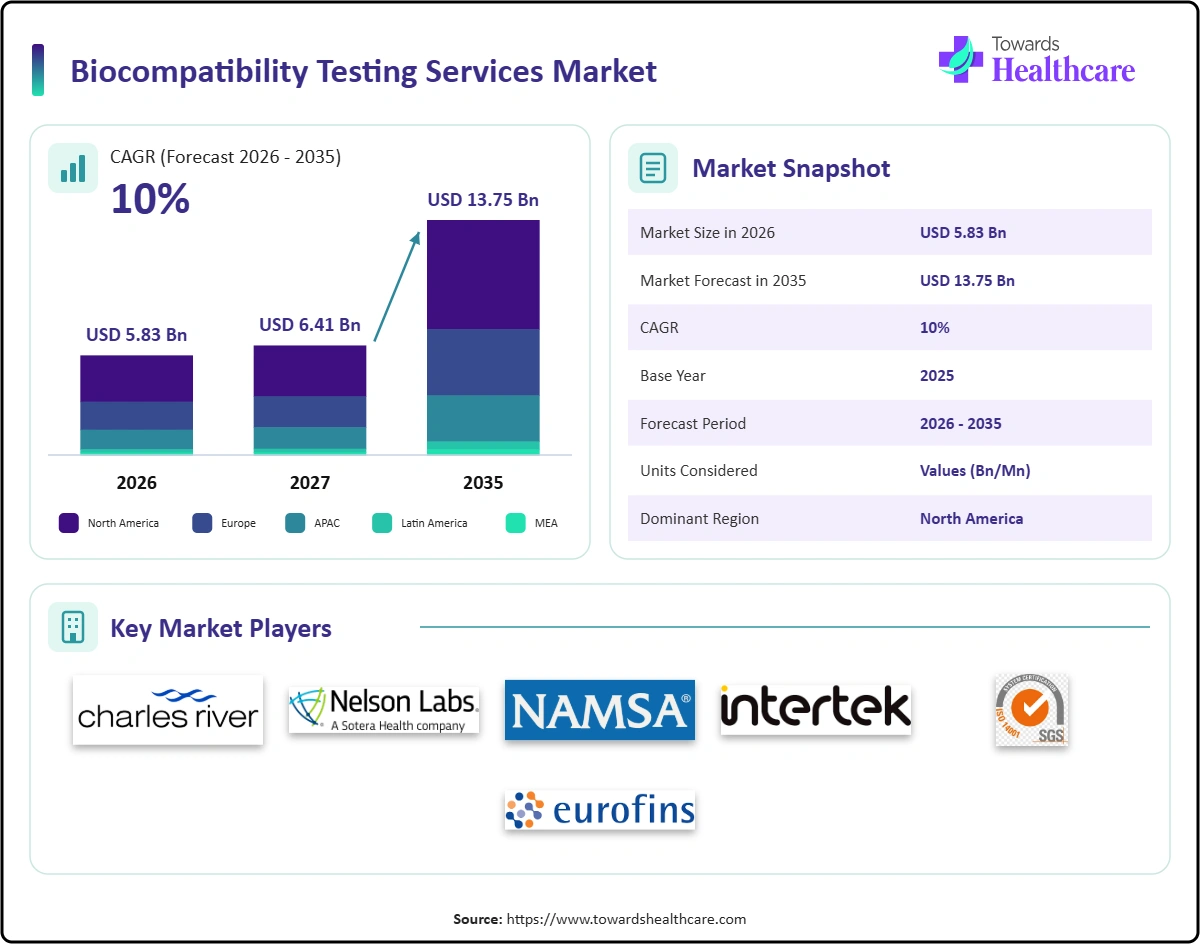
The biocompatibility testing services market is projected to grow from USD 5.30 billion in 2025 to USD 13.75 billion by 2035 because every new or modified medical device and many drug delivery products must demonstrate biocompatibility before approval, and regulators in the U.S. and Europe now require more extensive chemical characterization and risk assessment. Stringent MDR evidence criteria, increasing number of implants and combination products, increased outsourcing by manufacturers, and novel in vitro tests increase demand for testing, thereby contributing to a market value of USD 8.54 billion by 2030 and maintaining a CAGR of 10.00% from 2026 to 2035.
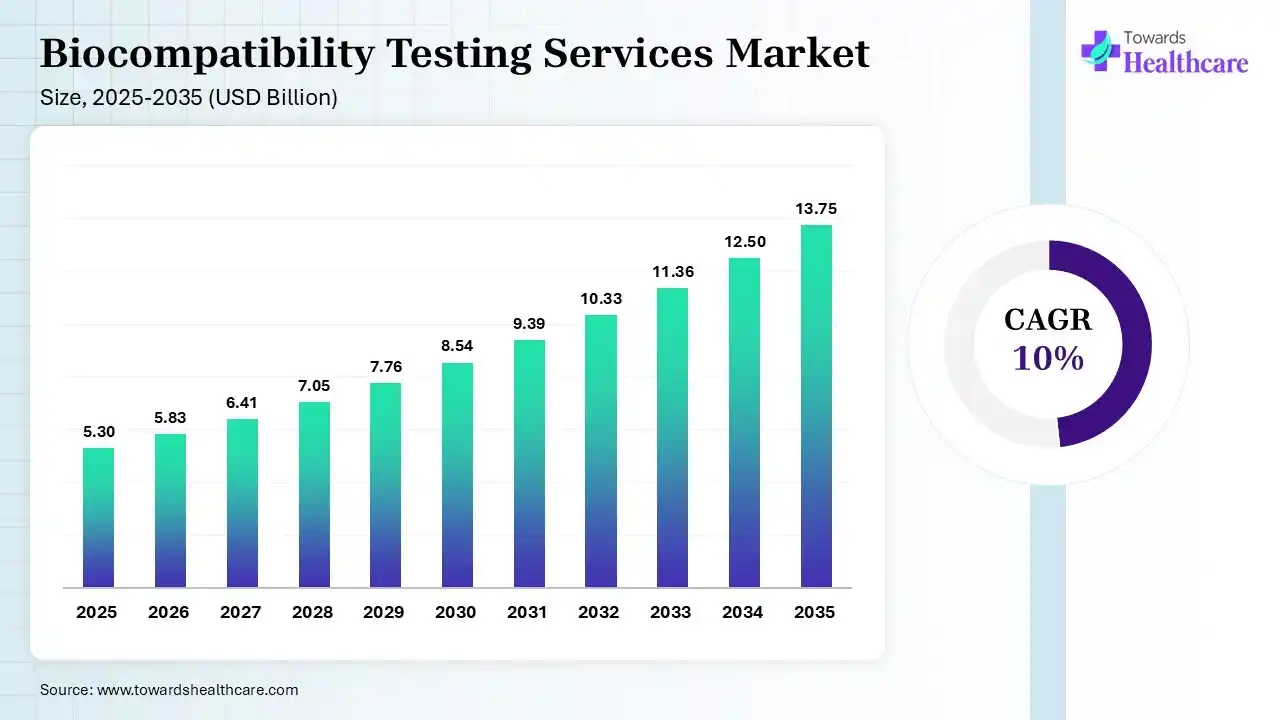
Analyst View: This market size is calculated based on the number of medical device, combination product, and pharmaceutical packaging projects that require testing for biocompatibility by types of tests, stages of development, industry vertical, and geography, and then multiplying that figure with the average testing cost per project. The total was cross-checked against the medical device and biocompatibility testing revenue of leading contract laboratories and against published estimates, which places our base year slightly above the highest comparable figure. Technological developments and regulatory pressures have fueled growth rates, which have been moderated by price competition.
Driver: Device approvals require biocompatibility evidence. EU MDR increases the requirements for evidence. FDA expects chemical characterization. Implants and combination products are growing. Manufacturers outsource testing.
Restraint: Testing costs and schedules are a strain on small businesses. Laboratory capacity can be constrained. Standards interpretation is subject to variation from one regulatory agency to another. Price competition among laboratories. Skilled toxicologists are scarce.
Opportunity: In vitro and non-animal methods create new services. The development of medical devices in Asia represents an opportunity for expansion. Value is added by integrated regulatory consulting. Combination products and biologics packaging need testing. Digital journalism and digital platforms increase efficiency.
| Segments | 2025 Share | 2025 Value (USD Billion) | 2035 Value (USD Billion) | CAGR 2026–2035 |
| Material & Chemical Characterization | 24.20% | 1.28 | 3.20 | 9.52% |
| Sensitisation & Irritation | 16.20% | 0.86 | 2.21 | 9.92% |
| Cytotoxicity | 15.40% | 0.82 | 2.10 | 9.92% |
| Systemic Toxicity & Implantation | 14.60% | 0.77 | 1.99 | 9.92% |
| Hemocompatibility | 10.80% | 0.57 | 1.69 | 11.42% |
| Genotoxicity | 9.40% | 0.50 | 1.28 | 9.92% |
| Others | 9.40% | 0.50 | 1.28 | 9.92% |
Note: 2025 is the base year; 2035 values are forecasts.
Sources: Expert interviews, secondary sources, Towards Healthcare database and Towards Healthcare analysts.
Material & Chemical Characterization: This segment accounted for 24.20% (USD 1.28 billion) of the biocompatibility testing services market in 2025 and is projected to reach USD 3.20 billion by 2035, expanding at a CAGR of 9.52% from 2026 to 2035. Material and chemical characterization identifies and quantifies substances that may be released from a device or package, using extractables and leachables studies with chromatography and mass spectrometry, followed by toxicological risk assessment. It is the largest test type because the FDA and EU notified bodies now expect chemical data for most device submissions, and characterization can justify waiving some animal tests. Every research project needs highly advanced equipment and toxicologists. Laboratories are increasing their capability of analysis to cope with the demand.
Sensitization & Irritation: This segment accounted for 16.20% (USD 0.86 billion) of the biocompatibility testing services market in 2025 and is projected to reach USD 2.21 billion by 2035, expanding at a CAGR of 9.92% from 2026 to 2035. Sensitization and irritation testing determines whether materials induce allergic reactions or local irritations to skin, mucosa, or eyes. They are required for nearly all patient-contacting devices. In vitro methods are increasingly replacing traditional animal tests following updates to ISO 10993-10 and ISO 10993-23, which is changing laboratory workflows.
Cytotoxicity: This segment accounted for 15.40% (USD 0.82 billion) of the biocompatibility testing services market in 2025 and is projected to reach USD 2.10 billion by 2035, expanding at a CAGR of 9.92% from 2026 to 2035. Testing for cytotoxicity determines whether extracts from devices damage cell cultures. It is the most common biocompatibility test because it is required for virtually all devices, is relatively quick and inexpensive, and is used for screening materials early in development and for batch release.
Systemic Toxicity & Implantation: This segment accounted for 14.60% (USD 0.77 billion) of the biocompatibility testing services market in 2025 and is projected to reach USD 1.99 billion by 2035, expanding at a CAGR of 9.92% from 2026 to 2035. Systemic toxicity tests evaluate effects on the whole body after acute, subacute, subchronic or chronic exposure, and implantation tests assess local tissue response to implanted materials. These studies are required for implants and long-term contact devices such as orthopedic, cardiovascular, and neurological implants and are among the most expensive tests.
Hemocompatibility: This segment accounted for 10.80% (USD 0.57 billion) of the biocompatibility testing services market in 2025 and is projected to reach USD 1.69 billion by 2035, expanding at a CAGR of 11.42% from 2026 to 2035. Hemocompatibility tests assess reactions between blood and medical devices, such as hemolysis, clotting, complement activation, and formation of clots. It is the fastest-growing test type because of growth in cardiovascular devices, structural heart implants, dialysis and extracorporeal circulation systems, and blood-contacting drug delivery devices, and because regulators are requiring more comprehensive blood compatibility data.
Genotoxicity: This segment accounted for 9.40% (USD 0.50 billion) of the biocompatibility testing services market in 2025 and is projected to reach USD 1.28 billion by 2035, expanding at a CAGR of 9.92% from 2026 to 2035. Genotoxicity testing determines whether materials can damage genetic material, using bacterial reverse mutation and mammalian cell assays. It is required for long-term contact and implanted devices and for many combination products.
Others: This segment accounted for 9.40% (USD 0.50 billion) of the biocompatibility testing services market in 2025 and is projected to reach USD 1.28 billion by 2035, expanding at a CAGR of 9.92% from 2026 to 2035. Others include pyrogenicity and material-mediated pyrogen testing, reproductive and developmental toxicity, carcinogenicity assessment, and degradation studies for absorbable materials.
| Segments | 2025 Share | 2025 Value (USD Billion) | 2035 Value (USD Billion) | CAGR 2026–2035 |
| Clinical | 58.60% | 3.11 | 7.63 | 9.40% |
| Preclinical | 41.40% | 2.19 | 6.12 | 10.80% |
Note: 2025 is the base year; 2035 values are forecasts.
Sources: Expert interviews, secondary sources, Towards Healthcare database and Towards Healthcare analysts.
Clinical: This segment accounted for 58.60% (USD 3.11 billion) of the biocompatibility testing services market in 2025 and is projected to reach USD 7.63 billion by 2035, expanding at a CAGR of 9.40% from 2026 to 2035. Clinical-stage and commercial testing covers testing for regulatory submissions before clinical trials and market approval, as well as testing required when materials, suppliers, or manufacturing processes change for marketed devices. It is the largest segment because regulatory submissions require complete, GLP-compliant biocompatibility evaluations, and EU MDR has triggered re-testing of many legacy devices.
Preclinical: This segment accounted for 41.40% (USD 2.19 billion) of the biocompatibility testing services market in 2025 and is projected to reach USD 6.12 billion by 2035, expanding at a CAGR of 10.80% from 2026 to 2035. The preclinical test phase is the early evaluation of materials and prototypes to influence design decisions and prevent future failures. It is the fastest-growing segment as companies use cytotoxicity, chemical screening, and in vitro methods earlier in development to reduce risk.
| Segments | 2025 Share | 2025 Value (USD Billion) | 2035 Value (USD Billion) | CAGR 2026–2035 |
| Medical Devices | 74.20% | 3.93 | 9.86 | 9.63% |
| Pharmaceuticals & Biologics | 16.40% | 0.87 | 2.59 | 11.53% |
| Others | 9.40% | 0.50 | 1.30 | 10.03% |
Note: 2025 is the base year; 2035 values are forecasts.
Sources: Expert interviews, secondary sources, Towards Healthcare database and Towards Healthcare analysts.
Medical Devices: This segment accounted for 74.20% (USD 3.93 billion) of the biocompatibility testing services market in 2025 and is projected to reach USD 9.86 billion by 2035, expanding at a CAGR of 9.63% from 2026 to 2035. Medical devices account for most demand because ISO 10993 and FDA guidance require biological evaluation for nearly all devices that contact the body, from catheters and wound dressings to orthopedic implants, cardiovascular devices, and wearable sensors. Strong device innovation and EU MDR recertification support volumes.
Pharmaceuticals & Biologics: This segment accounted for 16.40% (USD 0.87 billion) of the biocompatibility testing services market in 2025 and is projected to reach USD 2.59 billion by 2035, expanding at a CAGR of 11.53% from 2026 to 2035. Pharmaceuticals and biologics include drug delivery devices, prefilled syringes, autoinjectors, inhalers, and container closure systems, where extractables and leachables testing protects drug quality and patient safety. It is the fastest-growing industry application because of growth in biologics, injectable drugs such as GLP-1 therapies delivered by pens and autoinjectors, and combination products.
Others: This segment accounted for 9.40% (USD 0.50 billion) of the biocompatibility testing services market in 2025 and is projected to reach USD 1.30 billion by 2035, expanding at a CAGR of 10.03% from 2026 to 2035. Others include cosmetics, dental materials, contact lenses, tissue-engineered products, and materials suppliers that need biocompatibility data for their customers.
| Segments | 2025 Share | 2025 Value (USD Billion) | 2035 Value (USD Billion) | CAGR 2026–2035 |
| Medical Device Manufacturers | 62.80% | 3.33 | 8.31 | 9.58% |
| Pharmaceutical & Biotechnology Companies | 18.60% | 0.99 | 2.55 | 9.98% |
| CROs & CDMOs | 12.40% | 0.66 | 2.04 | 11.98% |
| Others | 6.20% | 0.33 | 0.85 | 9.98% |
Note: 2025 is the base year; 2035 values are forecasts.
Sources: Expert interviews, secondary sources, Towards Healthcare database and Towards Healthcare analysts.
Medical Device Manufacturers: This segment accounted for 62.80% (USD 3.33 billion) of the biocompatibility testing services market in 2025 and is projected to reach USD 8.31 billion by 2035, expanding at a CAGR of 9.58% from 2026 to 2035. Medical device manufacturers are the largest end users, outsourcing most biocompatibility testing to specialized laboratories rather than maintaining in-house GLP capabilities. While large organizations conduct elaborate testing programs in their portfolio, new ventures rely on outside labs and consultants.
Pharmaceutical & Biotechnology Companies: This segment accounted for 18.60% (USD 0.99 billion) of the biocompatibility testing services market in 2025 and is projected to reach USD 2.55 billion by 2035, expanding at a CAGR of 9.98% from 2026 to 2035. Pharmaceutical and biotechnology companies use biocompatibility and extractables and leachables testing for drug delivery systems, packaging, and combination products, often alongside drug development programs.
CROs & CDMOs: This segment accounted for 12.40% (USD 0.66 billion) of the biocompatibility testing services market in 2025 and is projected to reach USD 2.04 billion by 2035, expanding at a CAGR of 11.98% from 2026 to 2035. CROs and CDMOs subcontract specialized biocompatibility tests or build in-house capabilities to offer integrated development services. This is the fastest-growing end use as device and drug developers increasingly use full-service outsourcing partners.
Others: This segment accounted for 6.20% (USD 0.33 billion) of the biocompatibility testing services market in 2025 and is projected to reach USD 0.85 billion by 2035, expanding at a CAGR of 9.98% from 2026 to 2035. Others include academic institutions, materials suppliers, and component manufacturers that generate biocompatibility data for their materials.
Analyst View: Segmental values were derived based on the matching of project numbers and spending on tests to the types of tests, development phases, sectors, and end users. Chemical characterization, clinical stage testing, devices, and device manufacturers lead because of regulatory submissions. We expect hemocompatibility, preclinical testing, pharmaceuticals, and CROs to gain share.
| Region | 2025 Share | 2025 Value (USD Billion) | 2035 Value (USD Billion) | CAGR 2026–2035 |
| North America | 46.40% | 2.46 | 6.02 | 9.36% |
| Europe | 28.20% | 1.49 | 3.79 | 9.76% |
| Asia Pacific | 19.60% | 1.04 | 3.16 | 11.76% |
| Latin America | 3.40% | 0.18 | 0.46 | 9.76% |
| Middle East & Africa | 2.40% | 0.13 | 0.32 | 9.76% |
Note: 2025 is the base year; 2035 values are forecasts.
Sources: Expert interviews, secondary sources, Towards Healthcare database and Towards Healthcare analysts.
North America: This region accounted for 46.40% (USD 2.46 billion) of the biocompatibility testing services market in 2025 and is projected to reach USD 6.02 billion by 2035, expanding at a CAGR of 9.36% from 2026 to 2035. The United States has the world's largest infrastructure for medical devices and witnesses a high volume of FDA 510(k), De Novo, and PMA submissions, each requiring biocompatibility evaluation. FDA guidance on ISO 10993-1 and chemical characterization has raised testing intensity. Leading laboratories, including NAMSA, Nelson Labs, Charles River and Pacific BioLabs, are based in the region, and NAMSA expanded its U.S. capacity by acquiring WuXi AppTec's U.S. device testing operations in 2025 and Labcorp device testing assets in 2026.
Europe: This region accounted for 28.20% (USD 1.49 billion) of the biocompatibility testing services market in 2025 and is projected to reach USD 3.79 billion by 2035, expanding at a CAGR of 9.76% from 2026 to 2035. Europe is the second-largest region, driven by the EU Medical Device Regulation, which requires more clinical and biological evidence and has led to re-evaluation of many legacy devices by notified bodies. Germany, Ireland, France, Switzerland, and the UK have strong device industries. Eurofins, SGS, and TÜV SÜD are major providers, and Eurofins expanded through the acquisition of ac.biomed in 2025.
Asia Pacific: This region accounted for 19.60% (USD 1.04 billion) of the biocompatibility testing services market in 2025 and is projected to reach USD 3.16 billion by 2035, expanding at a CAGR of 11.76% from 2026 to 2035. Asia Pacific is the fastest-growing region as China, India, Japan, and South Korea expand domestic medical device manufacturing and exports, requiring testing to international standards. Regulators in China have increased the stringency of device registrations, while local labs are building GLP facilities, and testing facilities abroad are expanding in Singapore, Japan, and India.
Latin America: This region accounted for 3.40% (USD 0.18 billion) of the biocompatibility testing services market in 2025 and is projected to reach USD 0.46 billion by 2035, expanding at a CAGR of 9.76% from 2026 to 2035. Latin America is a smaller market, supported by device manufacturing in Mexico and Costa Rica serving the U.S. market and by regulatory requirements in Brazil. Most complex testing is still performed in North America and Europe.
Middle East & Africa: This region accounted for 2.40% (USD 0.13 billion) of the biocompatibility testing services market in 2025 and is projected to reach USD 0.32 billion by 2035, expanding at a CAGR of 9.76% from 2026 to 2035. The Middle East and Africa are early markets, with demand from growing device registration requirements in Saudi Arabia and the UAE and limited local testing capacity.
Analyst View: Regional shares were built from project numbers and testing spend in each region. North America comes out on top due to the scale of the device industry and FDA regulations. Asia Pacific gets the highest growth premium since the demand for medical devices is growing fast there.
| Rank | Company Name | Market-Specific Revenue (USD Billion) | 2025 Share | Key Products/Business | Headquarters |
| 1 | NAMSA | 0.62 | 11.70% | Biocompatibility and medical device testing | United States |
| 2 | Eurofins Scientific | 0.48 | 9.06% | Medical device and E&L testing | Luxembourg |
| 3 | SGS | 0.30 | 5.66% | Biocompatibility and chemical testing | Switzerland |
| 4 | Charles River Laboratories | 0.28 | 5.28% | Device safety and toxicology testing | United States |
| 5 | Nelson Labs | 0.24 | 4.53% | Biocompatibility and microbiology testing | United States |
| 6 | Intertek | 0.18 | 3.40% | Chemical characterization and E&L testing | United Kingdom |
| 7 | Labcorp | 0.12 | 2.26% | Toxicology and device testing | United States |
| 8 | TÜV SÜD | 0.10 | 1.89% | Medical device testing and certification | Germany |
| 9 | WuXi AppTec | 0.10 | 1.89% | Medical device testing in China | China |
| 10 | Pacific BioLabs | 0.05 | 0.94% | Biocompatibility testing | United States |
Note: Company revenues and shares are 2025 estimates.
Sources: Company press releases, expert interviews, secondary sources, Towards Healthcare database and Towards Healthcare analysts.
NAMSA led the biocompatibility testing services market with an estimated 11.70% (USD 0.62 billion) of 2025 revenue, followed by Eurofins Scientific at 9.06% (USD 0.48 billion) and SGS at 5.66% (USD 0.30 billion). NAMSA is positioned at the forefront as a specialty medical device CRO providing services in the areas of biocompatibility testing and chemical characterization. Eurofins Scientific provides medical device and extractables and leachables testing across a global laboratory network, and SGS offers biocompatibility and chemical testing for device and pharmaceutical clients. Competitive strengths of Charles River Laboratories, Nelson Labs, Intertek, LabCorp, TÜV SÜD, WuXi AppTec, and Pacific BioLabs are their knowledge in toxicology, microbiology, and biocompatibility, chemical analysis, and geographic presence.
The top 10 companies accounted for an estimated 46.60% (USD 2.47 billion) of 2025 revenue, while the remaining 53.40% (USD 2.83 billion) was shared among regional laboratories, university testing centers and specialized chemistry labs. The biocompatibility testing services market is moderately concentrated, and competition centers on regulatory expertise, GLP compliance, turnaround time, analytical capabilities, in vitro method availability, global reach, and price. Market consolidation is occurring through acquisitions as major players expand their capabilities.
The biocompatibility testing services ecosystem links standards bodies and regulators with testing laboratories, analytical instrument and reagent suppliers, consultants, and device and pharmaceutical developers.
| Ecosystem Stage | Role in the Market | Key Companies |
| Standards & Regulators | Set testing standards and review data | ISO, USP, FDA, EU notified bodies, NMPA |
| Testing Laboratories | Perform biocompatibility and chemical testing | NAMSA, Eurofins, SGS, Charles River, Nelson Labs, Intertek |
| Instruments & Reagents | Supply analytical instruments and cell assays | Agilent, Thermo Fisher Scientific, Waters, cell assay suppliers |
| Consultants | Plan biological evaluations and risk assessments | Regulatory and toxicology consultancies |
| Clients | Develop devices and drug products | Medical device makers, pharma and biotech companies, CDMOs |
Sources: Company press releases, expert interviews, secondary sources, Towards Healthcare database and Towards Healthcare analysts.
The Towards Healthcare Companies Quadrant positions key participants in the biocompatibility testing services market by market strength, reflecting revenue scale, market share and geographic reach, and by innovation and growth strategy, reflecting product portfolio breadth, R&D intensity and partnerships. Positions reflect each company's estimated 2025 biocompatibility testing revenue and our assessment of its capabilities, capacity expansion and regulatory expertise.
Sources: Company press releases, expert interviews, secondary sources, Towards Healthcare database and Towards Healthcare analysts.
Leaders: NAMSA, Eurofins Scientific, SGS, Charles River Laboratories, and Nelson Labs combine large biocompatibility testing revenue with broad test menus, chemical characterization capacity, and active expansion.
Innovators: WuXi AppTec and Pacific BioLabs provide specialization and local expansion.
Niche Players: Intertek, Labcorp, and TÜV SÜD serve certification and toxicology segments.
By Test Type
By Development Stage
By Industry Application
By End Use
By Region
The biocompatibility testing services market was defined as biocompatibility, chemical characterization, extractables and leachables, and related toxicological testing services for medical devices, combination products, and pharmaceutical packaging, worldwide. The 2025 base year was built bottom-up from projects requiring biocompatibility evaluation by test type, development stage, industry, and region, and average testing spend, and checked top-down against the medical device and biocompatibility testing revenue of leading contract laboratories. Segment, regional and company values were allocated from test types, development stages, industries, end users and regional demand. Important figures were validated through cross-checking of company disclosures, regulatory/industry sources, and third-party estimates; if figures could not be reconciled, they were simply left out. All segment, regional, and company figures were reconciled to the same 2025 base year, and the 2026-2035 forecast, which applies a constant CAGR from the 2025 base, was recalculated and validated.
Analyst View: The biocompatibility testing services market is growing as device innovation and stricter regulation increase testing needs. Our estimate is based on demand associated with project spending and testing; hence our forecast is subject to approval for the devices, regulations, and outsourcing. Our major upside drivers are chemical characterization, combination products, and growth in Asia; the key risks are price pressure and capacity constraints.