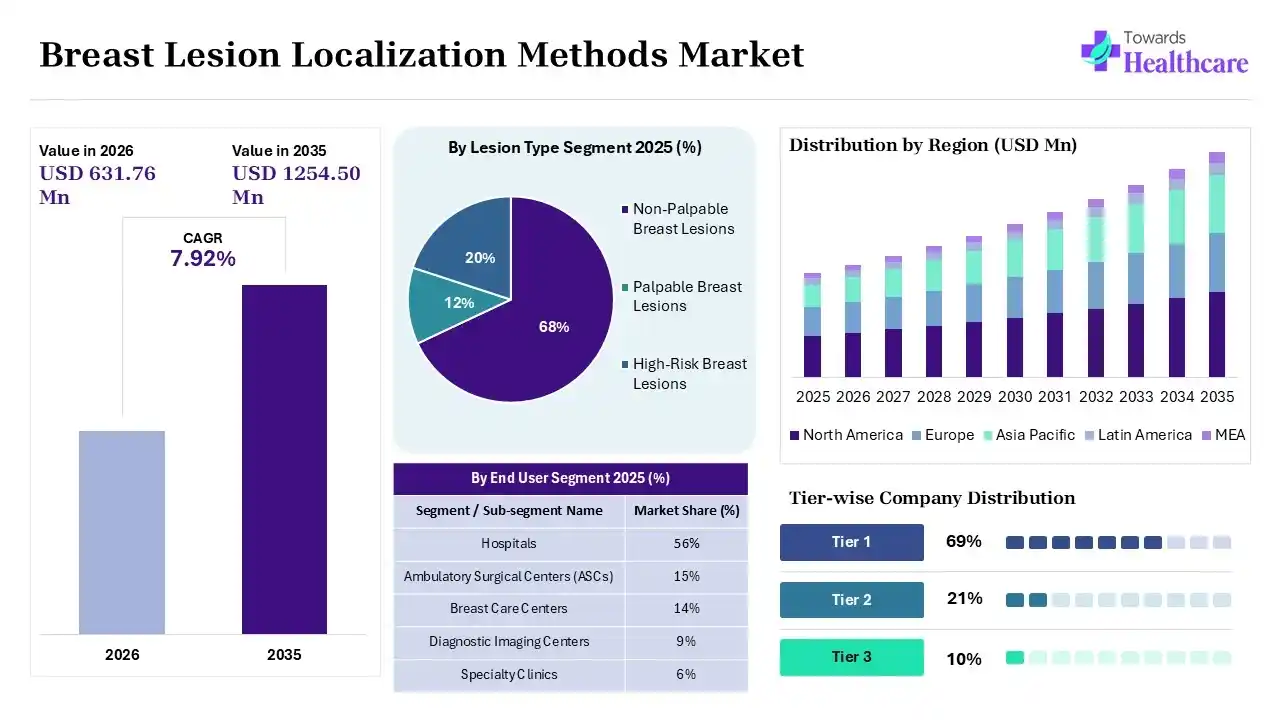
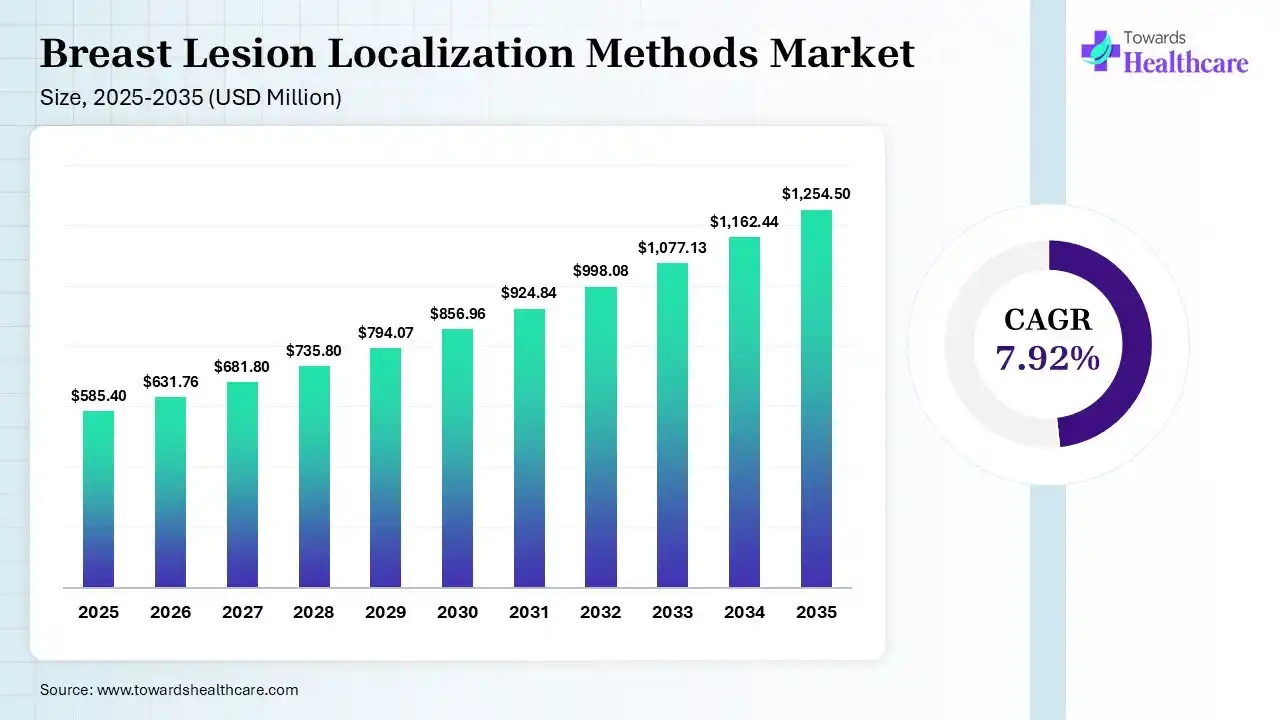
The global breast lesion localization methods market size is calculated at USD 585.4 million in 2025, where it continues to grow in 2026 at USD 631.76 million due to growing demand for wire-free technologies. It is expected to reach USD 1254.5 million by 2035 with a CAGR of 7.92% due to increasing shift towards minimally invasive technologies. North America accounted for 40% of the market in 2025 due to growth in breast cancer screening rates.
What are the Breast Lesion Localization Methods?
The breast lesion localization methods refer to the procedures and technologies used for accurate detection of breast lesions. They help in improving surgical accuracy, reducing damage to healthy tissues, and enhancing patient outcomes.
Different types of methods such as wire-guided localization, radioactive seed localization, Magnetic Seed Localization, RFID localization, etc are being used for breast lesion detection. They help in the detection of non-palpable lesions, high-risk lesions, and other suspicious lesions.
Wire-guided localization was primarily used for non-palpable breast lesion detection, where advancements in ultrasound and mammography increased their use. Furthermore, the development of radioactive seed localization followed by wire-free location technologies increased their adoption. Expansion of digital technologies is also promoting the advancements of MRI, mammography, tomosynthesis, and other minimally invasive approaches.
It focuses on the value generated for surgeons, radiologists, hospitals, patients, and healthcare systems through advanced localization techniques. Additionally, based on the information gathered by Payal Rabde, growing breast cancer cases, demand for wire-free technologies, and a shift towards minimally invasive approaches are anticipated to drive the market expansion.
| Table | Scope |
| Market Size in 2026 | USD 631.76 Million |
| Projected Market Size in 2035 | USD 1254.5 Million |
| CAGR (2026 - 2035) | 7.92% |
| Leading Region | North America by 40% |
| Historical Data | 2020 - 2023 |
| Base Year | 2025 |
| Forecast Period | 2026 - 2035 |
| Measurable Values | USD Millions/Units/Volume |
| Market Segmentation | By Localization Method, By Imaging Guidance, By Lesion Type, By End User, By Region |
| Top Key Players | Hologic, Inc., Merit Medical Systems, Inc., Becton, Dickinson and Company, Stryker Corporation, Endomagnetics Ltd. |
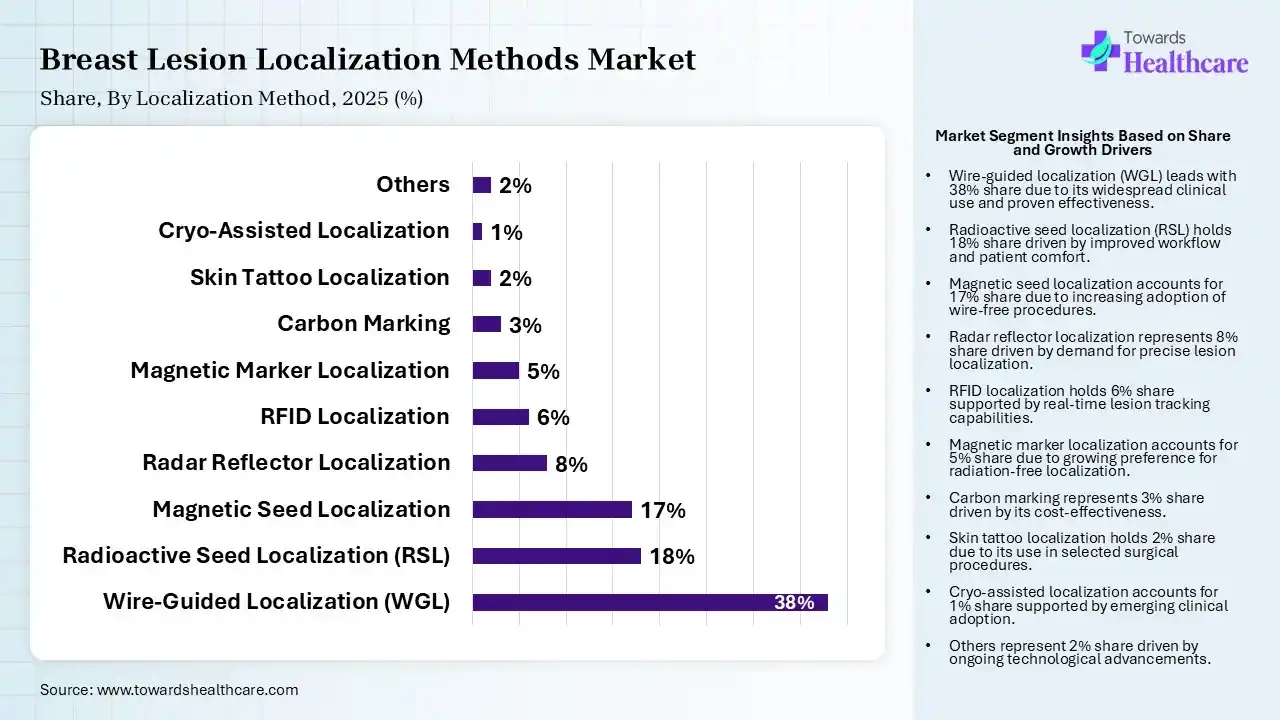
| Segment | Share 2025 (%) |
| Wire-Guided Localization (WGL) | 38% |
| Radioactive Seed Localization (RSL) | 18% |
| Magnetic Seed Localization | 17% |
| Radar Reflector Localization | 8% |
| RFID Localization | 6% |
| Magnetic Marker Localization | 5% |
| Carbon Marking | 3% |
| Skin Tattoo Localization | 2% |
| Cryo-Assisted Localization | 1% |
| Others | 2% |
The Wire-Guided Localization (WGL) Segment Dominated the Market With 38% in 2025
The wire-guided localization (WGL) segment led the breast lesion localization methods market with a 38% share in 2025, driven by established clinical protocols that supported their widespread adoption. A large installed base maintained procedural familiarity, which increased their use. Lower procedural cost also sustained their demand in emerging healthcare systems.
The magnetic seed localization segment held the second-largest share of 17% of the market in 2025 and is expected to witness the fastest growth with a CAGR of 11.10% during the forecast period, as hospitals are replacing radioactive techniques with radiation-free alternatives. Technological improvements also simplify localization. As per the survey conducted by Payal Rabde, expanding regulatory approvals also accelerate their utilization.
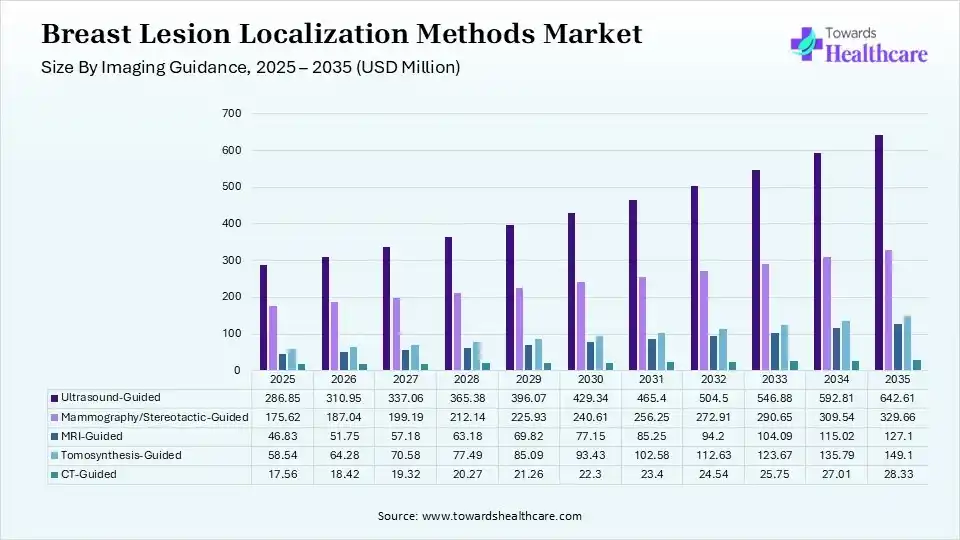
| Segment | Share 2025 (%) |
| Ultrasound-Guided | 49% |
| Mammography/Stereotactic-Guided | 30% |
| MRI-Guided | 8% |
| Tomosynthesis-Guided | 10% |
| CT-Guided | 3% |
The Ultrasound-Guided Segment Dominated the Market With 49% in 2025
The ultrasound-guided segment accounted for the highest revenue share of 49% of the breast lesion localization methods market in 2025, driven by real-time visualization, which improved localization accuracy. Broad equipment availability also supported routine procedures. Lower procedural costs also encouraged widespread use.
The MRI-guided segment held the second-largest share of 8% of the market in 2025 and is expected to show the highest growth with a CAGR of 10.50% during the forecast period, due to rising MRI screening identifying occult lesions. High diagnostic sensitivity also drives their demand. Increasing availability of breast MRI also expands utilization.
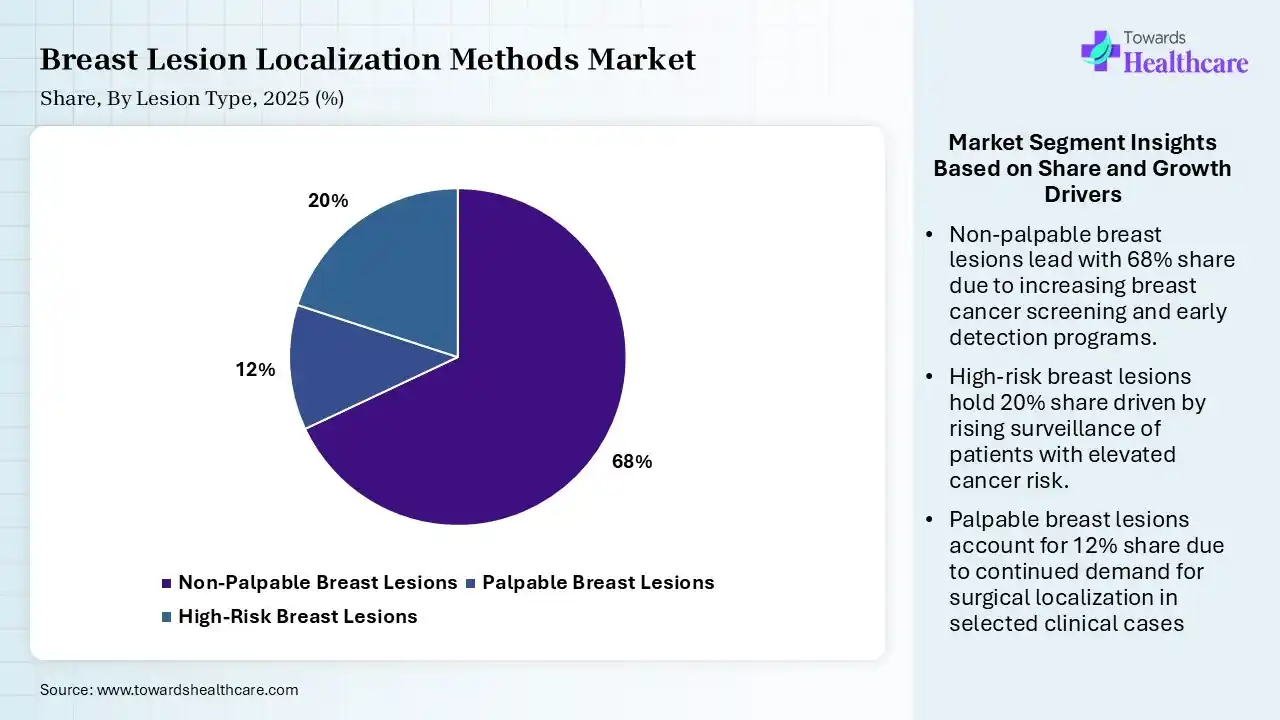
| Segment | Share 2025 (%) |
| Non-Palpable Breast Lesions | 68% |
| Palpable Breast Lesions | 12% |
| High-Risk Breast Lesions | 20% |
The Non-Palpable Breast Lesions Segment Dominated the Market With 68% in 2025
The non-palpable breast lesions segment held a major revenue share of 68% of the breast lesion localization methods market in 2025, driven by growth in breast screening programs that detect more early-stage lesions. Localization technologies primarily target non-palpable abnormalities. A rise in diagnostic imaging also supported procedure growth.
The high-risk breast lesions segment held the second-largest share of 20% of the market in 2025 and is expected to expand rapidly with a CAGR of 9.40% during the forecast period, due to increasing diagnosis of atypical lesions, which supports intervention. Personalized treatment planning also drives localization demand. Enhanced surveillance programs also increase detection rates.
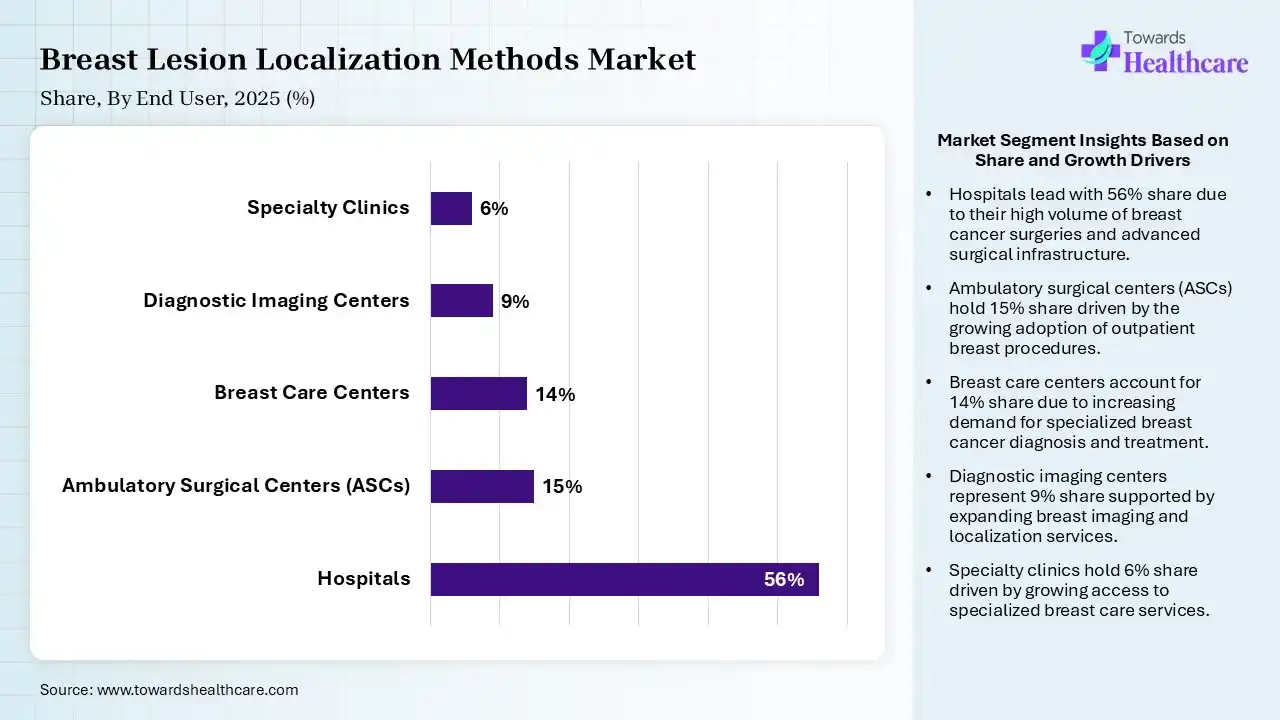
| Segment | Share 2025 (%) |
| Hospitals | 56% |
| Ambulatory Surgical Centers (ASCs) | 15% |
| Breast Care Centers | 14% |
| Diagnostic Imaging Centers | 9% |
| Specialty Clinics | 6% |
The Hospitals Segment Dominated the Market With 56% in 2025
The hospitals segment contributed the biggest revenue share of 56% of the breast lesion localization methods market in 2025, driven by the presence of comprehensive breast surgery services, which maintained high procedure volumes. Multidisciplinary teams improved patient outcomes. Based on the analysis of Payal Rabde, investments in advanced localization technologies continue to increase.
The ambulatory surgical centers (ASCs) segment held the second-largest share of 15% of the market in 2025 and is expected to gain the highest share with a CAGR of 9.60% during the forecast period, due to continuous expansion of outpatient breast surgeries. Lower healthcare costs also support ASC utilization. Improved workflow also encourages technology adoption, increasing their use.
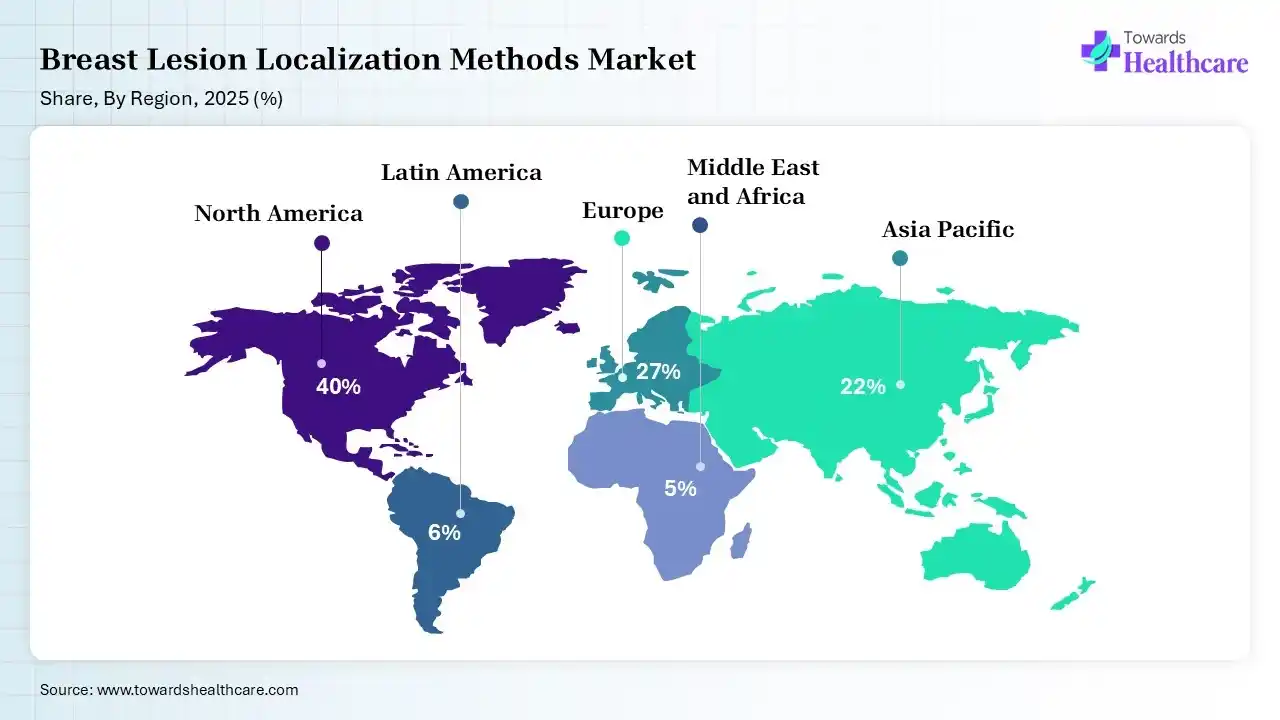
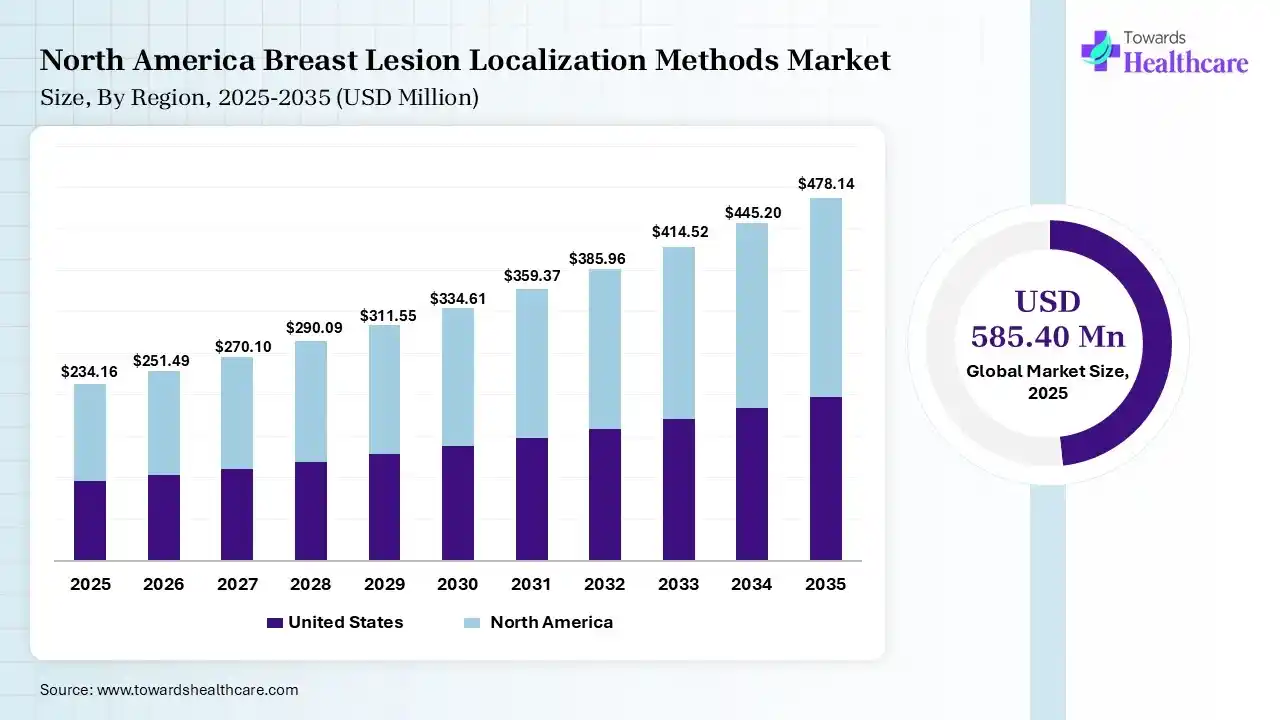
North America dominated the breast lesion localization methods market with 40% in 2025, due to high breast cancer screening rates, which supported procedure volumes. Advanced localization technologies also achieved rapid adoption. Strong reimbursement support also accelerated their adoption, where high healthcare expenditure and the presence of advanced medical device companies also increased their innovations. At the same time, growth in R&D activities and health awareness also contributed to the market growth.
US Market Trends
U.S. held an 82% share of the breast lesion localization methods market in 2025, driven by a large screening population, which increased procedure volume. Strong reimbursement supports also increased the use of advanced localization, where continuous technology innovation also accelerated their adoption. According to the information gathered by Payal Rabde, the presence of companies like Stryker serving 50K employees and more than 150 M patients also contributed to the market growth.
Canada Market Trends
Canada held a 12% share in the market in 2025 and is expected to grow with the highest CAGR of 7.90% during the studied years, due to growing national breast screening are expanding diagnoses. Healthcare modernization also improves access, where rising minimally invasive surgeries also support their demand. Increasing incidence of breast cancer and increasing investments are also driving the innovations of wire-free localization technologies. Growing government support and health awareness are also increasing adoption.
Europe held a 27% share of the breast lesion localization methods market and is expected to grow significantly during the forecast period, due to growing national screening initiatives, which increase early detection. Hospitals are modernizing breast surgery infrastructure, where growing preference for wire-free localization is also supporting their expansion. Favourable reimbursement policies and regulatory frameworks also increase access to these methods, where well-established infrastructure is also enhancing market growth.
Germany Market Trends
Germany held a 24% share in the breast lesion localization methods market in 2025, driven by the presence of advanced healthcare infrastructure, which supported adoption. High breast imaging utilization also increased their demand, where technology innovations also increased their upgrades. Growth in breast cancer cases and healthcare expenditure also increased their adoption rates, where a rise in clinical activities also increased their innovations. A rise in demand for minimally invasive approaches also encouraged their use.
UK Market Trends
UK held a 20% share in the market in 2025 and is expected to witness the fastest growth with a CAGR of 8.90% over the forecast period, due to growing NHS screening programs, which expand localization procedures. Wire-free adoption is also increasing rapidly, where clinical guidelines are driving innovation. Increasing health awareness is also driving their adoption, where expanding multidisciplinary care services are also increasing their use. Expanding technological advancements are also accelerating their innovations.
Asia Pacific held a 22% share of the breast lesion localization methods market in 2025 and is expected to grow at the fastest CAGR of 9.80% during the forecast period, due to expanding healthcare infrastructure improving access. Rising breast cancer incidence increases localization demand, where growing government investments strengthen diagnostic capabilities. Growing health awareness and demand for breast conservation series are also increasing their use, where growing innovation is also promoting market expansion.
China Market Trends
China held a 33% share of the breast lesion localization methods market in 2025, driven by the presence of a large patient population, which supported demand. Hospital modernization expanded localization technologies, where government healthcare investment also accelerated adoption. Expanding cancer screening programs and breast cancer centres also increased the adoption of various localization methods. Growth in clinical activities and favourable regulations also accelerated their innovations.
India Market Trends
India held an 18% share in the market in 2025 and is expected to expand rapidly with a CAGR of 11.40% in the coming years, due to expanding diagnostic infrastructure, which drives adoption. Rising cancer awareness also supports early breast cancer screening, where growing private hospital investment in advanced localization is also increasing their use. Increasing cancer burden and to cover unmet diagnostic need, the adoption of various localization methods and imaging technologies is increasing.
Latin America held a 6% share in the breast lesion localization methods market in 2025 and is expected to show lucrative growth during the forecast period, due to screening awareness, which continues improving. Growing private healthcare investment is expanding breast care services. Adoption of modern localization technologies is gradually increasing. The growing demand for breast conservation surgeries is also increasing the adoption of devices, where adoption of wire-free localization technologies is also driving market growth.
Brazil Market Trends
Brazil held a 48% share in the breast lesion localization methods market in 2025, driven by the largest regional healthcare market, which increased demand. Growth in private hospital investment also supported localization. Screening programs continued expanding, where growth in breast cancer cases also increased the adoption of advanced imaging technologies. A rise in demand for minimally invasive procedures also increased their adoption and innovation rates, where expansion of clinical activities also increased their use.
Argentina Market Trends
Argentina held a 22% share in the market in 2025 and is expected to gain the highest market share with a CAGR of 7.80% during the forecast period, due to improving oncology services, which increase procedures. Growing adoption of modern imaging is also expanding localization, where increasing healthcare reforms are supporting technology adoption. Rising investments in women's health services are also expanding access to specialized localized procedures, where government initiatives are also encouraging their usage.
MEA held a 5% share in the breast lesion localization methods market in 2025 and is expected to show notable growth during the forecast period, due to continuous development of cancer care infrastructure. Increasing government healthcare spending supports modernization, where growing international collaborations are also improving technology availability. Increasing breast cancer burden and health awareness are driving the demand for location methods, where expansion of breast cancer centres is also propelling the market growth.
GCC Market Trends
GCC Countries held a 46% share in the breast lesion localization methods market in 2025 and is expected to show the fastest growth with a CAGR of 7.60% over the forecast period, driven by increased government investments to modernize cancer centers. Growth in premium hospitals also increased adoption of advanced localization, where expansion of screening programs continued their adoption. Increased demand for breast conservation surgeries and minimally invasive approaches also promoted their adoption.
The rest of the Middle East & Africa held a 30% share in the market in 2025, due to international healthcare partnerships, which improve access. Depending on Payal Rabde’s survey, cancer awareness campaigns are also increasing diagnosis, where gradual technology adoption also supports their growth. Expansion of oncology services and cancer centers also increases the adoption of advanced methods and imaging technologies. Growing medical device industries are also driving the development of affordable localization technologies.
| Companies | Headquarters | Solutions |
| Hologic, Inc. | Massachusetts, U.S. | LOCalizer, DuoSystems, and Tuloc |
| Merit Medical Systems, Inc. | Utah, U.S. | SCOUT and SCOUT Bx OneMark |
| Becton, Dickinson and Company | New Jersey, U.S. | AccuMark, HookWire, and J-Wire |
| Stryker Corporation | Michigan, U.S. | MOLLI |
| Endomagnetics Ltd. | Cambridge, UK | Magseed |
In July 2026, after the launch of QP-Breast, its CE and UKCA-marked AI tool using MRI for detection of breast cancer, CEO of Quibim, Dr Ángel Alberich-Bayarri, states that “Radiology teams are facing growing demand, but resources aren’t keeping pace. QP-Breast is designed to assist clinicians during the interpretation of breast MRI studies by providing accurate detection of lesions suspicious for breast cancer. By automating time-consuming parts of MRI analysis and delivering clear, structured outputs, we’re enabling radiologists to focus on what matters most. That is, making informed decisions and improving their patients’ care,” says Dr Ángel Alberich-Bayarri, CEO of Quibim, in a release.
| Company Overview | Focuses on the innovation, manufacturing, and delivery of best-in-class medical devices and superior service. |
| Product Portfolio | BioPince Ultra Full Core Biopsy Instrument, CLEANER Rotational Thrombectomy System, Option ELITE Retrievable Vena Cava Filter, etc. |
| Geographical Presence | U.S. |
| Business Strategy | Aim to deliver exceptional outcomes in what they do. |
| Recent Developments | Partnership with The American Venous Forum (“AVF”) |
| SWOT Analysis |
Strengths:
Weakness:
Opportunities:
Threats:
|
| Company Overview | Focus on need and opportunity to simplify and improve the localization technology for the surgical removal of breast cancers. |
| Product Portfolio | Pintuition System, Pintuition Maker, etc |
| Geographical Presence | Netherlands and U.S. |
| Business Strategy | Aim to provide intuitive and accurate devices that deliver optimal patient care |
| Recent Developments | Partnership with Menges Medical |
| SWOT Analysis |
Strengths:
Weakness:
Opportunities:
Threats:
|
| Company Overview | Develops diagnostics, medical imaging, and surgical technologies |
| Product Portfolio | Breast health, gynecological health, body composition, etc |
| Geographical Presence | U.S., Germany, UK, China, Australia, and Japan |
| Business Strategy | Aim to develop life-changing medical technologies that effectively detect, diagnose, and treat the health conditions that disproportionately affect women. |
| Recent Developments | Significant Patent Victory Against Siemens Healthineers Over Breast Cancer Detection Technology |
| SWOT Analysis |
Strengths:
Weakness:
Opportunities:
Threats:
|
Based on Payal Rabde's analysis, the breast lesion localization methods market is expected to show significant growth during the forecast period due to a wide range of factors. The growing breast cancer cases, screening programs, health awareness, demand for minimally invasive surgeries, and breast conserving surgeries are increasing the adoption of breast lesion localization methods. Expanding breast cancer centres, oncology services, outpatient services, wire-free technologies, and imaging systems are also driving their growth. Segments such as magnetic seed localization, MRI-guided, non-palpable breast lesions, high-risk breast lesions, and ambulatory surgical centers (ASCs) are expected to show notable growth, which will drive new investment opportunities. Similarly, companies like Hologic, Inc., Stryker Corporation, Argon Medical Devices, Inc., Merit Medical Systems, Inc., Sirius Medical, Becton, Dickinson and Company, and Endomagnetics Ltd. are anticipated to grow significantly, attracting new investments.
By Localization Method
By Imaging Guidance
By Lesion Type
By End User
By Region









Principal Consultant
Payal Rabde is a Healthcare Market Research Analyst at Towards Healthcare Research & Consulting with 4+ years of experience in pharmaceuticals, biotechnology, medical devices, and life sciences.
Learn more about Payal Rabde

Reviewed By
Aditi Shivarkar is a seasoned professional with over 14 years of experience in healthcare market research. As a content reviewer, Aditi ensures the quality and accuracy of all market insights and data presented by the research team.
Learn more about Aditi Shivarkar