
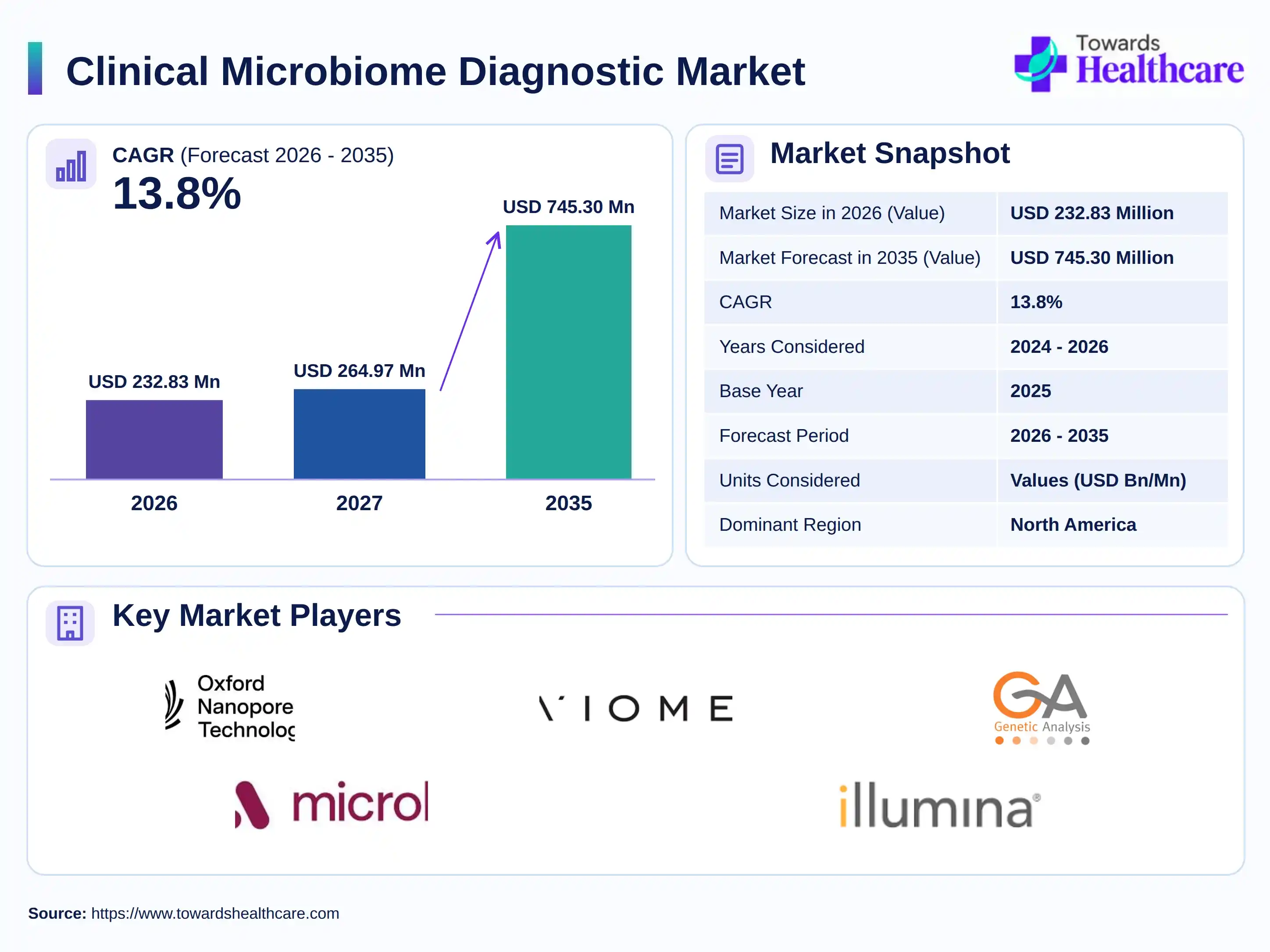
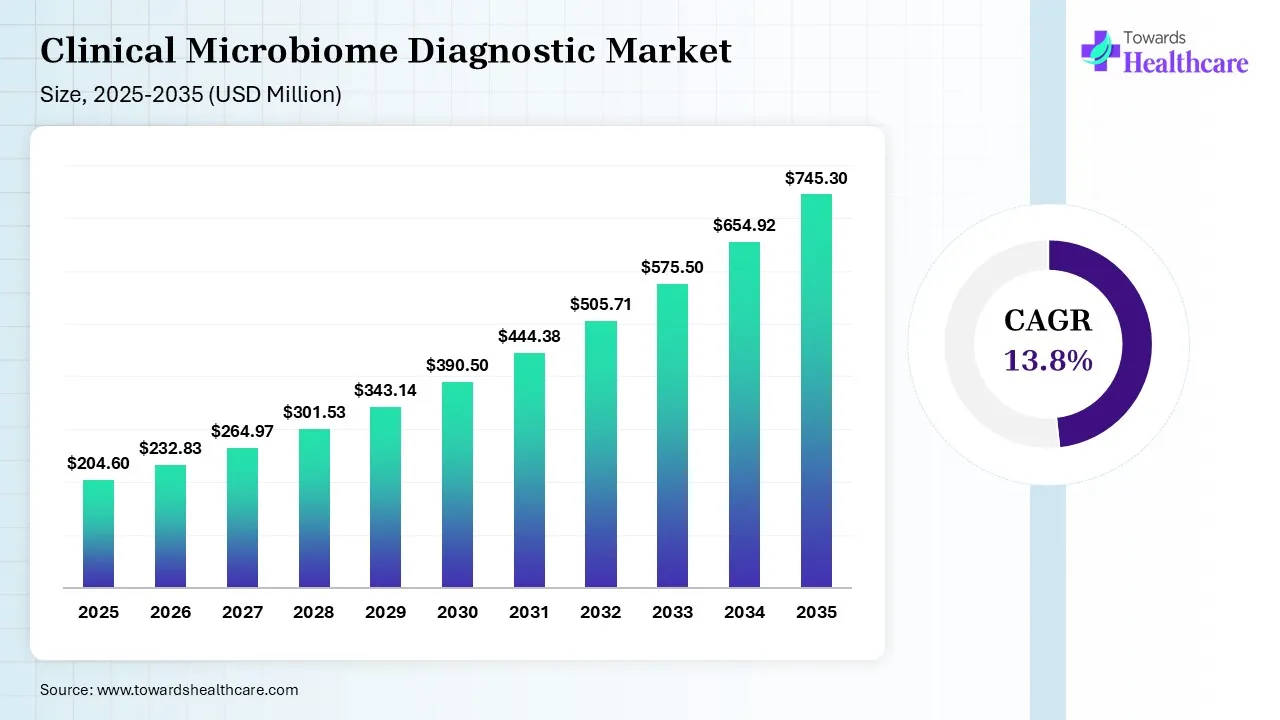
The clinical microbiome diagnostic market is projected to grow from USD 204.60 million in 2025 to USD 745.30 million by 2035 because more clinicians and consumers order gut and vaginal microbiome tests, and lower sequencing costs make detailed metagenomic profiling affordable. Microbiome studies in pharmaceuticals and clinical trials increase the demand for standard tests, which drives the market to USD 390.50 million by 2030, and maintains a CAGR of 13.80% from 2026 to 2035.
Analyst View: In addition to sales of reagents, kits, instruments, and analysis software to labs and research users, we calculated the estimate by multiplying the average test prices by the volumes of microbiome tests conducted in clinical, practitioner, and consumer channels. Volumes reflect the patient bases reported by testing companies, practitioner adoption, and research and trial activity. The total was cross-checked against the revenue of leading microbiome testing and sequencing companies and against published estimates, which places our base year slightly above the comparable figures. The growth is on account of quick adoption from a low base, tempered by minimal reimbursement and changing clinical data.
Market Size & Growth Outlook
Regional Market Spotlight
Segmental Spotlight
Sources: Expert interviews, secondary sources, Towards Healthcare database and Towards Healthcare analysts.
Research continues to link the microbiome to digestive, metabolic, immune, reproductive, and mental health conditions. Sequencing cost reductions make metagenomics testing more economical. Clinicians in gastroenterology, women's health and functional medicine are ordering tests to guide care. Consumers are interested in personalized gut health. Microbiome-based drugs and live biotherapeutics need testing in trials and potentially in practice.
There is ongoing research being done on linking microbiome test results to treatment decisions in various diseases. Reimbursement for microbiome tests is limited, so most tests are paid out of pocket. Methods and reference ranges vary by lab, which complicates comparison of the results. There is more regulation of consumer marketing claims regarding the microbiome. Some consumers wonder about the worth of repeat tests.
Companion tests for approved microbiome therapies, such as treatments for recurrent C. difficile, could create reimbursed clinical uses. Vaginal microbiome testing can support fertility, pregnancy, and recurrent infection care. Standardized clinical panels can win acceptance from physicians and payers. Interpretation and healthcare services by artificial intelligence can generate additional revenues. Expansion in Asia and Europe means new customers.
| Segments | 2025 Share | 2025 Market Value |
| Fecal | 54.20% | USD 110.89 million |
| Vaginal | 16.80% | USD 34.37 million |
| Saliva | 14.60% | USD 29.87 million |
| Others | 14.40% | USD 29.46 million |
Sources: Expert interviews, secondary sources, Towards Healthcare database and Towards Healthcare analysts.
Fecal samples accounted for 54.20% (USD 110.89 million) in 2025 because gut microbiome analysis supports care for irritable bowel syndrome, inflammatory bowel disease, metabolic conditions, and C. difficile, and stool kits are easy to collect at home. Practitioner-ordered gut tests now combine microbiome profiling with pathogen, parasite and inflammation markers. Vaginal samples, at 16.80% (USD 34.37 million), are a fast-growing segment as metagenomic tests guide care for recurrent bacterial vaginosis, yeast infections and fertility; saliva accounts for 14.60% (USD 29.87 million) and is used for oral health and some systemic disease research; and other samples such as skin, urine, and blood account for 14.40% (USD 29.46 million).
| Segments | 2025 Share | 2025 Market Value |
| Fecal | 54.20% | USD 110.89 million |
| Vaginal | 16.80% | USD 34.37 million |
| Saliva | 14.60% | USD 29.87 million |
| Others | 14.40% | USD 29.46 million |
Sources: Expert interviews, secondary sources, Towards Healthcare database and Towards Healthcare analysts.
Reagents and kits accounted for 64.60% (USD 132.17 million) in 2025 because every test requires collection kits, DNA stabilization, extraction, and library preparation reagents, and they are consumed with each sample. Instruments, at 18.20% (USD 37.24 million), include sequencers and PCR systems used by testing laboratories. Software and services account for 17.20% (USD 35.19 million) and are growing quickly as companies add bioinformatics, clinician reports, and care coaching to their tests.
| Segments | 2025 Share | 2025 Market Value |
| 16S rRNA Sequencing | 41.80% | USD 85.52 million |
| Shotgun Metagenomics | 34.60% | USD 70.79 million |
| qPCR | 15.40% | USD 31.51 million |
| Others | 8.20% | USD 16.78 million |
Sources: Expert interviews, secondary sources, Towards Healthcare database and Towards Healthcare analysts.
16S rRNA sequencing accounted for 41.80% (USD 85.52 million) in 2025 because it is a low-cost way to identify bacteria and has a long research track record. Shotgun metagenomics, at 34.60% (USD 70.79 million), is the fastest-growing technology because it identifies species and strains, functional genes, fungi, and viruses, which makes reports more clinically useful. qPCR accounts for 15.40% (USD 31.51 million) and is used for targeted panels of key organisms, and other methods account for 8.20% (USD 16.78 million).
| Segments | 2025 Share | 2025 Market Value |
| Hospitals & Clinics | 48.60% | USD 99.44 million |
| Direct-to-Consumer | 20.20% | USD 41.33 million |
| Pharmaceutical & Biotech Companies | 18.40% | USD 37.65 million |
| Research Institutes | 12.80% | USD 26.19 million |
Sources: Expert interviews, secondary sources, Towards Healthcare database and Towards Healthcare analysts.
Hospitals and clinics accounted for 48.60% (USD 99.44 million) in 2025, covering gastroenterology, women's health, functional medicine, and integrative practices that order tests for patients. Direct-to-consumer channels, at 20.20% (USD 41.33 million), sell home kits with app-based reports; pharmaceutical and biotech companies account for 18.40% (USD 37.65 million) and are the fastest-growing end user as microbiome drug trials expand; and research institutes account for 12.80% (USD 26.19 million).
Analyst View: Segment values were allocated by matching test volumes by channel and body site to technologies and prices, and adding product sales by type. Fecal testing and reagents and kits lead because gut tests dominate volumes and every sample consumes kits. We expect vaginal testing, shotgun metagenomics, software and services, and pharma users to gain share.
| Region | 2025 Share | 2025 Market Value |
| North America | 51.20% | USD 104.76 million |
| Europe | 24.60% | USD 50.33 million |
| Asia Pacific | 18.40% | USD 37.65 million |
| Latin America | 3.40% | USD 6.96 million |
| Middle East & Africa | 2.40% | USD 4.91 million |
Sources: Expert interviews, secondary sources, Towards Healthcare database and Towards Healthcare analysts.
North America accounted for 51.20% (USD 104.76 million) in 2025. Many testing companies and strong practitioner demand drive the market. Microbiome drug development adds to research testing. Consumers buy home kits through online channels.
Europe accounted for 24.60% (USD 50.33 million) in 2025. Strong microbiome research supports clinical use. Practitioner testing is growing in the UK and Germany. European regulatory authorities develop standards for microbiome tests.
Asia Pacific accounted for 18.40% (USD 37.65 million) in 2025 and is the fastest-growing region. Australian companies offer clinic-grade metagenomic tests. Consumer health spending is rising in China, Japan, and South Korea. Sequencing capacity is expanding.
Latin America accounted for 3.40% (USD 6.96 million) in 2025. The increasing number of private laboratories facilitate gut microbiome tests. Awareness is growing in Brazil and Mexico.
The Middle East and Africa accounted for 2.40% (USD 4.91 million) in 2025. Testing is mainly available in Gulf private clinics. International providers serve much of the demand.
Analyst View: Regional shares were built from test volumes, research activity, and test prices in each region. North America leads because it hosts most testing companies and consumers. We assign Asia Pacific the highest growth premium because consumer and clinical microbiome testing is growing quickly there from a small base.
| Rank | Company Name | Market-Specific Revenue (USD Million) | 2025 Share | Key Products/Business | Headquarters |
| 1 | Illumina | 22.00 | 10.75% | Sequencing systems and microbiome library preparation | United States |
| 2 | Viome | 16.00 | 7.82% | Metatranscriptomic gut and oral microbiome tests | United States |
| 3 | Evvy | 12.00 | 5.87% | Metagenomic vaginal microbiome testing and care | United States |
| 4 | Microba Life Sciences | 10.00 | 4.89% | Microbiome Explorer clinical metagenomic tests | Australia |
| 5 | DNA Genotek | 9.00 | 4.40% | OMNIgene microbiome sample collection kits | Canada |
| 6 | Oxford Nanopore Technologies | 8.00 | 3.91% | Long-read sequencing for microbiome analysis | United Kingdom |
| 7 | BD | 7.00 | 3.42% | Specimen collection and microbiology systems | United States |
| 8 | Genetic Analysis | 6.00 | 2.93% | GA-map gut microbiome dysbiosis tests | Norway |
| 9 | Tiny Health | 6.00 | 2.93% | Shotgun metagenomic gut tests for families | United States |
| 10 | ViennaLab Diagnostics | 4.00 | 1.96% | Microbiome PCR strip assays | Austria |
Sources: Company press releases, expert interviews, secondary sources, Towards Healthcare database and Towards Healthcare analysts.
Illumina led the clinical microbiome diagnostic market with an estimated 10.75% (USD 22.00 million) of 2025 revenue, followed by Viome at 7.82% (USD 16.00 million) and Evvy at 5.87% (USD 12.00 million). Illumina leads by supplying the sequencers and library preparation kits used by most microbiome testing laboratories. Viome and Evvy lead among testing companies, Viome with large-scale gut and oral meta-transcriptomic testing and Evvy with metagenomic vaginal microbiome testing linked to prescription care, which reported more than 75,000 patients in 2025. Microba offers clinic-grade metagenomic gut tests to practitioners in Australia and the UK, DNA Genotek supplies stabilizing collection kits, and Tiny Health, Genetic Analysis and ViennaLab serve specialized clinical and family testing needs. The top 10 companies accounted for 48.88% (USD 100.00 million) of the total income in 2025, with the remaining 51.12% (USD 104.60 million) coming from other entities like as testing facilities, functional medicine labs, consumer microbiome companies, and providers of sequencing services. The clinical microbiome diagnostic market is fragmented, and competition centers on sequencing depth, clinical validation, report usefulness for practitioners, care services, and price. Firms that provide testing and then treatment, whether through prescriptions, counseling, or specific supplements, are building patient loyalty, as regulatory bodies and professional organizations create guidelines for clinical statements.
By Sample Type
By Product
By Technology
By End User
By Region
The clinical microbiome diagnostic market was defined as microbiome tests, reagents, kits, instruments, software, and services for gut, vaginal, oral, skin, and other samples used in clinical, practitioner, consumer, and research settings worldwide. The 2025 base year was built bottom-up from microbiome test volumes by channel, average test prices, and the sales of reagents, kits, instruments, and software. It was checked top-down against the revenue of leading microbiome testing and sequencing companies. Segment, regional, and company values were allocated from sample types, products, technologies, end users, and regional testing activity. The most important estimates were corroborated using company information, regulatory and industry figures, and external independent estimates, and those that could not be reconciled were eliminated. All segment, regional, and company figures were reconciled to the same 2025 base year, and the 2026-2035 forecast, which applies a constant CAGR from the 2025 base, was recalculated and validated.
Analyst View: Overall Market - The clinical microbiome diagnostic market is small but growing quickly as metagenomic testing moves from research and wellness into clinical care. Our estimate links demand to test volumes, prices, and product sales by channel, so the forecast follows practitioner adoption, consumer demand, and microbiome drug development. The main upside comes from shotgun metagenomics, women's health, and companion testing, while the main risks are limited reimbursement and evolving evidence.