Pipeline Programs

CGT Companies Tracked

Manufacturing Facilities


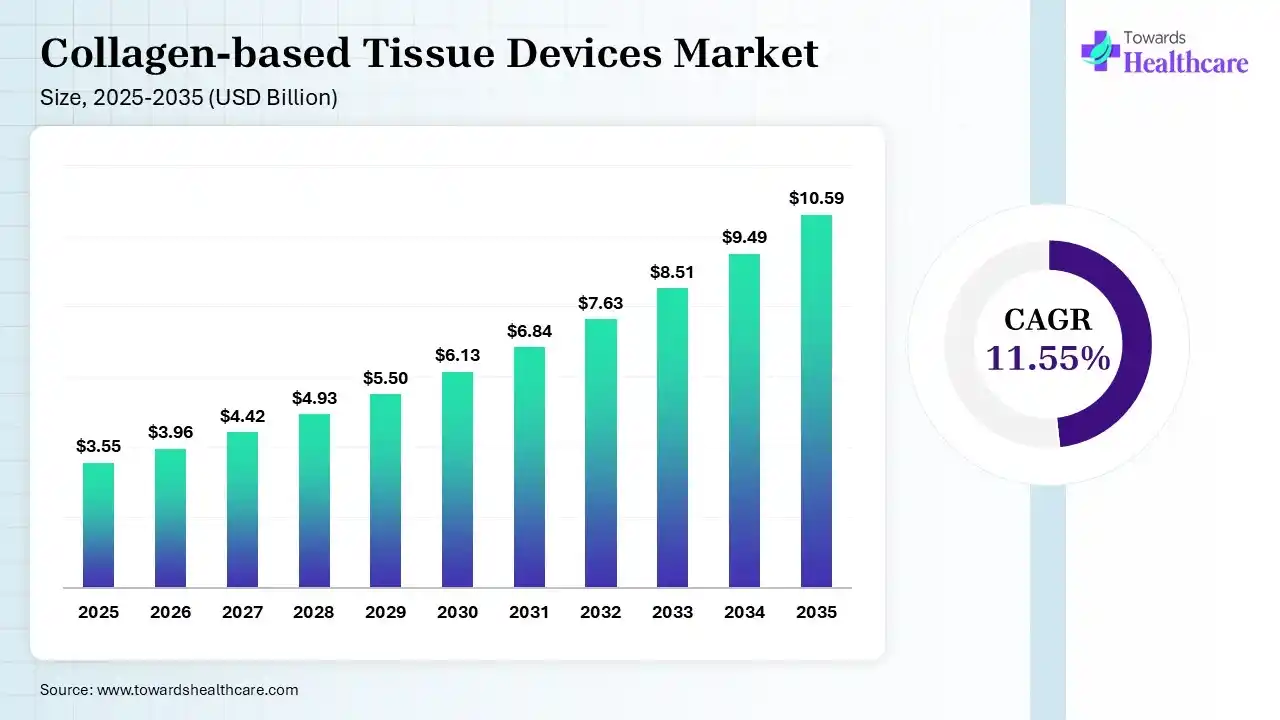
The collagen-based tissue devices market size was estimated at USD 3.55 billion in 2025 and is predicted to increase from USD 3.96 billion in 2026 to approximately USD 10.59 billion by 2035, expanding at a CAGR of 11.55% from 2026 to 2035. Analysis also highlights that the collagen-based tissue devices market is expanding due to rising demand for advanced wound care, increasing use of collagen-based biomaterials in tissue regeneration, growing prevalence of chronic wounds, advancements in regenerative medicines, and increasing adoption of minimally invasive tissue repair solutions.
Collagen-based tissue devices refer to medical devices and biomaterial-based products that use collagen as a primary component to support tissue repair, regeneration, wound healing, and reconstruction. The different types of devices include collagen-based wound dressings, tissue scaffolds, surgical meshes, hemostatic agents, soft-tissue repair products, bone regeneration materials, and tissue-engineered products. Moreover, product/device type, collagen sources, collagen type, material form, application, end users, and distribution channels are covered in this report.
Analyst View:
The collagen-based tissue devices market is driven by an aging population, rising chronic diseases, and growing demand for regenerative medicine. Opportunities are expanding toward advanced biologic matrices, engineered scaffolds, antimicrobial products, injectable solutions, and patient-specific constructs. However, reimbursement barriers, clinical evidence requirements, regulatory complexity, material variability, and competition from alternative biomaterials remain key challenges.
| Segment / Sub-segment Name | Market Share (%) | CAGR (%) |
| Wound Care Devices | 34.00% | 11.20% |
| Tissue Engineering Scaffolds | 22.00% | 14.8% |
| Orthopedic Tissue Repair Devices | 14.00% | 11.90% |
| Dental Tissue Repair Devices | 10.00% | 10.70% |
| Surgical Hemostatic Devices | 8.00% | 9.10% |
| Soft Tissue Repair Devices | 6.00% | 10.90% |
| Cardiovascular Tissue Devices | 3.00% | 12.60% |
| Ophthalmic Tissue Devices | 3.00% | 13.90% |
The above table indicates that wound care devices segment dominate the collagen-based tissue devices market with a 34.0% market share, driven by increasing chronic wounds, surgical procedures, and demand for advanced wound-healing solutions. Tissue Engineering Scaffolds segment represent the fastest-growing segment, with a 14.8% CAGR, supported by advances in regenerative medicine and tissue regeneration. Other segments include Orthopedic Tissue Repair Devices (14.0%), Dental Tissue Repair Devices (10.0%), Surgical Hemostatic Devices (8.0%), Soft Tissue Repair Devices (6.0%), Cardiovascular Tissue Devices (3.0%), and Ophthalmic Tissue Devices (3.0%).
Analyst View:
Wound Care Devices remain the key market segment due to their established clinical applications and recurring demand. Meanwhile, Tissue Engineering Scaffolds segment offer significant growth potential as collagen serves as both a structural and biological component in tissue regeneration. Emerging opportunities include injectable scaffolds, 3D-printed constructs, cardiovascular patches, and ophthalmic regeneration, although these applications require longer development timelines and stronger clinical evidence.
| Segment / Sub-segment Name | Market Share (%) | CAGR (%) |
| Sponges | 24.00% | 9.80% |
| Membranes | 18.00% | 10.90% |
| Sheets & Films | 12.00% | 10.50% |
| Hydrogels | 14.00% | 15.7% |
| Matrices & scaffolds | 16.00% | 14.90% |
| Powders & Microparticles | 6.00% | 9.40% |
| Fibers & Sutures | 5.00% | 8.70% |
| 3D-Printed Constructs | 5.00% | 18.2% |
The table shows that sponges segment dominate the collagen-based tissue devices market with a 24.0% market share, supported by their established use in wound care, hemostasis, surgical procedures, and tissue repair. The 3D-Printed Constructs segment are the fastest-growing segment, registering an 18.2% CAGR, driven by advancements in 3D bioprinting, personalized tissue engineering, and regenerative medicine. Other segments include Membranes (18.0%), Matrices & Scaffolds (16.0%), Hydrogels (14.0%), Sheets & Films (12.0%), Powders & Microparticles (6.0%), and Fibers & Sutures (5.0%).
Analyst View:
The market is shifting from conventional collagen products toward advanced formats offering greater functionality and customization. Hydrogels support minimally invasive delivery and can incorporate cells, drugs, and growth factors, while 3D-printed constructs provide personalized solutions with higher-value potential. Manufacturers using advanced crosslinking, sterilization, porosity control, 3D printing, and drug-loading technologies can achieve stronger differentiation in the market.
| Segment / Sub-segment Name | Market Share (%) | CAGR (%) |
| Bovine Collagen | 42.00% | 9.40% |
| Porcine Collagen | 30.00% | 11.10% |
| Equine Collagen | 7.00% | 8.60% |
| Marine Collagen | 6.00% | 13.80% |
| Recombinant Collagen | 9.00% | 19.60% |
| Human-Derived & Other Source | 6.00% | 10.30% |
The table indicates that the bovine collagen segment dominates the collagen-based tissue devices market with a 42.0% market share, supported by its established clinical use, availability, and broad application across wound care and tissue repair. The recombinant collagen segment is the fastest-growing segment, with a 19.6% CAGR, driven by advances in biotechnology, improved consistency, and growing demand for engineered collagen with controlled properties. Other segments include Porcine Collagen (30.0%), Equine Collagen (7.0%), Marine Collagen (6.0%), and Human-Derived & Other Sources (6.0%).
Analyst View:
Source selection is becoming increasingly important in the collagen-based tissue devices market. Bovine collagen benefits from established clinical use and wide availability, while porcine collagen is widely used in wound-care and surgical applications. Recombinant and marine collagen offer future growth potential through improved consistency, sustainability, and controlled properties. However, animal-derived collagen faces challenges related to sourcing, pathogen control, TSE risks, traceability, and regulatory documentation.
| Segment / Sub-segment Name | Market Share (%) | CAGR (%) |
| Type I | 62% | 10.90% |
| Type II | 12.00% | 13.70% |
| Type III | 9.00% | 11.80% |
| Type IV | 5.00% | 14.40% |
| Type V | 3.00% | 10.60% |
| Type I/III Blends | 7.00% | 15.3% |
| Other/ Composite Collagen Types | 2.00% | 13.10% |
The collagen type table shows that Type I collagen segment dominates the collagen-based tissue devices market with a 62.0% market share, owing to its strong structural properties, biocompatibility, and extensive use in wound healing, tissue repair, and regenerative applications. The Type I/III collagen blends segment is the fastest-growing segment, registering a 15.3% CAGR, supported by their ability to combine the structural strength of Type I collagen with the regenerative characteristics of Type III collagen, making them increasingly relevant for advanced tissue repair and wound-healing applications. Other segments include Type II (12.0%), Type III (9.0%), Type IV (5.0%), Type V (3.0%), and Other/Composite Collagen Types (2.0%).
Analyst View:
Type I collagen dominates the market due to its wide use in skin, bone, tendon, and wound-healing applications. Meanwhile, Type I/III blends and composite scaffolds are gaining attention as they can be designed to meet the specific tissue repair and regeneration needs of different applications.
| Segment / Sub-segment Name | Market Share (%) | CAGR (%) |
| Wound Healing & Skin Regeneration | 36.00% | 11.80% |
| Bone Regeneration | 18.00% | 11.90% |
| Cartilage & Joint Repair | 11.00% | 13.80% |
| Tendon & Ligaments | 9.00% | 13.40% |
| Dental & Periodontal Regeneration | 10.00% | 10.80% |
| Soft Tissue Reconstruction | 7.00% | 10.90% |
| Cardiovascular Repair | 4.00% | 12.90% |
| Ophthalmic Regeneration | 2.00% | 16.5% |
| Other Regenerative Applications | 3.00% | 12.10% |
The above table demonstrates that the wound healing & skin regeneration segment dominates the collagen-based tissue devices market with a 36.0% market share, supported by the growing prevalence of chronic wounds, increasing surgical procedures, and rising demand for advanced wound-healing solutions. The ophthalmic regeneration segment is the fastest-growing segment, registering a 16.5% CAGR, driven by increasing interest in collagen-based biomaterials for corneal repair and tissue regeneration. Other segments include Bone Regeneration (18.0%), Cartilage & Joint Repair (11.0%), Dental & Periodontal Regeneration (10.0%), Tendon & Ligaments (9.0%), Soft Tissue Reconstruction (7.0%), Cardiovascular Repair (4.0%), and Other Regenerative Applications (3.0%).
Analyst View:
The market is currently driven by wound management, while future growth is expected from regenerative applications. Ophthalmic, cartilage, tendon, and ligament applications have smaller market shares but offer strong growth potential due to increasing use of advanced collagen-based technologies. However, the major challenge is proving that these products provide better clinical benefits than conventional dressings, synthetic scaffolds, autografts, allografts, and other biological materials to justify higher prices.
| Segment / Sub-segment Name | Market Share (%) | CAGR (%) |
| Hospitals | 51.00% | 10.80% |
| Ambulatory Surgical Centers | 16.00% | 12.60% |
| Specialty Clinics | 18.00% | 14.1%R |
| Research & Academic | 7.00% | 13.70% |
| Specialty Tissue Engineering Centers | 5.00% | 16.20% |
| Other Healthcare Facilities | 3.00% | 9.50% |
The above table shows that the hospitals segment dominates the collagen-based tissue devices market with a 51.0% market share, supported by their high volume of surgeries, wound-care procedures, tissue repair, and access to specialized healthcare services. The specialty tissue engineering centers segment is the fastest-growing segment, with a 16.2% CAGR, driven by increasing adoption of regenerative medicine, advanced tissue-engineering techniques, and collagen-based scaffolds. Other segments include Specialty Clinics (18.0%), Ambulatory Surgical Centers (16.0%), Research & Academic Institutions (7.0%), and Other Healthcare Facilities (3.0%).
Analyst View:
The procurement base is gradually expanding beyond hospitals. Hospitals remain important for complex procedures and large-scale adoption, while specialty wound-care, orthopedic, dental, and regenerative clinics offer faster-growing opportunities. Suppliers need strong hospital partnerships along with specialist training, application-specific evidence, and effective distributor networks. Specialty tissue-engineering centers are also becoming important as early adopters of advanced scaffolds and engineered collagen products.
| Segment / Sub-segment Name | Market Share (%) | CAGR (%) |
| Direct Sales | 48.00% | 9.80% |
| Medical Device Distributors | 27% | 11.30% |
| Specialty Distributors | 15.00% | 14.2% |
| Online/E-commerce | 4.00% | 17.80% |
| Government & Institutional Procurement | 6.00% | 10.10% |
The table indicates that the direct sales segment dominates the collagen-based tissue devices market with a 48.0% market share, supported by direct relationships between manufacturers, hospitals, and healthcare providers. The online/E-commerce segment is the fastest-growing channel, with a 17.8% CAGR, driven by increasing digital procurement and easier product access. Medical Device Distributors account for 27.0%, while Specialty Distributors hold 15.0% and are growing at 14.2% due to their focus on specialized healthcare products. Government & Institutional Procurement represents 6.0% of the market, supported by institutional healthcare purchasing and public-sector demand.
Analyst View:
The distribution strategy depends on the complexity of the product. Advanced regenerative devices require direct clinical support and strong account management, while established wound-care products can be effectively distributed through medical device distributors. A hybrid approach can support market expansion by combining direct sales to major hospitals and ASCs with specialized distributors serving wound-care, dental, and specialty-clinic customers.
|
Region
|
Market Share
|
Position
|
|
North America
|
37.00%
|
9.30
|
|
Europe
|
28.00%
|
10.00%
|
|
Asia-Pacific
|
24.00%
|
13.50%
|
|
Latin America
|
6.00%
|
10.50%
|
|
Middle East & Africa
|
5.00%
|
10.80%
|
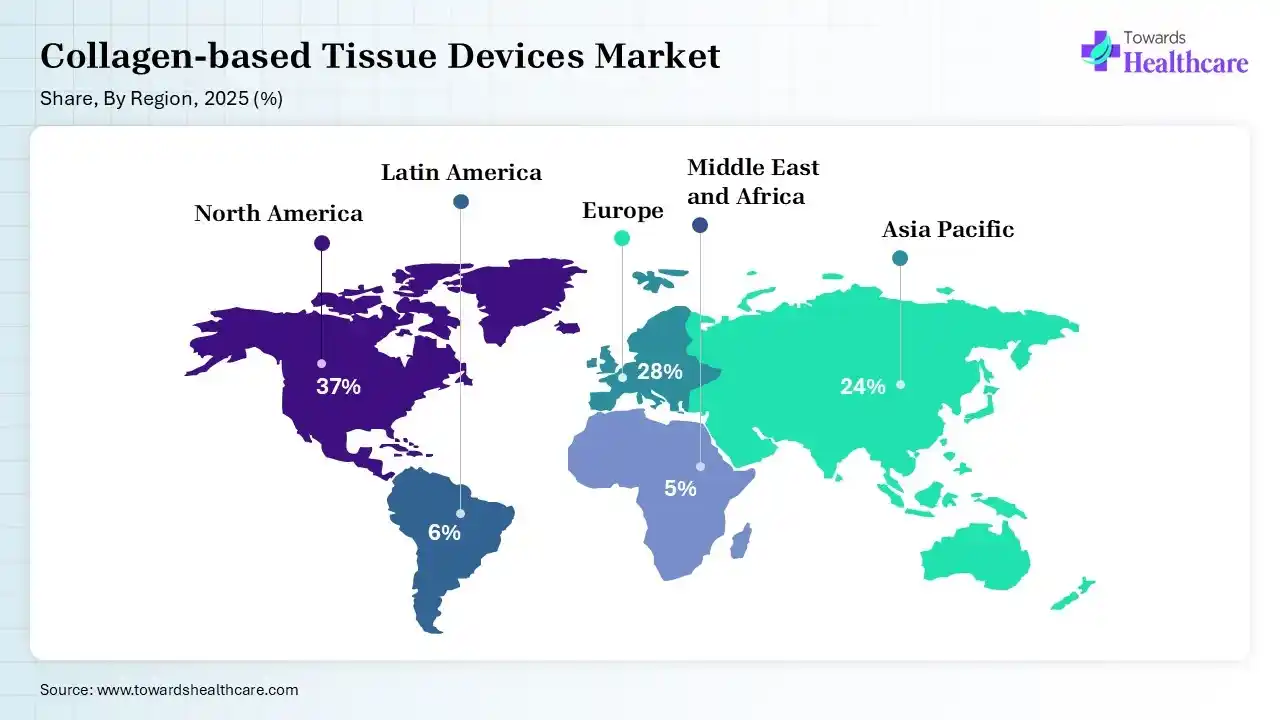
The regional insights table indicates that North America dominates the collagen-based tissue devices market with a 37.0% market share, supported by advanced healthcare infrastructure, high adoption of regenerative medicine, and strong demand for advanced wound-care and tissue-repair products. Asia-Pacific is the fastest-growing region, with a 13.5% CAGR, driven by expanding healthcare infrastructure, increasing healthcare spending, rising surgical procedures, and growing adoption of advanced tissue-regeneration technologies. Europe holds a 28.0% share, while Latin America and Middle East & Africa account for 6.0% and 5.0%, respectively.
Analyst View
North America has the largest healthcare base, supported by strong adoption of regenerative medicine and advanced reimbursement systems. Europe benefits from developed medical-device infrastructure and an aging population. Asia-Pacific offers strong growth potential due to its large population, improving healthcare access, rising demand for advanced treatments, and growing medical-device manufacturing capabilities.
| Country | Market Share | CAGR (%) |
| US | 31.80% | 9.10% |
| Canada | 3.70% | 10.20% |
| Mexico | 2.22% | 12.10% |
In above table U.S. dominates the collagen-based tissue devices market with a 31.8% market share, supported by its advanced healthcare infrastructure, high adoption of innovative medical devices, and strong demand for wound care and tissue-repair solutions. Mexico is the fastest-growing country, with a 12.1% CAGR, driven by improving healthcare infrastructure, increasing medical procedures, and growing adoption of advanced tissue-regeneration products. Canada holds a 3.7% market share and is growing at a 10.2% CAGR, supported by expanding healthcare services and demand for advanced medical technologies.
Analyst View:
The U.S. market offers strong opportunities for advanced collagen-based products due to its large chronic-wound patient base, high healthcare spending, developed wound-care infrastructure, and presence of medical-device companies. However, reimbursement and clinical evidence remain important factors. Products need to show clear clinical and economic benefits, such as faster wound healing, fewer complications, reduced procedures, or lower overall treatment costs.
|
Country
|
Market Share
|
CAGR (%)
|
|
Germany
|
5.60%
|
9.60%
|
|
UK
|
5.04%
|
10.10%
|
|
France
|
4.20%
|
9.80%
|
|
Italy
|
2.80%
|
10.20%
|
|
Spain
|
2.24%
|
10.60%
|
|
Netherlands
|
1.96%
|
11.10%
|
|
Switzerland
|
1.68%
|
10.90%
|
|
Rest of Europe
|
4.48%
|
10.50%
|
In the above table, Direct Sales dominates the collagen-based tissue devices market with a 48.0% market share, supported by direct relationships with hospitals, clinics, and healthcare providers, particularly for specialized medical devices. Online/E-commerce is the fastest-growing channel, with a 17.8% CAGR, driven by increasing digital procurement and easier access to products. Medical Device Distributors account for 27.0%, while Specialty Distributors hold 15.0% and are growing at 14.2%, supported by demand for specialized healthcare products. Government & Institutional Procurement represents 6.0% of the market and is growing at 10.1%.
Analyst View:
Europe offers strong growth potential for collagen-based tissue devices due to its aging population and increasing demand for wound care, orthopedic, and reconstructive treatments. Germany, the U.K., and France are key markets because of their large healthcare systems and well-developed specialist medical infrastructure.
|
Country
|
Market Share
|
CAGR (%)
|
|
China
|
8.64%
|
14.20%
|
|
Japan
|
4.80%
|
11.60%
|
|
India
|
4.80%
|
15.40%
|
|
South Korea
|
2.16%
|
13.90%
|
|
Australia
|
1.68%
|
11.90%
|
|
Rest of Asia-Pacific
|
2.64%
|
14.60%
|
In the above table, China dominates the Asia-Pacific collagen-based tissue devices market with an 8.64% market share, supported by its large healthcare base, expanding medical infrastructure, and growing adoption of advanced tissue-repair solutions. India is the fastest-growing country, with a 15.40% CAGR, driven by improving healthcare infrastructure, increasing surgical procedures, rising healthcare spending, and growing adoption of regenerative medicine and advanced tissue-engineering technologies.
Analyst View:
Asia-Pacific offers strong growth opportunities for collagen-based tissue devices. China benefits from its large population and growing medical-device industry, while Japan has an advanced healthcare system and an aging population. India is also expanding rapidly, supported by high market growth and increasing local manufacturing capabilities.
| Country | Market Share | CAGR (%) |
| Brazil | 2.88% | 10.40% |
| Mexico | 1.20% | 11.80% |
| Argentina | 0.60% | 9.70% |
| Colombia | 0.48% | 11.20% |
| Chile | 0.36% | 10.80% |
| Rest of Latin America | 0.48% | 10.70% |
In the above table, Brazil dominates the Latin American collagen-based tissue devices market with a 2.88% market share, supported by its large healthcare system, growing demand for advanced wound care, and increasing adoption of medical technologies. Mexico is the fastest-growing country, with an 11.80% CAGR, driven by improving healthcare infrastructure and rising demand for advanced treatment solutions. Colombia follows with an 11.20% CAGR, while Chile grows at 10.80%, the Rest of Latin America at 10.70%, and Argentina at 9.70%.
Analyst View:
Brazil offers the largest commercial opportunity due to its well-developed healthcare market, while Mexico benefits from its connection with North American healthcare and manufacturing networks. Distributor partnerships are expected to remain important as healthcare systems and market access differ across Latin American countries.
| Country | Market Share | CAGR (%) |
| Saudi Arabia | 1.25% | 11.70% |
| UAE | 1.00% | 12.30% |
| South Africa | 1.00% | 10.40% |
| Israel | 0.75% | 14.80% |
| Turkey | 0.50% | 11.50% |
| Rest of Middle East & Africa | 0.50% | 10.20% |
In the above table, Saudi Arabia dominates the Middle East & Africa collagen-based tissue devices market with a 1.25% market share, supported by healthcare infrastructure development, increasing healthcare investment, and growing demand for advanced medical technologies. Israel is the fastest-growing country, with a 14.80% CAGR, driven by its advanced healthcare system, strong medical research capabilities, and increasing adoption of innovative tissue-repair and regenerative medicine solutions. The UAE holds a 1.00% share and grows at 12.30% CAGR, while South Africa also accounts for 1.00% with a 10.40% CAGR. Turkey holds 0.50% with an 11.50% CAGR, and the Rest of the Middle East & Africa represents 0.50%, growing at 10.20% CAGR.
Analyst View:
Saudi Arabia and the UAE offer attractive opportunities for premium collagen-based devices due to healthcare modernization and growing investment in specialized hospitals. Israel shows the fastest growth, with a 14.8% CAGR, supported by its strong biotechnology and medical-technology sectors.
Wound management remains an important commercial application, supported by the high number of people requiring wound care and the significant healthcare costs associated with treatment. Diabetes is another major demand driver, as the number of people living with diabetes continues to rise globally, increasing the need for effective wound care and tissue-repair solutions.
Analyst View:
Products focused on diabetic foot ulcers, venous leg ulcers, pressure injuries, surgical wounds, and complex wounds offer strong market opportunities. Commercial growth increasingly depends on showing clear improvements in wound healing and overall treatment costs, rather than only demonstrating the biological benefits of collagen.
Animal-derived collagen continues to hold a dominant position in the market, but its use involves important regulatory and safety requirements. Regulatory guidance covers medical devices containing bovine and porcine materials, with a focus on pathogen risks, proper documentation, manufacturing controls, and premarket requirements. ISO 22442-1 also focuses on risk management for devices using animal tissues or derivatives, including bacterial, viral, TSE, immunological, and toxicological risks, while ISO 22442-2 covers the sourcing, collection, handling, storage, and transportation of animal tissues.
Analyst View:
Animal-source qualification is becoming increasingly important for collagen-based tissue devices. Suppliers with clear source traceability, controlled processing, validated pathogen and TSE risk management, and consistent product properties can build greater customer confidence and make the procurement process easier.
The FDA’s Quality Management System Regulation (QMSR) came into effect on February 2, 2026, bringing ISO 13485:2016 into the U.S. medical-device quality management framework.
Analyst View:
For collagen-device manufacturers, aligning with QMSR makes globally consistent quality systems more important. Companies operating in both the U.S. and Europe can reduce duplication in quality processes by maintaining a strong ISO 13485-based quality management system.
| Metric | 2023 | 2024 | 2025 |
| Total Revenue | US$1,541.6M | US$1,610.5M | US$1,635.2M |
| Tissue Technologies | US$482.6M | US$466.9M | US$434.7M |
| Wound Reconstruction & Care | US$374.0M | US$350.6M | US$323.5M |
| Private Label | US$108.6M | US$116.3M | US$111.2M |
| R&D Expense | US$104.2M | US$115.4M | US$99.0M |
The company’s total revenue increased from US$1,541.6 million in 2023 to US$1,635.2 million in 2025, showing overall business growth. However, Tissue Technologies revenue declined from US$482.6 million to US$434.7 million during the same period. Within this segment, Wound Reconstruction & Care revenue decreased from US$374.0 million in 2023 to US$323.5 million in 2025, while Private Label revenue remained relatively stable, increasing from US$108.6 million to US$111.2 million. R&D expenses increased from US$104.2 million in 2023 to US$115.4 million in 2024 before declining to US$99.0 million in 2025, indicating continued investment in research and product development despite the lower spending in 2025.
Analyst View:
Integra is an important competitor in the collagen-based tissue devices market due to its strong background in collagen technology and its Tissue Technologies portfolio. Its key strengths include a wide surgical distribution network, established clinical products, biomaterial processing capabilities, and a strong hospital customer base. However, the decline in Tissue Technologies revenue in 2025 shows that having collagen and biologic tissue products alone does not guarantee market growth. Factors such as reimbursement, manufacturing consistency, clinical demand, and product portfolio mix also play an important role.
| Metric | 2023 | 2024 | 2025 |
| Net product revenue | US$433.1M | US$482.0M | US$563.0M |
| Total revenue | US$433.1M | US$482.0M | US$564.2M |
Organogenesis shows the shift from basic collagen dressings toward advanced multifunctional products, such as collagen combined with antimicrobial technology. The 170-patient clinical trial is important because stronger clinical evidence can support wider adoption and reimbursement. Overall, competition is increasingly focused on clinical evidence, reimbursement, and product functionality rather than collagen composition alone.
Analyst View:
Organogenesis shows the shift from basic collagen dressings toward advanced multifunctional products, such as collagen combined with antimicrobial technology. The 170-patient clinical trial is important because stronger clinical evidence can support wider adoption and reimbursement. Overall, competition is increasingly focused on clinical evidence, reimbursement, and product functionality rather than collagen composition alone.
| Business | 2023 | 2024 | 2025 |
| Advanced Wound Management | US$1,606M | US$1,681M | US$1,793M |
| Advanced Wound Care | US$725M | US$735M | US$766M |
| Advanced Wound Bioactive | US$553M | US$735M | US$621M |
| Advanced Wound Devices | US$328M | US$735M | US$406M |
Smith+Nephew’s Advanced Wound Management business grew from US$1,606 million in 2023 to US$1,793 million in 2025, showing steady growth. Within this segment, Advanced Wound Care revenue increased from US$725 million to US$766 million, while Advanced Wound Bioactives grew from US$553 million to US$621 million. Advanced Wound Devices recorded the strongest increase, rising from US$328 million in 2023 to US$406 million in 2025, indicating growing demand for advanced wound-treatment technologies
Analyst View:
Smith+Nephew shows the advantage of combining biologic matrices with a broader wound-management portfolio. Its competitive strength comes from offering wound-care products, biologics, devices, and an established commercial network rather than relying only on collagen or ECM materials. The US$1.793 billion Advanced Wound Management revenue should therefore be viewed as a broader competitive benchmark, not as collagen-device revenue alone.
| Category | 2023 | 2024 | 2025 |
| Wound | US$205.7M | US$231.0M | US$276.3M |
| Surgical | US$115.8M | US$117.9M | US$142.3M |
| Total | US$321.5M | US$348.9M | US$418.6M |
The company’s total revenue increased from US$321.5 million in 2023 to US$418.6 million in 2025, showing strong overall growth. The Wound business remained the largest contributor, rising from US$205.7 million to US$276.3 million during the period. The Surgical business also grew from US$115.8 million in 2023 to US$142.3 million in 2025. Overall, both business segments contributed to the company’s revenue growth, with the Wound segment showing the larger increase.
Analyst View:
MiMedx highlights the competition from human tissue-derived regenerative products, which can be used as alternatives to collagen-based matrices in wound care and surgical applications. Therefore, competition in this market includes not only collagen manufacturers but also broader companies offering biologic wound-healing solutions.
| Indicator | 2025 |
| Net sales | US$8.232B |
| R&D expense | US$458.5M |
| Employees | ~17,000 |
| R&D employees | ~2,000 |
| Manufacturing employees | ~6,000 |
| Patents/patent applications controlled | 6,000+ |
The company reported net sales of US$8.232 billion in 2025, reflecting its strong overall commercial scale. It invested US$458.5 million in R&D, supported by around 2,000 R&D employees, highlighting continued focus on product development and innovation. The company employed approximately 17,000 people, including around 6,000 manufacturing employees, indicating significant production capabilities. It also controlled more than 6,000 patents and patent applications, demonstrating a broad intellectual property portfolio that supports its technologies and product development.
Analyst View:
Zimmer Biomet is strategically relevant due to its strong presence in orthopedic tissue repair and regeneration. Its large orthopedic business, manufacturing capabilities, and R&D expertise provide opportunities to develop and commercialize advanced biomaterial technologies.
The company’s scale also highlights the growing importance of OEM partnerships, licensing, and co-development for collagen-device manufacturers, rather than relying only on standalone product commercialization.
| Metric | 2025 |
| Total net sales | US$25.116B |
| Orthopaedics | US$9.469B |
| MedSurg & Neurotechnology | US$15.647B |
| R&D/engineering | US$1.623B |
The company reported total net sales of US$25.116 billion in 2025, highlighting its strong overall business scale. The MedSurg & Neurotechnology segment generated US$15.647 billion, making it the larger contributor to sales, while Orthopaedics generated US$9.469 billion, reflecting its significant presence in the orthopedic market. The company also invested US$1.623 billion in R&D and engineering, demonstrating a strong focus on product development, medical technologies, and innovation across its business segments.
Analyst View:
Stryker is strategically relevant due to its strong presence in orthopedic repair, surgical procedures, and established hospital relationships. Large orthopedic companies can support the adoption of collagen-based devices by integrating biomaterials into broader surgical and procedure-based solutions.
Kerecis represents an important alternative collagen source based on fish skin. Coloplast’s investor materials reported that Kerecis had around 50 clinical studies, including the Odinn randomized controlled trial involving 255 patients across 15 care centers in four countries. The company also projected around 30% three-year CAGR through 2025/26.
Earlier investor materials reported Kerecis revenue of DKK 510 million in FY2021/22, with approximately 98% of sales coming from the U.S. At that time, Kerecis had around 500 employees and had treated more than 20,000 patients globally.
Analyst View:
Kerecis highlights the growing opportunity for marine collagen and fish-derived biologic alternatives in the market. Its approach also shows how the choice of collagen source can become a key market differentiator. Fish-derived technologies can attract customers looking for alternatives to mammalian tissues while offering a distinct clinical and product development approach.
| Company | Relevant Position | Key Technology / Portfolio Exposure | Publicly Reported Scale Indicator |
| Integra LifeSciences | Tissue reconstruction, wound care | Engineered collagen, bovine collagen products, tissue matrices | Tissue Technologies revenue: US$434.7M in 2025 |
| Organogenesis | Advanced wound care, surgical/sports medicine | Native porcine collagen, PuraPly platform | Total revenue: US$564.2M in 2025 |
| Smith+Nephew | Advanced wound management | Porcine SIS/ECM, wound biologics and devices | AWM revenue: US$1.793B in 2025 |
| MiMedx | Wound and surgical biologics | Human tissue-derived regenerative products | Revenue: US$418.6M in 2025 |
| Zimmer Biomet | Orthopedics | Broad orthopedic and biologic ecosystem | Revenue: US$8.232B in 2025 |
| Stryker | Orthopedics / MedSurg | Broad surgical and orthopedic ecosystem | Revenue: US$25.116B in 2025 |
| Kerecis / Coloplast | Advanced wound care | Fish-skin technology | Kerecis projected ~30% 3-year CAGR in prior investor guidance |
The above table includes companies with different areas of expertise across collagen-based tissue devices, wound care, biologics, and orthopedic applications. Integra LifeSciences focuses on tissue reconstruction and wound care, while Organogenesis and Smith+Nephew have strong positions in advanced wound-care products and biologics. MiMedx competes through human tissue-derived regenerative products. Zimmer Biomet and Stryker have broader orthopedic and surgical portfolios that provide opportunities to integrate biomaterial technologies. Kerecis, part of Coloplast, represents a fish-skin-based approach in advanced wound care and highlights the potential of marine-derived technologies. The reported revenue and growth figures show the different scales and growth profiles of these companies across the broader regenerative medicine and tissue-repair market.
Analyst View:
Competition in the collagen-based tissue devices market is developing across five key areas:
The major competitive threat to pure-play collagen companies may come not only from other collagen suppliers but also from alternative extracellular-matrix and biologic technologies that can demonstrate better clinical results or economic benefits.
| Company | Product / Platform | Collagen / ECM Characteristic | Relevant Application |
| Organogenesis | PuraPly AM | Purified native porcine Type I collagen + PHMB | Chronic/acute wounds |
| Organogenesis | PuraPly MZ | Purified micronized porcine collagen | Deep/complex wounds |
| Organogenesis | PuraPly SX | Four-layer native crosslinked ECM + PHMB | Surgical wounds |
| Smith+Nephew | OASIS Matrix | Porcine SIS/ECM | Chronic/acute wounds, burns |
| Integra | PriMatrix | Bovine-derived collagen | Dermal/wound repair |
| Integra | DuraGen | Collagen matrix | Dural repair |
The market includes a range of collagen and extracellular-matrix (ECM) products designed for different tissue-repair and wound-care applications. Organogenesis offers PuraPly AM, PuraPly MZ, and PuraPly SX, using different forms of porcine collagen and ECM technologies for chronic, acute, deep, complex, and surgical wounds. Smith+Nephew’s OASIS Matrix uses porcine SIS/ECM for wound care and burn treatment. Integra provides bovine-derived collagen products such as PriMatrix for dermal and wound repair and DuraGen for dural repair. Kerecis uses marine-derived fish-skin technology for wound-care applications, providing an alternative to mammalian-derived tissue products.
Analyst View:
Technology development in the collagen-based tissue devices market is increasingly focused on multifunctional products. New-generation products are expected to offer more than basic collagen-based support and may include antimicrobial activity, MMP/protease control, controlled degradation, micronized delivery, injectable formulations, multilayer structures, improved cellular infiltration, vascularization, 3D bioprinting, drug or cell delivery, and personalized tissue regeneration.
| Buyer Group | Primary Requirements | Key Procurement Driver |
| Hospitals | Clinical efficacy, safety, reimbursement, supply reliability | Patient outcomes and total cost of care |
| Academic Medical Centers | Clinical evidence, innovation, research collaboration | Technology differentiation |
| ASCs | Ease of use, procedure time, inventory efficiency | Lower procedure cost and faster workflows |
| Wound Care Clinics | Healing outcomes, reimbursement, application ease | Wound closure and cost-effectiveness |
| Orthopedic Clinics | Mechanical properties, integration, clinical evidence | Functional repair |
| Dental Clinics | Handling, resorption profile, membrane strength | Procedure efficiency |
| Ophthalmology Clinics | Biocompatibility, optical properties, sterility | Safety and tissue regeneration |
| Government Buyers | Price, compliance, supply reliability | Tender economics |
| Distributors | Margin, shelf life, training requirements | Commercial turnover |
The above table indicates that different buyer groups have different requirements when purchasing collagen-based tissue devices. Hospitals mainly focus on clinical effectiveness, safety, reimbursement, and reliable supply, while academic medical centers prioritize clinical evidence, innovation, and research collaboration. ASCs look for easy-to-use products, shorter procedure times, and efficient inventory management. Wound care clinics focus on healing outcomes, reimbursement, and ease of application, whereas orthopedic clinics require strong mechanical properties, tissue integration, and clinical evidence. Dental and ophthalmology clinics have more application-specific needs, such as membrane strength, resorption, biocompatibility, sterility, and tissue regeneration. Government buyers mainly consider price, compliance, and supply reliability, while distributors focus on margins, shelf life, training needs, and product turnover.
| Buying Criterion | Commercial Importance |
| Clinical efficacy | Very High |
| Regulatory clearance/approval | Very High |
| Safety and biocompatibility | Very High |
| Sterilization validation | Very High |
| Source traceability | Very High for animal-derived products |
| Reimbursement eligibility | Very High |
| Price / procedure economics | High |
| Shelf life | High |
| Ease of handling | High |
| Storage requirements | High |
| Product consistency | High |
| Evidence of wound closure / tissue integration | Very High |
| Surgeon familiarity | High |
| Distribution reliability | High |
| Customization | Increasing |
| Sustainability | Increasing |
Above table shows that purchasing decisions for collagen-based tissue devices are mainly influenced by clinical efficacy, regulatory approval, safety, biocompatibility, sterilization, reimbursement eligibility, and evidence of wound closure or tissue integration. Source traceability is particularly important for animal-derived products. Other factors such as price, shelf life, ease of handling, storage requirements, product consistency, surgeon familiarity, and distribution reliability also have high commercial importance. In addition, customization and sustainability are becoming increasingly important as healthcare providers look for more application-specific and efficient tissue-repair solutions.
FDA guidance emphasizes safe and consistent manufacturing of animal-derived medical devices, along with proper documentation of animal-material controls and measures to reduce pathogen-related risks. ISO 22442 also covers the sourcing, collection, handling, and processing of animal-derived materials, with controls to manage risks associated with transmissible agents. These requirements make source traceability, quality control, and risk management important considerations for companies developing and commercializing animal-derived collagen devices.
Analyst View:
The buying decision is increasingly focused on the overall clinical outcome rather than the collagen material alone. The key value proposition is based on clinical evidence, consistent product performance, reimbursement support, and lower overall treatment costs. For hospitals, factors such as faster healing, fewer complications, and reduced use of healthcare resources can strongly influence purchasing decisions. Specialty clinics may place more importance on ease of application, product availability, and reimbursement support. For procurement teams, source traceability, regulatory documentation, product consistency, and reliable supply are becoming essential requirements for product qualification.
| Opportunity | Market Signal | Commercial Potential | Key Barrier |
| Recombinant collagen | 19.60% provided CAGR | Very High | Cost and scale |
| 3D-printed constructs | 18.2% provided CAGR | Very High | Clinical/regulatory translation |
| Ophthalmic regeneration | 16.5% provided CAGR | High | Clinical evidence |
| Specialty tissue-engineering centers | 16.2% provided CAGR | High | Limited current volume |
| Hydrogels | 15.7% provided CAGR | Very High | Manufacturing/crosslinking |
| Type I/III blends | 15.3% provided CAGR | High | Product standardization |
| India | 15.40% provided CAGR | Very High | Reimbursement/access fragmentation |
| Marine collagen | 13.80% provided CAGR | High | Scale and regulatory qualification |
| Cardiovascular tissue devices | 12.60% provided CAGR | High | Long development cycles |
The table shows that several emerging areas offer strong commercial opportunities based on their provided growth rates. Recombinant collagen and 3D-printed constructs have very high potential, although cost, manufacturing scale, and clinical or regulatory requirements remain key challenges. Ophthalmic regeneration, specialty tissue-engineering centers, hydrogels, and Type I/III collagen blends also offer attractive opportunities, supported by their higher growth rates and expanding applications. India represents a high-potential market, although differences in reimbursement and healthcare access may affect adoption. Marine collagen provides an alternative source with good growth potential, while cardiovascular tissue devices offer opportunities despite longer product-development and clinical timelines.
Analyst View:
The most promising opportunities are emerging in areas that combine strong growth with advanced technology. Recombinant collagen, hydrogels, and 3D-printed constructs have significant potential to drive the market toward more advanced, differentiated, and higher-value tissue-repair products.
| Risk | Impact | Explanation |
| Reimbursement restrictions | High | Premium biologic products require evidence of economic value. |
| Clinical evidence requirements | High | Novel regenerative products require more robust validation. |
| Animal-source risks | High | Pathogen/TSE and traceability requirements increase manufacturing complexity. |
| Raw-material variability | High | Biological-source variation can affect product consistency. |
| Alternative biomaterials | High | Synthetic, ECM, placental and other biologics compete with collagen. |
| Manufacturing complexity | Medium–High | Sterilization and preservation can affect collagen structure. |
| Regulatory changes | Medium–High | U.S./EU requirements continue to evolve. |
| Procurement price pressure | High | Hospitals increasingly emphasize value-based purchasing. |
| Supply-chain disruption | Medium | Animal and marine sourcing can create geographic dependencies. |
| Limited awareness of novel applications | Medium | Emerging products require clinician education. |
The table shows that the collagen-based tissue devices market faces several commercial, clinical, regulatory, and supply-chain risks. Reimbursement restrictions are a major concern because premium biologic products need to demonstrate clear economic value. Novel regenerative products also require strong clinical evidence before wider adoption. Animal-derived materials involve pathogen, TSE, and traceability requirements, while variation in biological raw materials can affect product consistency. Competition from synthetic biomaterials, ECM products, placental materials, and other biologics can further impact market growth. Manufacturing can also become complex due to sterilization and preservation processes that may affect collagen properties. In addition, changing U.S. and European regulations, hospital price pressure, supply-chain dependencies, and limited awareness of newer applications may create further challenges for market expansion.
Analyst View:
The biggest long-term risk is that conventional collagen products may become more commoditized and compete mainly on price. In such a scenario, established manufacturers with larger production capabilities and economies of scale may have a competitive advantage.
Based on my assessment, the collagen-based tissue devices market is expected to expand due to rising demand for advanced wound care and tissue-repair solutions. Growing interest in regenerative medicine, tissue engineering, and biomaterial-based therapies will support market development. I also anticipate that recombinant collagen, marine collagen, hydrogels, and 3D-printed constructs will drive product innovation. Increasing adoption of personalized tissue regeneration and minimally invasive repair solutions is also expected to create new opportunities across the market.
Payal Rabde, Senior Research Analyst, led the primary market research, developed the methodology, analysed trends, segmentation, competition, forecasts, and strategic opportunities, forming the report's analytical foundation.
Aman Singh, senior researcher, was responsible for collecting and validating clinical trial data, research publications, company information, partnerships, and other quantitative datasets, strengthening evidence-based analysis and market estimations.
Aditi Shivarkar, senior researcher, reviewed the complete research document, performed quality checks, validated findings, refined content, corrected inconsistencies, and finalized the report, ensuring accuracy, clarity, credibility, and publication-ready quality.
By Product/Device Type
By Material Form
By Collagen
By Collagen Type
By Application
By End User
By Distribution Channel
By Region



Principal Consultant
Payal Rabde is a Healthcare Market Research Analyst at Towards Healthcare Research & Consulting with 4+ years of experience in pharmaceuticals, biotechnology, medical devices, and life sciences.
Learn more about Payal Rabde

Reviewed By
Aditi Shivarkar is a seasoned professional with over 14 years of experience in healthcare market research. As a content reviewer, Aditi ensures the quality and accuracy of all market insights and data presented by the research team.
Learn more about Aditi Shivarkar