
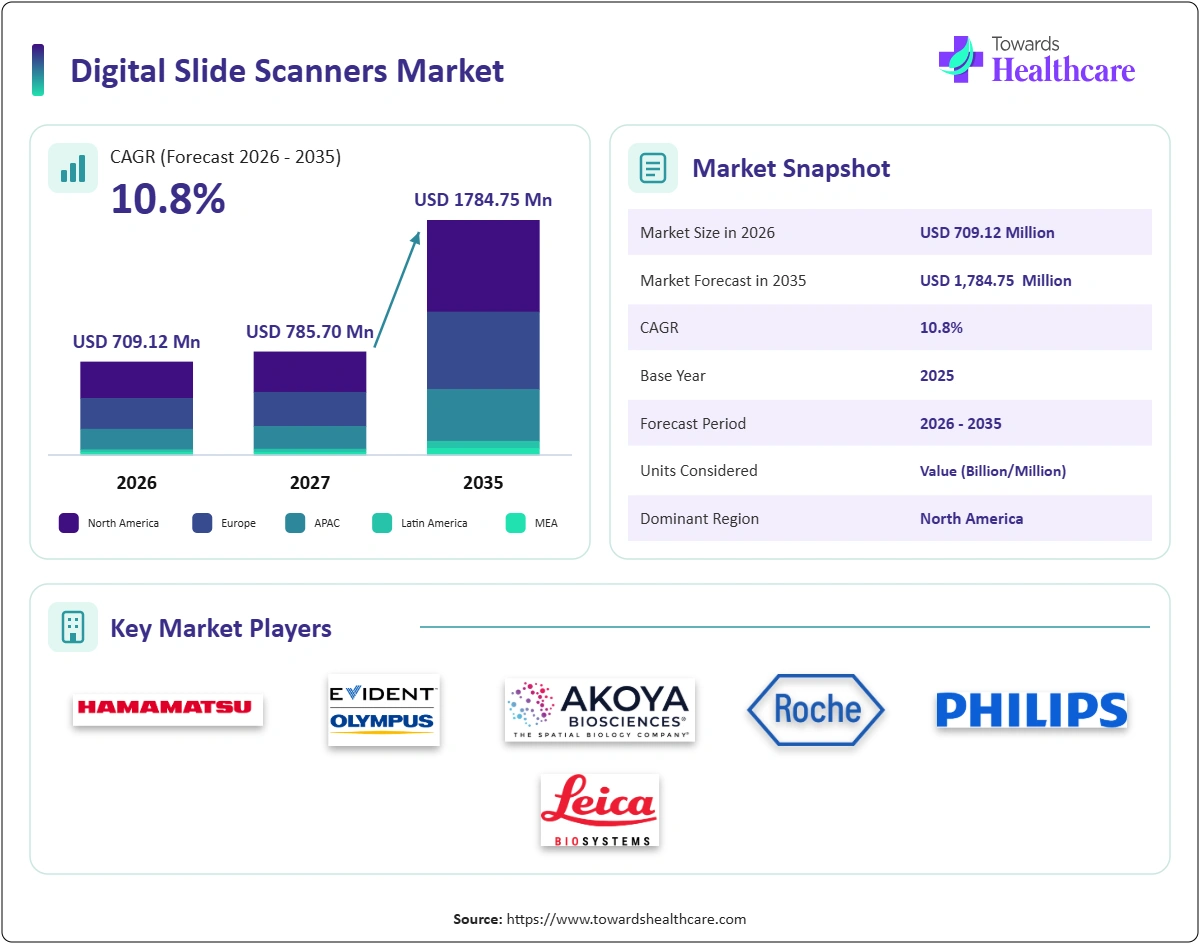
The market is projected to grow from USD 640.00 million in 2025 to USD 1,784.75 million by 2035 because pathology labs are digitizing to cope with pathologist shortages and to use AI, and every digital workflow starts with a slide scanner. Pathologist shortages, AI adoption, lab consolidation and precision oncology support strong growth, lifting the market to USD 1,068.76 million by 2030 and sustaining a CAGR of 10.80% during the forecast period. Slide scanners are the digital successors of the microscope and complement life science microscopes in research labs.
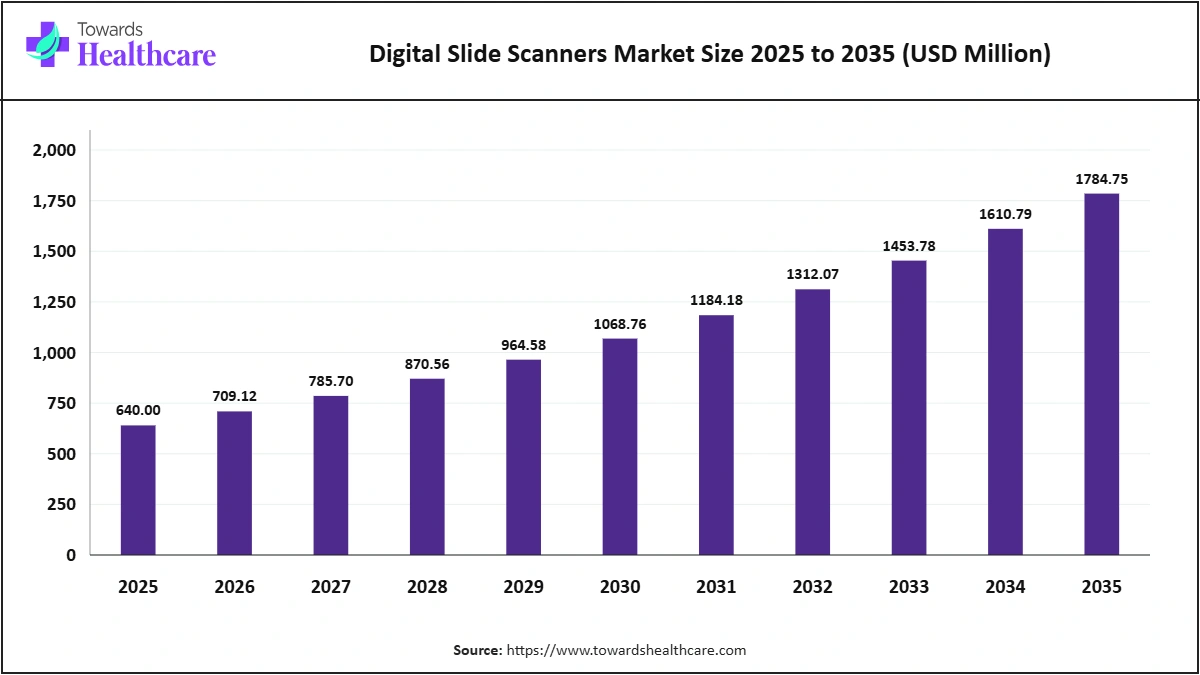
Analyst View: We built the estimate from scanner installations by throughput and region and average system prices, cross-checked against digital pathology revenues of leading suppliers. Our value sits just above published comparable estimates.
| Driver | Impact | ≈ CAGR Contribution | Time Horizon | Key Regions |
| Pathologist shortages | High | +4.22 pp | Short to long term | Global, strongest in North America |
| AI pathology tools need digital slides | Medium | +3.56 pp | Medium to long term | Global, fastest uptake in Asia Pacific |
| Lab consolidation | Medium | +3.03 pp | Short to medium term | Global |
| Telepathology | Low | +2.37 pp | Long term | Developed and emerging markets |
Note: Contributions are indicative estimates of each factor's effect on annual growth.
Sources: Expert interviews, secondary sources, Towards Healthcare database and Towards Healthcare analysts.
Taken together, these drivers add about 13.18 percentage points to the annual growth of the digital slide scanners market, with pathologist shortages having the largest effect. Their influence is strongest in North America, while uptake grows fastest in Asia Pacific.
| Restraint | Impact | ≈ Negative CAGR Contribution | Time Horizon | Key Regions |
| High upfront cost | High | -1.07 pp | Short to medium term | Global |
| Storage and IT burden | High | -0.78 pp | Medium term | Price-sensitive and emerging markets |
| Workflow change | Medium | -0.52 pp | Short term | North America and other mature markets |
Note: Contributions are indicative estimates of each factor's effect on annual growth.
Sources: Expert interviews, secondary sources, Towards Healthcare database and Towards Healthcare analysts.
These restraints are expected to reduce annual growth of the digital slide scanners market by about 2.38 percentage points, led by high upfront cost. Their effect eases over the forecast period as suppliers, buyers and regulators adapt, leaving a net CAGR of 10.80% from 2026 to 2035.
Compact benchtop scanners provide growth potential as improve accessibility of digital pathology to small laboratories. Digital pathology is being increasingly adopted in Asia, which presents an opportunity for scanner manufacturers. The demand for spatial biology is increasing, which fuels the need for advanced digital slide scanning and imaging capabilities. Cloud-based services offer opportunities for remote slide access, storage, and collaboration among laboratories. The increasing number of AI-ready labs creates demand for high-resolution digital slide scanners that are compatible with automated image analysis.
Note: 2025 is the base year; 2035 shares and CAGRs are forecasts.
Sources: Expert interviews, secondary sources, Towards Healthcare database and Towards Healthcare analysts.
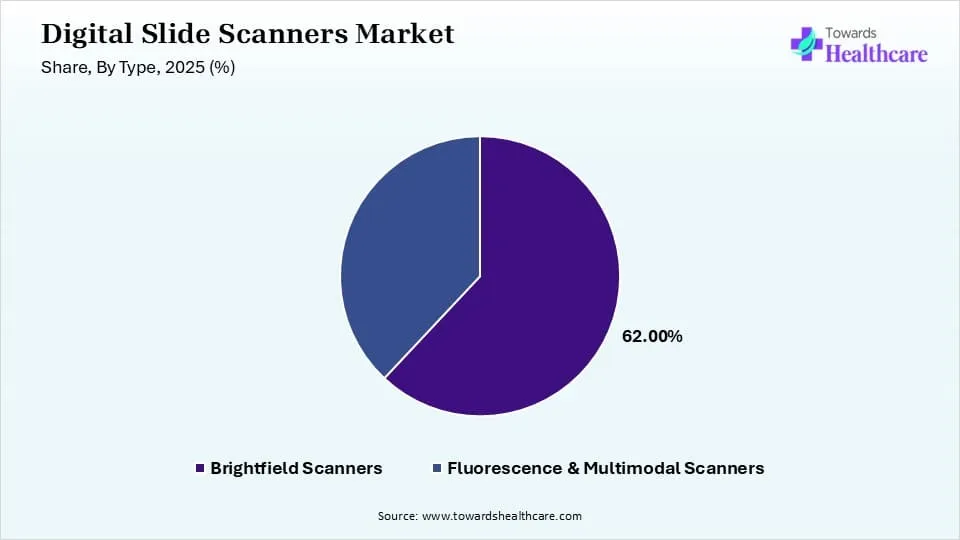
Brightfield Scanners held 62.00% of the market in 2025 and is projected to expand at a CAGR of 10.17% during the forecast period. Brightfield scanners lead because routine H&E and IHC slides are imaged in brightfield. The brightfield scanners segment is expected to grow slower than the overall market between 2026 and 2035.
Fluorescence & Multimodal Scanners grow fastest, with multiplex imaging in research and oncology. This segment is expected to grow faster than the market over the forecast period.
Segment Outlook: Brightfield Scanners remains the largest type segment through 2035, holding about 58.55% of the market in 2035, while Fluorescence & Multimodal Scanners records the highest CAGR of 11.77% from 2026 to 2035. Although Fluorescence & Multimodal Scanners starts from the smallest base, its faster growth shows how demand is shifting within the digital slide scanners market.
Note: 2025 is the base year; 2035 shares and CAGRs are forecasts.
Sources: Expert interviews, secondary sources, Towards Healthcare database and Towards Healthcare analysts.
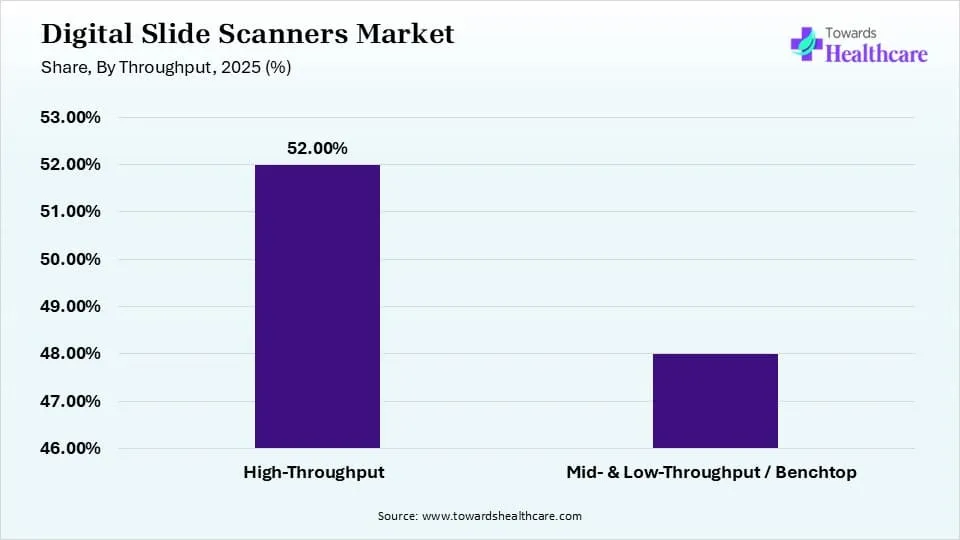
High-Throughput captured 52.00% of the market in 2025 and is projected to expand at a CAGR of 10.11% during the forecast period. High-throughput scanners lead because large labs digitize hundreds of slides a day. The high-throughput segment is expected to grow slower than the overall market over the forecast period.
Mid- & Low-Throughput / Benchtop scanners grow fastest in smaller labs and frozen section workflows. The mid- & low-throughput / benchtop segment is expected to grow faster than the market from 2026 to 2035.
Segment Outlook: High-Throughput remains the largest throughput segment through 2035, holding about 48.84% of the market in 2035, while Mid- & Low-Throughput / Benchtop records the highest CAGR of 11.51% from 2026 to 2035. Although Mid- & Low-Throughput / Benchtop starts from the smallest base, its faster growth shows how demand is shifting within the market.
Note: 2025 is the base year; 2035 shares and CAGRs are forecasts.
Sources: Expert interviews, secondary sources, Towards Healthcare database and Towards Healthcare analysts.
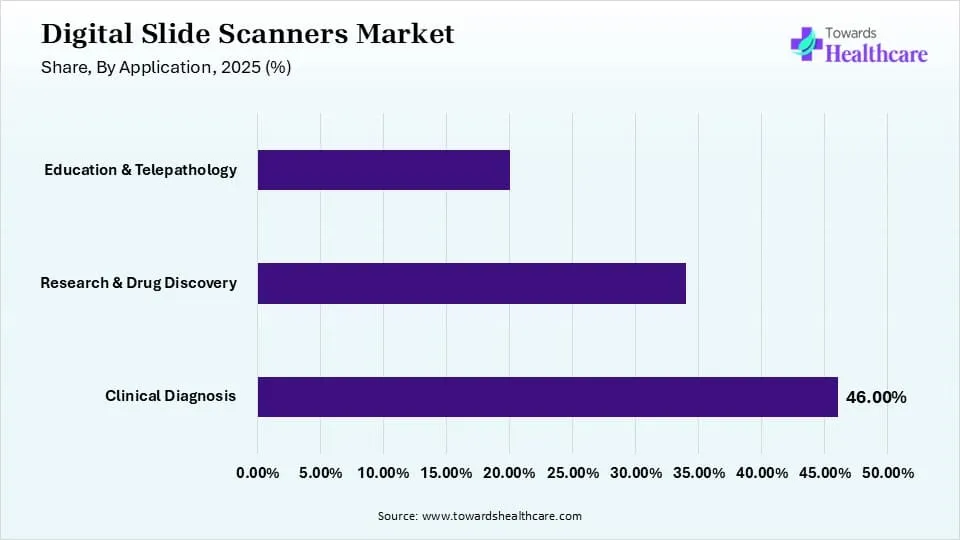
Clinical Diagnosis captured 46.00% of the market in 2025 and is projected to grow at a CAGR of 11.33% from 2026 to 2035. Clinical diagnosis leads and grows fastest as labs adopt FDA-cleared primary diagnosis systems. This segment is expected to grow faster than the overall market over the forecast period.
Research & Drug Discovery use scanners for biomarker and toxicology studies. This segment is expected to grow at a slower rate than the overall market between 2026 and 2035.
Education & Telepathology share slides remotely. This segment is expected to grow slower than the overall market over the forecast period.
Segment Outlook: Clinical Diagnosis remains the largest application segment through 2035, holding about 48.25% of the market in 2035, and also records the highest CAGR of 11.33% from 2026 to 2035, strengthening its lead in the market.
Note: 2025 is the base year; 2035 shares and CAGRs are forecasts.
Sources: Expert interviews, secondary sources, Towards Healthcare database and Towards Healthcare analysts.
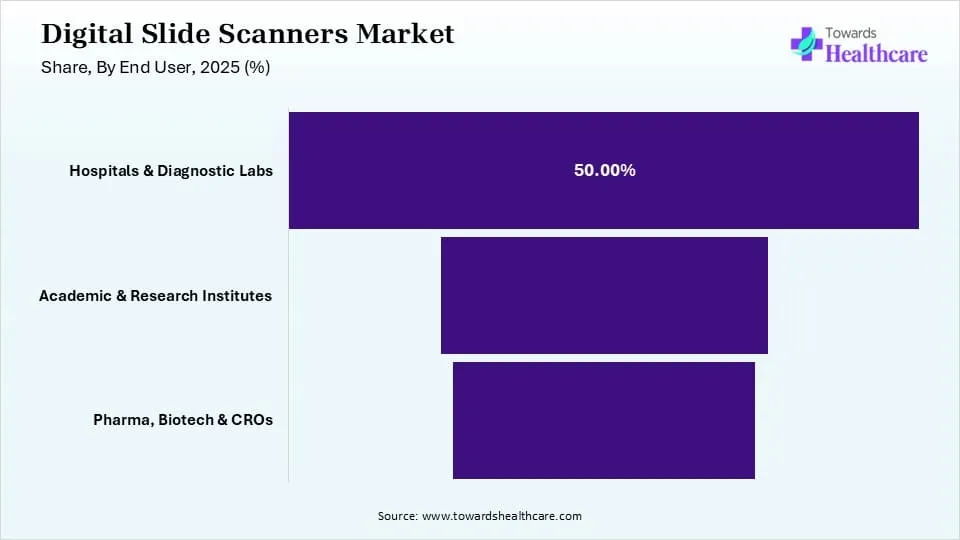
Hospitals & Diagnostic Labs captured a 50.00% share in 2025 and is projected to grow at a CAGR of 11.19% from 2026 to 2035. Hospitals and diagnostic labs lead because pathology departments are going digital. This segment is expected to grow faster than the overall market over the forecast period.
Academic & Research Institutes use scanners for research and teaching. This segment is expected to grow slower than the overall market between 2026 and 2035.
Pharma, Biotech & CROs grow with digital biomarker work. This segment is expected to grow at a slower rate than the market over the forecast period.
Segment Outlook: Hospitals & Diagnostic Labs remains the largest end user segment through 2035, holding about 51.80% of the market in 2035, and also records the highest CAGR of 11.19% from 2026 to 2035, strengthening its lead in the digital slide scanners market.
Analyst View: Segment shares were allocated from demand, product portfolios and pricing in each category. Brightfield Scanners, High-Throughput, Clinical Diagnosis and Hospitals & Diagnostic Labs lead their categories because they meet the core needs of today's buyers. We expect Fluorescence & Multimodal Scanners and Mid- & Low-Throughput / Benchtop to gain share as newer technologies, users and applications grow faster.
Note: 2025 is the base year; 2035 shares and CAGRs are forecasts.
Sources: Expert interviews, secondary sources, Towards Healthcare database and Towards Healthcare analysts.
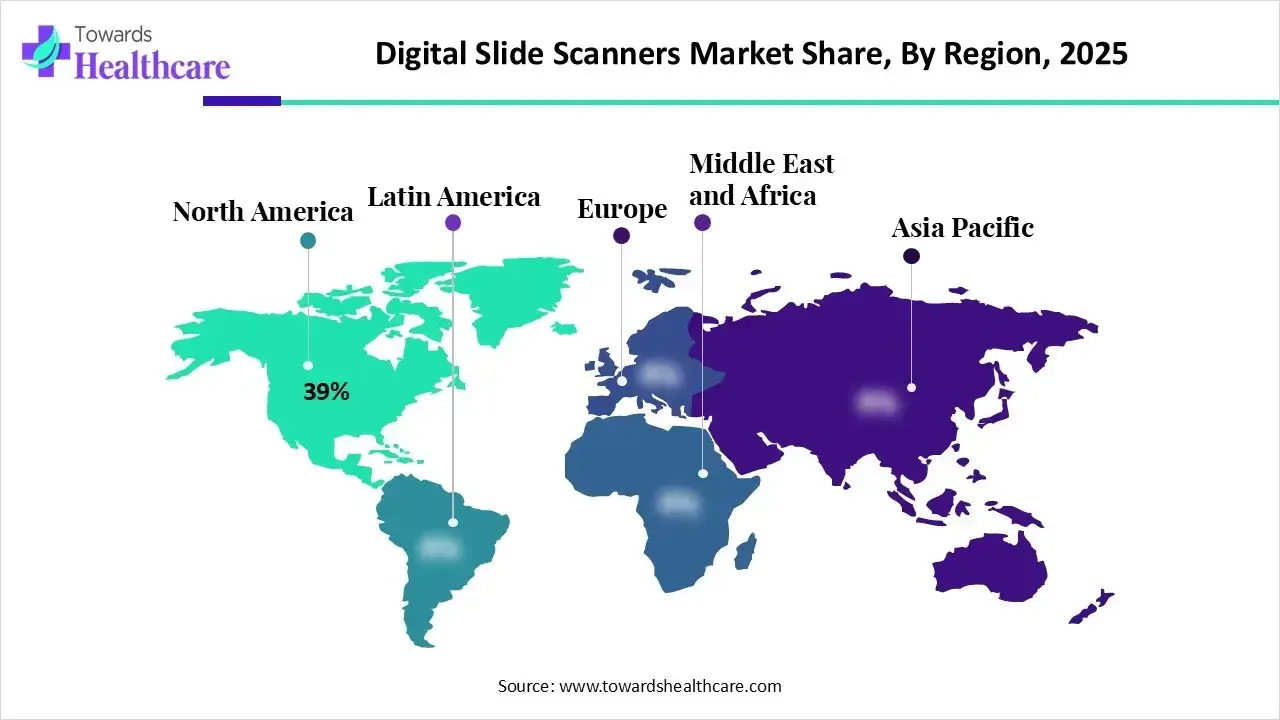
North America captured 39.00% of the market in 2025 and is projected to expand at a CAGR of 10.28% during the forecast period. North America leads because of FDA-cleared primary diagnosis systems, large lab networks and AI pathology adoption. North America is expected to grow slower than the overall market between 2026 and 2035.
Europe is an early adopter with national digital pathology programmes in the UK, Netherlands and Nordics. Europe is expected to grow broadly in line with the overall market over the forecast period.
Asia Pacific grows fastest with pathologist shortages and investment in China, Japan, India and Australia. Asia Pacific is expected to grow at a faster rate than the market between 2026 and 2035.
Latin America is starting digitization. This region is expected to grow broadly in line with the overall market throughout the forecast period.
Middle East & Africa is experiencing expansion of digital labs ecosystem. This region is expected to grow broadly in line with the market between 2026 and 2035.
Analyst View: Regional shares were built from demand, installed base, spending and supplier presence in each region. North America leads because of its mature demand base and strong suppliers. We assign Asia Pacific the highest growth premium because investment, adoption and capacity are expanding fastest there.
| Rank | Company Name | 2025 Share (%) | Key Products / Business | Headquarters |
| 1 | Leica Biosystems (Danaher) | 3.12% | Aperio GT 450 and GT 450 DX scanners | Germany |
| 2 | Hamamatsu Photonics | 2.34% | NanoZoomer scanners | Japan |
| 3 | Philips | 1.88% | IntelliSite Pathology Solution | Netherlands |
| 4 | Roche Diagnostics | 1.56% | VENTANA DP 200 and DP 600 scanners | Switzerland |
| 5 | 3DHISTECH | 1.25% | PANNORAMIC scanners | Hungary |
| 6 | Zeiss | 0.78% | Axioscan slide scanners | Germany |
| 7 | Akoya Biosciences | 0.62% | PhenoImager spatial imaging | United States |
| 8 | Evident (Olympus) | 0.62% | VS200 research slide scanner | Japan |
| 9 | Grundium | 0.47% | Ocus compact scanners | Finland |
| 10 | OptraSCAN | 0.31% | Digital pathology scanners | United States |
Note: Company shares are 2025 estimates.
Sources: Company press releases, expert interviews, secondary sources, Towards Healthcare database and Towards Healthcare analysts.
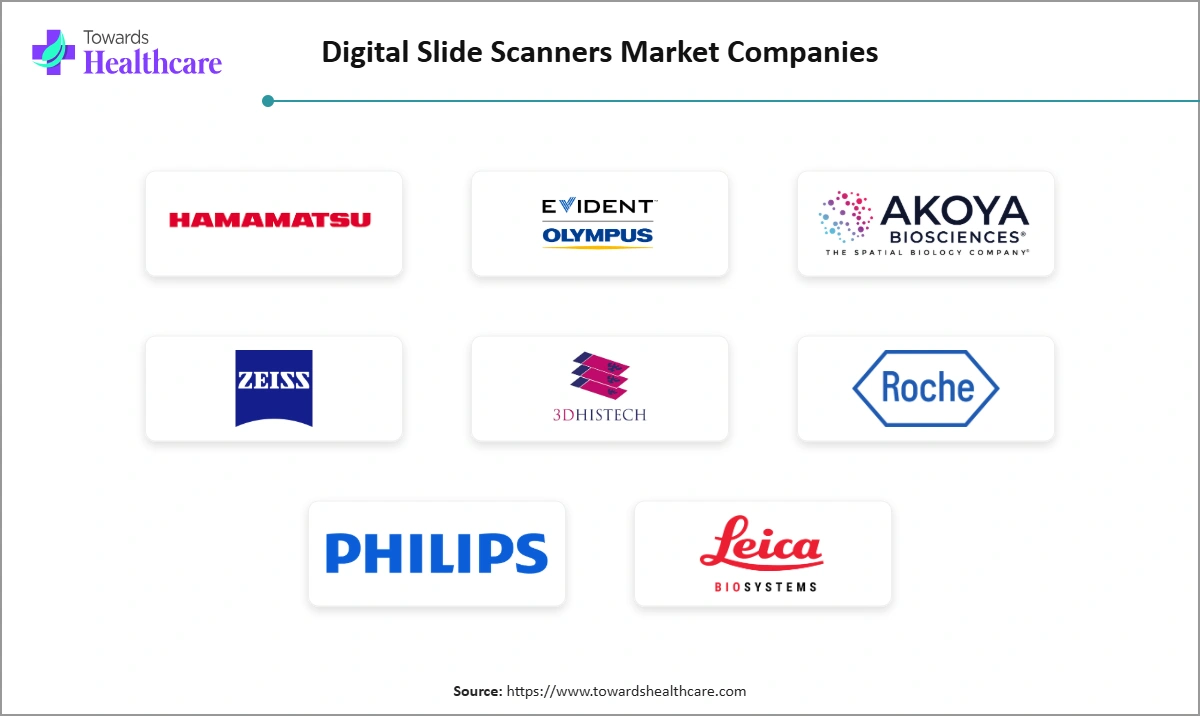
Leica Biosystems (Danaher) led the market with a 3.12% share in 2025, followed by Hamamatsu Photonics at 2.34% share and Philips at 1.88% share. Leica Biosystems (Danaher) leads with aperio GT 450 and GT 450 DX scanners, Hamamatsu Photonics competes with nanoZoomer scanners, and Philips offers intelliSite Pathology Solution. Roche Diagnostics, 3DHISTECH, Zeiss, Akoya Biosciences, Evident (Olympus), Grundium and OptraSCAN compete through VENTANA DP 200 and DP 600 scanners, PANNORAMIC scanners, axioscan slide scanners, phenoImager spatial imaging, VS200 research slide scanner, ocus compact scanners and digital pathology scanners. The top 10 companies accounted for 12.97% of 2025 revenue, while the remaining 87.03% was shared among several Chinese and Indian scanner manufacturers. The market is moderately concentrated, and competition revolves around image quality, scan speed, FDA and IVDR clearance, file format openness, AI and LIS integration, reliability and price.
Leica Biosystems (Danaher): Leica Biosystems (Danaher) is headquartered in Germany. It held a 3.12% share of the digital slide scanners market in 2025. Its offering centres on Aperio GT 450 and GT 450 DX scanners. In the Towards Healthcare Companies Quadrant it is positioned as a Leader.
Hamamatsu Photonics: Hamamatsu Photonics is headquartered in Japan. It accounted for 2.34% of revenue in 2025. Its offering centres on NanoZoomer scanners. It has been positioned as a Leader in the Towards Healthcare Companies Quadrant.
Philips: Philips, part of Koninklijke Philips N.V., has its corporate headquarters in the Netherlands. The company captured 1.88% of the market in 2025. Its portfolio comprises IntelliSite Pathology Solution. In the Towards Healthcare Companies Quadrant it is positioned as a Leader.
Roche Diagnostics: Roche Diagnostics, part of F. Hoffmann-La Roche Ltd, is headquartered in Switzerland. It held a 1.56% share of the digital slide scanners market in 2025. Its offering centres on VENTANA DP 200 and DP 600 scanners. In the Towards Healthcare Companies Quadrant it is positioned as a Leader.
3DHISTECH: 3DHISTECH is headquartered in Hungary. The company accounted for 1.25% of revenue in 2025. Its offering revolves around PANNORAMIC scanners. It has been positioned as a Leader in the Towards Healthcare Companies Quadrant.
Zeiss: Zeiss, part of Carl Zeiss AG, is headquartered in Germany. It held a 0.78% share in 2025. Its offering centres on Axioscan slide scanners. In the Towards Healthcare Companies Quadrant it is positioned as a Leader.
Akoya Biosciences: Akoya Biosciences has its corporate headquarters in the United States. It held 0.62% share of revenue in 2025. Its offering centres on PhenoImager spatial imaging. Akoya Biosciences has been positioned as an Innovator in the Towards Healthcare Companies Quadrant.
Evident (Olympus): Evident (Olympus) is headquartered in Japan. It held an 0.62% share of the digital slide scanners market in 2025. Its portfolio comprises VS200 research slide scanner. In the Towards Healthcare Companies Quadrant it is positioned as an Innovator.
Grundium: Grundium has its global headquarters in Finland. The company held 0.47% of revenue in 2025. Its offering revolves around Ocus compact scanners. Grundium has been positioned as an Innovator in the Towards Healthcare Companies Quadrant.
OptraSCAN: OptraSCAN is headquartered in the United States. It held an 0.31% share in 2025. Its offering centres on Digital pathology scanners. In the Towards Healthcare Companies Quadrant it is positioned as an Innovator.
The digital slide scanners ecosystem links optics & component suppliers, scanner makers, software & ai vendors, users and regulators, with each stage adding value before products reach end users.
| Ecosystem Stage | Role in the Market | Key Companies |
| Optics & Component Suppliers | Supply cameras, objectives and stages | Optics and sensor makers |
| Scanner Makers | Make whole slide scanners | Leica, Hamamatsu, Philips, Roche, 3DHISTECH |
| Software & AI Vendors | Provide viewers and AI | Paige, PathAI, Proscia, Ibex |
| Users | Digitise slides | Hospitals, labs, research, pharma |
| Regulators | Clear systems | FDA, EU IVDR |
Sources: Company press releases, expert interviews, secondary sources, Towards Healthcare database and Towards Healthcare analysts.
Optics & Component Suppliers: Supply cameras, objectives and stages. Key participants include Optics and sensor makers.
Scanner Makers: Make whole slide scanners. Key participants include Leica, Hamamatsu, Philips, Roche, 3DHISTECH.
Software & AI Vendors: Provide viewers and AI. Key participants include Paige, PathAI, Proscia, Ibex.
Users: Digitise slides. Key participants include Hospitals, labs, research, pharma.
Regulators: Clear systems. Key participants include FDA, EU IVDR.
Value in the digital slide scanners market flows from upstream material and technology suppliers to manufacturers and service providers, then through distribution partners to end users. Companies that integrate several stages or build long-term relationships with end users capture a larger share of this value.
The Towards Healthcare Companies Quadrant positions key participants in the digital slide scanners market by market strength, reflecting revenue scale, market share and geographic reach, and by innovation and growth strategy, reflecting product portfolio breadth, R&D intensity and partnerships. Positions reflect each company's estimated 2025 share of the digital slide scanners market and our assessment of its product innovation, portfolio breadth and partnerships.
Sources: Company press releases, expert interviews, secondary sources, Towards Healthcare database and Towards Healthcare analysts.
Leaders: Leica Biosystems (Danaher), Hamamatsu Photonics, Philips, Roche Diagnostics, 3DHISTECH and Zeiss combine high market share with broad portfolios and strong innovation.
Innovators: Akoya Biosciences, Evident (Olympus), Grundium and OptraSCAN bring newer technologies and specialised products.
By Type
By Throughput
By Application
By End User
By Region
The market is defined as whole slide imaging scanners that digitise glass pathology slides, including brightfield, fluorescence and multimodal scanners in high-throughput, mid-throughput and low-throughput and benchtop formats, with related software and services, used for clinical diagnosis, research and drug discovery, education and telepathology by hospitals and diagnostic laboratories, academic and research institutes, and pharmaceutical and biotechnology companies and CROs. The 2025 base year was built bottom-up from demand volumes and average prices by type, throughput, application and end user and region, and checked top-down against the market-specific revenues of leading companies and published estimates.
Segment, regional and company values were allocated from type, throughput, application and end user and region demand. Key estimates were verified by cross-checking company disclosures, regulatory and industry data and published third-party estimates, and inputs that could not be reconciled were excluded. All segment, regional and company figures were reconciled to the same 2025 base year, and the 2026-2035 forecast, which applies a constant CAGR from the 2025 base, was recalculated and validated.
Analyst View: The market is set for steady expansion as pathologist shortages and related demand keep growing. Our estimate links value to underlying demand, installed base and pricing, so the forecast follows real adoption rather than headline hype. The main upside comes from benchtop scanners and Asian adoption, while the main risks are high upfront cost and IT burden.