


The global drug delivery devices market size was estimated at USD 463.86 billion in 2025 and is predicted to increase from USD 500.23 billion in 2026 to approximately USD 986.7 billion by 2035, expanding at a CAGR of 7.84% from 2026 to 2035. Due to a growth in diseases globally, the demand for effective treatment options is rising, promoting the use of various drug delivery devices. The growing investments and use of AI are accelerating their development and innovations. The presence of advanced healthcare, a large population, and technological advancements is also increasing their use across various regions. Moreover, the companies are also launching new devices, which is promoting the market growth.
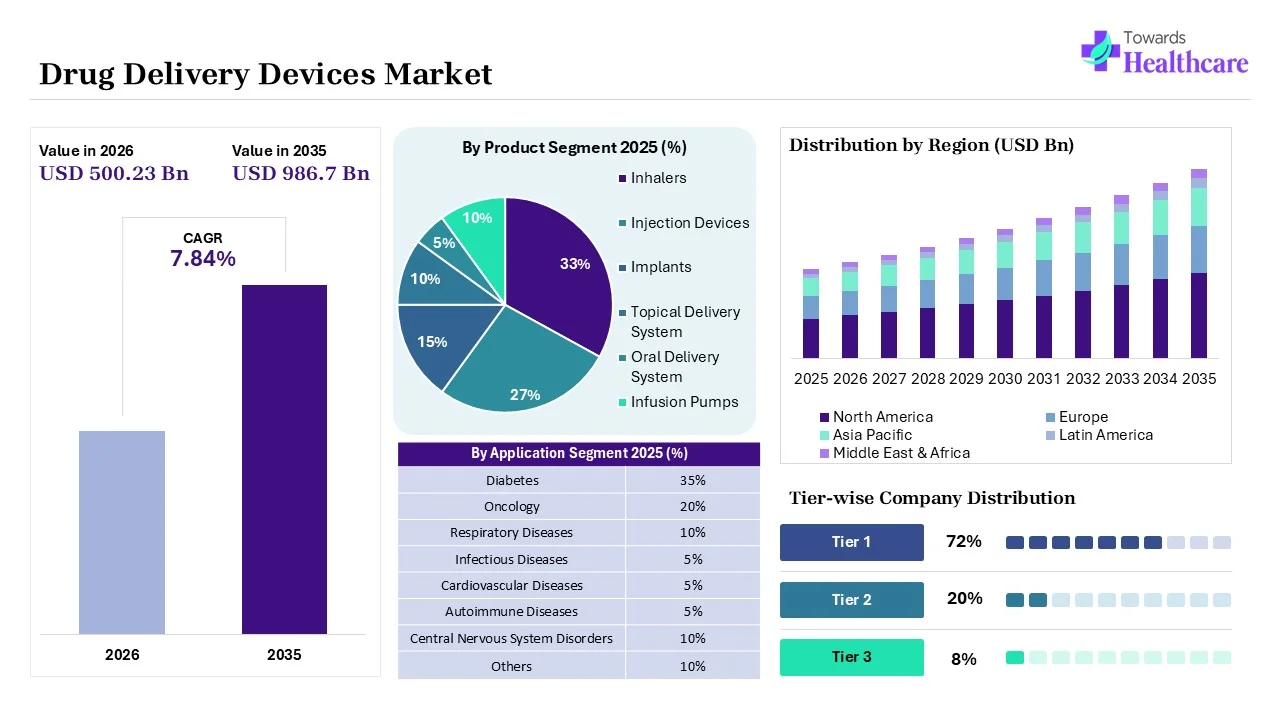
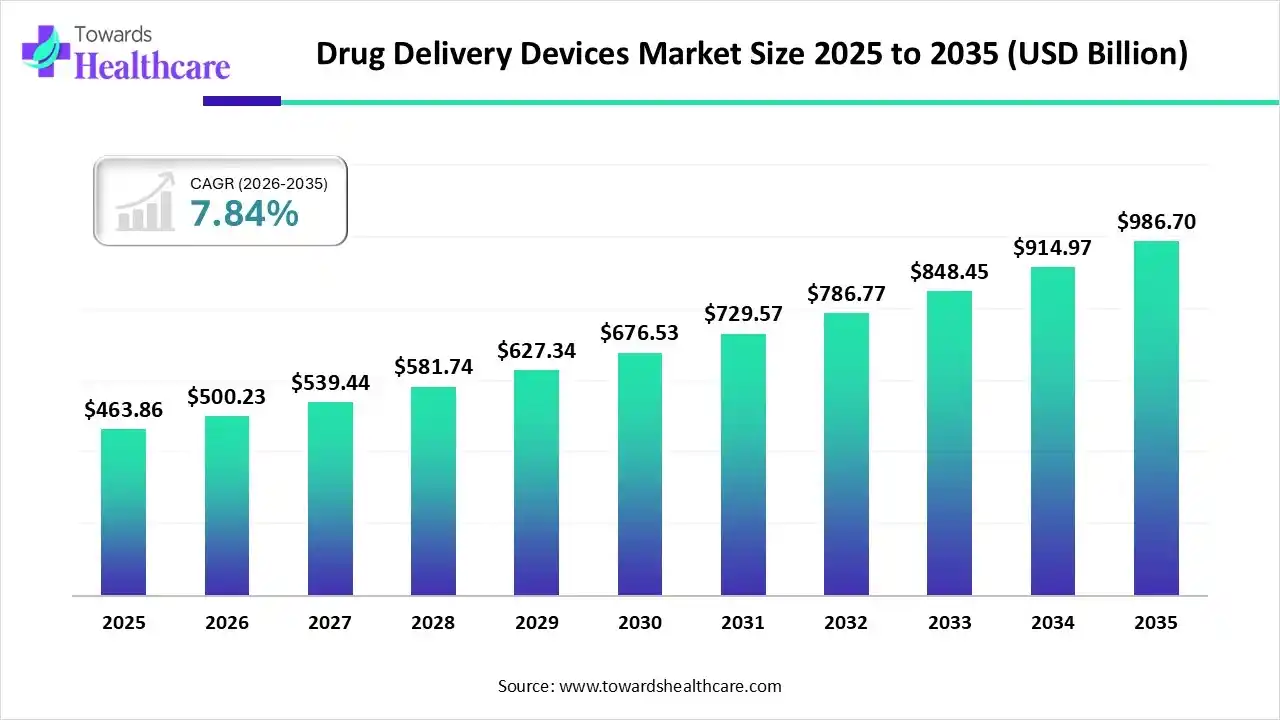
The drug delivery devices market encompasses medical devices and systems designed to deliver medicines into the body via a variety of methods, such as injectables, inhalation, transdermal, and birthing methods. Drug delivery devices help to increase the accuracy of treatment delivery to patients and to ensure that patients adhere to the dosage prescribed by a physician, which improves the efficacy of medications used to treat many acute and chronic diseases.
Growth is expected to continue across the globe due to increased incidences of diabetes, cardiovascular disease, cancer, a multitude of respiratory diseases, and self-administered drug delivery products that can be used at home without having professional assistance. Technology also plays a large role in supporting the growth of the global drug delivery device market through advances in smart drug delivery systems, wearable delivery devices, and connected drug delivery systems.
The availability of advanced technologies such as connected drug delivery systems, smart injectors, wearable infusion devices, and digital monitoring has also revolutionized the industry. Furthermore, the growth of healthcare infrastructure, hundreds of millions of dollars of investment into pharmaceutical innovation, and the shift toward more personalized medicine are also creating many new opportunities for expansion in the market. As healthcare systems around the world focus on greater efficiency and a patient-centric approach to healthcare, demand for more advanced drug delivery devices will continue to be strong worldwide.
The drug delivery devices market focus in medical devices designed to administer medication safely, accurately, and efficiently through injectable, inhalation, transdermal, infusion, wearable, and needle-free delivery systems. The market is expanding due to the rising prevalence of chronic diseases, increasing demand for biologics and biosimilars, and the growing preferences for home-based and self-administered therapies. Continuous innovation in wearable injectors, smart connected devices, needle-free technologies, and sustained-release delivery systems is enhancing treatment convenience, adherence, and clinical outcomes. The integration of AI, digital health platforms, and remote patient monitoring is further improving personalized medication management. Future opportunities lie in expanding applications for gene and cell therapies, advanced biologic delivery, and connected healthcare ecosystems, supported by and ongoing advancements, patient-centric care models, and ongoing advancements, patient-centric care models, and ongoing advancement sin precision medicine and pharmaceutical innovation.
The use of AI in drug delivery devices is increasing for patient treatment monitoring, where its predictive analytics help in detecting patient response. It is also used in the development of personalized solutions, with the use of patient data. It also helps in the optimization of these devices, promoting the development of improved and patient-friendly devices. AI is also being used to develop advanced devices, promoting their integration with telehealth platforms.
Shift Towards Self-Administration
The growing chronic diseases and geriatric population are increasing the demand for home care drug products, which is increasing the use of self-administration devices, enhancing their convenience, treatment adherence, and comfort.
Blooming Smart Devices
Different types of smart devices are being developed, which enable tracking and monitoring of the treatment along with controlled drug delivery, enhancing patient adherence and successful treatment rates.
Focus on User-Friendly Devices
The companies are focusing on the development of patient-friendly devices with the development of small and portable devices offering easy drug administration along with fewer errors.
| Key Elements | Scope |
| Market Size in 2026 | USD 500.23 Billion |
| Projected Market Size in 2035 | USD 986.7 Billion |
| CAGR (2026 - 2035) | 7.84% |
| Leading Region | North America by 45% |
| Key Applications | Diabetes management, oncology drug administration, biologics delivery, vaccine administration, pain management, respiratory therapy |
| Primary End Users | Hospitals, ambulatory surgical centers, home healthcare settings, specialty clinics, patients (self-administration) |
| Key Growth Drivers | Rising biologics use, self-administration trend, chronic disease burden, wearable injector adoption, drug-device combination products |
| Measurable Values | USD Millions/Units/Volume |
| Market Segmentation | By Product, By Application, By End Use, By Region |
| Top Key Players | Medtronic, Becton Dickinson (BD), West Pharmaceutical Services, Insulet, Aptar Pharma, Ypsomed, Nemera, Gerresheimer, Terumo Corporation, SHL Medical, Owen Mumford |
| Segments | Shares % |
| Inhalers | 33% |
| Injection Devices | 27% |
| Implants | 15% |
| Topical Delivery System | 10% |
| Oral Delivery System | 5% |
| Infusion Pumps | 10% |
Why Did the Inhalers Segment Dominate in the Drug Delivery Devices Market in 2025?
The inhalers segment held the largest share of 33% in the market in 2025 with share od 33%, due to the growth in the incidence of respiratory diseases. The inhalers also provided a rapid onset of action, which increased their adoption rates. Furthermore, their portability and non-invasive approach also increased their use.
Injection Devices
The injection devices segment is expected to show the highest growth during the predicted time, due to high bioavailability and rapid onset of action. Moreover, the growing development of biologics and advanced therapies is also increasing their demand. Additionally, the growing shift towards self-administration is also increasing their use.
| Segments | Shares % |
| Diabetes | 35% |
| Oncology | 20% |
| Respiratory Diseases | 10% |
| Infectious Diseases | 5% |
| Cardiovascular Diseases | 5% |
| Autoimmune Diseases | 5% |
| Central Nervous System Disorders | 10% |
| Others | 10% |
What Made Diabetes the Dominant Segment in the Drug Delivery Devices Market in 2025?
The diabetes segment led the market with share of 35% in 2025, due to growth in its incidence rates and health awareness. This, in turn, increased the demand for various drug delivery devices for effective treatment. Furthermore, the daily insulin administration and use of advanced therapies also increased the use of injectable devices.
Central Nervous System Disorders
The central nervous system disorders segment is expected to show the fastest growth rate during the upcoming years, driven by growth in CNS drug development and the growing number of disorders. This is increasing the demand for advanced drug delivery devices, where the investment from various sources is promoting their advancements.
| Segments | Shares % |
| Hospitals | 40% |
| Diagnostic Centers | 30% |
| Ambulatory Surgery Centers/Clinics | 10% |
| Home Care Settings | 10% |
| Others | 10% |
Which End Use Type Segment Held the Dominating Share of the Drug Delivery Devices Market in 2025?
The hospitals segment held the dominating share in the market by 40% share in 2025, due to high patient volume. The presence of skilled personnel and a variety of drug products also increased the use of various drug delivery devices. Additionally, reimbursement policies and emergency care are also increasing patient outcomes.
Diagnostic Centers
The diagnostic centers segment is expected to show significant growth during the predicted time, due to their advanced imaging technologies. At the same time, they also offer fast and accurate disease diagnosis. Additionally, their rapid expansion is also increasing the adoption of various devices.
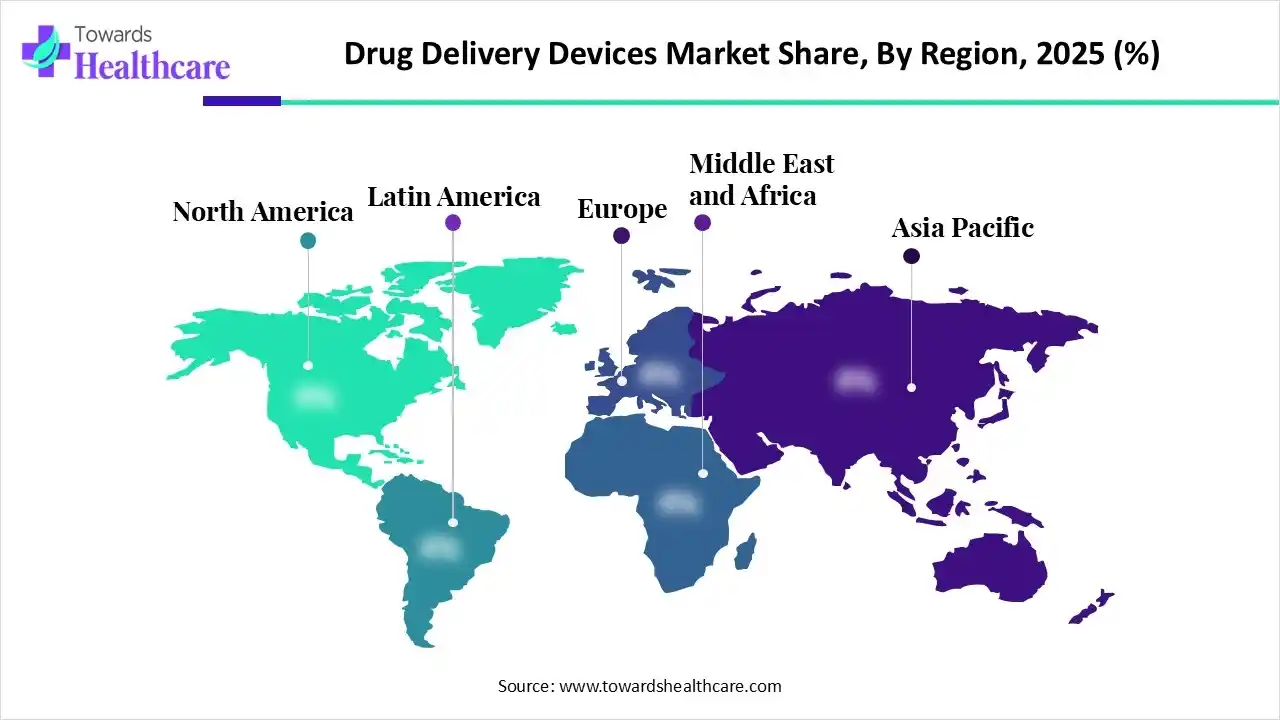
North America dominated the drug delivery devices market with share of 45% in 2025, due to the presence of advanced healthcare, which increased its use. At the same time, the growing incidence of chronic diseases has also increased their adoption rates. Furthermore, the growing health awareness and R&D investment are also increasing their adoption and innovation, respectively, which contributed to the market growth.
U.S. Market Trends
The U.S consists of a well-developed healthcare sector, which is increasing the use of different types of drug delivery devices. The companies are also developing advanced technologies where the healthcare investment is accelerating their innovations. Additionally, increasing patient awareness is also increasing the use of self-administering devices.
Canada Market Trends
The Drug Delivery device market has experienced stable growth within the Canadian healthcare sector due to an increasingly aged population, a growing burden of chronic diseases, and an increase in the number of people who have access to healthcare services in Canada. The demand for delivering drugs through more patient-friendly delivery systems such as auto-injectors and infusion devices is continuing to grow as more Healthcare Providers are making patient compliance with treatment their focus and will also be providing more at-home care to their patients in Canada.
Mexico Market Trends
The drug delivery device market in Mexico has room to grow thanks to improved healthcare systems, access to pharmaceutical medications, and the increased number of people with chronic conditions or cardiovascular diseases. The increased investment in modernizing healthcare systems and the demand for self-management devices are contributing to the growth of the drug delivery device market throughout both private and public healthcare systems.
Asia Pacific is expected to host the fastest-growing drug delivery devices market by 20% share during the forecast period, due to growing chronic diseases and a large population. The expanding healthcare is also increasing its adoption of various drug delivery devices, where the increasing government and private sector support is also increasing their innovation, enhancing the market growth.
China Market Trends
The presence of a large population is increasing the incidence of diabetes and other chronic diseases in China, which is increasing the use of various drug delivery devices. Additionally, the expanding healthcare sector and government initiatives are also increasing their use, enhancing their production rates.
India Market Trends
India is quickly becoming one of the fastest-growing global markets for drug delivery devices because of the large number of patients, the number of people with chronic diseases, and the expansion of healthcare coverage in India. An increasing number of people are using insulin pens, inhalers, and injectable systems, in addition to the growing domestic pharmaceutical manufacturing base, which has contributed to the growing demand for new drug delivery device technologies.
Japan Market Trends
The Drug Delivery Device market in Japan is being driven by the rapidly increasing size of the aging population and the continued strong demand for advanced drug delivery devices from Japanese patients. Japan has placed a high emphasis on Precision Medicine and the use of Patient-Centered Therapy, which promotes the use of new and innovative Drug Delivery Systems, including Injection Systems, Inhalation Systems, and Wearable Drug Delivery Devices to treat chronic conditions.
Europe is expected to grow significantly in the drug delivery devices market by 25% share during the forecast period, due to its growing advancements. The industries are focusing on the development of various drug delivery devices, where the growing shift towards home care is also increasing their use. Additionally, the increasing diseases and health awareness are also increasing their use, promoting the market growth.
UK Market Trends
The well-developed healthcare infrastructure in the UK is driving the demand for drug delivery devices, creating new opportunities. The growing diseases are also increasing their continuous use, where the growth in the development of advanced therapies and biologics is also increasing their use, which is supported by funding.
Germany Market Trends
Germany is an important player in the international drug delivery device market because of Germany's established and reliable healthcare system, technologically advanced medical technology sector, and significant financial investment in healthcare. The increase in the use of biologic medications, preference for at-home treatment, and desire for new ways to deliver injectable medications or wearables to administer medications have all helped to grow the German drug delivery device market.
Netherlands Market Trends
The Netherlands has experienced continued growth in the drug delivery device market because of a strong healthcare infrastructure and a focus on patient-focused care. The increase in the use of digital health technology, the increase in chronic disease management programs, and the interest in drug delivery devices that are simple to use are all helping to drive the growth of the market.
In the coming era, the MEA will expand notably in the drug delivery devices market. The regional massive demand for biologics and GLP-1 therapies is driving development of diverse products to treat various chronic diseases. Alongside this, patients and health systems in the Gulf States and the wider MEA region are broadly leveraging continuous glucose monitors (CGMs) and smart, connected delivery systems.
UAE Market Trends
Gradual expansion of the market in the UAE is spurred by a significant focus on precision medicine, with major support from the UAE Reference Genome study and local biopharma manufacturing initiatives, such as Mubadala Bio. Recently, the regulatory framework of the UAE has developed the Emirates Drug Establishment to emphasize approvals and expedite time-to-market solutions.
South Africa Market Trends
The drug delivery devices market in Saudi Arabia is predicted to witness a lucrative expansion in the coming years. Significant growth is mainly propelled by a rising transition toward independent domestic manufacturing for sterile injectables and ophthalmic products. Alongside this, Saudi Arabia is receiving major support from the SFDA (Saudi Food and Drug Authority) and national pharma localization activities.
R&D
Clinical Trials and Regulatory Approvals
Formulation and Final Dosage Preparation
Patient Support and Services
| Category | Key Players / Examples | Role in Ecosystem |
| Technology Providers | West Pharmaceutical Services, Aptar Pharma, BD | Develop core drug delivery technologies (injectors, elastomer systems, containment) |
| Product Manufacturers | Baxter, Medtronic, Gerresheimer, BD | Produce final delivery devices like pumps, syringes, infusion systems |
| Service Providers | Phillips-Medisize, SMC Ltd | Contract design, prototyping, and manufacturing of delivery systems |
| Platform Providers | Insulet, Tandem Diabetes Care | Digital + device platforms (closed-loop insulin delivery systems) |
| CROs/CDMOs | Recipharm, Catalent (adjacent influence) | Support drug-device combination development and manufacturing |
| Software Vendors | Medtronic Digital Health ecosystem | Monitoring and control software for infusion/wearable devices |
| Research Institutions | MIT, Fraunhofer Institute, academic hospitals | Innovation in microfluidics, nanodelivery, smart devices |
| End-User Industries | Pharmaceuticals, Biotech, Hospitals, Homecare providers | Deploy and utilize delivery systems in clinical and at-home settings |
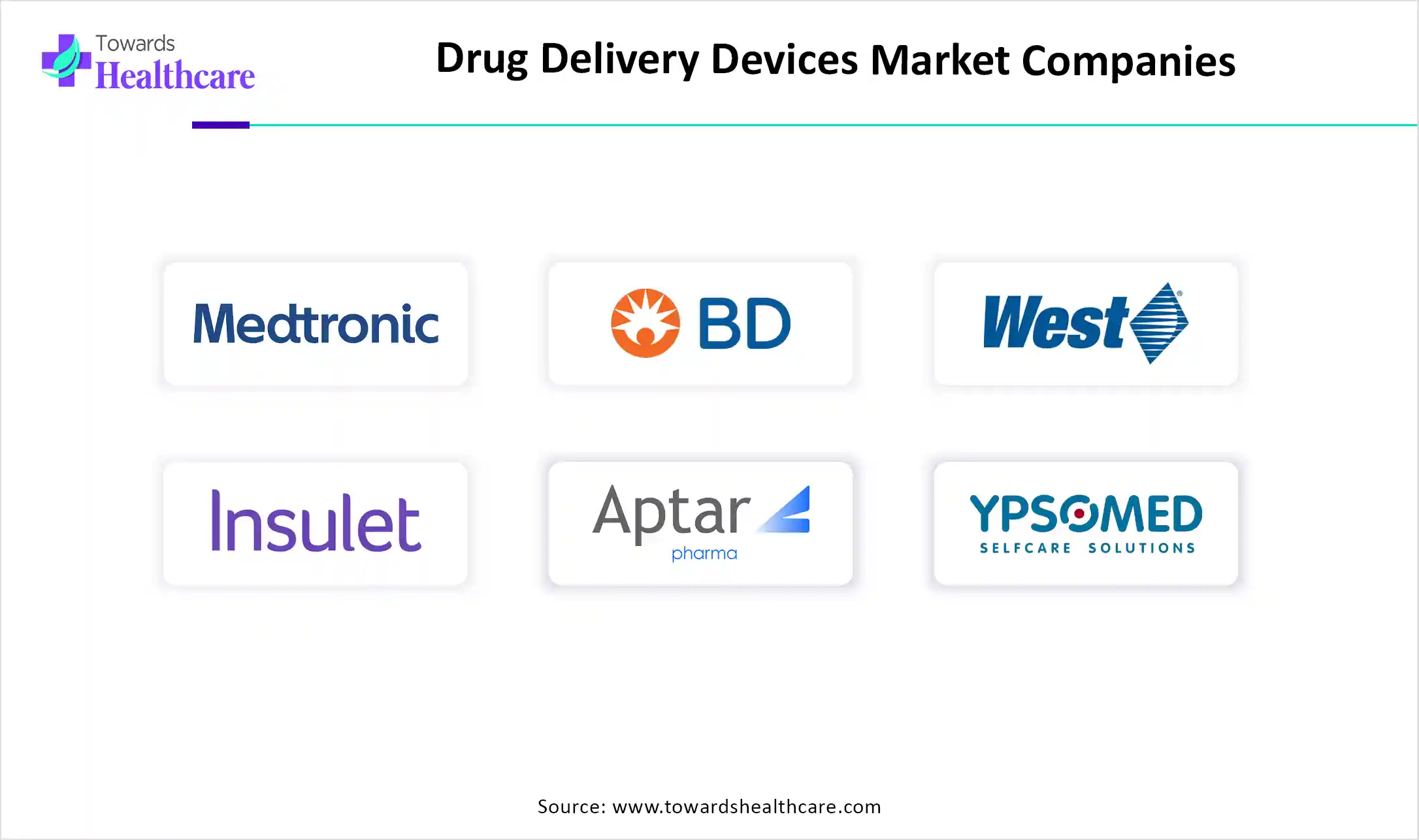
| Tier 1 | Tier 2 | Tier 3 | |
| Typical Market Influence | 55% | 30% | 15% |
| Tier 1 | ||||
| Company Name | Headquarters | Country | Why Relevant to This Market | Key Products/Services |
| Becton, Dickinson and Company (BD) | Franklin Lakes, New Jersey | USA | Global leader in injection and safety drug delivery systems | Prefillable syringes, safety needles, autoinjector components |
| Baxter International Inc. | Deerfield, Illinois | USA | Major provider of infusion and hospital drug delivery systems | Infusion pumps, IV delivery systems, parenteral drug administration |
| Medtronic plc | Dublin | Ireland | Dominant player in infusion-based therapeutic delivery systems | Insulin pumps, infusion systems, drug delivery catheters |
| Tier 2 | ||||
| Company Name | Headquarters | Country | Why Relevant to This Market | Key Products/Service |
| Ypsomed AG | Burgdorf | Switzerland | Strong focus on self-injection systems | Autoinjectors, pen injectors, wearable delivery devices |
| SHL Medical | Zug | Switzerland | Leading autoinjector and wearable injector developer | Large-volume autoinjectors, pen systems, wearable injectors |
| Aptar Pharma | Crystal Lake, Illinois | USA | Key drug delivery technology provider | Nasal sprays, inhalation devices, injectable systems |
| Tier 3 | ||||
| Company Name | Headquarters | Country | Why Relevant to This Market | Key Products/Services |
| Enable Injections | Cincinnati, Ohio | USA | Innovator in wearable on-body injector systems | Wearable bolus injectors for biologics |
| Phillips-Medisize | Hudson, Wisconsin | USA | Contract developer of advanced drug delivery devices | Auto-injectors, inhalation devices, connected drug systems |
| Haselmeier | Stuttgart | Germany | Specialized pen injector developer (now part of Gerresheimer ecosystem) | Pen injection systems, dose delivery devices |
In April 2026, "BD's innovations in medication management are setting a new standard for unified, data-driven healthcare operations," said Esteban Rossi, vice president and general manager for Medication Management Solutions, EMEA at BD. "Delivering the BD® Pyxis™ Pro Dispensing Solution and BD® Incada™ Platform directly to European hospitals empowers our customers to strengthen medication availability, improve efficiency and enhance patient care."
Strengths
Weaknesses
Opportunities
Threats
By Product
By Application
By End Use
By Region





Principal Consultant
Payal Rabde is a Healthcare Market Research Analyst at Towards Healthcare Research & Consulting with 4+ years of experience in pharmaceuticals, biotechnology, medical devices, and life sciences.
Learn more about Payal Rabde

Reviewed By
Aditi Shivarkar is a seasoned professional with over 14 years of experience in healthcare market research. As a content reviewer, Aditi ensures the quality and accuracy of all market insights and data presented by the research team.
Learn more about Aditi Shivarkar









