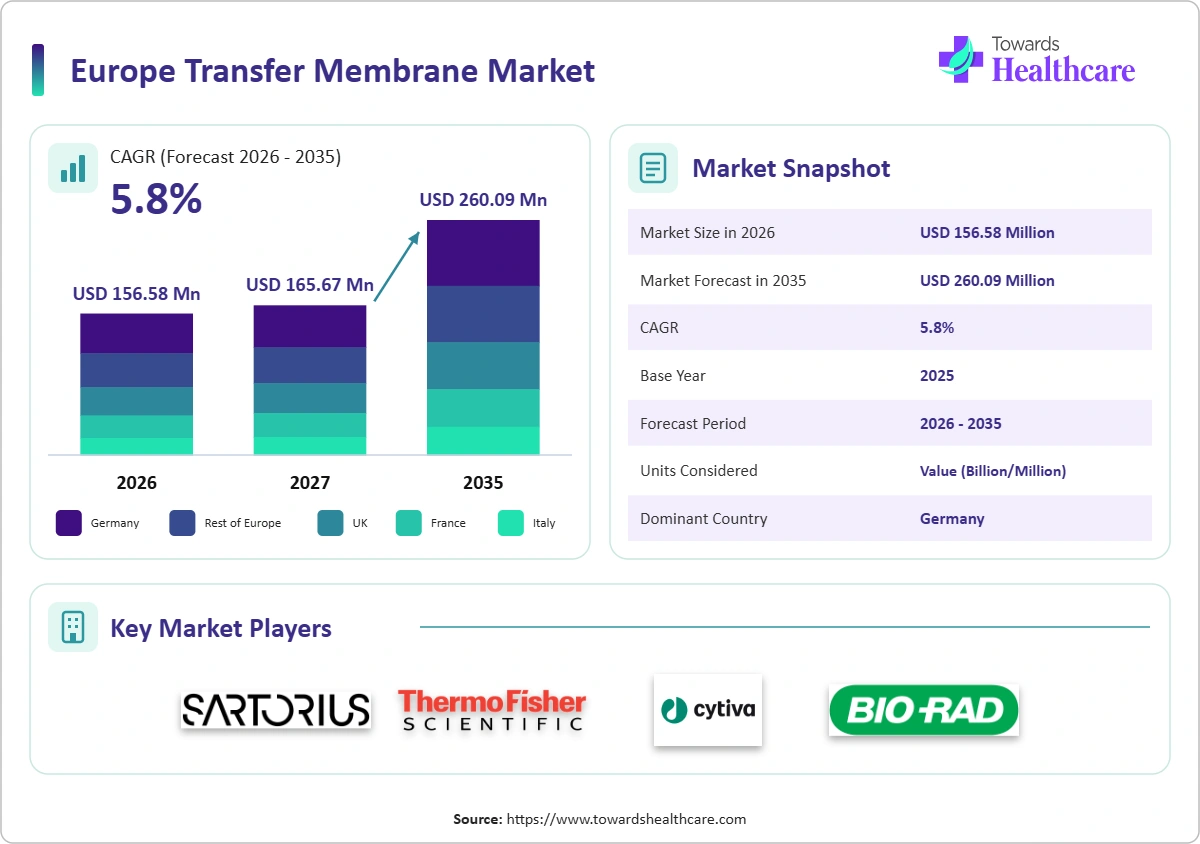
The Europe transfer membrane market is projected to grow from USD 148.00 million in 2025 to USD 260.09 million by 2035, driven by the continued use of western blotting in European laboratories. Protein research, biopharmaceutical R&D, antibody validation, and fluorescent detection are supporting consistent demand for transfer membranes across academic, pharmaceutical, biotechnology, and diagnostic applications.
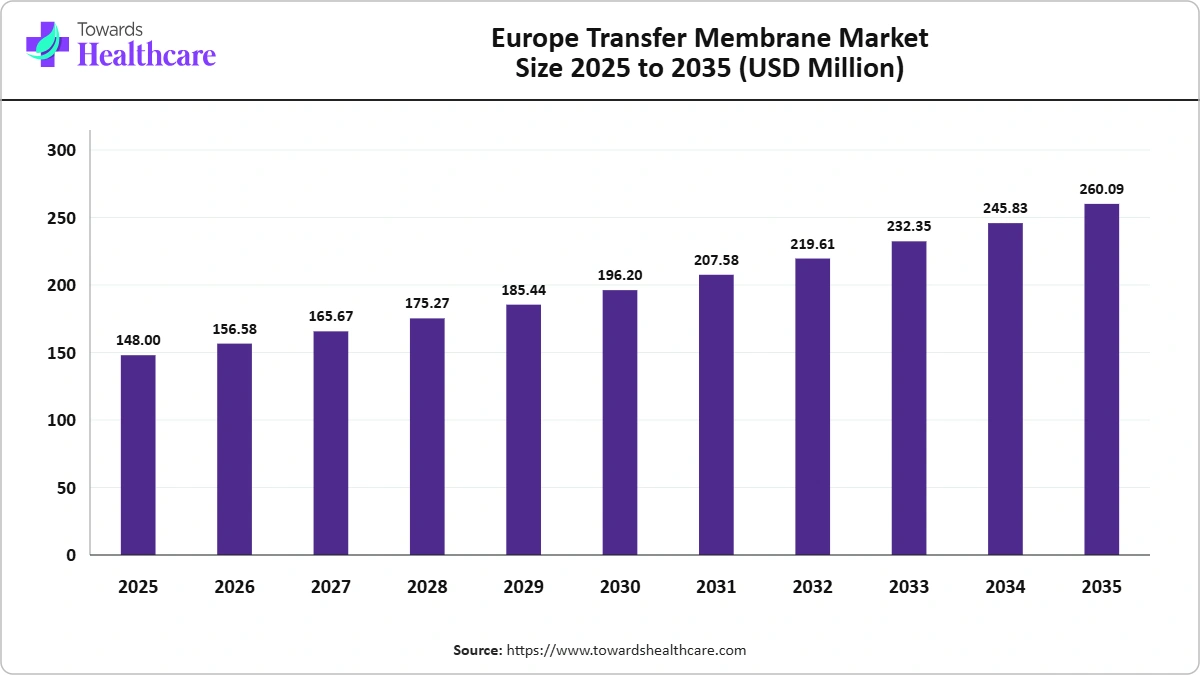
The market is expected to reach USD 196.20 million by 2030 and sustain a CAGR of 5.8% from 2026 to 2035. Transfer membranes remain essential consumables for blotting procedures, supporting their recurring demand across life science laboratories. Their use in protein research, cell culture, and genomics research is further contributing to market expansion.
Analyst View: We estimated the market using blotting volumes, membrane consumption by country, and average product prices, cross-validated against supplier activity. Published estimates for this specific European market are limited, so our valuation is based on available market evidence and industry inputs.
| Driver | Impact | ≈ CAGR Contribution | Time Horizon | Key Regions |
| Protein research continues | High | +2.26 pp | Short to long term | Europe-wide, strongest in Germany |
| Biopharma R&D | Medium | +1.91 pp | Medium to long term | Europe-wide, fastest uptake in Rest of Europe |
| Antibody validation | Medium | +1.63 pp | Short to medium term | Europe-wide |
| Fluorescent detection | Low | +1.27 pp | Long term | Germany and Rest of Europe |
Note: Contributions are indicative estimates of each factor's effect on annual growth.
Sources: Expert interviews, secondary sources, Towards Healthcare database and Towards Healthcare analysts.
Protein research is the largest contributor to market growth, adding an estimated 2.26 percentage points to annual growth. Biopharmaceutical R&D and antibody validation also support demand for transfer membranes across research and commercial laboratories. Fluorescent detection contributes to market expansion through increasing demand for specialized membrane products. Together, these factors contribute approximately 7.08 percentage points to annual market growth.
| Restraint | Impact | ≈ Negative CAGR Contribution | Time Horizon | Key Regions |
| Shift to capillary western and mass spectrometry | High | -0.57 pp | Short to medium term | Europe-wide |
| Research budget pressure | High | -0.42 pp | Medium term | Smaller and price-sensitive markets |
| Price competition | Medium | -0.28 pp | Short term | Germany and other mature markets |
Note: Contributions are indicative estimates of each factor's effect on annual growth.
Sources: Expert interviews, secondary sources, Towards Healthcare database and Towards Healthcare analysts.
The shift toward capillary western systems and mass spectrometry, research budget pressure, and price competition are estimated to reduce annual market growth by around 1.28 percentage points. Adoption of alternative analytical technologies represents the largest restraint, while limited research budgets and competitive pricing also affect demand. These factors are expected to moderate market expansion, resulting in a projected CAGR of 5.8% from 2026 to 2035.
Fluorescent membranes represent an important growth opportunity as laboratories increasingly adopt fluorescent western blotting techniques. Suppliers developing low-fluorescence PVDF membranes and products compatible with advanced detection systems can address evolving research requirements.
Eastern Europe presents opportunities as laboratory infrastructure, biotechnology activities, and research capabilities expand. The development of kits combining transfer membranes with transfer systems, laboratory automation, and growth in biotechnology research is expected to support additional market demand.
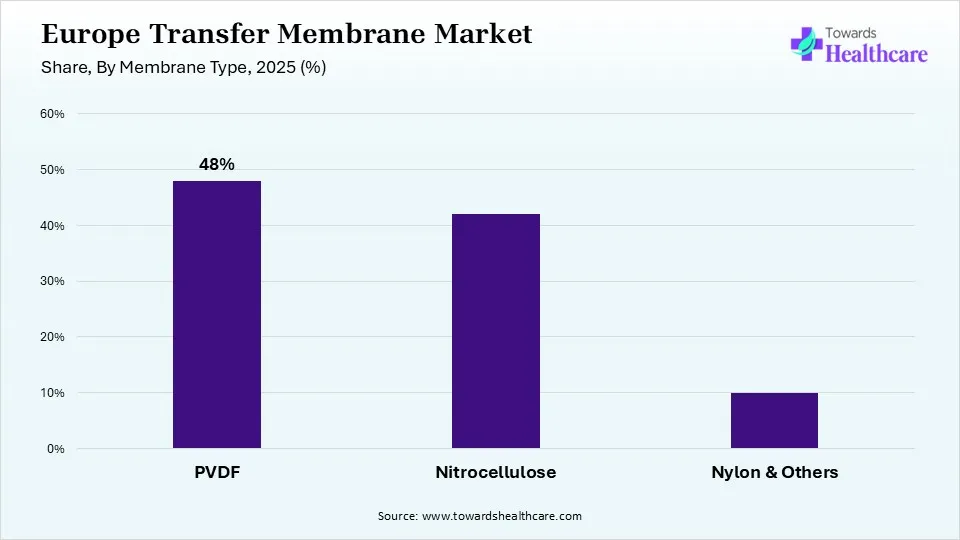
Note: 2025 is the base year; 2035 shares and CAGRs are forecasts.
Sources: Expert interviews, secondary sources, Towards Healthcare database and Towards Healthcare analysts.
PVDF accounted for 48% of the market in 2025. The segment is projected to expand at a CAGR of 6.11% from 2026 to 2035. PVDF membranes are widely used in protein transfer applications because they provide strong protein binding and can be stripped and reprobed. The segment is expected to grow faster than the overall market.
Nitrocellulose membranes are favored for blotting due to their quick transfer capabilities and low background results, supporting continued use in protein analysis workflows. This sustained demand is projected to align with broader market growth.
The nylon and other membranes materials are used in nucleic acid blotting applications, including southern and northern blotting. Their specialized applications support a smaller share of the overall market. The segment is expected to grow broadly in line with the overall market.
Segment Outlook: During the forecast period, PVDF is expected to remain the largest membrane type segment, with its market share projected to increase from 48% in 2025 to around 49.42% in 2035. It is also expected to record the highest membrane type-level CAGR of 6.11%, strengthening its position in the transfer membrane market in Europe.
Western Blotting accounted for 80% of the market in 2025. The application is projected to expand at a CAGR of 5.88% from 2026 to 2035. Western blotting is widely used for protein detection and analysis, creating substantial recurring demand for transfer membranes. Its established role in protein research and biopharmaceutical R&D supports its lead. The segment is expected to grow broadly with the overall market.
Southern and Northern Blotting techniques are used for nucleic acid analysis and continue to support specialized research applications. Their smaller application base compared with western blotting limits their overall market share. The segment is expected to grow more slowly than the overall market.
Others category includes dot blots and other specialized blotting applications. These techniques contribute to demand across research laboratories requiring alternative blotting methods. The segment is expected to grow more slowly than the overall market.
Segment Outlook: Western blotting is expected to remain the largest application segment through 2035, with its share projected to increase from 80% in 2025 to approximately 80.60% in 2035. It is also expected to record the highest application-level CAGR of 5.88%, reinforcing its leading position in the market.
Academic and Research Institutes accounted for 52% of the market in 2025 and are expected to record a CAGR of 5.25% from 2026 to 2035. Universities and research institutes use transfer membranes extensively for protein research and other laboratory applications. The research activities and recurring requirements for blotting consumables support the segment's growth. The segment is expected to grow more slowly than the overall market.
Pharma and Biotech Companies use transfer membranes for biopharmaceutical R&D, antibody validation, and protein analysis. Increasing research activities and demand for reliable laboratory consumables are supporting segment expansion.
Diagnostic Labs and CROs use transfer membranes for specialized analytical and research applications. The segment is expected to grow broadly in line with the market.
Segment Outlook: Academic and research institutes are expected to remain the largest end-user segment by 2035, although their share is projected to decline from 52% in 2025 to roughly 49.36% in 2035. Pharmaceutical and biotechnology companies are expected to record the highest end-user-level CAGR of 6.65%, increasing their share to 36.83%. Diagnostic laboratories and CROs will continue to serve specialized requirements within the market.
Analyst View: In our analysis, segment estimates were developed by allocating market demand according to membrane consumption, product portfolios, application requirements, end-user demand, and average product prices. PVDF, western blotting, and academic and research institutes remain the leading segments because they address the core requirements of European membrane buyers. However, pharmaceutical and biotechnology companies are expected to gain market share as biopharmaceutical R&D, antibody validation, and related research activities expand. Adoption of fluorescent detection and specialized membrane technologies is expected to support demand for advanced transfer membrane products across the forecast period.
Germany accounted for 24% of the market in 2025 and is projected to register a CAGR of 5.26% from 2026 to 2035. The country leads the European market because of its large research and biotechnology base and established demand for laboratory consumables. Its pharmaceutical and research activities support recurring requirements for transfer membranes across protein analysis and blotting applications. Germany is expected to grow slower than the overall market.
The rest of Europe region includes the Nordics, Benelux, and Eastern Europe. Increasing research investments and laboratory adoption in biotechnology are driving regional demand, with the rest of Europe projected to grow faster than the overall market.
The United Kingdom country's strong university network and biotechnology sector support demand for transfer membranes across research and laboratory applications. The United Kingdom is expected to grow broadly in line with the overall market.
France public research institutes bolster the demand for transfer membranes in protein and nucleic acid research, with expected growth aligning with the overall market during the forecast period.
Italy growing research activities across the country support demand for laboratory consumables and blotting membranes. The country is expected to grow broadly in line with the overall market.
Spain expanding biotechnology activities and research requirements in Spain are supporting the adoption of transfer membranes.
Switzerland pharmaceutical research hubs are driving demand for specialized laboratory consumables and transfer membranes, with expected growth in line with the overall market.
Analyst View: In our analysis, country-level estimates were developed using membrane demand, installed research infrastructure, laboratory spending, and supplier presence across individual markets. Germany maintains its lead through its mature research and biotechnology base and established supplier presence. The rest of Europe is expected to record the highest growth because research investment, adoption, and capacity are expanding faster across the region.
| Rank | Company Name | 2025 Share (%) | Key Products / Business | Headquarters |
| 1 | Merck KGaA (MilliporeSigma) | 24.00% | Immobilon PVDF membranes | Germany |
| 2 | Bio-Rad Laboratories | 18.00% | Trans-Blot membranes and kits | United States |
| 3 | Cytiva (Danaher) | 16.00% | Amersham Protran and Hybond | United States |
| 4 | Thermo Fisher Scientific | 16.00% | iBlot stacks and membranes | United States |
| 5 | Sartorius | 3.00% | Membranes | Germany |
| 6 | Macherey-Nagel | 3.00% | Blotting membranes | Germany |
| 7 | Carl Roth | 3.00% | Lab membranes | Germany |
| 8 | Pall (Danaher) | 2.00% | Membranes | United States |
| 9 | Santa Cruz Biotechnology | 1.00% | Blotting membranes | United States |
| 10 | Azure Biosystems | 1.00% | Blotting membranes | United States |
Note: Company shares are 2025 estimates.
Sources: Company press releases, expert interviews, secondary sources, Towards Healthcare database and Towards Healthcare analysts.
Merck KGaA (MilliporeSigma) led the Europe transfer membrane market with an estimated 24% share of 2025 revenue, followed by Bio-Rad Laboratories at 18%, Cytiva (Danaher) at 16.00%, and Thermo Fisher Scientific at 16%.
Merck KGaA (MilliporeSigma) maintains its lead with its Immobilon PVDF membranes, while Bio-Rad Laboratories competes with its Trans-Blot membranes and kits. Cytiva (Danaher) offers Amersham Protran and Hybond membranes, while Thermo Fisher Scientific competes through iBlot stacks and membranes.
Other prominent participants include Sartorius, Macherey-Nagel, Carl Roth, Pall (Danaher), Santa Cruz Biotechnology, and Azure Biosystems. These companies compete through membrane products, blotting membranes, and laboratory consumables.
The top 10 companies accounted for an estimated 87% of 2025 revenue, while the remaining 13% was shared among regional distributors and other brands. The transfer membrane market in Europe is concentrated, with competition primarily based on protein-binding capacity, background performance, product consistency, compatibility with transfer systems, distribution networks, and pricing.
Merck KGaA (MilliporeSigma): Headquartered in Germany, captured an estimated 24% share of the Europe transfer membrane market in 2025. Its product portfolio primarily features Immobilon PVDF membranes. In the Towards Healthcare Companies Quadrant, the company is categorized as a Leader.
Bio-Rad Laboratories: Based in the United States, the company held an estimated 18% market share in 2025. Its product range mainly focuses on Trans-Blot membranes and kits. According to the Towards Healthcare Companies Quadrant, the company is classified as a Leader.
Cytiva (Danaher): Headquartered in the United States, it captured an estimated 16% share of the market in 2025. Its product offerings feature Amersham Protran and Hybond membranes. The company is classified as a Leader in the Towards Healthcare Companies Quadrant.
Thermo Fisher Scientific: Located in the United States, secured an estimated 16% market share in 2025. Its portfolio comprises iBlot stacks and membranes. According to the Towards Healthcare Companies Quadrant, the company is recognized as a Leader.
Sartorius: Headquartered in Germany, the company is accounted for an estimated 3% share of the market in 2025. The company's product range includes membranes designed for laboratory applications. In the Towards Healthcare Companies Quadrant, Sartorius is acknowledged as a Leader.
Macherey-Nagel: Based in Germany, it captured an estimated 3% market share in 2025. Its product portfolio features a range of blotting membranes. According to the Towards Healthcare Companies Quadrant, the company is recognized as a Leader.
Carl Roth: Located in Germany, the comapny held an estimated 3% share of the market in 2025. Its offerings primarily include membranes intended for laboratory use. The company is categorized as an Innovator in the Towards Healthcare Companies Quadrant.
Pall (Danaher): With its headquarters in the United States, the company accounted for approximately 2% of the market in 2025. Its membrane portfolio caters to various laboratory applications, while its placement in the Towards Healthcare Companies Quadrant reflects its classification as an Innovator.
Santa Cruz Biotechnology: The U.S.-based company held an estimated 1% market share in 2025, supported by its range of blotting membrane products. It falls under the Innovator category in the Towards Healthcare Companies Quadrant.
Azure Biosystems: Contributing an estimated 1% to the market in 2025, the U.S.-based company offers blotting membranes for research and laboratory use. Its competitive positioning places it among the Innovators in the Towards Healthcare Companies Quadrant.
The Europe transfer membrane ecosystem connects polymer suppliers, membrane manufacturers, distributors, end users, and research funders. Each stage contributes to the production, distribution, adoption, and development of transfer membranes used across European research, pharmaceutical, biotechnology, and diagnostic laboratories.
| Ecosystem Stage | Role in the Market | Key Companies |
| Polymer Suppliers | Supply PVDF and nitrocellulose | Polymer makers |
| Membrane Makers | Make membranes | Merck KGaA, Bio-Rad, Cytiva, Thermo Fisher |
| Distributors | Supply labs | VWR, Carl Roth, Fisher |
| Users | Run blots | Universities, pharma, CROs |
| Funders | Fund research | Horizon Europe, national funders |
Sources: Company press releases, expert interviews, secondary sources, Towards Healthcare database and Towards Healthcare analysts.
Polymer Suppliers: Polymer suppliers provide the raw materials used in transfer membrane manufacturing, particularly PVDF and nitrocellulose. These materials form the foundation of membrane production and support the supply of products used in blotting applications.
Membrane Makers: Membrane manufacturers produce transfer membranes from polymer materials for laboratory use, with key players like Merck KGaA, Bio-Rad, Cytiva, and Thermo Fisher.
Distributors: Distributors provide transfer membranes and laboratory products to research entities in pharmaceuticals, biotechnology, and diagnostics, with key players such as VWR, Carl Roth, and Fisher improving product access within Europe.
Users: End users of transfer membranes include universities, pharmaceutical companies, biotechnology firms, and CROs, for applications such as western, southern, and northern blotting in labs.
Funders: Research funding organizations, notably Horizon Europe and national funders, support scientific and biotechnology activities that drive demand for laboratory consumables.
Value in the Europe transfer membrane market flows from upstream polymer suppliers to membrane manufacturers and distribution partners before reaching research and laboratory end users. Research funding supports activities across the value chain by enabling scientific and biotechnology development. Companies that maintain strong supplier relationships, manufacturing capabilities, distribution networks, and long-term relationships with end users can capture a larger share of market value.
The Towards Healthcare Companies Quadrant positions key participants in the Europe transfer membrane market by market strength, reflecting revenue scale, market share, and geographic reach, and by innovation and growth strategy, reflecting product portfolio breadth, R&D intensity, and partnerships. Positions reflect each company's estimated 2025 share of the Europe transfer membrane market and our assessment of its product innovation, portfolio breadth, and partnerships.
Sources: Company press releases, expert interviews, secondary sources, Towards Healthcare database and Towards Healthcare analysts.
Leaders: Merck KGaA (MilliporeSigma), Bio-Rad Laboratories, Cytiva (Danaher), Thermo Fisher Scientific, Sartorius, and Macherey-Nagel combine established market positions with broad product portfolios and strong innovation capabilities.
Innovators: Carl Roth, Pall (Danaher), Santa Cruz Biotechnology, and Azure Biosystems offer specialized laboratory and blotting membrane products and contribute to competition through their product portfolios and market participation.
By Membrane Type
By Application
By End User
By Country
The Europe transfer membrane market was defined as the market for transfer membranes used in blotting applications across European countries. The assessment includes PVDF, nitrocellulose, nylon, and other membrane types used for western blotting, southern and northern blotting, and other applications, such as dot blots. The market covers demand from academic and research institutes, pharmaceutical and biotechnology companies, and diagnostic laboratories and CROs.
The 2025 base-year estimate for membrane demand was created through a detailed analysis of demand volumes and average prices across various membrane types and applications, verified against market data from leading suppliers and published estimates. Values were assigned based on membrane type, application, end-user demand, and country consumption, with key estimates corroborated by company disclosures, regulatory data, expert interviews, and secondary sources, excluding any non-reconcilable inputs.
The market forecast for transfer membranes highlights demand in applications such as protein research, biopharmaceutical R&D, and antibody validation. It considers alternative analytical technologies and market conditions like budget pressures and price competition. Estimates align to a 2025 base year, with a recalculated forecast for 2026-2035 using a projected CAGR of 5.8%, ensuring consistent estimates across membrane types and applications.
Analyst View: The Europe transfer membrane market is projected to grow steadily until 2035, driven by ongoing protein research, biopharmaceutical R&D, and antibody validation. PVDF will remain the dominant membrane type due to its robust protein-binding capabilities. Western blotting will lead application demand, with academic and research institutes as the primary end-users. However, pharmaceutical and biotechnology companies are also expected to gain market share as demand for specialized laboratory consumables rises. Key growth areas include fluorescent membranes and automated blotting systems, with Eastern Europe showing potential due to expanding research activities. Germany will lead the market, but the Rest of Europe is anticipated to experience the fastest growth. Challenges include the rise of capillary western systems and budget pressures on research, suggesting a need for suppliers to focus on product consistency and compatibility to maintain competitiveness.