

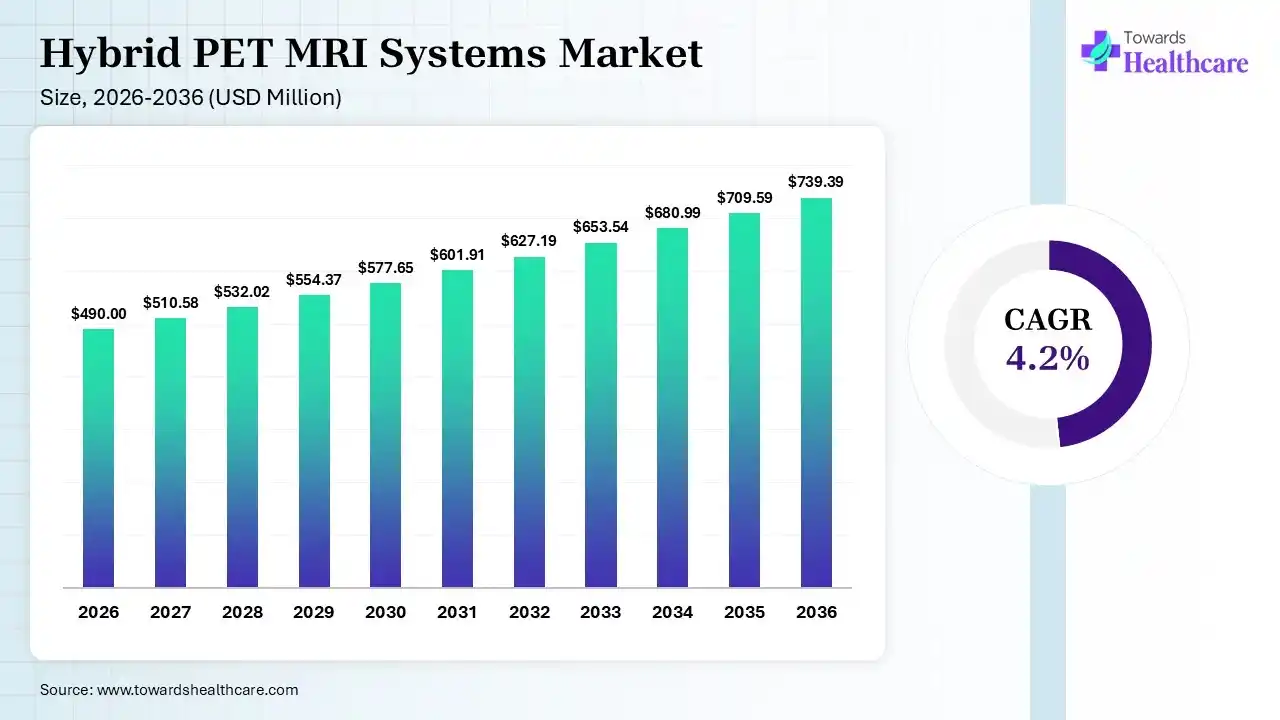
The hybrid PET/MRI systems market is projected to reach USD 490 million in 2026 and USD 739.39 million by 2036, growing at a CAGR of 4.2% during 2026-2036. Technological advances in PET sensitivity, MRI performance, time-of-flight (ToF) technology, and multimodal imaging are expanding the system’s clinical capabilities. PET/MRI combines molecular and metabolic imaging with detailed soft-tissue visualization. This makes it valuable in oncology, neurology, selected cardiovascular applications, pediatric imaging, and clinical research.
The global installed base grew from approximately 70 systems in 2016 to around 190 in 2019, reflecting gradual adoption by academic hospitals and research institutions. High acquisition costs, complex workflows, uncertain reimbursement, and competition from advanced PET/CT systems continue to limit broader adoption. Wider clinical use will depend on whether hospitals can justify the investment through improved diagnostic outcomes and operational efficiency.
Competition is intensifying as manufacturers advance PET/MRI platforms and modernize existing systems. The Siemens Biograph ONE, cleared in the United States in January 2026, has renewed attention to detector performance and system capabilities. The key commercial question is whether better image quality, higher patient throughput and stronger clinical utility can justify replacement purchases and support routine clinical adoption.
The full market assessment covers equipment sales and recurring revenue from software, servicing, upgrades, and research applications. It evaluates installed-base growth, replacement demand, regional purchasing power, and the economics of clinical deployment to identify where manufacturers can secure sustainable revenue growth.
Hybrid PET MRI systems are differentiated by acquisition architecture, clinical application, system configuration, and end-user environment. Simultaneous PET/MRI enables PET and MR data to be acquired together, supporting temporal alignment and motion-sensitive investigations. Sequential or tandem configurations acquire the modalities in sequence, potentially simplifying integration but introducing workflow and registration considerations.
Clinical whole-body systems represent a distinct purchasing category from preclinical platforms designed for animal imaging and translational research. The latter may use specialized configurations, including high-field MRI, and serve pharmaceutical research, disease-model development, and experimental imaging. Combining both categories in a single market estimate can obscure differences in unit economics, purchasing criteria, and competitive positioning.
Oncology is a central application because PET identifies metabolic or molecular activity while MRI provides detailed anatomical and soft-tissue information. Neurology offers opportunities in brain tumor assessment, dementia research, neurodegenerative disease investigation, and selected epilepsy applications. Cardiovascular and musculoskeletal applications offer additional opportunities, although adoption depends on clinical evidence, protocol availability, and the relative advantages of alternative modalities.
By end user, academic medical centers and research hospitals are strategically important because they support clinical studies, tracer development, protocol validation, and specialist training. Large tertiary hospitals may prioritize diagnostic differentiation, while dedicated imaging centers evaluate utilization, reimbursement, and the ability to recover capital expenditure.
PET/MRI adoption depends on whether its clinical and research benefits justify the higher investment and operating requirements. MRI provides strong soft-tissue contrast without adding ionizing radiation from the MRI component, although the PET component still exposes patients to radiotracers. In selected cases, combining both modalities can reduce the need for separate examinations and provide more integrated diagnostic information.
PET/CT remains a strong competitor because of its established installed base, standardized clinical pathways, broad availability, and familiar workflows. Advances in detector sensitivity, time-of-flight performance and extended axial field of view further strengthen competing PET/CT systems. Hospitals must demonstrate clear clinical or research benefits to justify PET/MRI investment.
High capital costs, specialist staffing requirements, complex examination protocols and uncertain reimbursement continue to limit adoption. Advances in clinical evidence, radiotracer applications, image reconstruction and system upgrades could improve the investment case. However, these developments must deliver measurable benefits to support wider purchasing decisions.
Demand is likely to remain concentrated among institutions with strong oncology and neurology programs, substantial research activity and specialized imaging expertise. Hospitals focused on routine, high-throughput imaging may find it harder to justify the investment. Manufacturers must demonstrate clinical value, operational efficiency and a credible return on investment to expand adoption.
PET/MRI pricing is primarily evaluated through system acquisition cost, installation expenditure, lifecycle ownership cost, and the economic return generated by clinical or research use. A single global ASP would be misleading without controlling for configuration, detector generation, MRI field strength, software, service agreements, facility modifications, and contract scope.
The total investment extends beyond the scanner itself. Procurement may require shielding and site preparation, specialized installation, compatible imaging infrastructure, staff training, software integration, and ongoing maintenance. Service coverage and software upgrades can become significant considerations because PET and MRI subsystems must operate together while meeting demanding calibration and performance requirements.
Pricing power is influenced by the limited number of established clinical platforms, specialized engineering requirements, regulatory qualification, and the difficulty of replacing an installed system with a competing platform. However, budget constraints and PET/CT alternatives limit how far vendors can translate technical superiority into higher realized prices.
For buyers, the relevant comparison is cost per completed examination, achievable annual scan volume, maintenance expenditure, downtime, reimbursement, and the clinical value of additional information. For suppliers, differentiation depends on demonstrating measurable workflow and diagnostic benefits rather than relying exclusively on hardware specifications.
PET/MRI supply is concentrated in a small group of technology developers with the engineering capabilities to integrate PET detectors, MRI hardware, reconstruction algorithms, and clinical workflows. Consequently, conventional manufacturing-capacity metrics are less informative than product availability, installation capability, service coverage, and the ability to support upgrades.
Demand is shaped by institutional capital budgets, clinical utilization, research funding, and the age and capabilities of existing systems. Replacement opportunities are particularly important because early installations are now part of a more mature installed base. However, a long equipment life can defer replacement, particularly where existing systems continue to meet clinical and research requirements.
Regional supply conditions also differ. Buyers may face constraints related to import procurement, technical support, regulatory authorization, and access to trained service engineers. A manufacturer with an approved product but limited local servicing capability may be less competitive than a supplier offering a stronger installed-base support network.
The analysis evaluates shipment volumes, procurement pipelines, installation lead times where disclosed, service infrastructure, and the balance between new placements and replacement demand. It also distinguishes manufacturing capacity from effective commercial supply: a system cannot be deployed simply because production capacity exists if regulatory, installation, or customer-readiness requirements remain unmet.
The PET/MRI value chain begins with detector technologies, scintillation materials, photodetectors, superconducting MRI magnets, radiofrequency components, gradients, and supporting electronics. These components feed into subsystem engineering, system integration, image reconstruction, attenuation correction, calibration, and final clinical validation.
System integrators capture value through the coordination of PET and MRI hardware, software, patient positioning, acquisition synchronization, and diagnostic workflow. Component suppliers contribute specialized technologies, but system-level performance depends on the reliability of the entire imaging chain. This creates technical and commercial barriers for new entrants.
Downstream value extends beyond the initial sale through installation, preventive maintenance, software updates, applications training, technical support, and replacement components. These activities can strengthen customer retention and produce recurring revenue.
The strategic implication is that competitive advantage is not determined solely by detector sensitivity or MRI field strength. Integration quality, uptime, image reconstruction, application support, and lifecycle service all influence the customer's realized value.
PET/MRI development includes advancements in detector compatibility, simultaneous acquisition, attenuation correction, and reconstruction. Older detectors based on avalanche photodiodes were limited in terms of timing capabilities, while new silicon photomultipliers allowed for more complex PET detector structures.
Current developments include improved detector sensitivity, motion correction, more advanced reconstruction, more flexible MRI coils, and new software solutions. Such innovations may increase image quality, patient comfort, and examination efficiency; however, their commercial success will depend on the measurable performance of the system and on its ability to conduct more examinations.
One of the distinguishing features is system architecture: simultaneous acquisition enables concurrent imaging and study of dynamic physiological processes, while sequential acquisition allows for certain advantages in terms of integration and workflow. High-field preclinical devices follow their own innovation path, which is focused on small animal imaging and translational research.
Future differentiation will depend on the combination of hardware capabilities, software for clinical use, upgradability, and clinical performance in specific applications.
The PET/MRI systems are subject to medical device regulations along with the electrical safety standards, electromagnetic compatibility standards, imaging performance standards, and quality system standards relevant to the particular markets. Regulatory clearance is dependent on configuration - that is, the approval of one particular PET/MRI machine will not lead to the approval of another PET/MRI machine or any modification that might be performed at a later time.
The clinical acceptance will rely upon the evidence of the efficacy of the technology, its efficiency in terms of workflows, and the importance of integrated imaging for the particular population group of patients. The hospital will have to take into account the particular reimbursement scheme, the clinical protocol, requirements for radiation protection during the PET procedures, and availability of the radiologists and nuclear medicine specialists.
Access to regulatory clearance and public procurement policy can influence geographical competition. One example of such influence of trade policy on market access, regardless of technological capabilities, is the EU regulation of 2025 forbidding certain types of Chinese-origin medical devices in qualifying public procurement contracts with a total cost of over €5 million.
The core customer base consists of tertiary hospitals, academic medical centers, specialist oncology institutions, neuroscience centers, and research facilities. These buyers differ in their willingness to invest, their clinical workload, and their ability to generate revenue or research funding from a high-cost imaging asset.
Academic institutions often value advanced imaging for research and protocol development. Clinical hospitals must additionally assess referral volumes, examination throughput, reimbursement, staffing, and competition from existing PET/CT and MRI equipment. Pharmaceutical and translational research organizations may prioritize access to specialized imaging capabilities for experimental studies.
Customer purchasing decisions are influenced by diagnostic utility, system reliability, service responsiveness, compatibility with existing workflows, and the availability of experienced technologists. Once installed, a system can create switching barriers through staff training, validated protocols, software integration, and the operational cost of replacing established workflows.
The competitive landscape revolves around a limited number of manufacturers with proven capabilities in hybrid imaging. Competition is shaped by installed-base relationships, product maturity, clinical evidence, regulatory access, detector performance, MRI integration, service networks, and long-term upgrade support.
The established clinical market includes Siemens Healthineers, GE HealthCare, Philips, and United Imaging Healthcare. Their relevant platforms span different product generations and architectures.
Siemens established an early position with the Biograph mMR and subsequently advanced the portfolio with the Biograph ONE, cleared in the United States in January 2026. GE HealthCare's SIGNA PET/MR platform emphasizes integrated PET and premium MRI capabilities, including time-of-flight performance. United Imaging's uPMR 790 represents another integrated clinical platform, while Philips' Ingenuity TF PET/MRI reflects an earlier sequential acquisition approach.
These differences matter because a new-generation platform can improve the competitive proposition without immediately changing market leadership. Installed-base replacement is gradual, and hospitals assess the benefits of new equipment against the cost of replacing functioning systems. Product availability, upgrade pathways, local service capabilities, and clinical validation can therefore be as important as headline technical specifications.
The competitive assessment distinguishes established clinical system vendors from preclinical specialists, component and technology providers, and companies offering adjacent imaging solutions. It also separates confirmed product participation from broader corporate imaging capabilities.
| Segments | 2026 Share | 2026 Market Value (USD Million) |
| Simultaneous PET/MRI | 72% | $352.80 |
| Sequential PET/MRI | 18% | $88.20 |
| Tandem Configurations | 10% | $49.00 |
Simultaneous PET/MRI is estimated to lead because it captures functional PET data and high-resolution MRI information during the same imaging session, supporting precise image registration and coordinated clinical workflows. Sequential and tandem configurations serve more specialized requirements depending on system design, imaging protocols and facility needs.
| Segments | 2026 Share | 2026 Market Value (USD Million) |
| Clinical Whole-Body PET/MRI | 82% | $401.80 |
| Preclinical PET/MRI | 18% | $88.20 |
Clinical whole-body PET/MRI is estimated to dominate due to its use in oncology, neurology and other diagnostic applications involving human patients. Preclinical PET/MRI supports small-animal imaging, drug development and translational research at academic institutions and specialized research organizations.
| Segments | 2026 Share | 2026 Market Value (USD Million) |
| Oncology | 42% | $205.80 |
| Neurology | 28% | $137.20 |
| Cardiovascular Imaging | 12% | $58.80 |
| Musculoskeletal Imaging | 8% | $39.20 |
| Other Applications | 10% | $49.00 |
Oncology is estimated to be the largest application because PET metabolic information and MRI soft-tissue contrast can complement each other in cancer assessment and treatment planning. Neurology also represents a major application, particularly for research and evaluation of neurological disorders.
| Segments | 2026 Share | 2026 Market Value (USD Million) |
| Hospitals | 35% | $171.50 |
| Academic Medical Centers | 28% | $137.20 |
| Dedicated Imaging Centers | 14% | $68.60 |
| Research Institutions | 15% | $73.50 |
| Pharmaceutical and Translational Research Organizations | 8% | $39.20 |
Hospitals are estimated to lead because they provide advanced diagnostic imaging and manage complex oncology and neurological cases. Academic medical centers also account for a substantial share because they combine specialized clinical services with imaging research and translational studies.
| Segments | 2026 Share | 2026 Market Value (USD Million) |
| Equipment | 76% | $372.40 |
| Software | 9% | $44.10 |
| Services | 11% | $53.90 |
| Upgrades | 4% | $19.60 |
Equipment is estimated to generate the largest share of revenue because integrated PET/MRI scanners require substantial capital investment in imaging hardware, detector systems and MRI components. Software, maintenance services and upgrades contribute recurring and supplementary revenue throughout the equipment lifecycle.
| Segments | 2026 Share | 2026 Market Value (USD Million) |
| North America | 35% | $171.50 |
| Europe | 27% | $132.30 |
| Asia Pacific | 25% | $122.50 |
| Latin America | 6% | $29.40 |
| Middle East and Africa | 7% | $34.30 |
North America is estimated to lead because of its advanced medical imaging infrastructure, research investment and established adoption of high-cost diagnostic technologies. Europe also represents a significant market, while Asia Pacific offers growth potential as healthcare infrastructure and advanced imaging capabilities expand.
The United States is estimated to account for most North American market revenue because of its concentration of advanced imaging facilities, academic medical centers and medical research programs. Canada contributes through hospital-based imaging and research, while adoption elsewhere is more limited.
Germany is estimated to be the largest listed individual European market because of its established medical imaging infrastructure and clinical research capabilities. The UK and France also contribute through advanced hospital networks, academic research and oncology services.
China and Japan are estimated to account for substantial shares of regional revenue because of their advanced imaging capabilities, clinical research activity and hospital infrastructure. India represents an expansion opportunity as access to advanced diagnostics and specialist imaging facilities develops.
Brazil is estimated to lead the Latin American market because of its comparatively large healthcare system and concentration of specialist medical facilities. Adoption across the rest of the region is influenced by equipment affordability, funding and access to advanced imaging services.
GCC countries are estimated to contribute through investment in advanced hospitals and diagnostic infrastructure. South Africa serves as an important market in the region, while adoption elsewhere depends on capital availability, specialist expertise and access to advanced imaging technologies.
| Company | Headquarters | Market position | Core strength | Major applications/segments |
| Siemens Healthineers | Germany | Established clinical platform provider | Integrated PET/MRI and installed-base support | Clinical whole-body imaging |
| GE HealthCare | United States | Established clinical platform provider | PET/MR and MRI integration | Oncology, neurology, clinical imaging |
| Philips | Netherlands | Historical clinical platform provider | Hybrid imaging architecture | Clinical PET/MRI |
| United Imaging Healthcare | China | Integrated-system challenger | Digital imaging and integrated platforms | Clinical PET/MRI |
| Bruker | United States | Preclinical imaging specialist | Research imaging technologies | Preclinical and translational research |
| Mediso | Hungary | Preclinical PET/MRI specialist | Integrated PET/MRI and high-field MRI | Small-animal imaging |
| MR Solutions | United Kingdom | Preclinical imaging specialist | Integrated preclinical imaging systems | Research and drug development |
| Cubresa | Canada | PET/MRI technology specialist | PET insert and integration approaches | MRI-compatible molecular imaging |
| Molecubes | Belgium | Preclinical imaging specialist | Modular molecular imaging | Preclinical research |
| Canon Medical Systems | Japan | Adjacent imaging participant | MRI and diagnostic imaging capabilities | Adjacent technology and potential integration |
| Fujifilm Healthcare | Japan | Adjacent imaging participant | MRI and medical imaging technology | Adjacent technology |
| Nova Medical | United States | MRI component specialist | Radiofrequency coils and MRI components | MRI subsystem supply |
| ZMT Zurich MedTech | Switzerland | MRI technology specialist | Electromagnetic simulation and MRI engineering | MRI development and integration |
The PET/MRI market remains a specialized segment of medical imaging, with competition influenced by the technical expertise required to integrate positron emission tomography (PET) and magnetic resonance imaging (MRI) technologies. Siemens Healthineers, Philips, and GE HealthCare have established positions in medical imaging, supported by their imaging portfolios, technical capabilities, and relationships with hospitals and research institutions.
An international survey of 39 active PET/MRI sites published in 2016 found that 77% of participating sites used Siemens equipment, compared with 13% for Philips and 10% for GE. These figures reflect the installed equipment at the surveyed sites at that time and should not be interpreted as current market shares or vendor sales rankings.
Competitive positioning depends on system performance, clinical applications, software capabilities, installation requirements, service coverage, and the ability to integrate PET/MRI into existing imaging workflows. High capital costs and specialized infrastructure requirements also create barriers to entry, favoring vendors with established imaging expertise and technical support networks.
Market concentration may change as healthcare providers evaluate newer platforms, replacement systems, and upgrades. However, determining whether vendor concentration is increasing or declining requires current data on equipment shipments, new installations, installed-base changes, and replacement activity. Without comparable recent data, the historical survey provides useful context on early vendor adoption but cannot establish the present competitive structure of the PET/MRI market.
Competitive differentiation in hybrid PET/MRI systems depends on the combined performance of detector sensitivity, time-of-flight (TOF) capability, MRI performance, scanning protocols, image reconstruction, workflow efficiency, and lifecycle support. Individual specifications, including timing resolution and axial field of view, cannot independently establish clinical superiority without standardized definitions and comparable testing conditions. Our analysis indicates that the most meaningful competitive advantage lies in translating hardware and software capabilities into measurable improvements in scan efficiency, diagnostic confidence, patient experience, and operational reliability. We believe manufacturers that demonstrate these benefits under comparable clinical conditions are better positioned to establish differentiated value beyond headline technical specifications.
Clinical and preclinical PET/MRI systems require distinct competitive benchmarks because their performance priorities differ. Clinical platforms are assessed on simultaneous acquisition capabilities, hardware generation, TOF performance, MRI integration, patient comfort, upgradeability, and software support, whereas preclinical systems are differentiated by spatial resolution, quantitative accuracy, magnetic field strength, experimental flexibility, and animal imaging capabilities. Our assessment is that combining these categories into a single ranking would obscure application-specific strengths and produce misleading comparisons. The strategic implication is that hospitals, imaging centers, and research institutions must evaluate systems against their intended use cases, total operational requirements, and long-term technology needs rather than relying on isolated specifications or broad product claims.
The full report provides comparative assessments of clinical platforms and preclinical scanners, examining technical capabilities, commercial positioning, product breadth, software ecosystems, upgrade pathways, service coverage, customer relationships, and geographic reach. It further identifies relative strengths, limitations, and capability gaps to support supplier benchmarking, procurement decisions, and competitive strategy. Where comparable evidence is available, the analysis distinguishes measurable performance advantages from manufacturer claims, enabling stakeholders to assess which capabilities are commercially meaningful and which require further validation.
This intelligence can also be structured into a PET/MRI competitive benchmarking database, tracking manufacturer, system model, clinical or preclinical classification, detector technology, TOF capability, timing resolution, axial field of view, MRI specifications, spatial resolution, acquisition capabilities, software features, upgrade options, service coverage, geographic availability, and supporting evidence. Users can filter and benchmark systems by application, technical capability, supplier, and market availability, complementing the strategic report with a granular reference for technology evaluation, procurement shortlisting, and ongoing competitive monitoring.
The PET/MRI competitive landscape spans clinically integrated scanner systems, sequential systems, preclinical PET/MRI platforms, MRI-compatible PET inserts, and supporting software. Product differentiation depends on more than portfolio breadth: detector technology, MRI magnetic field strength, image reconstruction capabilities, acquisition configuration, application suitability, and clinical validation determine how effectively each system addresses specific research and clinical workflows. Our analysis indicates that commercial availability and workflow integration are more meaningful indicators of competitive positioning than announced product breadth alone, particularly in a market where advanced technical capabilities do not automatically translate into routine clinical adoption.
Our assessment is that the principal competitive gaps lie in regional product availability, system upgradeability, specialized application support, and the transition from research-stage platforms to clinically deployable solutions. These differences influence the addressable customer base, implementation requirements, and potential for broader adoption. In our view, suppliers that combine validated performance with adaptable configurations, application-specific capabilities, and credible clinical deployment pathways are better positioned to address diverse customer requirements.
The full report provides a structured comparison of clinical and preclinical portfolios, detector and MRI technologies, reconstruction and acquisition capabilities, product generations, upgrade pathways, application coverage, and clinical validation. It further examines commercial availability and development-stage differentiation to identify portfolio strengths, capability gaps, and opportunities for product development or market expansion.
This intelligence can also be provided as a structured competitive benchmarking dataset, tracking manufacturer, system or product name, configuration, clinical or preclinical classification, detector technology, MRI field strength, reconstruction capabilities, applications, clinical validation status, commercial availability, development stage, regional availability, and upgrade pathways. Records can be filtered by technology, application, geography, and commercialization status to benchmark competing platforms at the product level, complementing the strategic report's assessment of competitive positioning and market readiness.
Geographic competition is about the geographic positioning of the manufacturer, hospital budget for capital equipment, development of specialty imaging infrastructure, clinical research activities, regulation, procurement, and trained service staff.
North America is an important market for investment in advanced imaging technologies, whereas Europe has the well-established research and clinical base for PET/MRI technology. Asia Pacific region provides certain opportunities related to the development of healthcare infrastructure and imaging technology within individual countries.
Product launches, detector innovations, software development, research partnerships, and platform evolution provide critical clues about future competition. The launch of the Biograph ONE in 2026 shows evidence of renewed innovation efforts in clinical PET/MRI, following an extended period of little change in the hardware-generation landscape.
Strategic developments need to be assessed according to their technical importance, regulatory status, commercial progress, and their impact on the buying behavior of customers. Detector technology, reconstruction software, MRI compatibility, or research collaboration in clinical applications may provide competitive advantages to products without increasing market share immediately.
The unique character of the market makes acquisitions focused on imaging software, MRI-compatible detector technology, preclinical imaging, and application-specific technology possible as well. But acquisitions and prices have to be determined based on official announcements, not just the consolidation trends in medical imaging.
Company-level analysis is based on the same proven ecosystem of direct system vendors, preclinical experts, and related technology providers. Profiles separate corporate financial results from those specifically attributed to PET/MRI.
In relation to the key clinical suppliers, the assessment considers a wide variety of products, technology differentiation, relationships with the installed base, geographical reach, regulatory reach, and upgrade strategy. In relation to the preclinical experts, it emphasizes system capabilities, scientific uses, product specialization, and access to the scientific customer.
Strategic positioning highlights market leaders, technology leaders, application specialists, geographical challengers, and newcomers. Such classifications revolve around proof of market participation and capabilities.
The strongest opportunities are likely to emerge in clinical and research applications where PET/MRI delivers clear diagnostic value and capabilities that competing imaging systems cannot fully match. Oncology, neurology and advanced imaging research offer potential where clinical needs justify the investment.
The existing installed base also creates revenue opportunities through software upgrades, service contracts, system modernization and eventual replacement. These revenue streams can support growth even when demand for new installations remains limited. Emerging markets may offer additional opportunities as advanced imaging infrastructure expands, provided hospitals have sufficient budgets, regulatory access, and trained specialists.
Commercial success ultimately depends on whether the clinical and research benefits justify the total cost of ownership. Each opportunity should be assessed against the addressable customer base, expected system utilization, purchasing capacity, and lifecycle economics. These factors will determine which applications and regions can support sustainable revenue growth.
The PET/MRI market outlook depends on three factors: system modernization, clinical evidence for specialized applications, and cost competitiveness against alternative imaging technologies. Advances in detector performance, image reconstruction, motion correction, and MRI hardware could strengthen the value proposition. However, wider adoption will depend on whether these improvements deliver measurable clinical and economic benefits.
The base-case outlook assumes gradual growth driven by system replacements and research demand. The upside scenario depends on stronger clinical evidence, higher system utilization, and improved investment returns. The downside scenario reflects continued advances in PET/CT technology and delays in hospital capital spending.
Long-term growth will favor vendors that deliver reliable performance, strong service support, upgrade options, and clinical evidence. The full analysis evaluates revenue growth, shipment volumes, replacement demand, market segments, regional penetration and competitive developments through 2035.
Hybrid PET/MRI systems enable physicians to assess anatomy and biological activity in a single examination. However, high acquisition costs and complex installation requirements limit adoption to major hospitals and specialized imaging centers. Wider adoption will depend on improving cost efficiency, clinical value and operational performance to make the technology viable for more healthcare providers.
The primary market research process was carried out by Payal Rabde, Senior Research Associate, who also designed the methodology and did market segmentation, regional trend analysis, buyer intelligence, competitive analysis, and forecasts, laying the foundation for the analytical part of the report.
Aman Singh, Head of Research, has gathered and checked regulatory policies, company financial information, production information, commodity price information, and various other quantitative information sources, which were obtained independently, thereby increasing the quality of evidence supporting the calculations of the market values.
Aditi Shivarkar, VP Research, has validated and refined the research material, verified facts, corrected inconsistencies, and completed the research document, making it accurate and to the point.
By System Architecture
By System Type
By Application
By End User
By Revenue Stream
By Region


Principal Consultant
Payal Rabde is a Healthcare Market Research Analyst at Towards Healthcare Research & Consulting with 4+ years of experience in pharmaceuticals, biotechnology, medical devices, and life sciences.
Learn more about Payal Rabde

Reviewed By
Aditi Shivarkar is a seasoned professional with over 14 years of experience in healthcare market research. As a content reviewer, Aditi ensures the quality and accuracy of all market insights and data presented by the research team.
Learn more about Aditi Shivarkar