The analysis provides market intelligence and strategic insights into the evolving advanced therapy manufacturing landscape in the U.S." with "The analysis examines India's home-based cancer care market, including service categories, patient needs, provider capabilities, and regional opportunities. The analysis was led by Payal Rabde, Senior Research Analyst, who brings experience in healthcare and life sciences market research. For this report, she assessed the India home-based cancer care market across different types of cancers, services, treatment stages, and end users. The report examines India's home-based cancer care market by service type, cancer type, treatment stage, delivery model, end user, and region. Government-reported NCD clinic and day-care centre counts describe the broader noncommunicable disease infrastructure; they do not directly measure the size or capacity of India's home-based cancer care market
India's home-based cancer care market covers oncology-related nursing, symptom management, palliative care, post-discharge support, rehabilitation, and selected clinically appropriate services delivered in patients' homes.
The distinction between home healthcare and home-based cancer care is commercially important. The latter requires oncology-specific clinical protocols, escalation procedures, medication management, and coordination with cancer centres.
India's broader home healthcare sector provides context for evaluating home-based cancer care, but its market value must be estimated separately from the wider sector.
India's home-based cancer care market is an emerging component of the broader home healthcare and oncology services industry. It covers medical and supportive services delivered outside conventional hospitals, including home nursing, palliative care, symptom and pain management, post-treatment support, rehabilitation, tele-oncology, home diagnostics, medication management, and selected treatment-related services where clinically appropriate. The market remains relatively fragmented, and a precise standalone market size is difficult to establish because home-based cancer care is not consistently reported as a separate category in industry statistics.
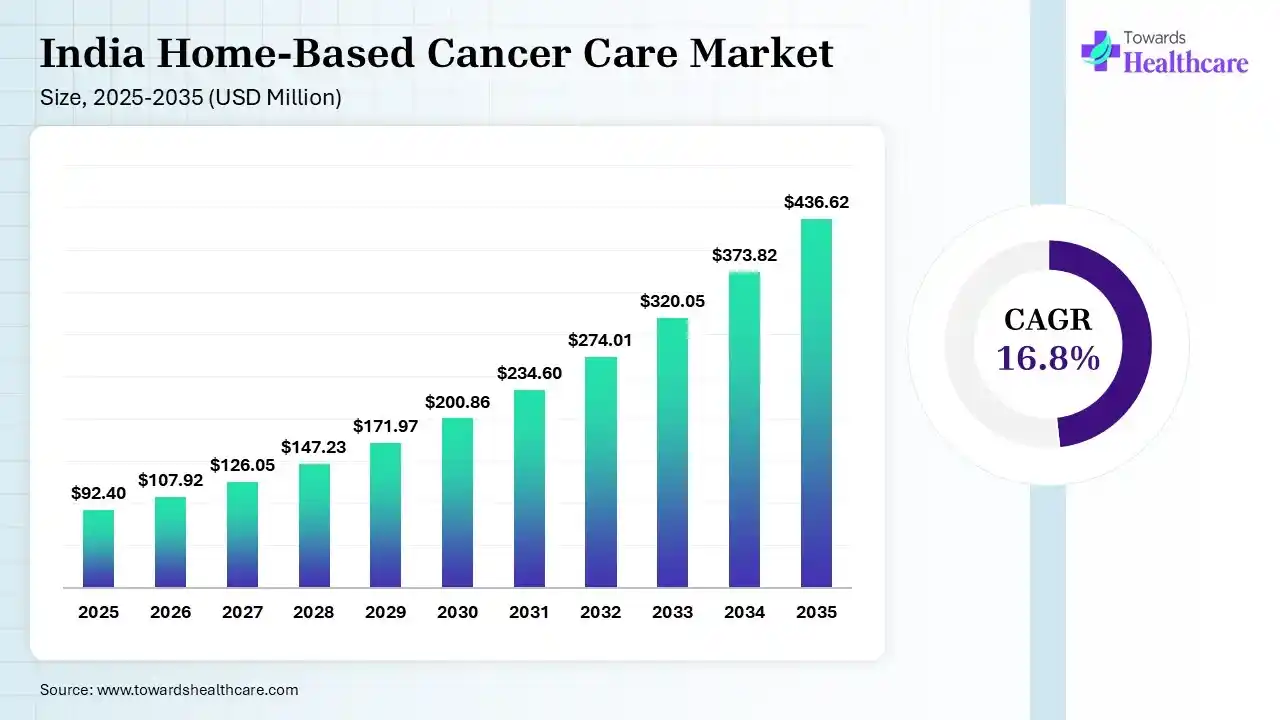
The India home-based cancer care market is estimated at USD 92.4 million in 2025 and is projected to reach USD 436.62million by 2035, representing a CAGR of 16.8% from 2025 to 2035
The underlying patient pool is substantial. India's National Cancer Registry Programme estimated 1,461,427 new cancer cases in 2022, with an estimated increase to approximately 1.57 million cases in 2025. The Government of India also reported 808,558 estimated cancer deaths in 2022.
NITI Aayog estimated India's home healthcare market at approximately US$6.2 billion in 2020 and projected it to reach US$21.3 billion by 2027. Cancer care represents a specialized subset of this market, with demand supported by India's substantial cancer burden and the increasing need for long-term supportive and palliative services.
Apollo's oncology homecare offering, for example, Apollo Homecare illustrates the hospital-linked home healthcare model. Include individual oncology services only when the provider's official service documentation confirms them and clearly distinguishes supportive care from treatment administration. Similarly, a Tata Memorial Hospital-A Tata Memorial Hospital study described a home-based palliative-care model developed in Mumbai. The six-year study enrolled 250 patients with advanced cancer, while the authors reported that the institution provided home care to more than 3,000 patients annually across its broader service..
The market can be segmented by service, cancer type, treatment stage, and geography. The market can be segmented by service, cancer type, treatment stage, and geography. For this report's analytical framework, home-based cancer care is classified by service type, cancer type, treatment stage, delivery model, end user, and geography; these categories are not independently verified market-revenue segments
| Service Type | 2025 Share | CAGR | Growth Interpretation |
| Supportive & Palliative Care |
32.0% - Dominating Unverified 19.8% - Fastest Growing Unverified |
14.90% | Large advanced-cancer and symptom-management requirement |
| Home Nursing & Clinical Monitoring | 21.00% | 16.10% | Rising need for continuous post-treatment and chronic-care support |
| Home Chemotherapy/Infusion Support | 19.00% | 19.8% - Fastest Growing | Greater interest in reducing hospital visits for suitable regimens |
| Post-Operative & Recovery Care | 11.00% | 15.70% | More oncology procedures create recovery requirements. |
| Rehabilitation & Physiotherapy | 7.00% | 16.40% | Survivorship and functional recovery increase demand. |
| Nutrition & Dietary Support | 4.00% | 17.30% | Malnutrition and treatment-related nutritional challenges |
| Psychological & Social Support | 3.00% | 17.00% | Greater recognition of psychosocial cancer burden |
| Remote Monitoring & Tele-oncology Support | 3.00% | 22.40% | Digital coordination expands home-care reach. |
WHO identifies cancer as one of the major conditions requiring palliative care and specifically emphasizes community- and home-based delivery. This, in turn, indicates the market is shifting from a visit-based nursing model toward integrated oncology-at-home models. The strongest commercial differentiation will likely come from providers capable of combining nursing, pharmacy, physician supervision, diagnostics, digital monitoring, and palliative support.
| Cancer Type | 2025 Share | CAGR | Demand Driver |
| Breast Cancer | 23.0% - Dominating | 16.20% | High patient volume and long treatment/recovery pathways |
| Lung Cancer | 14.00% | 15.40% | High symptom and palliative-care requirements |
| Oral & Head/Neck Cancers | 12.00% | 15.80% | Large Indian disease burden and rehabilitation requirements |
| Colorectal Cancer | 10.00% | 17.00% | Increasing treatment and survivorship needs |
| Blood Cancers | 9.00% | 19.1% - Fastest Growing | Complex treatment pathways and prolonged supportive care |
| Cervical Cancer | 8.00% | 14.80% | Large treatment population and palliative requirements |
| Ovarian Cancer | 6.00% | 16.40% | Long-term systemic treatment and supportive care |
| Prostate Cancer | 5.00% | 15.20% | Aging population and chronic treatment |
| Other Cancers | 13.00% | 16.80% | Broadening home-care eligibility |
Cancer-specific home-care demand depends on disease incidence, treatment pathways, patient eligibility, service utilization, affordability, and provider availability; comparative opportunities require patient-level or provider-level evidence.
| Treatment Stage | 2025 Share | CAGR | Key Opportunity |
| Palliative/Advanced Cancer | 31.0% - Dominating | 15.00% | Symptom control and quality-of-life support |
| Active Treatment | 29.00% | 19.2% - Fastest Growing | Selected chemotherapy, infusion and treatment monitoring |
| Post-Treatment/Survivorship | 18.00% | 17.10% | Rehabilitation and long-term monitoring |
| Recurrent Cancer | 13.00% | 16.30% | Repeated treatment and supportive care |
| Early-Stage/Post-Surgery | 9.00% | 15.90% | Recovery, wound and medication management |
Home-based cancer care can support selected patients during active treatment and survivorship when the care plan, clinical eligibility, and escalation protocols permit delivery at home
Geographically, demand is currently concentrated in Tier 1 cities and major healthcare clusters, where specialist hospitals, oncologists, organized home-care providers, diagnostic laboratories, and digital-health infrastructure are more developed. Geographically, demand is currently concentrated in Tier 1 cities and major healthcare clusters, where specialist hospitals, oncologists, organized home-care providers, diagnostic laboratories, and digital-health infrastructure are more developed.Major metropolitan areas are candidate markets for oncology-at-home services because they contain established hospital networks and healthcare providers; comparative city-level demand and service coverage require local evidence
| Region | 2025 Share | CAGR | Dominant Country/State-Level Market | Fastest-Growing Market |
| South India | 31.0% - Dominating | 17.00% | Tamil Nadu | Telangana |
| West India | 27.00% | 16.40% | Maharashtra | Gujarat |
| North India | 24.00% | 16.80% | Delhi-NCR | Uttar Pradesh |
| East India | 12.00% | 18.1% - Fastest Growing Region - Unverified | West Bengal | Odisha |
| Northeast India | 6.00% | 17.70% | Assam | Tripura |
South India has an important advantage in healthcare infrastructure density and specialist availability. The key opportunity is to connect tertiary oncology centres with decentralized home services instead of building standalone home-care networks. Maharashtra is a candidate region for hospital-linked oncology-at-home services; its addressable demand, service coverage, and expansion barriers require state-level provider and patient data. Maharashtra's challenge is less about demand creation and more about scaling standardized services beyond major urban centres. North India presents a strong volume-expansion opportunity, but service quality can vary significantly between metropolitan and non-metropolitan markets. Partnerships with hospitals and regional cancer centres can reduce the clinical infrastructure gap. Community-linked palliative care and post-discharge oncology support are potential service areas to evaluate in eastern India; the size of unmet demand requires regional evidence
Potential demand drivers include the national cancer burden, the need for supportive care, travel requirements, and demand for post-discharge services. Quantify each factor only when a reliable India-specific source establishes its relevance to home-based cancer care.
Overall, the market is transitioning from a hospital-centric model toward a continuum-of-care model, where hospitals remain central for diagnosis, surgery, chemotherapy, radiation, and complex interventions, while home-based providers increasingly support monitoring, recovery, symptom management, rehabilitation, palliative care, and follow-up.
India's home-based cancer care ecosystem is highly fragmented and includes hospitals, specialized home healthcare companies, hospices, palliative-care organizations, NGOs, diagnostic laboratories, pharmacies, telemedicine platforms, insurance companies, and government healthcare programs. Unlike conventional hospital oncology, where large cancer centres dominate treatment delivery, home-based cancer care involves multiple providers participating across different stages of the patient journey.
India's government cancer-control infrastructure provides an important foundation. The Government of India reported 724 District NCD Clinics, 326 District Day Care Centres and 6,110 Community Health Centre NCD Clinics under the national program as of the period reported in 2023. Government operational guidance also calls for district hospitals to develop skills for home-based palliative care and identifies multidisciplinary teams involving nurses and counsellors. A 2015 Tata Memorial study of 690 new patients registered under a home-based palliative program found that 506 received home-based care; 50.98% were cared for at home, 28.85% required hospice referral, and 20.15% required a brief hospitalization.
The value chain generally begins with diagnosis and treatment planning at a hospital or cancer centre. Once a patient's clinical condition permits home-based care, the patient may be referred to a home healthcare provider, palliative-care organization, or hospital-affiliated home-care service. The provider conducts a home assessment and develops an individualized care plan involving physicians, nurses, physiotherapists, counsellors, nutritionists, pharmacists, and other professionals as required.
The next stage involves home-based service delivery. This can include nursing, medication administration, wound care, symptom management, pain management, physiotherapy, nutritional support, caregiver training, and monitoring. Diagnostic laboratories may provide home sample collection, while pharmacies and healthcare platforms can support medication delivery. Telemedicine allows oncologists and other specialists to maintain contact with patients without requiring frequent hospital visits.
At the advanced stage of illness, palliative and hospice providers become particularly important. Their role includes pain and symptom management, psychological and social support, caregiver assistance, and end-of-life care. WHO recognizes community- and home-based care as an important component of palliative care for patients with serious illnesses, including cancer.
Competition occurs across several dimensions. Providers compete on clinical expertise, geographic coverage, availability of trained nurses, physician access, response times, technology, pricing, hospital relationships, and breadth of services. Hospital-led programs have the advantage of direct access to oncologists and patient records, whereas specialized home-care providers can potentially offer greater flexibility and broader geographic coverage.The following organizations represent selected home healthcare, hospital-based cancer care, and palliative-care participants relevant to India's oncology-at-home ecosystem; inclusion does not establish market share or direct competition.
| Company/Organization | Relevant Capability | Strategic Relevance |
| Apollo Homecare/Apollo Hospitals | Oncology homecare, nursing, post-operative support, symptom monitoring and chemotherapy-related supportive care | Hospital-linked integrated model |
| Portea Medical | Home nursing, doctor visits, chronic-care and home-health services | Large home-care delivery infrastructure |
| Healthcare atHOME (HCAH) | Home nursing, clinical homecare and specialized healthcare services | Potential oncology-support platform |
| Tata Memorial Centre | Home-based palliative and supportive cancer care | Institutional benchmark for specialist home oncology |
| Tata Trusts | Distributed cancer-care and palliative-care initiatives | Decentralized cancer-care infrastructure |
| PALCARE | Free home-based palliative care, predominantly for cancer patients | Community/NGO delivery model |
| HCG-related oncology network | Oncology-focused healthcare and home-care-related services | Specialist oncology ecosystem |
Competition is developing around clinical integration rather than simply geographic coverage. Key ecosystem participants include large hospital networks, organized home healthcare companies, specialized palliative-care organizations, diagnostic providers, digital-health platforms, pharmaceutical companies, insurers, and NGOs. Hospital networks may provide specialist access and referral pathways; home healthcare companies may supply field-care teams; and NGOs may deliver community-based services. Verify these capabilities for each organization before making company-level comparisons.
Partnerships are therefore central to the market structure. A home-care provider may partner with a cancer hospital for referrals, a diagnostic laboratory for home testing, a pharmacy for medication fulfilment, and an insurer for reimbursement.
The market can be analyzed as the intersection of hospital oncology, home healthcare, and palliative-care services, with the degree of integration varying by provider and location
Potential demand drivers include cancer-related supportive-care needs, post-discharge requirements, travel burdens, and the availability of trained home-care professionals; quantify their impact only when supported by relevant evidence.
Relevant technologies include teleconsultations, digital care records, remote monitoring, and home diagnostic services. Report a technology as commercially deployed in India only when a named provider, product, service description, and reliable source establish its use.
Regulation represents an important consideration. India's healthcare environment involves multiple regulatory and professional requirements covering clinical practice, telemedicine, medicines, medical devices, health data, nursing, and patient privacy. India's national NCD program provides context for public-sector cancer and chronic-disease services; identify a specific program provision before claiming that it directly supports or funds private home-based cancer care.
Business models vary considerably. Providers may use fee-for-service, per-visit, subscription, care-package, hospital-partnership, insurance-reimbursement, or B2B2C models. Integrated packages can combine nursing, physician consultations, diagnostics, rehabilitation, and palliative support; any effect on retention or revenue per patient must be established using provider-level operating data. However, Affordability is a relevant consideration for privately purchased home healthcare. Add the exact out-of-pocket expenditure percentage only after citing the corresponding Ministry of Health and Family Welfare National Health Accounts release and reporting year.
Tier 2 and Tier 3 cities are potential expansion markets where local cancer-care demand, provider availability, specialist access, affordability, and operating costs support a viable service model.
Potential funding sources include healthcare investors, hospital groups, technology companies, impact investors, and philanthropic organizations; report actual sector investment only when a named transaction, date, amount, and reliable source are available.
Looking toward 2030, the market is likely to develop from fragmented home nursing and palliative services toward integrated oncology-at-home ecosystems. Hospitals will continue to handle complex diagnosis and treatment, while home providers increasingly support recovery, monitoring, symptom management, rehabilitation, palliative care, and follow-up.
The strategic opportunity is therefore not to replace hospital oncology but to extend cancer care beyond the hospital, creating a coordinated continuum between cancer centres, patients, caregivers, diagnostics, pharmacies, technology platforms, and home-care professionals.
The customer landscape for India's home-based cancer care market includes cancer patients, family caregivers, hospitals, oncologists, insurers, employers, and government healthcare programs. Patients and family caregivers are key end users of privately purchased home-care services; the purchaser, clinical referrer, and payer may differ by household and service model.
Cancer patients have different requirements depending on their disease stage and treatment pathway. Patients undergoing active treatment may require nursing support, medication management, monitoring, nutrition, and assistance with treatment-related side effects. Patients recovering after surgery or treatment may need physiotherapy, wound care, rehabilitation, and follow-up monitoring. Patients with advanced or metastatic cancer often require palliative care, pain management, symptom control, psychological support, and end-of-life care. WHO emphasizes that palliative care should address physical, psychological, social, and spiritual suffering and can be integrated into community and home-based care.
| Patient Priority | Potential Service Requirement |
| Clinical safety | Physician escalation and trained nursing are essential. |
| Oncologist coordination | Hospital-linked models gain trust. |
| Pain and symptom control | Supports palliative-care demand |
| Reduced hospital travel | Strong driver of home adoption |
| Treatment convenience | Supports home infusion and selected chemotherapy |
| Affordability | Critical in India's price-sensitive market |
| Availability of trained nurses | Major scaling constraint |
| Emergency support | Required for higher-acuity services |
| Medication availability | Pharmacy integration improves continuity. |
| Privacy and dignity | Important for end-of-life and long-term care |
| Digital monitoring | Supports remote follow-up |
| Family/caregiver support | Differentiates comprehensive services |
Family caregivers play a particularly important role in India.Family members may help arrange, select, or pay for home-care services; the extent of their involvement varies by household and requires patient or caregiver survey data to quantify. Their purchasing criteria generally include trust, caregiver qualifications, availability, affordability, response time, communication with doctors, and the provider's ability to manage emergencies. Reducing the physical and emotional burden of repeated hospital visits is also an important consideration.
Hospitals and oncologists represent another important customer and referral group. Cancer centres may use external home-care providers to support patients after discharge or for long-term supportive care. Strong relationships with hospitals can therefore provide providers with a recurring source of patients.
Insurance reimbursement may influence adoption where a patient's policy explicitly covers the relevant home healthcare service; verify coverage, exclusions, and eligibility against current insurer policy documents.
Key purchasing criteria across customer groups include clinical quality, trained staff, specialist oncology expertise, price, service availability, geographic coverage, technology, hospital affiliation, continuity of care, and reputation.
An important characteristic of the market is that the user, decision-maker, referrer, and payer may be different people or organizations. A patient may receive the service, a family member may select the provider, an oncologist may recommend it, and an insurer may pay for some services.
Consequently, successful providers need a multi-channel strategy that addresses patients and families while simultaneously building relationships with hospitals, oncologists, insurers, and other healthcare stakeholders.
India's home-based cancer care market offers opportunities across clinical services, technology, geographic expansion, hospital partnerships, and integrated care models. Potential opportunities include services that complement hospital oncology by supporting eligible patients with symptom management, post-discharge recovery, rehabilitation, and follow-up.
Home palliative care represents one of the most important opportunities. Patients with advanced cancer can require prolonged symptom management, pain relief, psychological support, caregiver assistance, and end-of-life services. Organized palliative-care networks can address an important gap between hospital treatment and community-based support.
A second opportunity is specialized oncology nursing. Cancer patients often require more specialized care than conventional home-care patients. Providers that develop trained oncology nursing teams can differentiate themselves through clinical expertise and standardized care pathways.
Hospital-to-home transition services offer another attractive opportunity. Hospitals can refer appropriate patients for post-discharge monitoring, medication management, wound care, rehabilitation, nutrition, and follow-up. Formal partnerships can create recurring referral channels for home-care companies.
Technology creates additional opportunities through tele-oncology, remote patient monitoring, digital health records, and home diagnostics. These services can improve access to specialists, particularly for patients outside major metropolitan areas. A hybrid model in which local nurses provide physical care while oncologists provide remote specialist support could help extend cancer care into Tier 2 and Tier 3 cities.
Home diagnostics and pharmacy services can also become part of integrated oncology-at-home platforms. Patients requiring repeated blood tests or medications can receive these services without frequent hospital visits.
Another opportunity is the development of integrated cancer-at-home platforms combining doctors, nurses, diagnostics, pharmacy, physiotherapy, nutrition, palliative care, and caregiver support. Such platforms can potentially improve patient retention and create multiple revenue streams.
Geographically, metropolitan areas provide near-term opportunities because they have high patient density and strong healthcare infrastructure. Once operating models are established, providers can expand into smaller cities using hub-and-spoke and technology-enabled models.
B2B opportunities are also significant. Partnerships with hospitals, insurers, pharmaceutical companies, diagnostic laboratories, and employers can provide access to larger patient populations.
Evaluate each opportunity by clinical eligibility, local demand, service coverage, workforce availability, hospital referral pathways, affordability, and unit economics.
Investment in India's home-based cancer care market is closely connected with the broader growth of home healthcare, digital health, chronic disease management, senior care, and palliative care. Potential sources of capital include venture capital, private equity, strategic healthcare investors, hospital groups, technology companies, impact investors, and philanthropic organizations.
The sector can be attractive because cancer care generates recurring requirements for monitoring, nursing, rehabilitation, medication management, and supportive services. However, home-based care is relatively labour-intensive, meaning investors must evaluate both technology and operational economics.
Investment diligence should distinguish technology development costs from the operating costs of clinical delivery, including staffing, travel, equipment, compliance, and patient acquisition.
Another opportunity is specialized oncology and palliative-care providers. Companies with trained oncology nurses, specialist physicians, standardized protocols, and hospital referral relationships may have stronger differentiation than general home-care providers.
Assess hospital partnerships using documented referral volumes, conversion rates, patient eligibility, service utilization, and contract terms rather than assuming that an affiliation guarantees recurring revenue.
Key financial metrics include customer acquisition cost, workforce utilization, travel costs, average revenue per patient, gross margin, repeat utilization, geographic density, and operating leverage. High geographic density can improve economics because healthcare professionals spend less time travelling between patients.
Funding can also support expansion into remote monitoring, home diagnostics, digital palliative care, and AI-enabled patient-risk monitoring. Government and philanthropic funding may be particularly relevant for palliative-care programs serving underserved populations.
Nevertheless, investors face risks including workforce shortages, fragmented service providers, uncertain reimbursement, clinical liability, regulatory requirements, and affordability constraints. Labour-intensive operations can also make rapid geographic expansion difficult.
Consequently, investment attractiveness depends on more than market size. Investors are likely to place greater emphasis on clinical quality, recurring revenue, strong hospital partnerships, workforce productivity, patient outcomes, technology integration, and sustainable unit economics.
The most scalable businesses are likely to combine physical healthcare delivery with digital coordination and recurring care models, allowing them to expand while maintaining appropriate clinical governance and service quality.
Market entry requires a clearly defined eligible patient population, clinically governed service scope, trained oncology-care personnel, referral pathways, and a viable local operating model. Providers should validate demand and affordability before expanding geographically. Investment decisions should prioritize verified patient volumes, clinical outcomes, workforce utilization, travel costs, and sustainable unit economics.
By Service Type
By Cancer Type
By Treatment Stage
By Delivery Model
By End User/Buyer
By Region


Principal Consultant
Payal Rabde is a Healthcare Market Research Analyst at Towards Healthcare Research & Consulting with 4+ years of experience in pharmaceuticals, biotechnology, medical devices, and life sciences.
Learn more about Payal Rabde

Reviewed By
Aditi Shivarkar is a seasoned professional with over 14 years of experience in healthcare market research. As a content reviewer, Aditi ensures the quality and accuracy of all market insights and data presented by the research team.
Learn more about Aditi Shivarkar