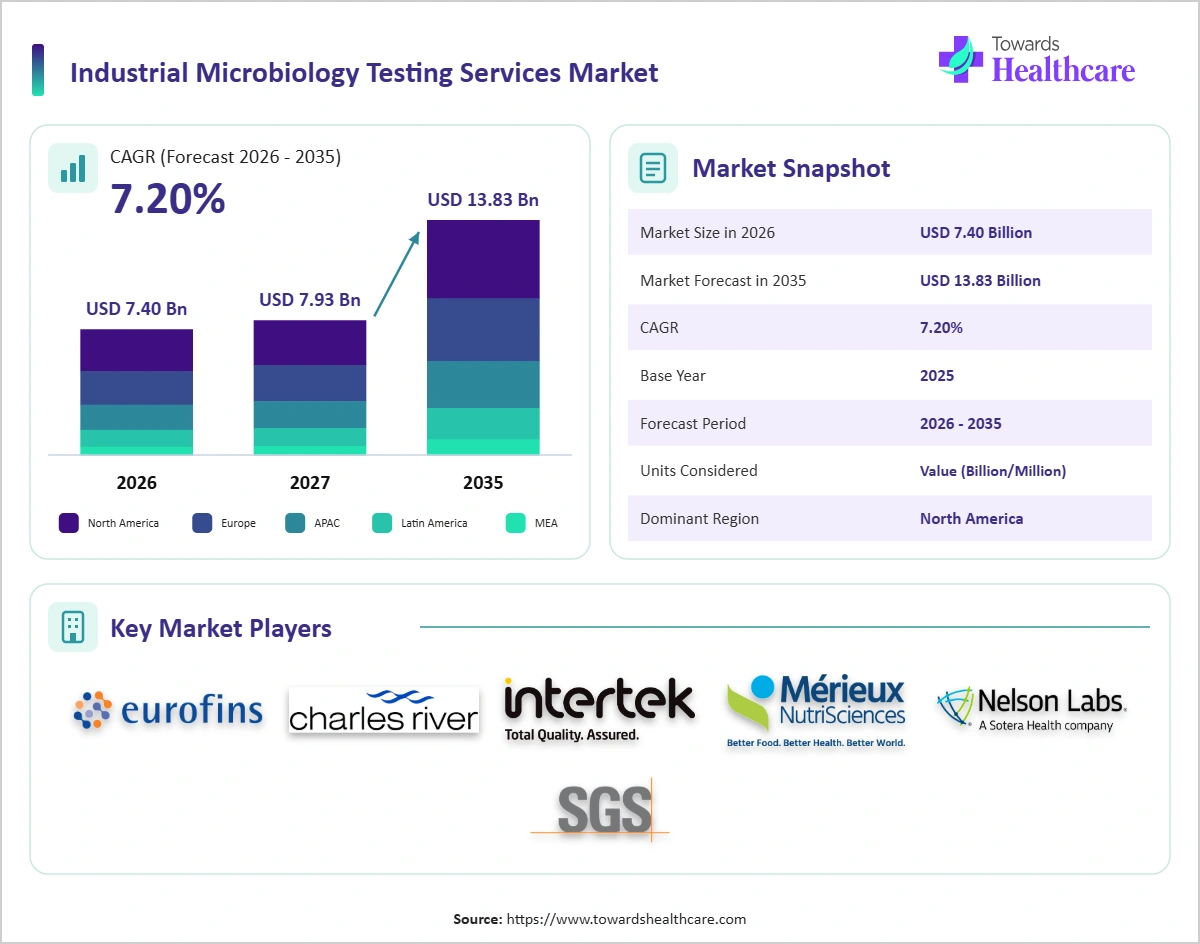
The industrial microbiology testing services market is expected to grow from USD 6.90 billion in 2025 to USD 13.83 billion by 2035, driven by increasingly stringent regulatory requirements and the growing preference for outsourced microbiological testing. Pharmaceutical, biotechnology, food, and medical device companies are increasingly relying on specialized laboratories to meet quality and safety standards. These factors are expected to support market expansion to USD 9.77 billion by 2030, at a CAGR of 7.20% from 2026 to 2035.
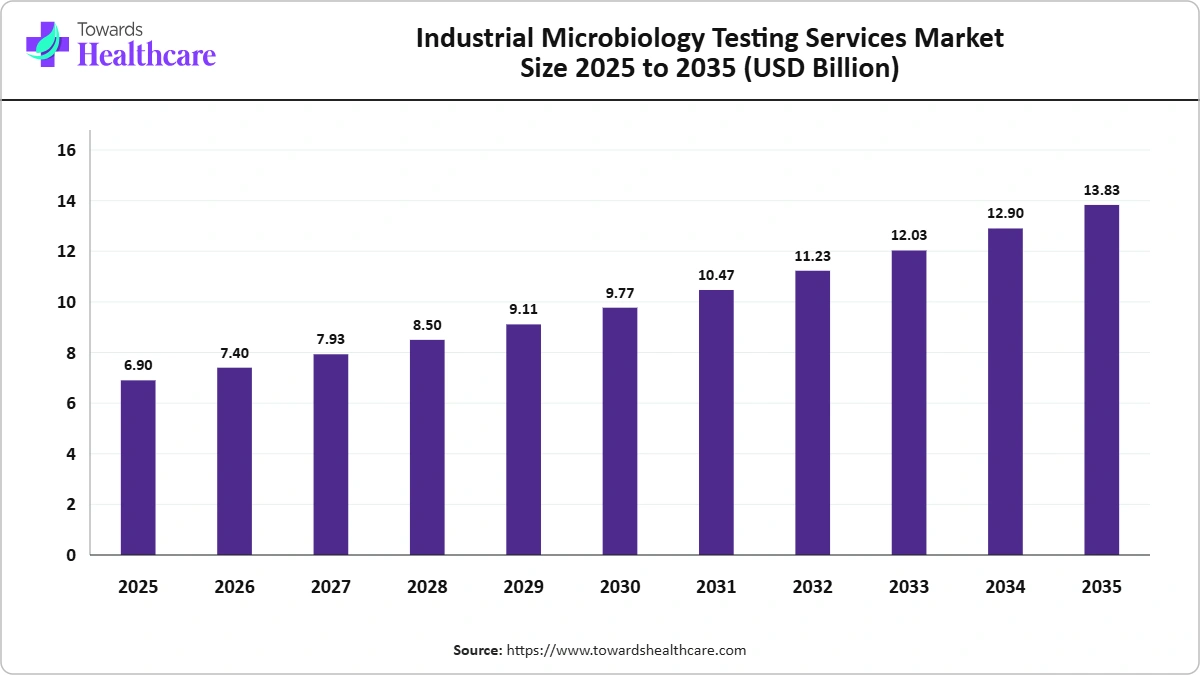
Analyst View: The market estimate was developed using testing volumes across different test types and end-use industries, along with average testing prices. These estimates were cross-checked against laboratory companies' revenues to strengthen the reliability of the market assessment.
Rapid Microbiological Methods: Growing adoption of rapid microbiological methods is reducing reliance on conventional culture-based testing. Faster detection and shorter testing timelines help manufacturers improve quality control and accelerate product release.
Recombinant Endotoxin Tests: Recombinant Factor C (rFC) assays are gaining attention as alternatives to traditional Limulus Amebocyte Lysate (LAL) testing. Their adoption supports the shift toward animal-free endotoxin testing methods.
Annex 1 Compliance: Stricter EU GMP Annex 1 requirements are increasing the need for comprehensive contamination control strategies. This is driving demand for environmental monitoring, microbial testing, and supporting data to demonstrate compliance.
Consolidation: Large testing networks are acquiring regional laboratories to expand their geographic reach and service capabilities. This trend is strengthening competition while creating opportunities to serve clients across multiple locations.
Automation: Increasing automation of laboratory processes, including media preparation and handling, is improving testing efficiency and workflow consistency. Automated systems also help reduce manual intervention and support higher testing throughput.
The industrial microbiology testing services market is driven by regulation and outsourcing. Annex 1, MoCRA, and food safety rules increase testing, while labs consolidate and adopt rapid methods.
| Driver | Impact | ≈ CAGR Contribution | Time Horizon | Key Regions |
| GMP regulation | High | +2.81 pp | Short to long term | Global, strongest in North America |
| Food safety | Medium | +2.37 pp | Medium to long term | Global, fastest uptake in Asia Pacific |
| Biologics growth | Medium | +2.02 pp | Short to medium term | Global |
| Outsourcing | Low | +1.58 pp | Long term | Developed and emerging markets |
Note: Contributions are indicative estimates of each factor's effect on annual growth.
Sources: Expert interviews, secondary sources, Towards Healthcare database, and Towards Healthcare analysts.
GMP regulation, food safety, and biologics growth drive most growth in the industrial microbiology testing services market.
| Restraint | Impact | ≈ Negative CAGR Contribution | Time Horizon | Key Regions |
| Price pressure | High | -0.71 pp | Short to medium term | Global |
| Skilled staff shortage | High | -0.52 pp | Medium term | Price-sensitive and emerging markets |
| Long validation of new methods | Medium | -0.35 pp | Short term | North America and other mature markets |
Note: Contributions are indicative estimates of each factor's effect on annual growth.
Sources: Expert interviews, secondary sources, Towards Healthcare database and Towards Healthcare analysts.
Price pressure is the main restraint, followed by staff shortages and slow method validation.
Cell and Gene Therapy Testing: Growing adoption of cell and gene therapies is creating demand for rapid sterility testing. These products often have short shelf lives, making timely microbiological results essential for quality control and product release.
Cosmetics Under MoCRA: The Modernization of Cosmetics Regulation Act (MoCRA) is strengthening U.S. cosmetic safety and quality requirements. This is increasing the need for microbiological testing to identify contamination and support regulatory compliance.
Asian Export Markets: Expanding exports of pharmaceutical, food, and cosmetic products across Asia are creating opportunities for accredited microbiology testing laboratories. Exporters rely on recognized testing facilities to meet international quality standards and destination-market requirements.
Note: 2025 is the base year; 2035 shares and CAGRs are forecasts.
Sources: Expert interviews, secondary sources, Towards Healthcare database, and Towards Healthcare analysts.
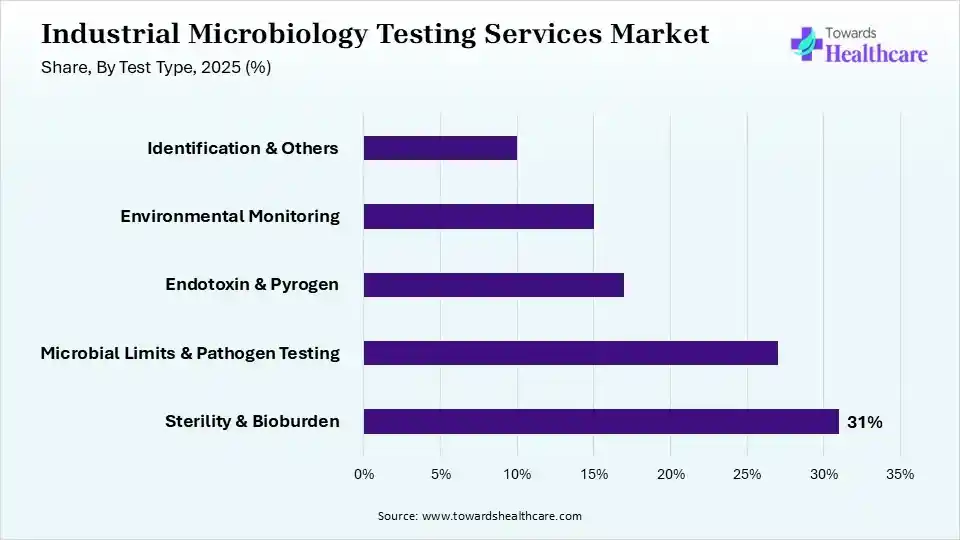
Sterility & Bioburden: Sterility and bioburden testing accounted for the largest test-type share at 31.00%. Demand is supported by the need to verify the microbial safety of sterile pharmaceutical products and medical devices before release.
Microbial Limits & Pathogen Testing driven largely by testing requirements for food products and non-sterile goods. These tests help detect harmful microorganisms and ensure compliance with applicable safety standards.
Endotoxin & Pyrogen growing adoption of recombinant Factor C (rFC) assays as alternatives to traditional Limulus Amebocyte Lysate (LAL) methods is shaping this segment.
Environmental Monitoring increasing emphasis on contamination control in pharmaceutical manufacturing and cleanroom environments is driving demand for routine microbial monitoring.
Identification & Others: Microbial identification and other testing services account for the remaining market share. These services support contamination investigations, microbial characterization, and routine quality control across various industries.
The pharmaceutical and biotechnology segment accounted for the largest end-user share at 41.00%. Strong demand comes from the need to maintain sterility and control microbial contamination throughout drug manufacturing. Increasing production of biologics, vaccines, injectable drugs, and cell and gene therapies is further driving the use of sterility, bioburden, endotoxin, and environmental monitoring services. Strict GMP requirements also encourage manufacturers to conduct regular microbiological testing at different stages of production.
The food and beverage supported by growing emphasis on food quality, hygiene, and consumer safety. Manufacturers rely on microbial limits and pathogen testing to detect harmful microorganisms such as Salmonella, E. coli, and Listeria in raw materials and finished products. Regulatory requirements, including the U.S. Food Safety Modernization Act (FSMA), are encouraging more frequent testing and stronger contamination prevention practices across food processing and packaging facilities.
Medical devices growing production of sterile devices, including surgical instruments, implants, catheters, and diagnostic products, is increasing demand for microbiological testing. Manufacturers use sterility and bioburden testing to assess microbial contamination and verify that sterilization processes are effective. Compliance with stringent quality standards and regulatory requirements further supports the adoption of specialized testing services.
Cosmetics & personal care driven by increasing attention to product safety and microbial quality. Cosmetics manufacturers require microbial limits testing, preservative efficacy testing, and pathogen screening to ensure that products remain safe during storage and use. The implementation of the Modernization of Cosmetics Regulation Act (MoCRA) in the U.S. is also strengthening expectations around cosmetic product safety and manufacturing practices, encouraging greater use of third-party microbiological testing laboratories.
Water & other end users account for the remaining market share. Demand for microbiological testing is supported by the need to monitor microbial contamination in drinking water, process water, wastewater, and industrial water systems. Testing helps identify harmful microorganisms, assess water quality, and support compliance with applicable safety standards. Other industrial users also rely on microbiological testing to monitor contamination risks in production environments and maintain consistent product quality.
Analyst View: Environmental monitoring and cosmetics testing are expected to gain market share at a faster pace, supported by stricter contamination control requirements and increasing regulatory focus on product safety. The growing adoption of advanced monitoring practices in pharmaceutical manufacturing and rising microbiological testing needs in the cosmetics industry are creating new growth opportunities. Meanwhile, sterility and bioburden testing and the pharma and biotech segment are expected to retain their leading positions, driven by mandatory quality control requirements, expanding biologics production, and the critical need to ensure the safety of sterile products.
Sources: Expert interviews, secondary sources, Towards Healthcare database, and Towards Healthcare analysts.
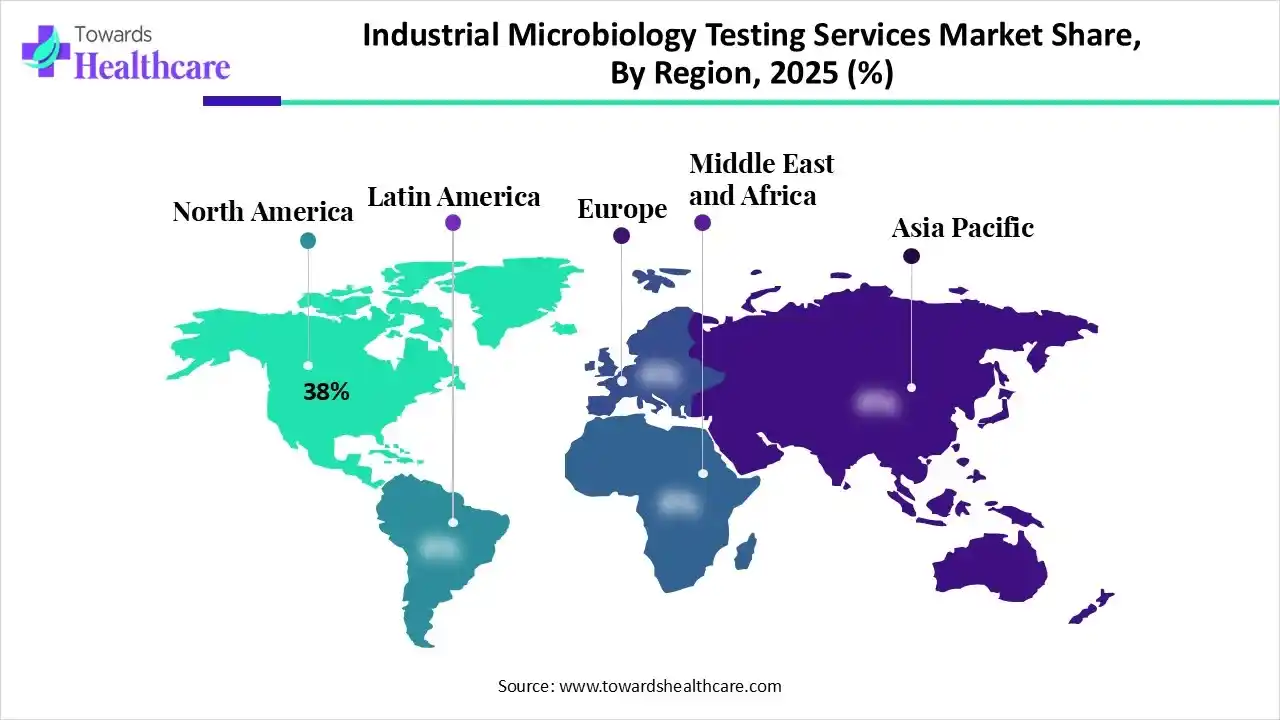
North America held the largest regional share at 38.00% in 2025, supported by stringent FDA regulations, GMP requirements, and food safety standards under the Food Safety Modernization Act (FSMA). The region's well-established pharmaceutical and biotechnology industries generate consistent demand for sterility, bioburden, endotoxin, and environmental monitoring services. Industry consolidation is also strengthening the regional testing landscape, with Eurofins completing its acquisition of Element's North American life sciences testing business in October 2026.
Europe GMP Annex 1 is a major demand driver, as its contamination control requirements encourage pharmaceutical manufacturers to strengthen environmental monitoring, microbial testing, and cleanroom quality assessments.
Asia Pacific growth is supported by expanding pharmaceutical, biotechnology, and food manufacturing activities in India and China. Increasing exports are also encouraging manufacturers to work with accredited laboratories to meet international quality standards and regulatory requirements in destination markets.
Latin America growth is supported by the gradual expansion of pharmaceutical and food processing industries, along with increasing attention to product quality and microbial safety. Rising regulatory oversight and the need to meet export-related testing requirements are creating opportunities for specialized microbiology testing laboratories.
The Middle East and Africa growing investments in pharmaceutical manufacturing, food processing, and healthcare infrastructure are supporting demand for microbiological testing services. Increasing emphasis on product safety, water quality, and compliance with international manufacturing standards is also encouraging the adoption of accredited testing facilities.
Analyst View: North America is expected to maintain its leading position in the industrial microbiology testing services market, supported by stringent regulatory requirements, established pharmaceutical manufacturing capabilities, and a strong network of specialized testing laboratories. Meanwhile, Asia Pacific is projected to record the fastest growth, driven by expanding pharmaceutical and food production, rising exports, and increasing demand for internationally accredited microbiological testing services.
| Rank | Company Name | 2025 Share (%) | Key Products / Business | Headquarters |
| 1 | Eurofins Scientific | 14.00% | pharma, food and environmental microbiology | Luxembourg |
| 2 | SGS | 7.00% | food and product testing | Switzerland |
| 3 | Charles River Laboratories | 5.00% | microbial solutions | United States |
| 4 | Mérieux NutriSciences | 5.00% | food testing | France |
| 5 | Intertek | 4.00% | product testing | United Kingdom |
| 6 | Nelson Labs (Sotera Health) | 4.00% | device and pharma microbiology | United States |
| 7 | Bureau Veritas | 3.00% | testing services | France |
| 8 | WuXi AppTec | 2.00% | testing services | China |
| 9 | Pace Analytical | 2.00% | environmental microbiology | United States |
| 10 | Cormica | 1.00% | pharma and device testing | United Kingdom |
Note: Company shares are 2025 estimates.
Sources: Company press releases, expert interviews, secondary sources, Towards Healthcare database and Towards Healthcare analysts.
Eurofins Scientific led the industrial microbiology testing services market with an estimated 14.00% share of 2025 revenue, followed by SGS at 7.00% and Charles River Laboratories at 5.00%. Eurofins Scientific maintains a strong position through its pharmaceutical, food, and environmental microbiology testing services. SGS competes through its food and product testing capabilities, while Charles River Laboratories focuses on specialized microbial testing solutions for pharmaceutical and biotechnology applications.
Other key participants include Mérieux NutriSciences, Intertek, Nelson Labs (Sotera Health), Bureau Veritas, WuXi AppTec, Pace Analytical, and Cormica. These companies compete across food testing, product testing, medical device and pharmaceutical microbiology, environmental analysis, and specialized testing services.
The top 10 companies accounted for an estimated 46.96% of total market revenue in 2025, while the remaining 53.04% was distributed among numerous regional laboratories and in-house testing facilities. This indicates a fragmented competitive landscape, with no single provider controlling the majority of the market. Competition is primarily based on laboratory accreditation, testing turnaround time, geographic network coverage, adoption of rapid microbiological methods, and service pricing. Providers with broad testing capabilities and established laboratory networks are better positioned to serve clients across multiple industries and regulatory markets.
Eurofins Scientific, headquartered in Luxembourg, held an estimated 14.00% share of the industrial microbiology testing services market in 2025. Its strong position is supported by a broad portfolio of pharmaceutical, food, and environmental microbiology testing services.
Headquartered in Switzerland, SGS accounted for approximately 7.00% of market revenue in 2025. Its competitive position is supported by food and product testing services, helping manufacturers meet quality, safety, and regulatory requirements.
Based in the United States, Charles River Laboratories held an estimated 5.00% share of the market in 2025. Its position is supported by specialized microbial testing solutions serving pharmaceutical and biotechnology companies.
Headquartered in France, Mérieux NutriSciences accounted for an estimated 5.00% market share in 2025. Its competitive presence is primarily driven by food microbiology testing services, which help food manufacturers assess microbial safety and maintain product quality.
Intertek, headquartered in the United Kingdom, held an estimated 4.00% share of the industrial microbiology testing services market in 2025. Its market presence is supported by product testing services that help businesses evaluate product quality, safety, and compliance with applicable standards.
Nelson Labs (Sotera Health), based in the United States, held an estimated 4.00% market share in 2025. Its portfolio focuses on microbiological testing for medical devices and pharmaceutical products, including services that support sterility assurance and regulatory compliance.
Bureau Veritas, headquartered in France, accounted for approximately 3.00% of market revenue in 2025. Its presence is supported by a range of testing services that help industrial and commercial clients assess product quality, safety, and compliance.
Based in China, WuXi AppTec held an estimated 2.00% share of the industrial microbiology testing services market in 2025. Its market presence is supported by testing services for pharmaceutical and biotechnology companies, helping them address product quality and development requirements.
Pace Analytical, headquartered in the United States, accounted for approximately 2.00% of market revenue in 2025. Its portfolio includes environmental microbiology testing, supporting the assessment of microbial contamination in environmental and water samples.
Headquartered in the United Kingdom, Cormica held an estimated 1.00% share of the industrial microbiology testing services market in 2025. Its offerings focus on pharmaceutical and medical device testing, supporting manufacturers with product quality and regulatory testing requirements.
The industrial microbiology testing services ecosystem links media & kit suppliers, testing labs, clients, accreditation bodies and regulators, with each stage adding value before products reach end users. Labs test cosmeceuticals, probiotics, and cell therapy products and use biological safety cabinet workflows.
| Ecosystem Stage | Role in the Market | Key Companies |
| Media & Kit Suppliers | Supply culture media and kits | Thermo Fisher (sold to Astorg), bioMérieux, Merck |
| Testing Labs | Run tests | Eurofins, SGS, Charles River |
| Clients | Commission tests | Pharma, food, cosmetics firms |
| Accreditation Bodies | Certify labs | ISO 17025 bodies |
| Regulators | Set rules | FDA, EMA, FSSAI |
Sources: Company press releases, expert interviews, secondary sources,Towards Healthcare database, and Towards Healthcare analysts.
Media & Kit Suppliers: Media and test kit suppliers play a critical role in maintaining the accuracy and reliability of microbiological testing. The quality, consistency, and performance of culture media, reagents, and testing kits directly influence test results and laboratory performance.
Testing Labs: Testing laboratories provide specialized microbiological testing services across pharmaceutical, food, medical device, cosmetics, and environmental applications. Established laboratory networks offer wider geographic coverage, standardized testing capabilities, and faster sample processing for clients operating across multiple regions.
Clients: Pharmaceutical, biotechnology, food, and medical device companies outsource microbiological testing to access specialized expertise and reduce the need for in-house laboratory infrastructure. Outsourcing also helps companies manage testing volumes, control operating costs, and maintain production capacity.
Accreditation Bodies: Accreditation bodies assess laboratories against recognized quality and technical standards to establish their competence and reliability. Accreditation helps testing providers demonstrate the accuracy of their methods, maintain consistent procedures, and meet customer and regulatory expectations.
Regulators: Regulatory authorities shape demand for microbiological testing through GMP requirements, pharmaceutical quality standards, and food safety regulations. These requirements encourage manufacturers to conduct routine testing, monitor contamination risks, and maintain documented evidence of product safety and regulatory compliance.
Value in the industrial microbiology testing services market flows from upstream material and technology suppliers to manufacturers and service providers, then through distribution partners to end users. Companies that integrate several stages or build long-term relationships with end users capture a larger share of this value.
The Towards Healthcare Companies Quadrant positions key participants in the industrial microbiology testing services market by market strength, reflecting revenue scale, market share and geographic reach, and by innovation and growth strategy, reflecting product portfolio breadth, R&D intensity and partnerships. Positions reflect each company's estimated 2025 share of the industrial microbiology testing services market and our assessment of its product innovation, portfolio breadth and partnerships.
Sources: Company press releases, expert interviews, secondary sources, Towards Healthcare database and Towards Healthcare analysts.
Leaders: Eurofins Scientific, SGS, Charles River Laboratories, Mérieux NutriSciences, Intertek, and Nelson Labs (Sotera Health) combine high market share with broad portfolios and strong innovation.
Innovators: Bureau Veritas, WuXi AppTec, Pace Analytical and Cormica bring newer technologies and specialised products.
By Test Type
By End User
By Region
The industrial microbiology testing services market was defined as outsourced microbiology testing services for industry, including sterility testing, bioburden, endotoxin and pyrogen testing, environmental monitoring, microbial identification, microbial limits and preservative efficacy testing, and pathogen testing, for pharmaceuticals and biologics, medical devices, food and beverage, cosmetics and personal care, and water. The 2025 base year was built bottom-up from demand volumes and average prices by test type and end user and region, and checked top-down against the market-specific revenues of leading companies and public industry data. Segment, regional and company values were allocated from test type and end user and region demand.
Key estimates were verified by cross-checking company disclosures, regulatory and industry data, and published third-party estimates, and inputs that could not be reconciled were excluded. All segment, regional and company figures were reconciled to the same 2025 base year, and the 2026-2035 forecast, which applies a constant CAGR from the 2025 base, was recalculated and validated.
Analyst View: We expect the industrial microbiology testing services market to grow steadily, supported by regulation. Rapid microbiological methods will raise prices per test while reducing turnaround times.