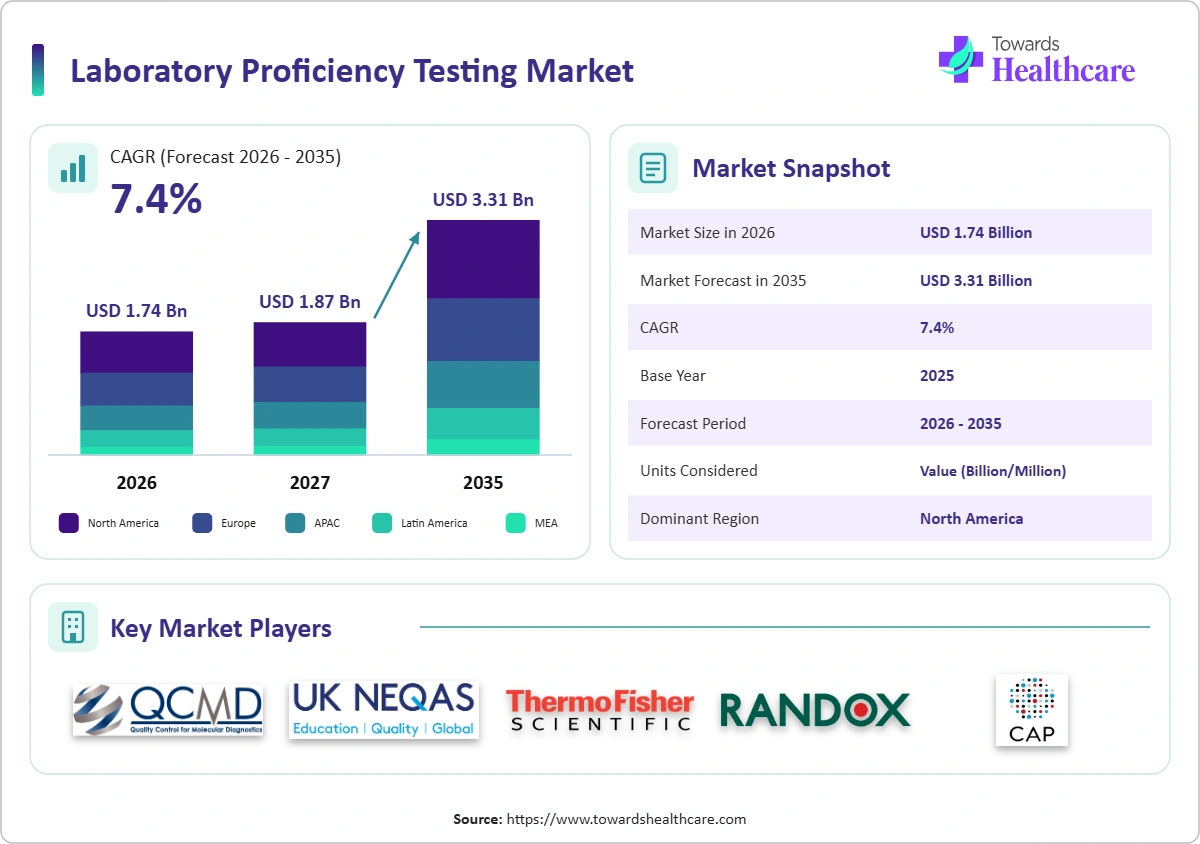
The laboratory proficiency testing market is expected to expand from USD 1.62 billion in 2025 to USD 3.31 billion by 2035, registering a CAGR of 7.40% by 2035. Increasing accreditation requirements are encouraging laboratories to participate in proficiency testing programs to demonstrate testing accuracy and maintain quality standards. Growing laboratory numbers, expanding diagnostic capabilities, and rising food and water safety requirements further support market growth, with revenue projected to reach USD 2.31 billion by 2030. Additionally, the expansion of next-generation sequencing, genomics, and cell culture testing is creating demand for specialized proficiency testing schemes.
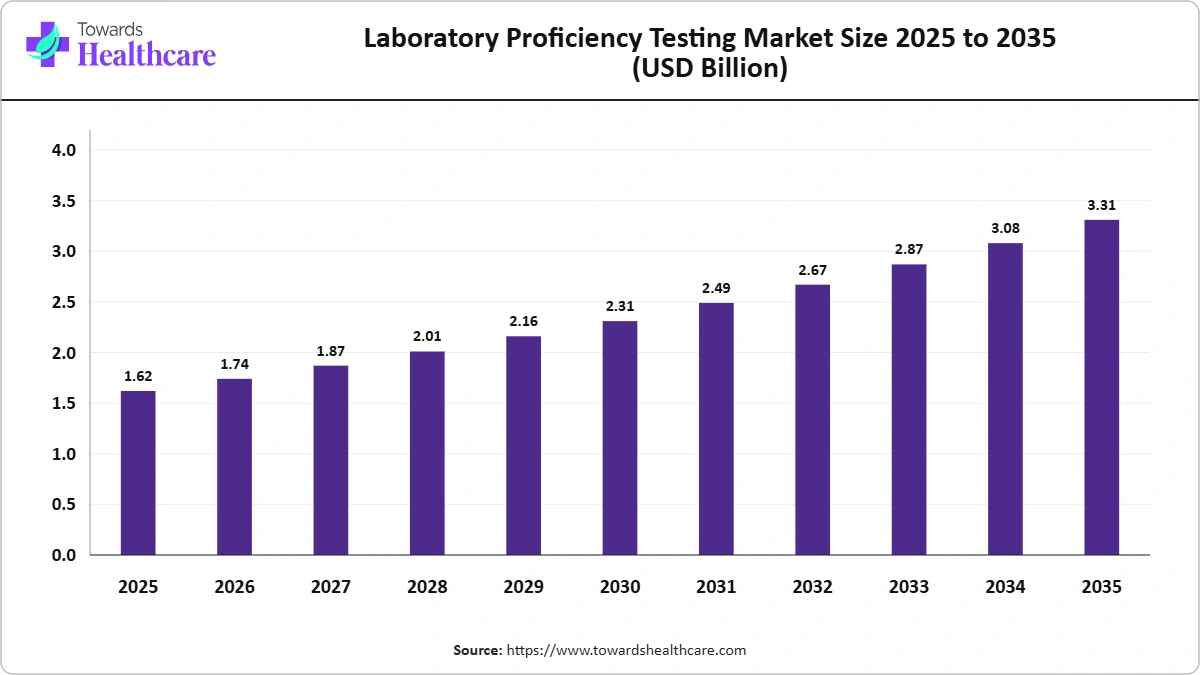
Analyst View: We built the estimate from the number of participating labs, schemes per lab and average scheme prices by region, cross-checked against revenues of leading PT providers. Our value sits just above published comparable estimates.
| Driver | Impact | ≈ CAGR Contribution | Time Horizon | Key Regions |
| Accreditation rules | High | +2.89 pp | Short to long term | Global, strongest in North America |
| Lab numbers grow | Medium | +2.44 pp | Medium to long term | Global, fastest uptake in Asia Pacific |
| New test types need schemes | Medium | +2.08 pp | Short to medium term | Global |
| Food and water safety | Low | +1.63 pp | Long term | Developed and emerging markets |
Note: Contributions are indicative estimates of each factor's effect on annual growth.
Sources: Expert interviews, secondary sources, Towards Healthcare database and Towards Healthcare analysts.
Taken together, these drivers add about 9.03 percent to the annual growth of the laboratory proficiency testing market, with accreditation rules having the largest effect. Their influence is strongest in North America, while uptake grows fastest in Asia Pacific.
| Restraint | Impact | ≈ Negative CAGR Contribution | Time Horizon | Key Regions |
| Price pressure | High | -0.73 pp | Short to medium term | Global |
| Small lab budgets | High | -0.54 pp | Medium term | Price-sensitive and emerging markets |
| Sample stability and shipping | Medium | -0.36 pp | Short term | North America and other mature markets |
Note: Contributions are indicative estimates of each factor's effect on annual growth.
Sources: Expert interviews, secondary sources, Towards Healthcare database and Towards Healthcare analysts.
These restraints are expected to reduce annual growth of the laboratory proficiency testing market by about 1.63 percent, led by price pressure. Their effect eases over the forecast period as suppliers, buyers, and regulators adapt, leaving a net CAGR of 7.40% from 2026 to 2035.
Growing adoption of molecular diagnostics and next-generation sequencing creates demand for specialized proficiency testing solutions. Expanding accreditation activities across Asia, increasing testing requirements among cannabis laboratories, and digital reporting platforms offer additional growth opportunities. The development of point-of-care proficiency testing programs can further expand market reach across decentralized testing facilities.
Note: 2025 is the base year; 2035 shares and CAGRs are forecasts.
Sources: Expert interviews, secondary sources, Towards Healthcare database, and Towards Healthcare analysts.
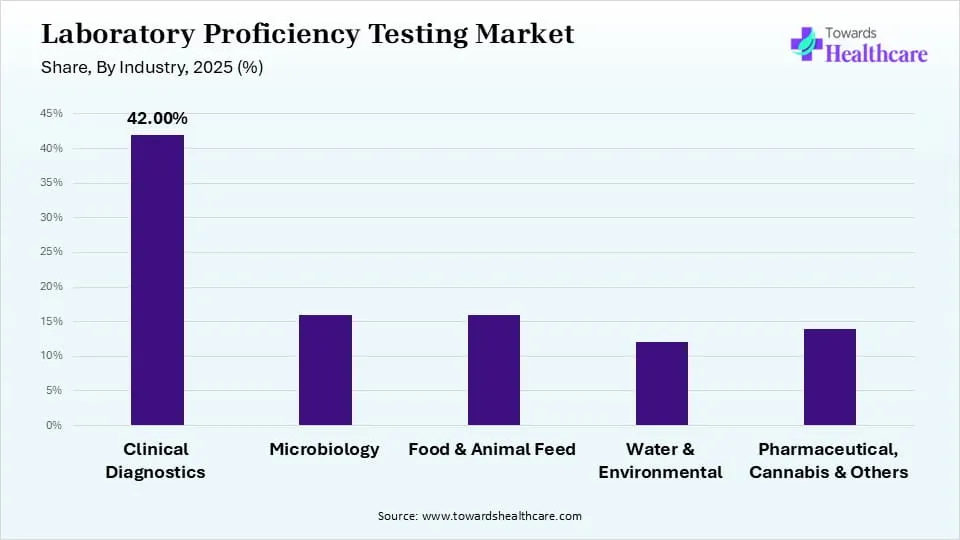
Clinical Diagnostics: Dominating the industry segment with a 42.00% market share in 2025, clinical diagnostics is projected to grow at a CAGR of 6.94% by 2035. Its leading position reflects accreditation requirements and CLIA regulations that mandate proficiency testing for many clinical analytes. However, growth is expected to remain below the overall market rate.
Microbiology schemes cover pathogens and resistance. The microbiology segment is expected to grow broadly in line with the overall market over the forecast period.
Food & Animal Feed is increasing food safety regulations and quality control requirements are encouraging laboratories to adopt proficiency testing programs. The segment is expected to grow broadly in line with the overall market.
Water & Environmental growing demand for accredited water quality and environmental testing is supporting participation in proficiency testing schemes. Growth is projected to remain broadly aligned with the overall market.
Pharmaceutical, Cannabis & Others expanding pharmaceutical quality testing, emerging cannabis testing requirements, and specialized laboratory applications are driving demand. The segment is expected to outperform the overall market.
Immunoassays & Clinical Chemistry: Leading the technology segment with a 40.00% market share in 2025, this category is projected to grow at a CAGR of 6.77% by 2035. Its dominance reflects widespread use in clinical laboratory testing and established proficiency testing schemes. However, growth is expected to remain below the overall market rate.
Molecular Diagnostics increasing adoption of PCR-based testing and next-generation sequencing is driving demand for specialized proficiency testing schemes. Growth is expected to exceed the overall market rate.
Chromatography & Spectrometry demand is supported by applications in food safety, water quality, and pharmaceutical testing. Growth is expected to remain broadly in line with the overall market.
Cell Culture & Others demand is supported by specialized laboratory testing, including cell culture analysis and other emerging techniques. The segment is projected to grow broadly in line with the overall market.
Hospital & Clinical Labs: Leading the end-user segment with a 50.00% market share in 2025, this category is projected to grow at a CAGR of 6.89% from 2026 to 2035. Its dominance reflects mandatory proficiency testing participation to maintain laboratory accreditation and demonstrate testing accuracy. However, growth is expected to remain below the overall market rate.
Food & Environmental Labs need ISO 17025 accreditation. The food & environmental labs segment is expected to grow broadly in line with the overall market over the forecast period.
Pharma & Others growing pharmaceutical quality control requirements and stricter regulatory standards are encouraging laboratories to adopt proficiency testing programs. The segment is expected to outperform the overall market.
Analyst View: Segment shares were allocated on the basis of demand, product portfolios, and pricing in each category. Clinical Diagnostics, Immunoassays & Clinical Chemistry and Hospital & Clinical Labs lead their categories because they meet the core needs of today's buyers. We expect Pharmaceutical, Cannabis & Others, Molecular Diagnostics, and Pharma & Others to gain share as newer technologies, users, and applications grow faster.
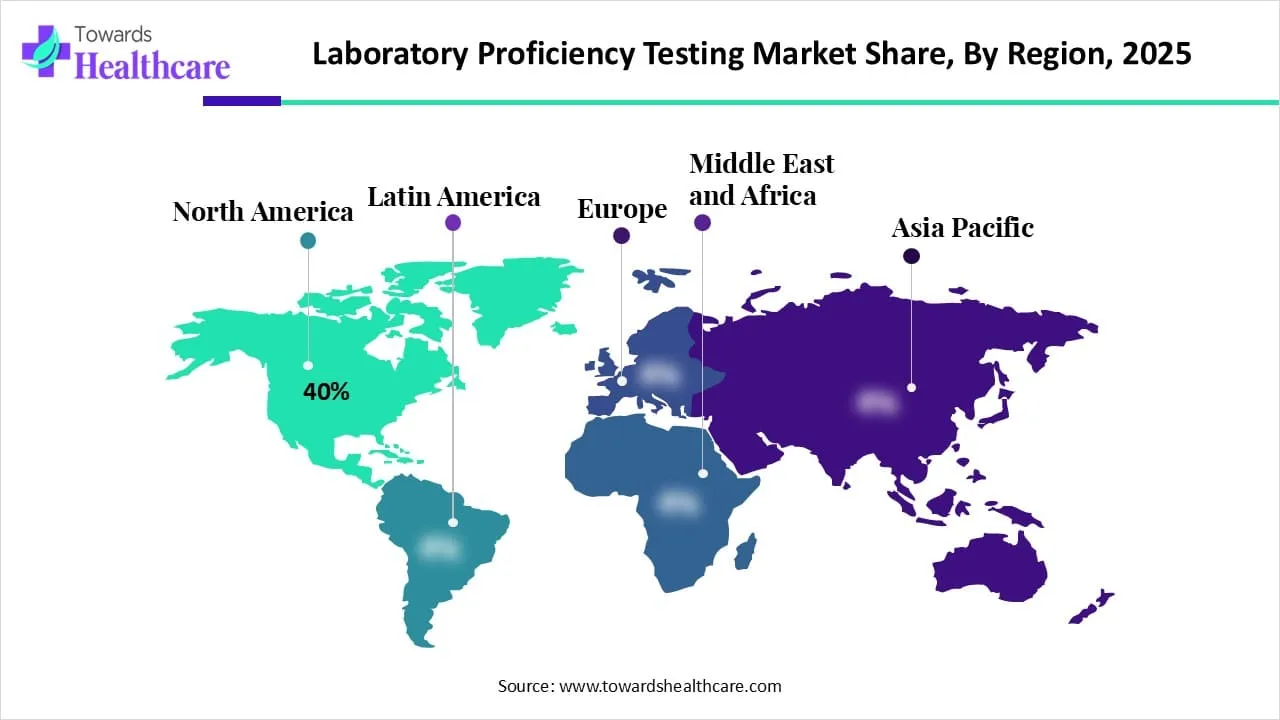
| Region | 2025 Share | 2035 Share | CAGR 2026-2035 |
| North America | 40.00% | 38.37% | 6.91% |
| Europe | 32.00% | 31.72% | 7.31% |
| Asia Pacific | 20.00% | 22.05% | 8.51% |
| Latin America | 4.00% | 3.93% | 7.31% |
| Middle East & Africa | 4.00% | 3.93% | 7.31% |
Note: 2025 is the base year; 2035 shares and CAGRs are forecasts.
Sources: Expert interviews, secondary sources, Towards Healthcare database and Towards Healthcare analysts.
North America: Dominating the regional market with a 40.00% share in 2025, North America is projected to grow at a CAGR of 6.91% by 2035. Mandatory proficiency testing under CLIA regulations and the presence of major testing providers strengthen its leading position. However, growth is expected to remain below the overall market rate.
Europe has established external quality assessment (EQA) providers and widespread ISO 15189 accreditation support regional demand. Growth is expected to remain broadly in line with the overall market.
Asia Pacific is expanding laboratory accreditation, particularly in China and India, and rising investments in diagnostic infrastructure are driving market expansion. The region is projected to outperform the overall market.
Latin America is growing laboratory accreditation initiatives and increasing emphasis on testing quality are supporting regional adoption. Growth is expected to remain broadly aligned with the overall market.
Middle East & Africa is expanding laboratory quality programs and greater emphasis on accreditation are creating demand for proficiency testing services. Growth is projected to remain broadly in line with the overall market.
Analyst View: Regional shares were built from demand, installed base, spending, and supplier presence in each region. North America leads because of its mature demand base and strong suppliers. We assign Asia Pacific the highest growth premium because investment, adoption, and capacity are expanding fastest there.
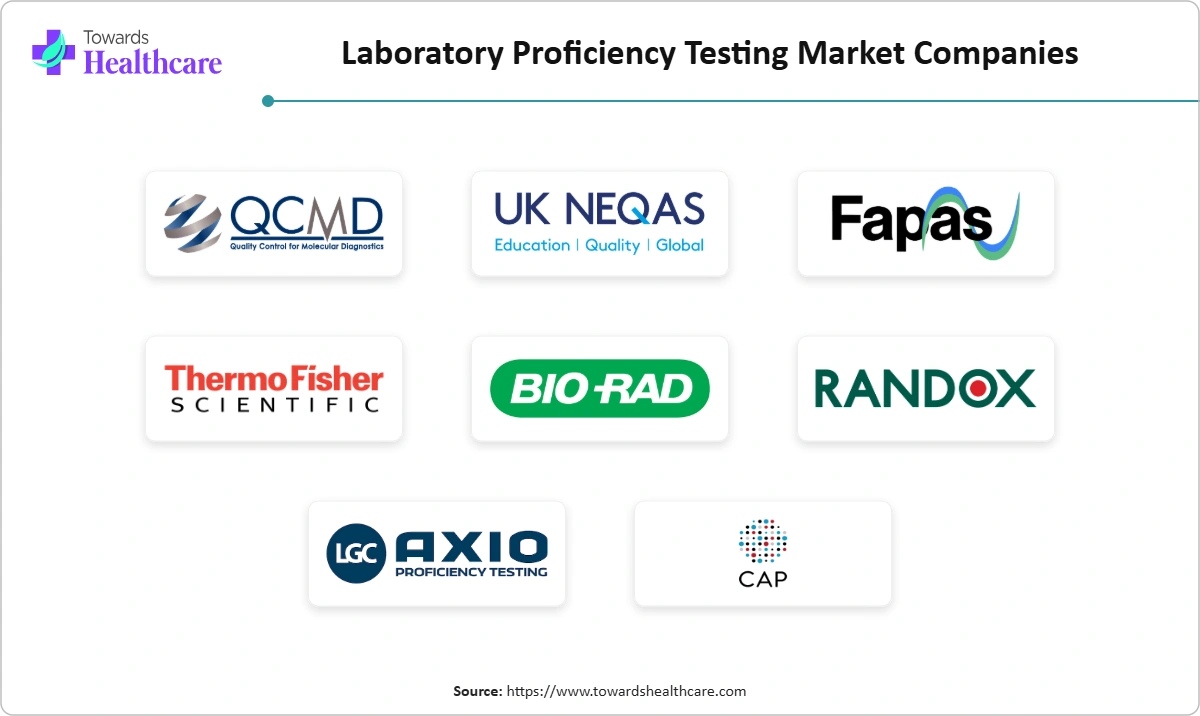
| Rank | Company Name | 2025 Share (%) | Key Products / Business | Headquarters |
| 1 | College of American Pathologists | 18.00% | CAP surveys and accreditation | United States |
| 2 | LGC (AXIO, API) | 14.00% | AXIO and American Proficiency Institute schemes | United Kingdom |
| 3 | Randox Laboratories | 8.00% | RIQAS EQA programmes | United Kingdom |
| 4 | Bio-Rad Laboratories | 8.00% | EQAS programmes | United States |
| 5 | Thermo Fisher Scientific | 4.00% | Quality control materials | United States |
| 6 | Merck KGaA (MilliporeSigma) | 4.00% | Proficiency testing for food and water | Germany |
| 7 | FAPAS (Fera Science) | 3.00% | Food and water PT | United Kingdom |
| 8 | Waters (ERA) | 3.00% | ERA environmental PT | United States |
| 9 | UK NEQAS | 3.00% | Clinical EQA schemes | United Kingdom |
| 10 | QCMD | 2.00% | Molecular EQA | United Kingdom |
Note: Company shares are 2025 estimates.
Sources: Company press releases, expert interviews, secondary sources, Towards Healthcare database and Towards Healthcare analysts.
College of American Pathologists led the laboratory proficiency testing market with an estimated 18.00% share of 2025 revenue, followed by LGC (AXIO, API) at 14.00% share and Randox Laboratories at 8.00% share. College of American Pathologists leads with CAP surveys and accreditation, LGC (AXIO, API) competes with AXIO and American Proficiency Institute schemes, and Randox Laboratories offers RIQAS EQA programmes. Bio-Rad Laboratories, Thermo Fisher Scientific, Merck KGaA (MilliporeSigma), FAPAS (Fera Science), Waters (ERA), UK NEQAS and QCMD compete through EQAS programmes, quality control materials, proficiency testing for food and water PT, ERA environmental PT, clinical EQA schemes and molecular EQA.
The top 10 companies accounted for an estimated 67.00% of 2025 revenue, while the remaining 33.00% was shared among many national and regional EQA providers. The laboratory proficiency testing market is moderately concentrated, and competition centers on scheme breadth, accreditation (ISO/IEC 17043), sample quality, reporting tools, regulator recognition and price.
College of American Pathologists: Based in the United States, the College of American Pathologists (CAP) held an 18.00% share of the laboratory proficiency testing market in 2025. Its portfolio focuses on CAP surveys and laboratory accreditation services. The organisation occupies a Leader position in the Towards Healthcare Companies Quadrant.
LGC (AXIO, API): The United Kingdom-based company captured approximately 14.00% of the market in 2025. Its offerings include AXIO and American Proficiency Institute schemes, serving laboratories across multiple testing categories. LGC is positioned as a Leader in the Towards Healthcare Companies Quadrant.
Randox Laboratories: Headquartered in the United Kingdom, Randox Laboratories represented 8.00% market share in 2025. Its RIQAS external quality assessment (EQA) programmes form a key part of its proficiency testing portfolio. The company is classified as a Leader in the Towards Healthcare Companies Quadrant.
Bio-Rad Laboratories: Operating from the United States, Bio-Rad Laboratories secured approximately 8.00% of the market in 2025. Its portfolio includes EQAS programmes designed to support laboratory quality assurance and performance evaluation. The company holds a Leader position in the Towards Healthcare Companies Quadrant.
Thermo Fisher Scientific: With its headquarters in the United States, Thermo Fisher Scientific accounted for 4.00% market share in 2025. Its offerings include quality control materials that support laboratory testing accuracy and consistency. The company is recognised as a Leader in the Towards Healthcare Companies Quadrant.
Merck KGaA (MilliporeSigma): Based in Germany, Merck KGaA (MilliporeSigma) held approximately 4.00% of the market in 2025. Its proficiency testing portfolio focuses on food and water testing applications. The company is positioned as a Leader in the Towards Healthcare Companies Quadrant.
FAPAS (Fera Science): The United Kingdom-based organization represented 3.00% market share in 2025. Its specialised proficiency testing schemes cover food and water analysis, supporting laboratory quality assurance. FAPAS occupies an Innovator position in the Towards Healthcare Companies Quadrant.
Waters (ERA): Headquartered in the United States, Waters (ERA) captured approximately 3.00% of the market in 2025. Its ERA portfolio focuses on environmental proficiency testing solutions for water and related analytical applications. The company is classified as an Innovator in the Towards Healthcare Companies Quadrant.
UK NEQAS: Operating from the United Kingdom, UK NEQAS accounted for 3.00% market share in 2025. Its portfolio centres on clinical external quality assessment schemes that evaluate laboratory performance. The organisation holds an Innovator position in the Towards Healthcare Companies Quadrant.
QCMD: Based in the United Kingdom, QCMD, part of Quality Control for Molecular Diagnostics, represented approximately 2.00% of the market in 2025. Its offerings specialise in molecular external quality assessment (EQA) schemes. The organisation is positioned as an Innovator in the Towards Healthcare Companies Quadrant.
The laboratory proficiency testing ecosystem links material producers, pt providers, accreditation bodies, labs and regulators, with each stage adding value before products reach end users.
| Ecosystem Stage | Role in the Market | Key Companies |
| Material Producers | Make test samples | Reference material makers |
| PT Providers | Run schemes | CAP, LGC, Randox, Bio-Rad |
| Accreditation Bodies | Assess labs | A2LA, UKAS, national bodies |
| Labs | Participate | Clinical, food, water, pharma labs |
| Regulators | Require PT | CMS (CLIA), EU, national regulators |
Sources: Company press releases, expert interviews, secondary sources, Towards Healthcare database and Towards Healthcare analysts.
Material Producers: Make test samples. Key participants include Reference material makers.
PT Providers: Run schemes. Key participants include CAP, LGC, Randox, Bio-Rad.
Accreditation Bodies: Assess labs. Key participants include A2LA, UKAS, national bodies.
Labs: Participate. Key participants include Clinical, food, water, pharma labs.
Regulators: Require PT. Key participants include CMS (CLIA), EU, national regulators.
Value in the laboratory proficiency testing market flows from upstream material and technology suppliers to manufacturers and service providers, then through distribution partners to end users. Companies that integrate several stages or build long-term relationships with end users capture a larger share of this value.
The Towards Healthcare Companies Quadrant assesses major players in the laboratory proficiency testing market across two dimensions: market strength and innovation capabilities. Market strength considers revenue scale, market share, and geographic presence, while innovation and growth strategy evaluate portfolio diversity, R&D investment, and strategic partnerships. Company positioning is based on estimated 2025 market shares and an assessment of product development, portfolio breadth, and collaborative initiatives.
Sources: Company press releases, expert interviews, secondary sources, Towards Healthcare database and Towards Healthcare analysts.
Leaders: College of American Pathologists, LGC (AXIO, API), Randox Laboratories, Bio-Rad Laboratories, Thermo Fisher Scientific and Merck KGaA (MilliporeSigma) combine high market share with broad portfolios and strong innovation.
Innovators: FAPAS (Fera Science), Waters (ERA), UK NEQAS and QCMD bring newer technologies and specialized products.
By Industry
By Technology
By End User
By Region
The laboratory proficiency testing market was defined to include external proficiency testing (PT) and external quality assessment (EQA) schemes in which laboratories analyze supplied samples and compare results to evaluate testing accuracy and performance. The study covers clinical diagnostics, microbiology, food and animal feed, water and environmental, pharmaceutical and biologics, cannabis, and other testing applications. It also considers key technologies, including immunoassays, clinical chemistry, molecular diagnostics, chromatography, and spectrometry, across hospital and clinical laboratories, food and environmental laboratories, pharmaceutical laboratories, and other end users.
The 2025 base-year market estimate was developed using a bottom-up approach, incorporating demand volumes and average selling prices across industry, technology, end-user, and regional segments. These estimates were cross-validated through a top-down assessment of market-specific revenues reported by leading companies and published third-party industry estimates. Discrepancies were reviewed, and the final market estimates were reconciled to establish a consistent baseline for the forecast period.
Segment, regional and company values were allocated from industry, technology and end user and region demand. Key estimates were verified by cross-checking company disclosures, regulatory and industry data and published third-party estimates, and inputs that could not be reconciled were excluded. All segment, regional and company figures were reconciled to the same 2025 base year, and the 2026-2035 forecast, which applies a constant CAGR from the 2025 base, was recalculated and validated.
Analyst View: The laboratory proficiency testing market is set for steady expansion as accreditation rules and related demand keep growing. Our estimate links value to underlying demand, installed base and pricing, so the forecast follows real adoption rather than headline hype. The main upside comes from molecular and NGS schemes, while the main risks are price pressure and small lab budgets.