Pipeline Programs

CGT Companies Tracked

Manufacturing Facilities


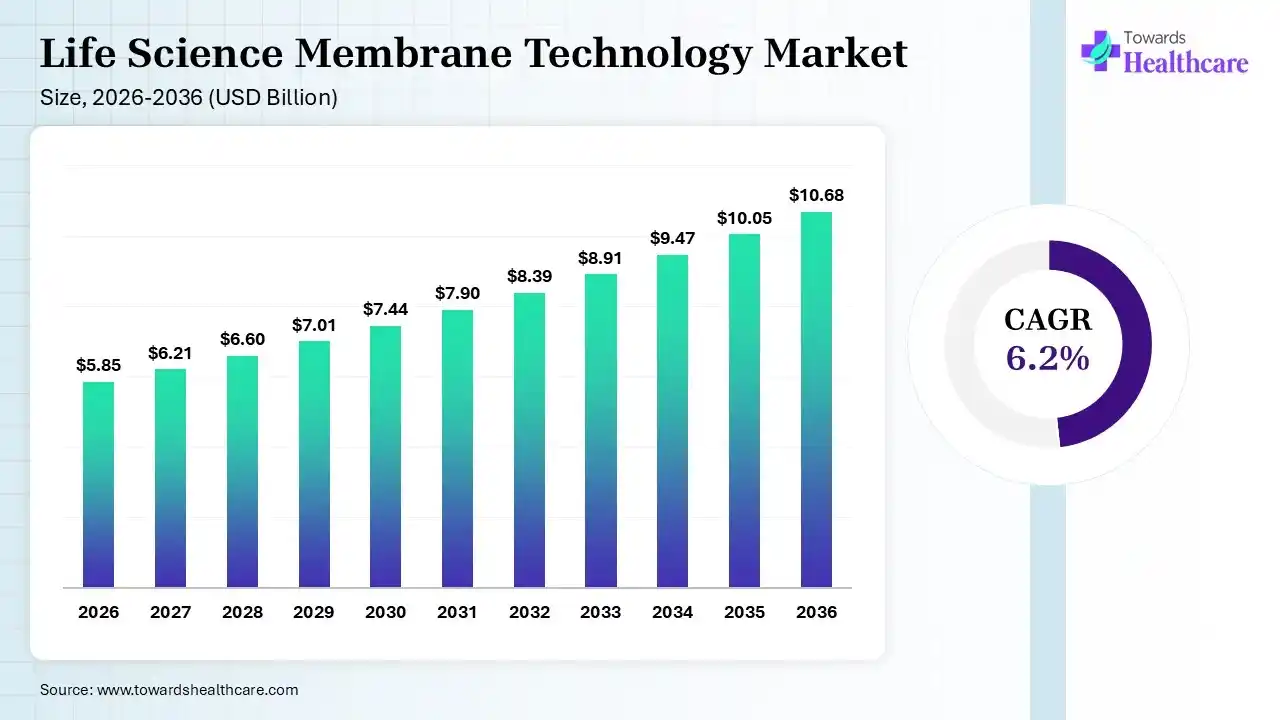
The life science membrane technology market is anticipated to reach US$ 5.85 billion in 2026 and is projected to grow to approximately US$ 10.68 billion by 2036, expanding at a CAGR of 6.2% during 2026-2035. Life science membrane technology supports the separation, purification, concentration, and clarification of biological and pharmaceutical materials. Membranes are used across laboratory workflows and pharmaceutical production, including prefiltration, bioburden reduction, sterile filtration, and buffer exchange. Their role varies by process stage, feed composition, required output quality, and the properties of the material being processed.
Pharmaceutical manufacturers rely on filtration systems to manage particles and impurities, support microbiological control, and maintain process consistency. In bioprocessing, membranes are used in upstream and downstream operations, including cell-harvest clarification, protein processing, and tangential flow filtration. Laboratory and diagnostic applications use membrane formats suited to sample preparation, analytical testing, and specialized separation requirements. Sartorius and Thermo Fisher Scientific describe filtration products for several of these applications in their official product and technical materials.
The market is influenced by pharmaceutical production requirements, biotechnology development, the need for dependable filtration performance, and demand for systems that can be integrated into different manufacturing scales. Product selection depends on pore characteristics, material compatibility, throughput, operating pressure, fouling behavior, integrity testing, and validation requirements.
The market is segmented according to the technology used, membrane material, product configuration, application, end user, and geographic region.
| Segment | Categories |
| By Technology | Microfiltration, ultrafiltration, nanofiltration, reverse osmosis, specialized membrane separation |
| By Material | Polymeric membranes, ceramic membranes, hybrid and other advanced materials |
| By Product Type | Membrane filters, capsule filters, cartridge filters, hollow-fiber modules, tangential flow filtration systems, membrane assemblies and accessories |
| By Application | Pharmaceutical manufacturing, bioprocessing and biologics, diagnostics and laboratory research, medical applications, process water purification |
| By End User | Pharmaceutical companies, biotechnology companies, contract development and manufacturing organizations, contract research organizations, hospitals and diagnostic laboratories, academic and research institutions |
| By Region | North America, Europe, Asia Pacific, Latin America, Middle East and Africa |
Microfiltration is used to remove suspended particles and larger contaminants from process streams. In pharmaceutical and biotechnology workflows, it can support clarification and prefiltration before subsequent separation stages.
Ultrafiltration separates materials according to molecular size and is used in applications such as protein concentration and buffer exchange. When combined with diafiltration, it can help exchange buffer components while retaining a target molecule.
Nanofiltration supports selective separation and impurity management in applications where the membrane's separation characteristics match the process requirements.
Reverse osmosis is used for dissolved-solids removal and water purification. Its relevance depends on the quality of water required and the design of the broader treatment system.
The technologies are not interchangeable in every application. Selection depends on the feed stream, target material, impurity profile, operating conditions, and intended output. Suppliers such as Sartorius and Repligen describe filtration and TFF solutions for different stages of bioprocessing in their official product information.
Polymeric membranes are used in laboratory filtration, pharmaceutical processes, and bioprocessing. Available materials include polyethersulfone (PES), cellulose acetate, cellulose nitrate, regenerated cellulose, polyamide, and PTFE. The choice depends on wetting behavior, chemical compatibility, flow characteristics, and the requirements of the intended application. Sartorius lists these materials within its membrane filter portfolio.
Ceramic membranes can be considered where chemical resistance, thermal stability, or durability is important. Hybrid and other advanced membrane materials are relevant when manufacturers seek a combination of permeability, selectivity, mechanical properties, and process compatibility.
Material selection should be based on demonstrated performance rather than a general assumption that one material is superior across all applications.
Pharmaceutical manufacturing uses membrane filtration for clarification, impurity reduction, and sterile filtration where appropriate. In aseptic manufacturing, sterile filtration must be validated for the specific product and process conditions. The U.S. Food and Drug Administration (FDA) guidance discusses microbial challenge testing, filter integrity, and validation under relevant operating conditions.
Bioprocessing applications include cell-harvest clarification, downstream filtration, protein concentration, diafiltration, and selected virus-filtration operations. Requirements vary according to the biological product and process design. For advanced therapies and other sensitive products, manufacturers must evaluate membrane compatibility, product recovery, and the effects of processing conditions on product quality.
Laboratory and diagnostic applications use membrane filters for sample preparation, analytical procedures, and specialized separation workflows. These products may differ from production-scale filters in format, capacity, and performance requirements.
Membrane filters are available in disc, sheet, capsule, cartridge, and module configurations. Laboratory filters are suited to smaller sample volumes and analytical workflows, while capsules and cartridges can be integrated into larger process systems.
Hollow-fiber modules offer a membrane configuration used in selected concentration and separation processes. Tangential flow filtration systems use crossflow to process a feed stream and are commonly used for ultrafiltration and diafiltration. Repligen's official portfolio includes TFF systems, hollow-fiber filters, and flat-sheet cassettes for research, process development, and manufacturing.
Biopharmaceutical process requirements: The production of biological medicines involves multiple stages of clarification, separation, and purification. Membrane systems help manufacturers manage these operations while maintaining control over process conditions.
Quality and contamination control: Pharmaceutical manufacturers must establish that filtration processes are appropriate for their products. Validation, integrity testing, and evaluation of worst-case operating conditions are important considerations in sterile filtration.
Flexible manufacturing: Different production scales and product types require filtration systems that can be configured for development, scale-up, and commercial manufacturing. Single-use assemblies can be considered where they suit the process design and facility requirements.
Process efficiency: Manufacturers evaluate filtration systems based on throughput, product recovery, membrane fouling, operating time, and integration with other equipment. Improvements in these areas may reduce process interruptions and improve operational consistency.
Membrane fouling can reduce flow rates and increase the need for cleaning, replacement, or process adjustment. Performance can also vary with fluid viscosity, surface tension, pH, temperature, pressure, flow rate, and interactions between the formulation and membrane material. The FDA identifies these factors as relevant to filter performance and validation.
Another challenge is the qualification process. Pharmaceutical customers may need to assess filter compatibility, integrity-test results, batch consistency, documentation, and product-specific validation data before adopting a filter in commercial manufacturing.
Specialized membranes can also involve higher product and validation costs. Customers therefore compare the purchase price with expected operating life, product recovery, throughput, replacement requirements, and the consequences of process interruption.
Suppliers can pursue opportunities in high-performance filtration, advanced biologics processing, TFF systems, specialized membrane materials, and application-specific assemblies. There is also scope to support customers with process development, product selection, validation documentation, and scale-up.
A practical opportunity lies in helping customers select a membrane configuration for their specific process instead of relying on broad product claims. Suppliers that demonstrate consistent performance and provide suitable technical support can strengthen their position with pharmaceutical and biotechnology manufacturers.
Membrane technology pricing varies by material, pore characteristics, membrane area, product format, operating capacity, and intended application. A laboratory disc filter, a sterile capsule filter, a hollow-fiber module, and an integrated TFF system have different specifications and cost structures and should not be compared on unit price alone.
Specialized pharmaceutical filtration products may also require application testing, quality documentation, traceability, and validation support. These requirements can influence the total cost of adopting a product.
Customer purchasing decisions typically consider:
Membrane manufacturing can involve polymer preparation, membrane formation, pore-structure control, surface treatment, module fabrication, and quality testing. The precise process varies with membrane material, product design, and intended application.
Life science applications require attention to membrane consistency, permeability, retention performance, material compatibility, and product integrity. For sterile filtration, validation must be appropriate to the process and filter being used. FDA guidance emphasizes evaluating performance under conditions that reflect actual manufacturing use and establishing suitable integrity-testing procedures.
The supply chain can include raw-material providers, membrane manufacturers, filter and module assemblers, equipment suppliers, distributors, and technical service providers. Manufacturers must coordinate component availability and quality controls with customer demand and product qualification requirements.
Supply reliability is especially relevant when customers use a validated filtration product in a regulated production process. Changes in membrane material, filter configuration, or manufacturing specifications may require assessment before a replacement product can be introduced.
The value chain connects material development with membrane production, filtration-system assembly, distribution, and final application.
Value creation depends on more than membrane production. Product consistency, suitable testing, application knowledge, reliable delivery, and technical support can all influence customer selection.
Product performance remains central to development
Membrane development focuses on permeability, selectivity, retention performance, chemical compatibility, fouling behavior, and mechanical strength. The relevant balance depends on the intended application and the characteristics of the material being processed.
Key areas include:
Innovation must be assessed using application-specific evidence. A higher nominal flow rate or a new membrane material does not, by itself, establish better performance across every product or process.
Customer priorities depend on the scale of production, product characteristics, process risks, and regulatory requirements.
| Customer group | Main requirements |
| Pharmaceutical manufacturers | Validated performance, quality documentation, sterility assurance where applicable, and supply consistency |
| Biotechnology companies | Flexible processing, product recovery, compatibility with biological materials, and scale-up support |
| CDMOs | Adaptable systems, dependable availability, and the ability to support multiple customer processes |
| CROs and process development laboratories | Repeatability, flexible formats, and practical evaluation of membrane performance |
| Diagnostic laboratories | Suitable membrane characteristics, sample compatibility, and reliable analytical results |
| Academic and research institutions | Application-specific performance, manageable operating costs, and product availability |
The competitive landscape includes established life science suppliers, specialized filtration companies, membrane-material manufacturers, and providers of integrated bioprocessing systems. Companies compete through product range, membrane performance, application expertise, quality systems, technical support, and supply reliability.
A supplier's position can differ by application. A company with a broad laboratory membrane portfolio may not have the same capabilities in sterile pharmaceutical filtration or large-scale TFF systems. Competitive comparisons should therefore be made at the product and application level rather than assuming that every supplier competes across the entire market.
| Company | Headquarters | Relevant capabilities |
| Sartorius AG | Göttingen, Germany | Laboratory membrane filters, pharmaceutical filtration devices, and bioprocess filtration solutions. |
| Merck KGaA | Darmstadt, Germany | Life science materials, laboratory filtration, and pharmaceutical process products. |
| Danaher Corporation | Washington, D.C., U.S. | Life science and bioprocessing technologies through businesses including Cytiva and Pall. |
| Thermo Fisher Scientific | Waltham, Massachusetts, U.S. | Laboratory and bioprocess filtration products supporting process development and manufacturing. |
| Repligen Corporation | Waltham, Massachusetts, U.S. | TFF systems, hollow-fiber filters, flat-sheet cassettes, and process-management solutions. |
| Asahi Kasei | Tokyo, Japan | Advanced materials and membrane technologies, including solutions relevant to biopharmaceutical processing. |
| TORAY Industries | Tokyo, Japan | Membrane materials and separation technologies. |
| Parker Hannifin | Cleveland, Ohio, U.S. | Filtration components and fluid-management technologies. |
| Eaton | Dublin, Ireland | Process filtration products and filtration assemblies. |
| Porvair | King's Lynn, United Kingdom | Specialist filtration products and laboratory-related technologies. |
| Meissner | Camarillo, California, U.S. | Biopharmaceutical filtration, sterile filtration, and single-use processing systems. |
| Donaldson Company | Bloomington, Minnesota, U.S. | Filtration technologies for industrial and selected life science applications. |
| GVS | Zola Predosa, Italy | Filtration products and components for healthcare and laboratory applications. |
| Cobetter Filtration | Hangzhou, China | Filtration products and process solutions for pharmaceutical and biotechnology customers. |
Product and technology comparison
| Benchmarking factor | What to assess |
| Product breadth | Membrane materials, pore ranges, filter formats, modules, and systems |
| Filtration performance | Flow rate, retention, selectivity, and operating stability |
| Material compatibility | Suitability for process fluids, formulations, and operating conditions |
| Quality and validation | Testing procedures, traceability, documentation, and application-specific evidence |
| Manufacturing capabilities | Capacity, batch consistency, and product configuration options |
| Technical support | Application testing, process development, troubleshooting, and scale-up |
| Supply reliability | Availability, lead times, distribution, and continuity of supply |
| System integration | Compatibility with existing equipment and single-use or reusable workflows |
Biological products can require several filtration and separation steps, with membrane requirements varying by molecule and process design. Suppliers can address these needs through application-specific products, process testing, and support from development through manufacturing.
Single-use filtration assemblies may suit facilities that handle multiple products or require flexible changeovers. Adoption depends on compatibility with the process, product quality considerations, waste management, and total operating cost.
Opportunities exist for products that improve filtration stability, throughput, product recovery, and ease of integration. Demonstrated performance in the customer's process is more meaningful than a general claim of superior membrane performance.
Customers may value help with membrane selection, process trials, filter validation, integrity testing, and troubleshooting. Suppliers that provide relevant documentation and technical assistance can strengthen their relationships with regulated manufacturers.
Suppliers may pursue opportunities by improving distribution, technical service, and product availability in regions with developing pharmaceutical and biotechnology production infrastructure. Such opportunities should be evaluated against local customer demand, regulatory expectations, and operating costs.
| Competitive force | Qualitative assessment | Market implications |
| Competitive rivalry | Significant | Suppliers compete on filtration performance, product quality, technical support, and product availability. |
| Threat of new entrants | Moderate | Manufacturing expertise, quality controls, customer qualification, and application-specific validation can create barriers. |
| Supplier bargaining power | Variable | Dependence on specialized membrane materials and components can influence supply continuity and production costs. |
| Buyer bargaining power | Moderate to high | Large pharmaceutical companies and CDMOs may negotiate commercial terms, while qualification requirements can make product changes complex. |
| Threat of substitutes | Application-dependent | Other separation technologies may suit selected processes, but substitution depends on process performance and validation requirements. |
The life science membrane technology market will continue to depend on the requirements of pharmaceutical manufacturing, biotechnology development, laboratory research, and specialized separation processes. Filtration needs vary by product type and manufacturing stage, making application suitability a central factor in technology selection.
Polymeric membranes are relevant across a broad range of filtration applications, while ceramic and hybrid materials can serve more specialized operating requirements. Microfiltration, ultrafiltration, nanofiltration, reverse osmosis, and TFF each address different separation objectives. Their commercial relevance depends on performance in the intended application rather than a universal technology ranking.
Over the forecast period, suppliers will need to demonstrate consistent product quality, suitable validation support, reliable supply, and effective integration with customer processes. Companies that combine membrane expertise with technical services may be better positioned to meet complex customer requirements.
By Technology
By Material
By Product Type
By Application
By End User
By Region


Principal Consultant
Payal Rabde is a Healthcare Market Research Analyst at Towards Healthcare Research & Consulting with 4+ years of experience in pharmaceuticals, biotechnology, medical devices, and life sciences.
Learn more about Payal Rabde

Reviewed By
Aditi Shivarkar is a seasoned professional with over 14 years of experience in healthcare market research. As a content reviewer, Aditi ensures the quality and accuracy of all market insights and data presented by the research team.
Learn more about Aditi Shivarkar